

The worst part of a bad US clinical evaluation isn’t the comment itself. It’s the panic spiral that follows.
You’re an IMG. You know every US letter and evaluation carries extra weight. So when a negative evaluation appears in your file—or a preceptor clearly isn’t happy—you feel like your whole match plan just cracked. It didn’t. But if you handle this wrong, it can do more damage than it needs to.
This is about damage control. Not theory. What to do in the next 24 hours, week, and month if a US clinical evaluation goes sideways.
Step 1: Figure Out Exactly How Bad It Is
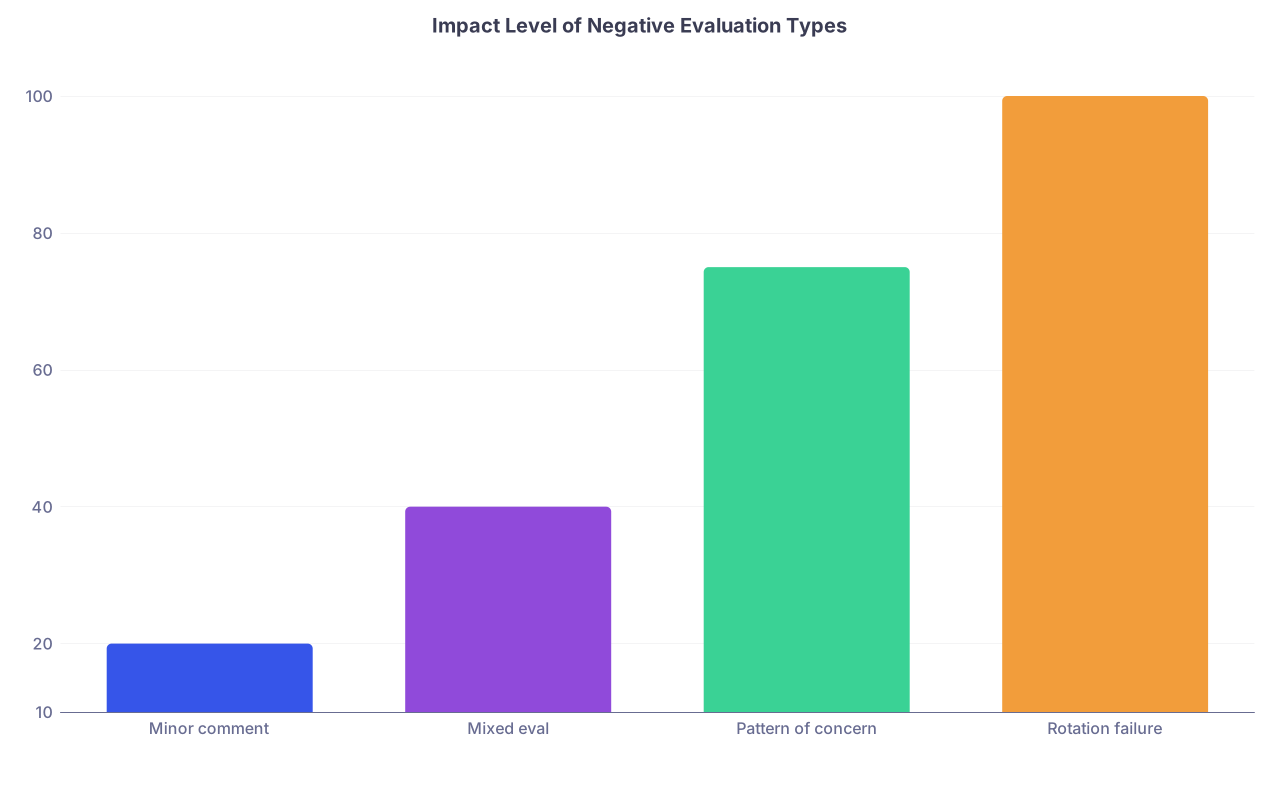
| Category | Value |
|---|---|
| Minor comment | 20 |
| Mixed eval | 40 |
| Pattern of concern | 75 |
| Rotation failure | 100 |
Not all “bad” evaluations are career-ending. Some are annoying. Some are recoverable. A few are truly serious. You need to sort out which one you’re dealing with.
There are four main flavors I see with IMGs:
Vague negative comments
Things like “needs to improve efficiency,” “quiet on rounds,” “would benefit from more confidence.” Annoying, but common. Usually not fatal.Mixed evaluation
Some strong positives plus one or two clear negatives. Example: “Hardworking and compassionate but struggled to present concisely and required frequent supervision.” Programs read these carefully but don’t automatically throw you out.Red-flag language
Words/phrases like:- “Unprofessional”
- “Dishonest”
- “Concerning judgment”
- “Patient safety concern”
- “Would not recommend for residency” This is serious. These are match-killers if not addressed directly.
Official failure or remediation
You failed the rotation. Or you had to repeat part of it. For IMGs, this must be managed very strategically.
So first, read the exact language. Not how it feels. Not how your friend summarized it. The actual words.
Ask yourself:
- Is this about:
- Knowledge?
- Communication?
- Professionalism?
- Work ethic?
- Is it a one-off comment or a theme?
- Do other evaluations say the same thing or is this the outlier?
If you’re seeing “unprofessional,” “lateness,” “poor communication with nurses,” “disrespectful,” or “not receptive to feedback” — those are the ones program directors remember.
If you do not have direct access to the full evaluation (common with some observerships and externship companies), push for it. Email whoever coordinates the rotation and ask (politely but clearly) for the detailed feedback “so I can improve.” You cannot manage what you cannot see.
Step 2: Do Not Argue First. Understand First.
Your first move shouldn’t be a long defensive email. That’s how people harden their opinion against you.
You need context:
- Was this one attending or the consensus?
- Did residents/nurses complain?
- Was there a specific incident?
If you’re still on the rotation or it just ended, do this:
Ask for a brief meeting
“Dr. Smith, I saw my evaluation and I’d really like to understand your feedback better. Would you have 10–15 minutes to discuss what I can work on?”Go in with three goals:
- Clarify what exactly triggered the negative comments.
- Show that you can take feedback like an adult.
- Leave a hint that you care about your future (without begging for them to change it).
In the meeting:
- Listen first. No interrupting.
- Take notes.
- Ask 1–2 specific questions: “Can you give me an example of when I seemed disorganized?”
- Thank them for being direct.
What you do not do:
You do not say, “Can you change my evaluation?” That just makes people defensive. Later, if the conversation goes well and they seem to soften, you might gently ask if they’d be open to clarifying something, but that’s not step one.
If you’ve already left the rotation, you can still send an email with similar tone: short, respectful, focused on learning.
Step 3: Classify the Risk to Your Application
Now you know what was said and why. Next: how much risk does this pose to your match?
Here’s the blunt truth: for IMGs, US clinical experiences are not “nice to have.” They’re currency. Programs use them to decide if you’re “trainable” in the US system.
Use this rough matrix:
| Situation | Risk Level | Typical Impact |
|---|---|---|
| One vague negative comment | Low | Usually ignored if others are good |
| One mixed eval with specific weakness | Moderate | Needs explanation and improvement |
| Red-flag professionalism language | High | Can preclude interviews |
| Rotation failure / remediation | Very High | Must be directly addressed |
Then overlay your overall profile:
Strong USMLEs (e.g., 245+ Step 2 / strong CK) and several solid US letters?
You have more room to absorb one bad eval.Borderline scores, limited US experience, and this is your main US rotation?
The same evaluation hurts much more.
You’re not trying to catastrophize. You’re deciding how aggressively you need to respond.
Step 4: Decide Whether to Fight, Fix, or Bury It
You have three basic strategies. Pick the one that matches your situation.
1. Fight (Carefully) – When There’s a Clear Error or Injustice
Use this if:
- You were evaluated for the wrong dates.
- They mixed you up with another student.
- You never actually worked with that evaluator.
- There is factually wrong information (e.g., “repeatedly late” when your time logs show otherwise).
Tactics:
- Start with the clerkship coordinator or program admin, not with a threat.
- Be factual, not emotional.
- Provide objective evidence: duty hour logs, emails, schedule, documentation.
- Your request is for “review” and “correction of factual discrepancies,” not “make this nicer.”
Sometimes you can also ask if an addendum can be added by someone who worked closely with you, especially if a supervising resident or second attending saw you perform differently.
Do not escalate to lawyers unless it’s egregious discrimination or harassment. Once you go legal, you burn that bridge forever and probably attract more scrutiny than help.
2. Fix – When the Criticism Has Truth
This is the more common situation. The attending was harsh, but not completely wrong.
For example:
- “Struggled with oral presentations”
- “Needed frequent prompting for plans”
- “Communication with nurses could improve”
- “Seemed disinterested at times”
You hate reading it. But you also know they’re not making it up.
Here’s what “fix” looks like:
- Acknowledge internally you need to improve. No ego.
- Get targeted coaching:
- Watch how strong students/residents present. Copy the structure.
- Ask a friendly resident: “Can I run my next presentation by you quickly before rounds?”
- For communication issues, check your tone, body language, eye contact. Often IMGs seem “disengaged” because they’re anxious and quiet.
- On your next rotations, explicitly tell attendings early:
“One thing I’m actively working on is giving more concise presentations and speaking up more on rounds. If you see ways I can improve during the month, I’d really appreciate your feedback.”
That line does three things: shows insight, shows effort, and sets them up to see growth.
3. Bury – When You Can’t Fix It, But You Can Outweigh It
This sounds harsh, but it’s reality. Some evaluations you won’t be able to change. So your job is to make that one bad data point look like the exception, not the rule.
You do that by:
- Getting multiple, very strong, very recent US letters that directly contradict the weakness.
- Having at least one attending write something like:
“She is one of the most reliable and professional students I have worked with…” if your earlier eval called your professionalism into question.
If a program sees six US letters describing you as hardworking, professional, teachable, and one rotation evaluation that’s negative, they often assume personality mismatch or a bad fit. If they see one good letter and one bad, they are much more cautious.
Step 5: Strategic Use (or Non-Use) of That Rotation in Your Application
Now the practical question: do you use this rotation for a letter? Do you list it prominently? Do you pretend it never happened?
Here’s how I’d approach it.
Letters of Recommendation
Strong rule: do not ask for a letter from someone who clearly did not like your performance.
Borderline exception: if the evaluation was written mid-rotation and you know you strongly improved, and the attending has verbally praised your progress, you can cautiously ask:
“Dr. Smith, I know I had a learning curve at the start of the month, but I’ve worked hard to apply your feedback. Would you feel comfortable writing a supportive letter for my residency applications?”
If they hesitate even 0.5 seconds: withdraw the request. “I completely understand, thank you for your honesty.”
INTENTIONALLY BAD OR WEAK LETTERS are worse than no letter.
ERAS Experiences Section
You still list the rotation. You do not try to hide US clinical experiences (that itself looks suspicious if discovered).
But you control the description:
- Focus on what you did and learned.
- Do not oversell.
- Do not lie.
If the main problem was professionalism or communication and you’ve since improved, you can later use another experience entry or a future rotation description to highlight those improvements.
Step 6: When (and How) to Address It Directly in Your Application
If the evaluation is mildly negative and not a red flag, you usually do not bring it up in your personal statement or ERAS essays. You let your better data points do the talking.
You should consider addressing it if:
- There was a formal remediation or failure.
- The language was clearly a red flag.
- Multiple documents in your file reference “concerns.”
Where to address it:
- Personal statement (short, direct paragraph)
- Or, for ERAS, the “Additional Information” section if used by your specialty
- Occasionally in a program-specific email if they ask directly
Basic structure:
Brief, factual description
“During one of my early US clinical rotations, I received critical feedback regarding my communication and efficiency on the ward.”Ownership, not blame
“The attending physician was correct that my presentations were disorganized and I did not communicate proactively with nursing staff.”Specific actions you took
“I sought direct coaching from residents, rehearsed presentations, and asked attendings on my subsequent rotations for real-time feedback.”Evidence of change
“In my next two US inpatient rotations, my evaluations noted concise presentations, improved teamwork, and strong professionalism. One attending specifically commented that I ‘communicate clearly with all members of the care team.’”One sentence closure
“This experience was uncomfortable but critical in pushing me to meet US expectations quickly.”
You’re not writing an essay about your suffering. You’re showing maturity and trajectory.
Step 7: Use Future Rotations as Intentional Repair Missions
Your next US clinical experience is no longer just “another rotation.” It’s your repair mission.
Treat it like that.
Before Day 1, make a list:
- What went wrong on the previous evaluation (behaviorally, not emotionally)
- What feedback phrases you want to see in your next one (e.g., “reliable,” “strong work ethic,” “team player,” “excellent communication”)
On Day 1–2 of the new rotation:
- Tell the senior resident or attending:
“I really want to grow in X and Y this month. Please feel free to give me direct feedback—I prefer it that way.”
During the month:
- Ask mid-rotation: “Is there anything I should change to be more helpful to the team?”
- Fix things immediately. Not after you go home and think about it for three days.
At the end:
- Ask the attending: “Based on this month, do you feel I’m ready for residency training in the US system?”
- If they say yes and you felt a good connection, follow with: “Would you feel comfortable writing a strong letter on my behalf?”
That is how you generate the kind of letter that neutralizes older negative noise.
Step 8: Psychological Damage Control (Because This Will Mess With Your Head)
I’ve seen IMGs with one bad evaluation start self-sabotaging everything that follows. They stop speaking up. They assume every attending hates them. They write weaker personal statements because they secretly believe they’re not good enough.
You cannot afford that.
A few ground rules:
- One attending’s opinion ≠ universal truth about your abilities.
- IMGs often get dinged more for style (quiet, indirect, overly deferential) than for knowledge. Style is highly fixable.
- US students get negative evaluations too. They just don’t catastrophize it as much because they feel less replaceable.
What helps:
- Talk to someone objective who understands the system: a US resident, faculty mentor, or even a structured advising service experienced with IMGs.
- Separate “this hurt” from “this defines me.” Write down every positive comment you’ve gotten on other rotations/school evaluations and reread them once before you start spiraling.
- Limit how many people you vent to. You want advisors, not an echo chamber of other anxious IMGs.
And then, at some point, you stop re-reading the evaluation. You focus on the next rotation.
Step 9: How Programs Actually Read a Single Negative Evaluation
You’re scared they’ll open your file, see one bad comment, and close it forever. That’s not how most program directors operate.
Their mental flow is more like this:

| Step | Description |
|---|---|
| Step 1 | Open Application |
| Step 2 | Review as usual |
| Step 3 | Check if pattern exists |
| Step 4 | Move to reject pile |
| Step 5 | Look for evidence of growth |
| Step 6 | Consider for interview |
| Step 7 | Deprioritize or reject |
| Step 8 | Any obvious red flags? |
Key takeaways:
- They’re looking for patterns, not perfection.
- They are more forgiving of knowledge gaps than professionalism problems.
- They care a lot about recency. A bad evaluation two years ago followed by strong recent US letters is seen differently from a bad evaluation last month with no counterevidence.
For IMGs, the bar is higher, yes. But the logic is the same.
Step 10: If You Haven’t Started US Rotations Yet—Prevent This
If you’re reading this early and haven’t had your first US rotation, good. You can front-load prevention.
Core prevention habits:
- Day 1: ask directly, “What are your expectations for students on this rotation?”
- Show up early, be visible, be useful, but not needy.
- Overcommunicate with nurses and staff. IMGs often ignore this and then get labeled “not a team player.”
- If you feel an attending is cold or distant, do not assume everything is fine. Seek feedback halfway through the rotation.
Think of US rotations as auditions. Because they are.
FAQ (Exactly 4 Questions)
1. Should I try to avoid sending my transcript or evaluation if it has a negative comment?
If the program or hospital requires that transcript/evaluation, you cannot ethically withhold it. Trying to hide required documents is much worse than a negative comment. What you can do is avoid using that specific attending for a letter and make sure you have multiple strong, recent US letters that counterbalance it. If the negative comment is serious, consider a brief, honest explanation in your personal statement or additional information section, emphasizing growth and subsequent performance.
2. Can I ask the attending to change or remove the negative comment?
You can ask for clarification and, very cautiously, for an addendum if something was inaccurate or if your performance significantly improved later in the rotation. But a direct “please change this” usually backfires. Focus on: “I understand your concerns. Since then I have done X, Y, and Z to improve. If you feel any part of the evaluation doesn’t reflect my overall performance, I’d be grateful if you’d consider clarifying that.” Some attendings will update, many won’t. Your more reliable strategy is to generate later evaluations that clearly show progression.
3. Will one bad US evaluation stop me from matching as an IMG?
By itself, usually not—unless it contains severe professionalism or safety red flags with no evidence of improvement. Programs look at the whole file: scores, patterns of performance, letters, interviews. One bad eval among several good ones is survivable, especially if it’s older and your recent performance is strong. Multiple negative evaluations, or a failure/remediation that you never explain, are far more dangerous. Your job is to turn this into a “growth story,” not a repeating pattern.
4. How do I talk about a bad evaluation if they ask in an interview?
Use a tight structure: briefly describe the situation without blaming, own your part, explain specifically what you changed, and end with how your later rotations went. For example: “On one of my early US rotations, I received critical feedback about my communication and efficiency. The attending was right that my presentations were unfocused. I asked for coaching from residents, practiced a structured format, and requested mid-rotation feedback on my next rotations. Since then, my evaluations have consistently mentioned clear communication and strong teamwork. It was a tough experience, but it pushed me to meet US expectations faster.” Then stop. Do not over-apologize or ramble.
Open your last evaluation right now and highlight every phrase that describes behavior, not emotion. Then write one concrete action you’ll take on your next rotation to change each of those behaviors. That’s how you turn a bad evaluation into a useful turning point instead of a permanent scar.


