

You finished medical school more than five years ago. Maybe you practiced abroad, maybe life derailed the plan, maybe you chased research or another career. Now you’re staring at ERAS, reading “no more than 5 years from graduation preferred” for the tenth time, and your stomach drops. You’re not a traditional applicant anymore. You’re “old grad.”
If that’s you, this is the play: use US clinical experience not as a checkbox, but as your weapon to re‑enter. You don’t have the luxury of generic observerships and vague letters. You need targeted, high‑yield, consequence‑bearing experience that convinces a PD to bet on you in 2026 despite a 2016 diploma.
Let’s walk through how to do that step by step.
First, be brutally clear about your problem
Programs screen out older grads fast. Not because they hate you. Because they’re risk‑averse.
Here’s what a program director actually worries about with someone who graduated 6, 8, 10 years ago:
- “Are they still clinically sharp, or will they fall apart on nights?”
- “Can they function in a US system—EMR, documentation, handoffs, paging culture, throughput?”
- “Will they struggle with speed, efficiency, and protocols?”
- “Why has nobody trained them yet? What am I missing?”
- “Will they pass boards if they’re this far removed from exams?”
Your Step scores matter, sure. But when you’re >5 years out, recent, meaningful US clinical experience (USCE) is what flips you from “auto‑reject” to “I’ll at least look at this.”
So your entire strategy is built around answering three questions with evidence, not excuses:
- Can I function in a modern, US‑style clinical environment?
- Have I been active in medicine recently, not just in 2017?
- Can someone I worked with vouch for me in a way that feels current and specific?
You answer all three with the right kind of USCE.
Understand what “counts” as US clinical experience for older grads
Not all USCE is created equal, and programs know it.
For you, the older grad, this is the hierarchy of value:
| Type of Experience | Approximate Strength |
|---|---|
| ACGME‑affiliated hands‑on externship | Very High |
| US hospital inpatient hands‑on (non‑ACGME) | High |
| Outpatient clinic externship with strong supervision | Moderate–High |
| Inpatient observership with real involvement | Moderate |
| Pure shadowing / “stand in the corner” observership | Low |
Here’s the catch: many programs and websites still list “observership” as acceptable. For a 2024 grad, that might be fine. For you, it’s not enough. You need:
- Recent (within 1–2 years of applying)
- Longer duration if possible (4–12 weeks at a site > 1–2 weeks hopping around)
- Documented responsibility, even if unofficial: presenting patients, writing draft notes, calling consults (with supervision), following a patient panel
If all you can get is pure shadowing, you still take it. But you structure it intentionally (I’ll show you how). You’re not randomly “observing.” You’re building a narrative: “I’ve actively re‑trained myself in US practice.”
Step 1: Choose your specialty lane before you choose your USCE
This is where a lot of older grads waste time. They grab whatever rotation they find—neurology in April, family medicine in June, psychiatry in October—then apply in internal medicine. Their CV reads like wandering, not focus.
You don’t have that luxury.
You need to pick one primary specialty target (maybe a reasonable backup), and then align everything to that:
- If you’re aiming for Internal Medicine → prioritize inpatient IM, hospitalist groups, academic IM clinics.
- If you’re aiming for Family Medicine → outpatient primary care, community hospitals, underserved clinics.
- Psychiatry → inpatient psych units, outpatient psych clinics, consult‑liaison if you can find it.
- Pediatrics → children’s hospitals, community peds.
Do not scatter. You’re trying to make a PD think: “Yes, they’ve been out of school a while, but they’ve clearly been moving toward this specialty for the last 1–2 years.”
So:
- Decide specialty target.
- Then start hunting for USCE specifically in that lane.
Step 2: Build a realistic USCE plan around your timeline
You can’t fix the year on your diploma. You can absolutely control how your last 12–18 months look.
If you’re applying in September:
- January–June: Primary, longer USCE block(s)
- July–August: Shorter but intense USCE block OR continuation at same site
- September: ERAS submission with fresh letters and recent experience
If you’re starting from scratch now, I’d aim for at least 12–16 weeks of serious USCE before applications. More is better, but do not delay infinitely chasing perfection. A solid, sustained 3–4 months at one or two strong sites beats 10 random 2‑week observerships.
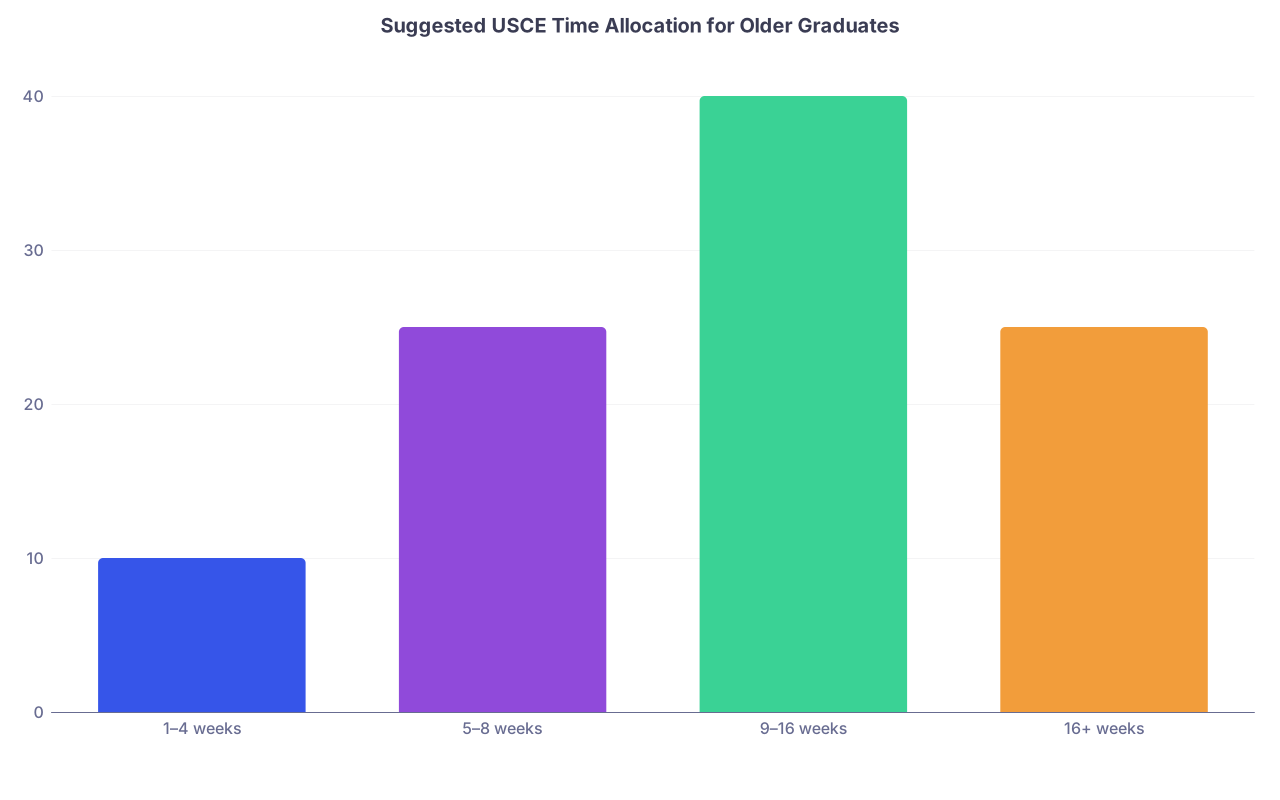
| Category | Value |
|---|---|
| 1–4 weeks | 10 |
| 5–8 weeks | 25 |
| 9–16 weeks | 40 |
| 16+ weeks | 25 |
Those numbers are not official, they’re reality from what I see: <9 weeks and your experience looks “light” when you’re >5 years out. 9–16 weeks with strong letters starts to change the conversation.
Step 3: Where and how to actually get USCE if you’re an older grad
This is where people get stuck and start spending $3,000 per month on low‑yield observership “packages.” Some of those are fine. Some are garbage. You need to be strategic.
Path 1: Direct hospital / clinic observerships or externships
These are best if you can find them. You look for:
- Community hospitals with IMG‑heavy residencies (Internal Medicine, Family Medicine, Pediatrics)
- Teaching hospitals that explicitly mention IMGs on their residency pages
- Large multi‑specialty clinics with physicians who trained abroad
You contact:
- Program coordinators
- Department chairs in your specialty
- Individual attendings (often those with IMG backgrounds)
You send a short, clear email, not a 1,000‑word life story.
Example structure:
- 2 sentences: who you are (IMG, year of grad, specialty interest, current work if any)
- 1–2 sentences: your ask (observership/externship for X weeks in [Month–Month])
- 1 sentence: why specifically them/that hospital
- Attached: 1‑page CV + brief personal statement (optional)
You’ll be ignored a lot. That’s normal. You keep going.
Path 2: Paid USCE programs (useful but be picky)
There are legitimate paid programs that:
- Place you in real clinics/hospitals with some hands‑on opportunities
- Have preceptors who write strong letters
- Understand the IMGs‑over‑5‑years problem
And there are programs that:
- Park you in a clinic where you watch the attending see 40 patients a day and maybe say “hello”
- Give you template letters with your name inserted
- Charge you like you’re buying a used car
If you go this route, grill them:
- Is there direct patient interaction? (History, counseling, education)
- Can I present patients to the attending?
- Do I see inpatients, outpatients, or both?
- How often does the attending write LORs, and are they personalized?
- How many hours per week am I actually in clinic or the hospital?
If they dodge those questions, walk.
Step 4: What to actually do in USCE so it “counts” for an older grad
You’re not showing up just to impress your attending. You’re showing up to prove three things to a future PD:
- You can think like a US intern.
- You can function in the US system.
- You can handle the pace despite your time away.
So during every rotation, your daily priorities:
See and present patients
Even if you’re “observing,” you can often:- Pre‑read the chart
- Take a focused history while the attending is in the room
- Present succinctly right afterward
Practice: 2–3 minute SOAP‑style presentations. If you’re rusty, you say so on day 1 and ask explicitly to get feedback. That humility actually reassures attendings.
Live inside the EMR (even if you can’t officially write notes)
Ask for:- Read‑only access if possible
- The chance to draft notes in Word and show them to your attending
- Practice placing “mock” orders in your head
You want to leave being able to say in your PS and interviews:
“I became comfortable with [Epic/Cerner/etc.], reviewing labs/imaging, and following active inpatient lists.”Act like a sub‑intern, not a tourist
You:- Show up early, stay late if needed
- Follow “your” patients over days
- Pre‑round and know overnight events
- Volunteer to call family (with supervision) or pharmacy
- Help update lists, track pending results
The attending needs to see you as someone who could be an intern in that environment. Even if you’re not writing orders.
Talk openly about your gap
Do not pretend your graduation year is a secret. On day 1 or 2, during a calmer moment, say something like:“I graduated in 2015 and have been working in [X]. I know that’s not recent, so I’m here to actively re‑train myself in a US inpatient/outpatient environment and get back to residency‑level functioning. I’d really appreciate any feedback on where I’m behind and what to focus on.”
That level of self‑awareness goes a long way.
Step 5: Turn that experience into heavy‑hitting letters of recommendation
For you, the older grad, LORs are the output metric of your USCE. If you leave with weak, generic letters, you wasted the rotation.
Your letters need to hit these themes:
- “Despite graduating in 2014, Dr. X functions at the level of a current US graduate.”
- “They quickly adapted to our EMR, inpatient workflow, and multidisciplinary communication.”
- “They showed clinical reasoning comparable to our interns.”
- “I would rank them favorably among current applicants, including recent grads.”
That’s the magic phrase you’re chasing: “I would rank them favorably among current applicants.”
To get that, you:
Ask for feedback midway through the rotation
“How am I doing compared to your typical sub‑I or observer? What should I improve before the end of the month?”Then you actually fix what they mention.
Ask for the letter early, not on the last day
Around week 2–3 of a longer rotation, or end of week 1 on a short one, say:
“If by the end of this rotation you feel comfortable, I’d be very grateful for a strong letter of recommendation for residency. I’m specifically trying to show that, despite the time since graduation, I can perform at a residency level.”Use that phrase “strong letter.” It gently pushes them to be honest. If they hesitate, better to know now than bank your application on a lukewarm LOR.
Provide a short “letter packet”
- Updated CV
- Brief 1‑page summary of your path (including the year you graduated, what you’ve been doing, why now)
- Bullet list of specific patients/cases you worked on with them (reminds them of details)
That gives them material to write a narrative, not a template.
Step 6: Rewrite your story around your recent USCE
When you’re >5 years out, the middle years are where PDs get nervous: “What were they doing from 2017–2023?”
Your job isn’t to hide those years. It’s to frame them, then pivot hard to your current, active trajectory.
Here’s how you weave USCE into the core parts of your application.
Personal Statement
Wrong approach for older grads:
- Long apology for the gap
- Vague “I always wanted to be a doctor”
- Two sentences on recent USCE buried in paragraph 5
Better structure:
- Very brief scene from your recent USCE that shows you in action in a US hospital/clinic.
- One paragraph framing your journey:
- Year of graduation
- What you did since (practice, research, family, another country, whatever)
- The honest trigger that made you come back to US residency now.
- A few concrete ways your recent USCE has updated your skills and confirmed your specialty choice.
- Concise closing that ties your past maturity + recent USCE into why you’re ready now, not “in theory.”
You’re not asking for pity. You’re showing evidence of current capability.
ERAS Experiences section
Your USCE entries should:
- Be near the top (most recent, highest relevance)
- Have strong bullet points that prove active participation, not passive observation
Example bullets (adapt to truth):
- “Pre‑rounded on 4–6 inpatients daily, reviewed overnight events, labs, and imaging prior to team rounds.”
- “Presented new admissions and follow‑up patients to attending physicians with assessment and plan.”
- “Drafted progress notes and admission H&Ps for attending review, incorporating problem‑based assessment.”
- “Coordinated with nursing, social work, and pharmacy to address discharge planning and medication reconciliation.”
If you only observed, you adjust honestly:
- “Observed management of 10–15 inpatients per day on a teaching service, focusing on clinical reasoning and guideline‑based care.”
- “Participated in bedside discussions, asked targeted questions regarding diagnostic choices, and independently reviewed relevant literature after rounds.”
Do not lie about writing orders or notes if you didn’t. But do not undersell yourself into “I watched people be doctors.” You probably did more than you think.
Step 7: Fix the other “older grad” red flags while you do USCE
USCE alone won’t rescue everything. You should fix what you can in parallel.
- Exams: If your Step 1/2 CK are old or weak, a strong, recent Step 3 can help show you’re still academically sharp.
- Recency of clinical work: If you’ve been completely out of clinical practice, try to get something (part‑time clinic, telehealth assistant, scribe work) while arranging USCE.
- Gaps on paper: If you took time off for immigration, caregiving, other professions, own it in the ERAS “gap” sections and your PS. Short, honest, move on.
You’re building a picture: “Yes, I graduated in 2016. But in 2024–2025, here’s what I’ve actively done to get ready for residency.”
Step 8: Where to apply and how many programs (be realistic, not blindly optimistic)
Older grad + IMG + limited USCE trying to match into Derm? No. This is where you’re blunt with yourself.
For most IMGs >5 years out, realistic primary targets:
- Internal Medicine (especially community and mid‑tier university programs)
- Family Medicine
- Pediatrics (harder but not impossible)
- Psychiatry (increasingly competitive but still accessible in some community sites)
You will gain more by applying smart and broad within a realistic specialty than by sprinkling 15 applications into competitive fields “just in case.”
For most older IMGs:
- 100–150 programs in your target specialty is normal.
- Some need more (150–200) depending on red flags.
- Apply heavy to:
- Programs with many IMGs
- Community programs
- States with historically more IMG‑friendly systems (NY, NJ, MI, IL, TX, FL, etc.)
One more thing: heavily consider applying to programs where your USCE attendings have connections. A single email from a US attending—“I worked with Dr. X, worth interviewing”—can jump you over the “2014 grad” filter.
Step 9: Use your USCE stories in interviews to flip the script
If you do this right, your USCE becomes your shield in interviews.
When asked, “You graduated in 2015, tell me about that gap,” you don’t launch into an apology monologue. You connect directly to your recent work.
Something like:
“I graduated in 2015 and spent several years practicing in [country] and then working in [X]. Once I decided to pursue US residency, I knew I needed to prove I could function at the current standard here, not just on paper. Over the last year I’ve done 16 weeks of US clinical experience in [specialty] at [sites]. That’s where I learned to manage patients on [Epic/Cerner], present efficiently on rounds, and coordinate care with social work, pharmacy, and nursing—very much like your interns do here.”
Then you give one specific patient example from USCE that shows your thinking and growth. That’s how you turn an “old grad” liability into a story of persistence and updated competence.
Quick reality check: when USCE won’t be enough
I’ll be blunt: there are situations where even excellent USCE will not fully compensate:
- Multiple Step failures without later strong performance
- 10+ years out of medical school with almost no recent clinical or exam activity
- No USCE and unwillingness to relocate or invest time/effort
In those cases, USCE still helps, but you need to widen your scope:
- Consider prelim/transitional spots, then re‑apply
- Consider less competitive specialties or less popular locations
- Consider parallel tracks: research, hospitalist work abroad with potential later US move, or non‑residency US roles
But if you’re 5–9 years out, determined, and willing to grind 6–12 months of serious USCE, I’ve seen people in your situation match. Not by luck. By being deliberate.

| Step | Description |
|---|---|
| Step 1 | Decide Specialty Target |
| Step 2 | Map 12-18 Month Timeline |
| Step 3 | Secure US Clinical Experience Sites |
| Step 4 | Perform at Subintern Level |
| Step 5 | Obtain Strong US Letters |
| Step 6 | Rewrite Application Around Recent USCE |
| Step 7 | Apply Broadly to IMG Friendly Programs |
| Step 8 | Use USCE Stories in Interviews |
If you remember nothing else
Three points.
- Being >5 years out is a real handicap, but not a death sentence. Recent, serious US clinical experience is the most powerful way to counter it.
- Treat every USCE month like a prolonged audition. Show up like an intern, ask for feedback, and leave with letters that explicitly compare you favorably to current applicants.
- Build your entire application—personal statement, experiences, interview answers—around a simple message: “Yes, I graduated years ago. Here’s what I’ve done this year to be fully ready for residency in the US now.”


