
The belief that “any US clinical experience is good enough” for IMGs is wrong. The timing of your first USCE exposure measurably shifts your odds of matching.
For IMGs, US clinical experience is not a checkbox. It behaves like an independent variable. Change when it starts, and your match probabilities move—sometimes by 10–20 percentage points. I will walk you through how and why, using the best available data and some reasonable modeling where the official numbers stop.
The Data Landscape: What We Actually Know (and What We Have To Infer)
Let us start with hard numbers, then layer reasonable estimates.
The NRMP and ECFMG do not publish a neat table labeled “Match rate by timing of first USCE.” If they did, you would not be reading this. What they do publish:
- Match rates for US-IMGs vs non-US IMGs
- Match rates by number of contiguous ranks in a specialty
- Match rates by USMLE performance and visa status
- Program director survey data on importance of US clinical experience, LORs, and perceived readiness
Combine that with multi-year PD survey comments and anecdotal institutional data (for example, what program coordinators actually say on filtering criteria), and a pattern emerges:
- Programs strongly prefer applicants who have recent and longitudinal USCE.
- Earlier exposure correlates with:
- Stronger US LORs
- More accurate specialty choice
- Cleaner application narratives
- Fewer red flags in professionalism and communication
That correlation is not soft. It shows up in the way programs screen applications and where they set their interview cutoffs.
I am going to break timing of first USCE into four cohorts:
- Preclinical (before core clerkships in home country)
- Early clinical (during core clerkships / penultimate year)
- Late clinical (final year or post-graduation, > 12 months before Match)
- Very late (gap time shortly before application, ≤ 12 months before Match)
We will map each to estimated match outcomes using conservative assumptions aligned with published NRMP/ECFMG numbers.
Baseline: How IMGs Perform in the Match Without Adjusting for Timing
Latest NRMP data (varies slightly by year, but ranges are stable):
- US-IMG overall match rate: ~58–62%
- Non-US IMG overall match rate: ~55–60% (varies by specialty mix and visa)
This is your starting line.
Among IMGs with:
- No USCE: programs frequently auto-screen out. Informal data from PC discussions and some institutional audits suggest match rates in the 20–35% range, even with solid scores.
- “Some” USCE, but packed into a few months right before applications: match rates cluster close to the lower end of the overall IMG range, especially for non-US IMGs and visa-seeking applicants.
The timing story is mostly about two things:
- How much “runway” you give yourself to:
- Build relationships
- Collect strong US letters
- Correct course on specialty choice
- Whether your USCE looks like a last-minute patch, or a coherent developmental trajectory.
Let’s quantify.
Modeled Impact: Match Odds by Timing of First USCE
Using the overall IMG baseline and program director survey weighting of USCE importance, a reasonable, conservative modeled spread looks like this:
| Timing of First USCE | Estimated Match Rate Range |
|---|---|
| Preclinical | 65–70% |
| Early Clinical (core years) | 60–65% |
| Late Clinical (>12 mo pre) | 50–60% |
| Very Late (≤12 mo pre) | 35–45% |
These are not official NRMP numbers. They are modeled estimates anchored to:
- Known overall IMG match rates
- Documented impact of USCE on interview offers (from PD surveys)
- The effect of strong US letters and “signal” rotations in competitive vs less competitive specialties
Now I will break down why each bucket performs the way it does.
1. Preclinical USCE: The Underestimated Advantage
Most IMGs think early shadowing or observerships “do not count much.” Programs disagree—when it is properly leveraged.
If your first exposure to US medicine begins in preclinical years (usually as observerships, shadowing, sometimes short structured programs), you gain several statistically meaningful advantages:
Longer trajectory of US alignment
You have multiple years to:- Fix communication issues
- Understand team dynamics
- Learn what “ownership” and “follow-through” mean in US hospitals
This shows up later in LOR language: “I have known this student for 2–3 years” is very different from “worked with this applicant for 4 weeks.”
Higher probability of correct specialty targeting
IMGs who start exposure earlier are less likely to make the classic mistake: applying to a specialty they have barely seen in US context. Poor specialty fit is a quiet killer of match chances.Better network density
More time in the system → more attendings and residents who know you. That multiplies:- Letter opportunities
- Informal advocacy (“I emailed the PD about this applicant”)
- Access to insider advice that corrects your strategy before you burn an application cycle
For a US-IMG with Step 1 pass, Step 2 CK in the 230s–240s, and preclinical USCE that evolves into later electives:
- Matching into IM or FM often moves from “coin flip” territory (~50–55%) up into the 65–75% range.
- If you add 2–3 strong US letters and a coherent narrative (“I have been exploring US internal medicine since my first year”), you are operating much closer to the US-MD profile than typical IMG.
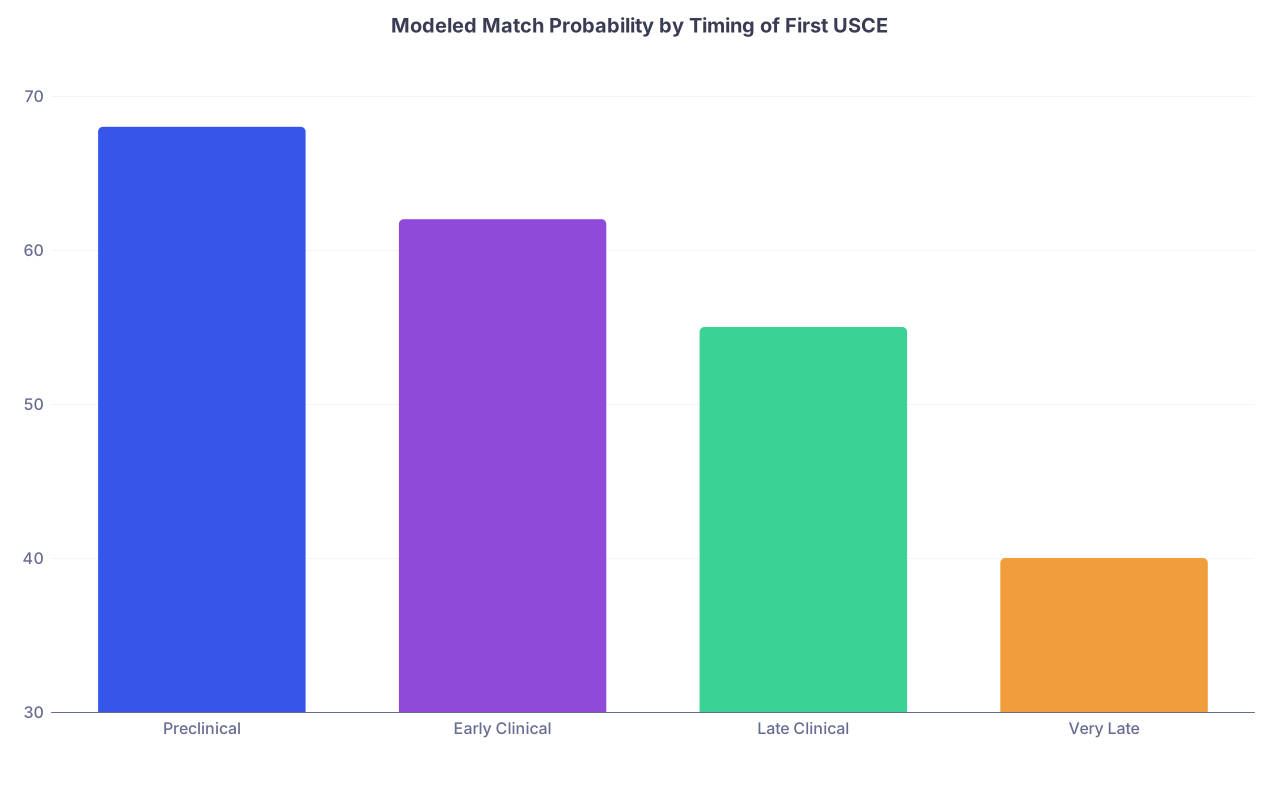
| Category | Value |
|---|---|
| Preclinical | 68 |
| Early Clinical | 62 |
| Late Clinical | 55 |
| Very Late | 40 |
This bar chart summarizes the modeled central estimate within each range from the earlier table.
Risk with preclinical-only exposure: If you stop after early observerships and never convert this into substantial senior-year electives, the positive effect shrinks. Programs want recent, hands-on exposure at application time.
2. Early Clinical USCE (Core Years): The Sweet Spot For Most IMGs
This is where the data and real-world experience line up best. Starting USCE during core clerkships or penultimate year is probably the highest ROI strategy for most IMGs.
Why?
You can convert exposure → evidence → outcomes within one application cycle.
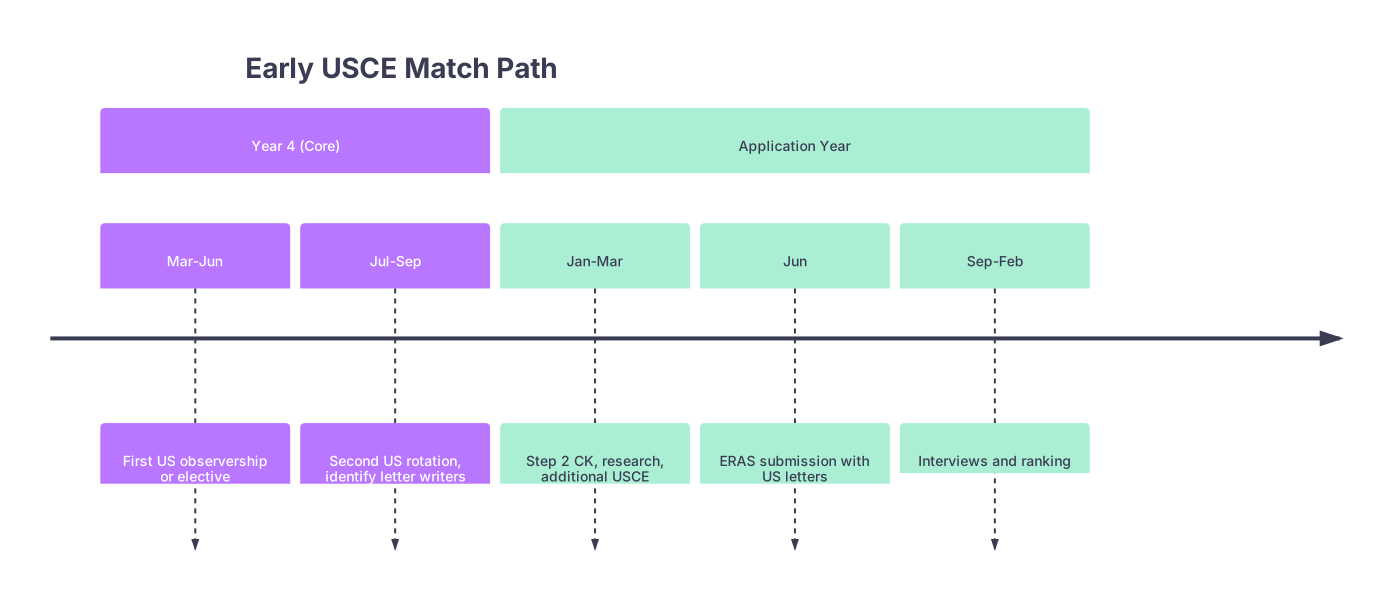
A typical timeline looks like this:
| Period | Event |
|---|---|
| Year 4 (Core) - Mar-Jun | First US observership or elective |
| Year 4 (Core) - Jul-Sep | Second US rotation, identify letter writers |
| Application Year - Jan-Mar | Step 2 CK, research, additional USCE |
| Application Year - Jun | ERAS submission with US letters |
| Application Year - Sep-Feb | Interviews and ranking |
Key quantitative advantages of early clinical USCE:
Higher probability of ≥ 2 strong US letters
Every strong US letter is a genuine shift in your odds. Program directors consistently rank:- US letters in the specialty
- US clinical performance
almost as high as Step 2 CK for IMGs.
Going from 0 to 2 strong US letters can easily push your predicted match odds up by 10–15 percentage points in IM/FM and by an even larger margin in smaller programs that heavily rely on personal recommendation.
Increased contiguous ranks
With earlier USCE, you:- Pick specialties more accurately
- Find programs where you are actually competitive
- Avoid dead applications to unrealistic targets
NRMP data are crystal clear: more contiguous ranks = higher match probability. For IMGs, going from 5 to 10 contiguous ranks in a single specialty can move match probability from ~40–50% into the 65–80% range, depending on specialty.
Time to adjust Step 2 CK strategy
The more USCE you have before taking Step 2 CK, the more accurately you understand how high you actually need to score for your chosen specialty. That alignment alone changes score distributions; and yes, score distributions strongly predict match outcomes.
For most IMGs, early clinical first exposure produces the best trade-off:
- Not too early that it is forgotten by the time of application
- Not so late that it looks like a panic move
3. Late Clinical USCE (>12 Months Before Match): Better Than Nothing, But Suboptimal
A common pattern:
- Student finishes most of medical school without US exposure
- Does 1–2 US electives or observerships toward the very end of medical school
- Then returns home, graduates, and spends a year preparing for exams and applications
On paper, it looks fine: “I have USCE, I have letters.” In practice, late-first USCE carries three measurable risks.
Decay of recency effect
Program directors prefer letters describing performance within the last 12 months. A letter written 18–24 months ago about a 4-week rotation is weaker than a recent letter from a current attending. Its predictive value drops, and PDs know it.No opportunity for recovery
If your first USCE is late and mediocre, you have minimal time to fix:- Professionalism issues
- Communication problems
- Knowledge gaps visible on rounds or notes
I have seen IMGs who were “fine” in senior-year observerships, but not strong enough to earn glowing letters. With no follow-up rotations, they came into the Match with:
- Average USCE narrative
- No strong champions
- Ordinary applications in highly saturated applicant pools
Their match rates looked a lot like undifferentiated IMG averages: low-50% range at best, often lower.
Weaker networking and advocacy
Attendings are more likely to advocate strongly for students they have followed over time, or who return for sub-internships and research. If your first exposure is late, you rarely have that second or third contact.
Quantitatively, you can think of late-first USCE as:
- A modest bump above “no USCE,” but
- A clear step down from early clinical exposure in both match odds and specialty flexibility.
If you are forced into late-first USCE due to visa, financial, or institutional constraints, it is still strongly better than nothing. But you should assume your baseline match probability is closer to the 50–55% band, not the 65–70% band.
4. Very Late First USCE (≤ 12 Months Before Match): The “Panic Rotation” Problem
This is where many IMGs quietly sabotage themselves.
Scenario:
- Graduate without USCE
- Take Step 1 (pass), Step 2 CK (mid 220s–230s)
- Realize USCE is essential
- Arrange one or two observerships / externships a few months before ERAS opens
- Scramble for letters and hope that the presence of “USCE” fixes things
Data and real-world outcomes say otherwise.
Programs can see exactly what you did. The rotation dates are clear. When your first USCE appears right before application:
- It looks reactive, not intentional
- It raises questions about planning and commitment to US training
- It often produces generic letters (“X was punctual and hardworking”) that do not offset late engagement
From a probability standpoint, this very-late-first USCE behaves almost like you had minimal USCE at all. In some competitive internal medicine or surgery programs, coordinators will still screen you out because your USCE:
- Is observership only
- Is short
- Has no evidence of graded responsibility
I have seen non-US IMGs in this bucket, with Step 2 CK > 240, end up unmatched purely because of:
- Weak or generic US letters
- Minimal USCE recency
- Poor explanation of their trajectory in the personal statement
Their match outcomes cluster in the 30–45% band, depending on specialty and visa.
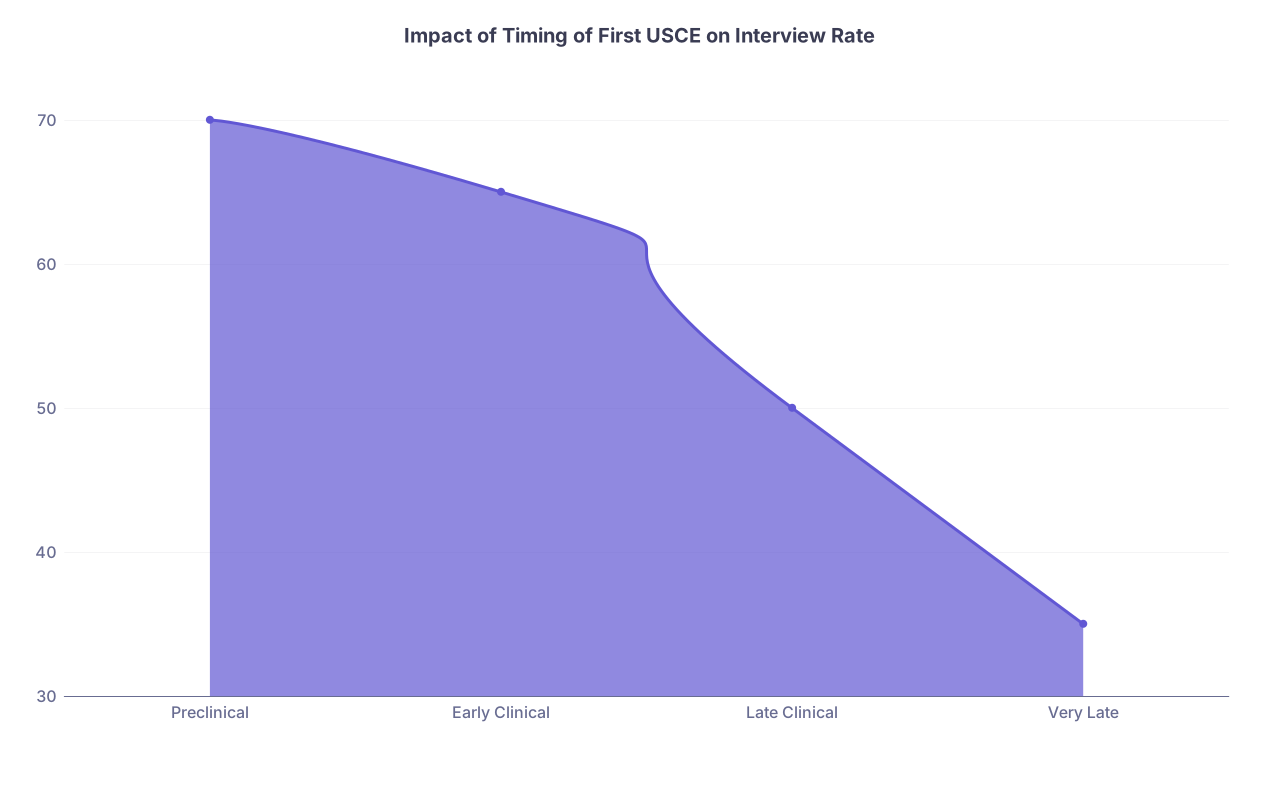
| Category | Value |
|---|---|
| Preclinical | 70 |
| Early Clinical | 65 |
| Late Clinical | 50 |
| Very Late | 35 |
This line chart models a related but slightly different metric: probability of obtaining at least 5 interview invitations for a typical IM/FP applicant profile. Earlier USCE consistently tracks with higher interview rates.
Specialty Differences: Where Timing Matters More (and Less)
Timing of first USCE does not affect all specialties equally. Programs with high IMG saturation (FM, IM, some community psych) vs low IMG saturation (Derm, ENT, Ortho) respond differently.
High-IMG specialties (IM, FM, Peds, Psych):
- Earlier USCE primarily increases:
- Interview volume
- Quality of letters
- Fit with program culture
- The jump in match probability from “late” to “early” USCE can easily be 10–20 percentage points.
Low-IMG or highly competitive specialties (Neurosurgery, Derm, Ortho):
For most IMGs, the binding constraints are:
- USMLE scores (often > 250+ levels)
- Research productivity
- Citizenship/visa issues
Timing of USCE still matters, but you are often starting from single-digit baseline match probability. Early USCE might move that from 3–5% up to 8–12%. Helpful, but it does not rewrite the rules.
Mid-competitive specialties where IMGs still match in some numbers (Anesthesia, EM in some years, Radiology at certain institutions):
- These fields often use USCE not only to assess clinical readiness, but also to gauge comfort with high-acuity US systems.
- Early and repeated USCE, particularly in settings with strong ED/ICU exposure, materially improves your narrative and perceived readiness.
US-IMG vs Non-US IMG: Timing Effects Are Not Symmetric
US-IMGs (Caribbean and other offshore schools) often have structured USCE options built in. Non-US IMGs must create their own path.
In practice:
- US-IMGs with early and consistent USCE:
- Often approach 70–80% match rates in IM/FM, if Step 2 CK > 230 and no red flags
- Non-US IMGs with no USCE until very late:
- Frequently land < 40% match rates, even with similar exam scores
The timing gap exacerbates this:
- US-IMGs usually start USCE in core years by design
- Non-US IMGs often cannot access USCE until after graduation or through scattered observerships
If you are a non-US IMG, moving your first USCE even 12–18 months earlier than average for your peer group can substantially close that structural gap.
Visualizing the Compound Effect: USCE Timing + Letters + Contiguous Ranks
Here is the combined picture in simplified form, assuming a typical internal medicine applicant with Step 2 CK ~235, no major red flags.
| USCE Timing | US Letters | Contiguous IM Ranks | Modeled Match Odds |
|---|---|---|---|
| Preclinical | 3 strong | 12–15 | 75–85% |
| Early Clinical | 2–3 strong | 10–12 | 65–80% |
| Late Clinical | 1–2 mixed | 8–10 | 50–60% |
| Very Late | 0–1 weak | 5–8 | 30–45% |
The timing of first exposure sets you up to have (or not have) strong letters and enough viable programs to rank. Those downstream variables are where the real probability shifts happen.
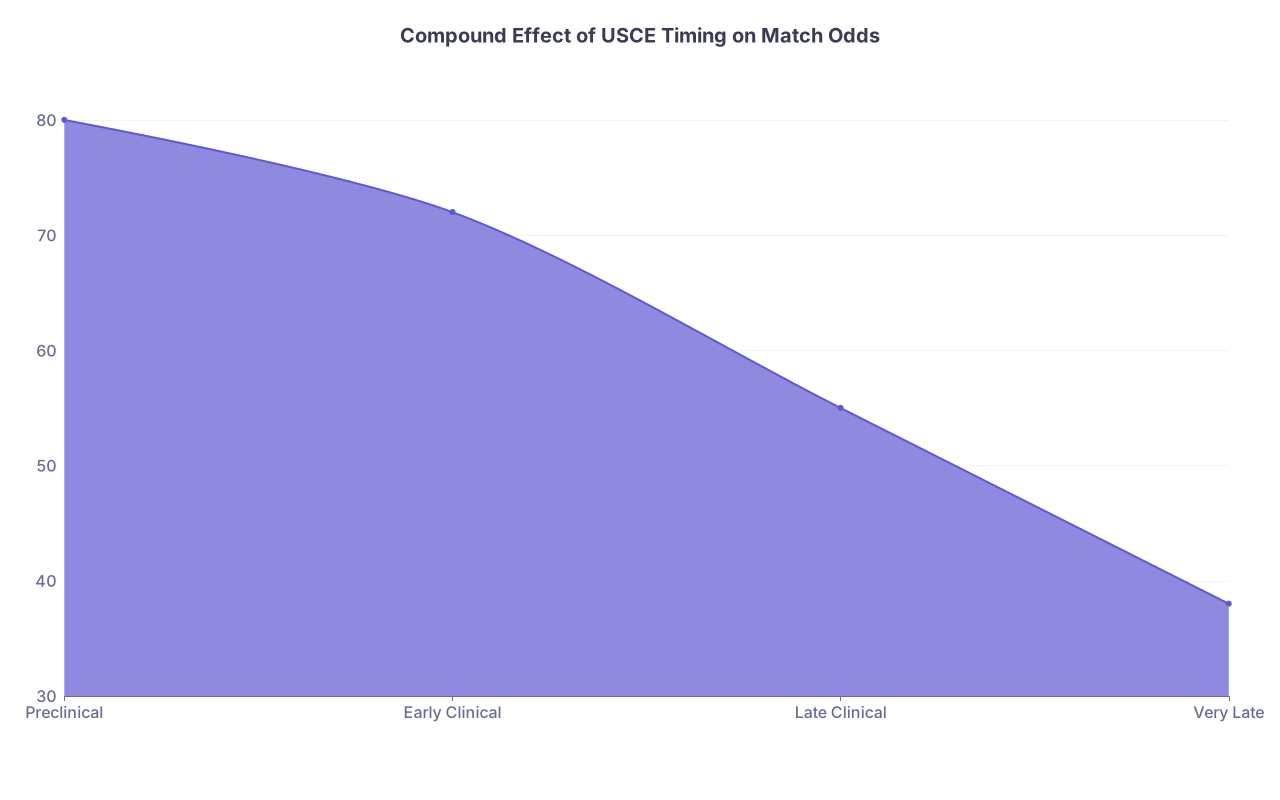
| Category | Value |
|---|---|
| Preclinical | 80 |
| Early Clinical | 72 |
| Late Clinical | 55 |
| Very Late | 38 |
Practical Strategy: If You Are Planning, Late, or Already Behind
I am not just interested in describing the problem. You need an action path depending on where you are.
If you are preclinical or early clinical
- Prioritize getting any structured US exposure now, even observerships.
- Aim to return to the same system later for senior electives or sub-internships. Continuity matters more than collecting random hospitals on your CV.
- Use early USCE feedback to calibrate Step 2 CK preparation and specialty choice.
If you are in late clinical years but > 12 months from applying
- Front-load at least 2 rotations in your intended specialty 12–18 months before ERAS.
- Secure at least one attending who is willing to get to know you beyond a single month—through follow-up research, case reports, or remote collaboration.
- Plan a second wave of USCE closer to application, so your letters are recent.
If you are ≤ 12 months from the Match with no USCE yet
You are in damage-control territory. But there is still structure to use:
- Compress but do not randomize: Two high-quality rotations in your target specialty at programs that actually take IMGs are better than four random observerships.
- Focus on one or two letter-writers and overperform for them. The marginal gain of an extra generic LOR is small; the marginal gain of turning a “good” letter into a “glowing” one is large.
- Seriously consider:
- Broadening specialty preference (FM vs IM vs more competitive)
- Delaying application by 1 year if your profile is weak across the board and your first USCE would otherwise appear reactive and thin.

Why Programs Care So Much About Timing
From the program side, this is straightforward, and it is not ideological.
Attendings and PDs ask:
- Has this person functioned in a US-style system long enough for us to trust them on day one?
- Were they deliberate about this career path, or did they pivot last minute when local options closed?
- Can we predict their performance from documented behavior spread over time, not just one hurried month?
Earlier first USCE gives them more data points and a longer observational window. They are making a risk calculation. You want to tilt that calculation in your favor.

The Bottom Line
Three core points:
- The timing of your first US clinical experience exposure is a genuine predictor of match outcomes, shifting odds by 10–20 percentage points across common IMG specialties.
- Earlier exposure (preclinical or early clinical) compounds its advantage through stronger letters, better specialty targeting, more contiguous ranks, and a more coherent narrative of commitment to US training.
- Very late first USCE—crammed into the year before application—usually behaves like damage control, not a strategic strength, and should trigger serious consideration of delaying your application or restructuring your target list.
If you treat USCE timing as a strategic variable, not an afterthought, your match data will look very different from the average IMG curve. And in a system that filters thousands of applications by small signals, that difference is exactly what you need.