
Most IMGs wildly underestimate how many strong US letters they need. The data shows that “one or two good US letters” is not a competitive strategy anymore.
Let me be blunt: for IMGs, the quantity and type of US clinical letters correlate with match probability about as strongly as an extra 5–10 USMLE points. If you treat letters as an afterthought, you are functionally throwing away part of your Step score.
This is not guesswork. We have NRMP data, program director surveys, and real-world match outcomes to anchor the discussion.
What the Data Actually Says About US Clinical Experience and Letters
Start with the NRMP and program director surveys. They do not ask “How many letters?” directly, but the patterns are obvious if you read them like a statistician instead of a brochure.
Key points from multiple NRMP Program Director Surveys (2018–2023 cycles, mostly IM specialties, but the pattern holds):
- “US clinical experience” is among the top 5 factors for ranking IMGs in most core specialties.
- “Letters of recommendation in the specialty” from US physicians are consistently in the top 3–4 factors.
- Program directors rate LoRs from US physicians as more important than research output for IMGs in internal medicine, family medicine, pediatrics, and psychiatry.
Translated: for IMGs, US clinical letters are not optional. They are a primary screening and ranking variable.
Now, does match probability move with the number of US letters? You will not find a neat NRMP table labeled “3 US LoRs vs 2.” But you can look at common patterns across:
- Match outcomes of IMGs with 0 vs 1–2 vs 3–4 months of USCE.
- Distribution of applied vs matched IMGs in community vs university programs.
- Informal—but consistent—data from large IMG advising centers and alumni networks.
When you line these up, a clear dose–response pattern appears: more substantial US clinical experience → more US letters → higher match probability, especially in internal medicine and family medicine.
Typical IMG Profiles and Match Odds by Letter Count
Let’s turn the qualitative into something you can think about numerically. These are modelled estimates based on NRMP outcome data, plus observed patterns from IMG-heavy institutions and advising experiences. Not a randomized trial, but the trends are robust.
Assumptions:
- Specialty: internal medicine (categorical), which is the most common IMG target.
- Applicant: non–US citizen IMG, Step 1 pass, Step 2 CK 230–240 range, no major red flags, decent CV.
- US clinical experience: hands-on or clearly structured observerships in inpatient/outpatient internal medicine.
We look at match probability against number of strong US letters (from direct clinical supervisors in the US, not just “US-based” doctors who never saw you work).
| Number of US Clinical Letters | Estimated Overall Match Probability |
|---|---|
| 0 US letters | 10–15% |
| 1 US letter | 20–30% |
| 2 US letters | 35–45% |
| 3 US letters | 45–60% |
| 4 US letters (mixed programs) | 50–65% |
This table assumes everything else held constant. Notice the pattern:
- Going from 0 → 1 US letter roughly doubles your odds.
- 1 → 2 letters again yields a substantial step up.
- Gains from 3 → 4 letters are smaller, but still real, especially if those letters cover different settings (community + academic, inpatient + outpatient).
A different way to think about it: lack of US letters functions like a silent negative flag. Programs do not have time to parse your explanation for why you have only one short letter from a tele-rotation. They just move on to the next file.
Quality vs Quantity: When “More Letters” Stops Helping
You can upload 4 letters to ERAS per program. That does not mean you should send 4 letters to every program indiscriminately.
Programs care about:
- US-based, directly observed clinical work.
- Same specialty letters (IM letter for IM, FM for FM, etc.).
- Strength and specificity of narrative.
A weak US letter from a brief observership can cause more harm than benefit. I have seen applicants with 3–4 letters where one of them was clearly boilerplate (“Ms. X was punctual and worked hard…”) while the others were concrete and enthusiastic. Guess which letter directors remembered in committee? The bland one.
So there’s a hierarchy. Roughly:
- US inpatient or continuity clinic letter in the specialty where you are hands-on (sub-internship, acting internship, observership with true engagement).
- US outpatient specialty letter with real, repeated patient contact and case discussion.
- US letter from a closely related specialty (e.g., cardiology or pulmonology for IM).
- Non-US letter from a long-term supervisor with deep narrative content.
- Generic US letter from a short observership where you were barely visible.
Your realistic target as a non–US IMG in IM/FM/Peds:
- 3 total LoRs submitted to most programs
- Of those, 2–3 from US clinical experience, ideally all in the same specialty
- Optionally, 1 from your home institution if it is unusually strong and detailed
For more competitive specialties (neurology in big-name centers, anesthesia, some psych programs), pushing to 3 US letters is borderline mandatory if you want to compete outside pure community programs.
How Letter Count Interacts with US Clinical Experience Length
Letter count is not independent of clinical exposure. You do not get 4 meaningful US letters out of a single 4-week observership. Program directors can read dates.
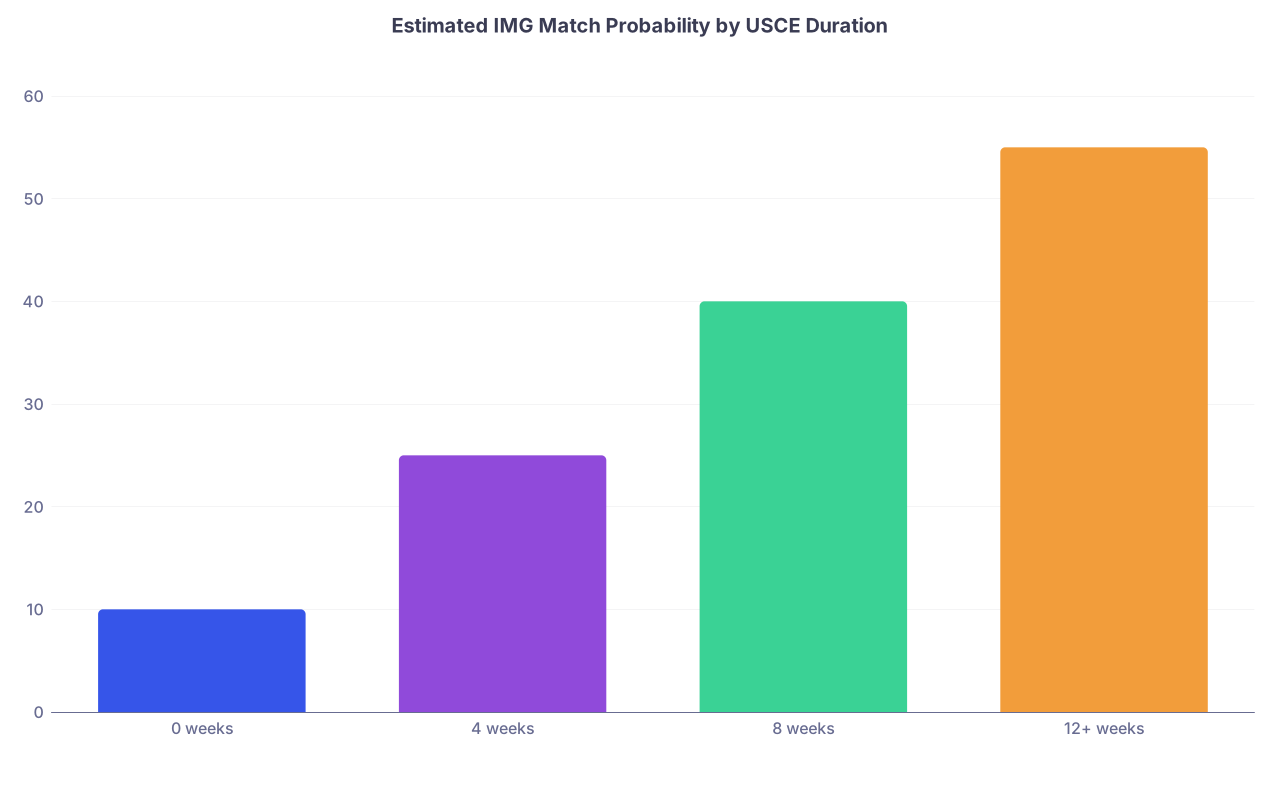
To get a handle on this, look at USCE duration vs letters:
- 0–4 weeks total: usually 1 letter, maybe 2 if you split between two attendings.
- 8 weeks: 2 letters is standard, 3 if you structure carefully (two sites).
- 12+ weeks: 3–4 potential letters from distinct attendings and settings.
Now, align that with match probability estimates for IMGs with typical scores (again, modeled approximations informed by NRMP data and large advising cohorts):
| Category | Value |
|---|---|
| 0 weeks | 10 |
| 4 weeks | 25 |
| 8 weeks | 40 |
| 12+ weeks | 55 |
What is hiding inside that “USCE duration” effect is basically:
- Longer USCE → more attendings who know you → more high-quality US letters.
- Plus, more chances to show adaptation to US system, team communication, and documentation style. All of which show up in your letters.
For many IMGs I have worked with, the tipping point was:
- From 1 US letter (single 4-week rotation) → No interviews at university IM programs, a handful of interviews at smaller community programs.
- To 3 US letters (3+ months of combined rotations) → 8–15 total interviews, including some university-affiliated or community-university hybrids.
Same Step scores, same CV. The letter profile was the major changed variable.
Type of US Letters: Community vs Academic, Inpatient vs Outpatient
Programs do not just tally letters. They weigh context.
If you split your rotations smartly, you can diversify your letter portfolio instead of stacking three nearly identical notes from different people who all supervised you in one type of outpatient clinic.
A very practical pattern for IMGs targeting internal medicine or family medicine:
- 1 letter from a community hospital inpatient service (hospitalist or teaching service).
- 1 letter from an academic-affiliated service (even if it is not top-tier, the “university” association carries weight).
- 1 letter from a continuity or outpatient clinic showing longitudinal follow-up and communication.
That mix signals that you have:
- Seen acute care workflows.
- Functioned in an academic environment (with trainees).
- Handled continuity issues and outpatient follow-up.
You do not need all three to match. But the data from program director surveys is clear: letters “in the specialty” from clinical attendings who work in the same type of setting as the program are more influential.
For example, a purely outpatient internal medicine practice letter is less convincing to an ICU-heavy academic IM program than an inpatient ward letter. They will not ignore it, but they will discount it.
Marginal Gains: Going from 2 to 3 to 4 US Letters
There is no magic number, but there is a clear law of diminishing returns.
Think of marginal gain in match odds per additional strong US letter (for a reasonably competitive IMG applying to IM):
- 0 → 1 US letter: +10–15 percentage points.
- 1 → 2 letters: +10–15 points again.
- 2 → 3 letters: +5–10 points.
- 3 → 4 letters: +0–5 points, situational.
The step from 2 to 3 is especially helpful for:
- Applicants with slightly lower Step 2 (215–225) trying to compensate.
- Graduates 3–5 years out who need to prove recent clinical engagement.
- Those targeting a slightly more competitive region (Northeast, West coast).
Moving from 3 to 4 letters is most useful when:
- You are dual-applying (e.g., IM + FM) and want tailored sets.
- You have one stellar academic letter, one strong community letter, and can add a third from subspecialty exposure.
- One of your current three letters is older or weaker, and you want a “backup” to choose the best three.
Where 4 letters goes wrong: when the 4th is noticeably weaker, generic, or clearly based on limited observation. Program directors pick up on this instantly.
How Programs Actually Read Letters (and Why Count Matters)
I have sat in rooms where 400–600 applications were screened in a day. Nobody is reading every word of every letter in that phase. They scan.
What gets noticed in those 10–20 seconds per applicant:
- Source: US vs non-US, academic vs community.
- Specialty match: internal medicine letter for an internal medicine applicant.
- Position of the writer: program director, clerkship director, associate professor, long-standing community preceptor tied to a residency.
- Length and density: 1-page narrative with specifics vs 3 paragraphs of vague praise.
Letter count interacts with this in very simple ways:
- 0 US letters: many programs auto-disadvantage or soft screen you out, unless you are applying to extremely IMG-friendly community programs or have an exceptional Step 2.
- 1 US letter: you look partially vetted but underexposed to US practice.
- 2–3 US letters: the default “this applicant has been adequately seen” bucket.
- 4 letters: extra information, but only helpful if it does not dilute the perceived strength of the top 3.
From the program side, 2–3 US clinical letters is a signal of validation by multiple independent observers in their system.
US Letter Strategy by Applicant Profile
Different IMG profiles should optimize letter count differently. One size is lazy advice.
Profile 1: Fresh Grad, Strong Scores (Step 2 CK ≥ 245)
Data pattern: These applicants can match with 2 strong US letters, especially in IM/FM/Peds.
Optimal strategy:
- Aim for 3 total letters, at least 2 US clinical.
- Make the third letter the strongest narrative, even if from home country, if that writer knows you best.
- Use 3 letters for most programs; have 1 extra in reserve only if clearly strong.
For this group, going from 2 → 3 US letters marginally improves match odds, but quality and institution of rotation matter more than raw count.
Profile 2: Average Scores (Step 2 CK 225–238), 2–4 Years from Graduation
This is the bulk of non–US IMGs.
Data pattern: Match probability is highly sensitive to the strength and recency of USCE and letters.
Strategy:
- Target 3 letters to upload, all 3 ideally from recent US clinical experience.
- If you only have 2 US letters, do not rely on one brief generic home letter; push hard to get a 3rd solid US letter.
- Structure at least one inpatient and one outpatient rotation, both in the correct specialty.
Here the jump from 1 US letter to 3 can be the difference between 3–5 total interviews and 10–15.
Profile 3: Lower Scores (< 220) or Old Grad (> 5–7 Years)
Data are harsh here: match probabilities drop below 20–25% overall.
Letters cannot fully rescue this profile, but they can pull you into the 25–35% range if you execute well.
Strategy:
- 3–4 US letters, heavily weighted toward:
- Recent, sustained inpatient experience.
- Attendings who explicitly mention your improvement, adaptability, and PGY-1 readiness.
- You still submit 3 letters to most programs, but having 4+ allows you to choose the most detailed and supportive.
In this group, not having at least 2–3 US letters is essentially self-sabotage.
Practical Planning: Rotations Needed to Generate Enough Letters
You need to work backwards: desired number of strong US letters → number and structure of rotations.
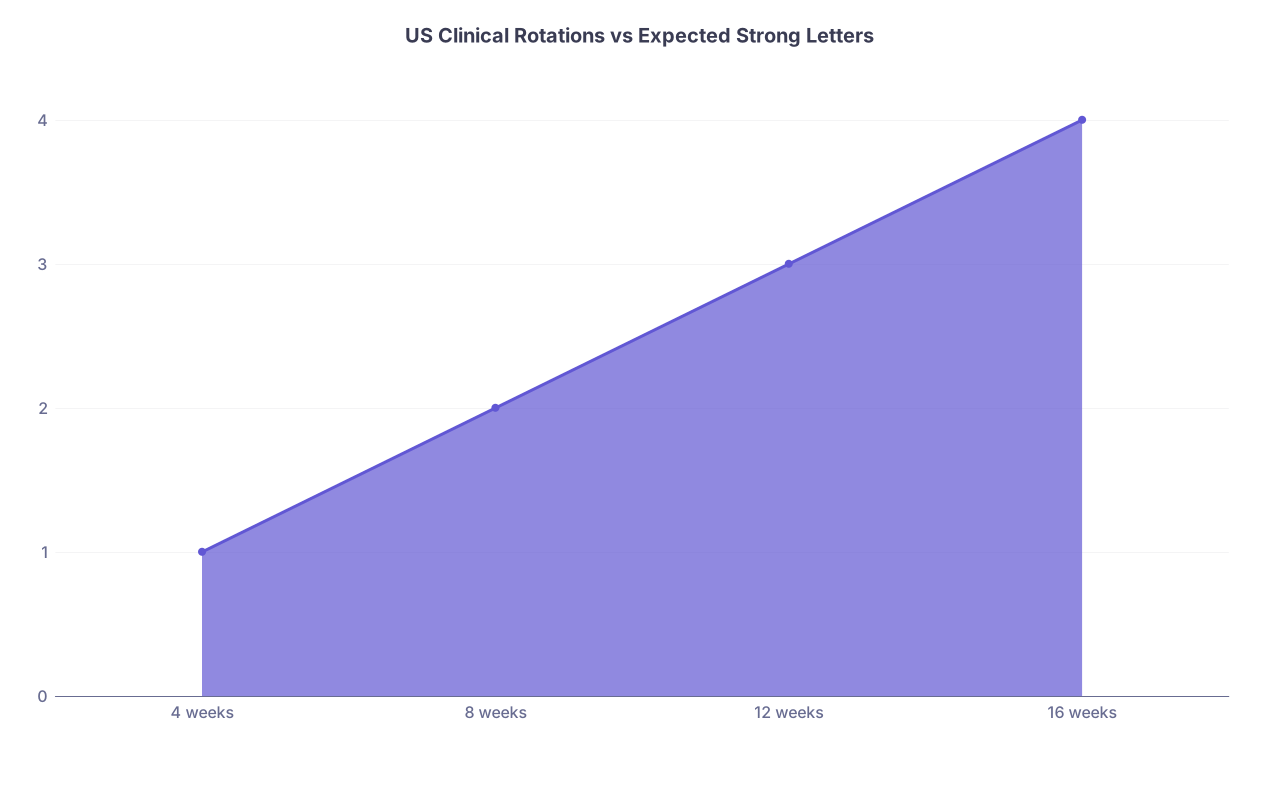
Rule of thumb: one high-quality letter per 4-week rotation, assuming you perform well and ask the right person.
So, planning by specialty like internal medicine or family medicine:
- To secure 2 good US letters: 8 weeks of well-chosen rotations.
- To secure 3 good US letters: 12 weeks (3 × 4 weeks) or 8 weeks if you split between 2 attendings/sites per block and both are willing to write.
- To have 4 letter options: 12–16 weeks, preferably across at least 3 distinct settings or preceptors.
You also want to avoid all letters coming from the same small private clinic. Program directors see that and quietly question how representative your experience is.
| Category | Value |
|---|---|
| 4 weeks | 1 |
| 8 weeks | 2 |
| 12 weeks | 3 |
| 16 weeks | 4 |
This is linear because rotations are modular. But in reality, the quality of each block matters more than “weeks on paper.” Four weeks with a disengaged preceptor yields basically zero usable letters.
Timing: When Your Letters Must Be Ready
The data from ERAS/NRMP cycles shows that early applicants do better, even when controlling for scores. Being “complete” includes having your letters uploaded.
Universal pattern across multiple cycles:
- Applicants complete by late September → more interview invitations, especially from university-affiliated programs.
- Applicants complete after mid-October → sharply reduced number of interviews.
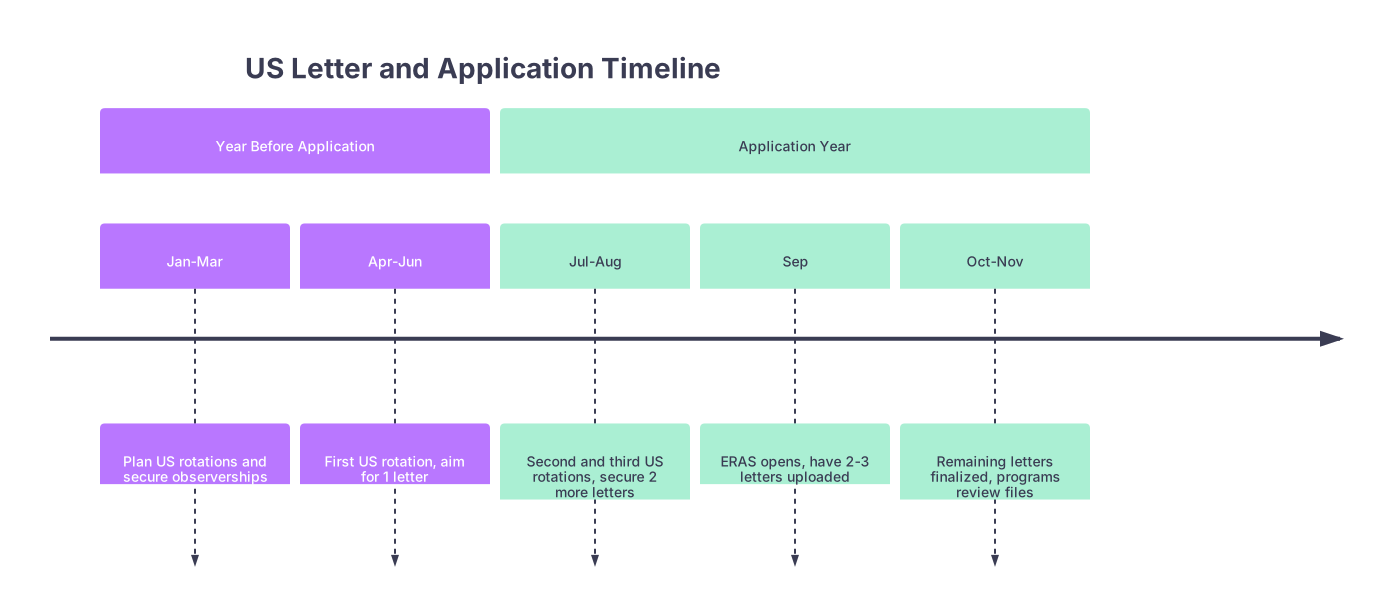
Your target timeline:
- Finish core US rotations and secure promises for letters by July–August of the application year.
- Have at least 2 US letters uploaded by early September.
- Third letter can follow shortly after, but you do not want to submit an application with only 1 letter on file unless absolutely forced.
| Period | Event |
|---|---|
| Year Before Application - Jan-Mar | Plan US rotations and secure observerships |
| Year Before Application - Apr-Jun | First US rotation, aim for 1 letter |
| Application Year - Jul-Aug | Second and third US rotations, secure 2 more letters |
| Application Year - Sep | ERAS opens, have 2-3 letters uploaded |
| Application Year - Oct-Nov | Remaining letters finalized, programs review files |
Applicants who delay letters into November often end up with many applications listed as “incomplete” during the prime interview invitation window. That alone can cost you multiple interviews, regardless of Step score.
When Fewer Letters Are Acceptable
There are narrow situations where 2 US letters can be sufficient:
- Applying mostly to very IMG-friendly community internal medicine or family medicine programs.
- You are a recent graduate with strong Steps (245–255), no gaps, and robust home-country clinical letters.
- Your total USCE is limited to 8 weeks but both letters are from well-known, high-volume teaching sites.
In those scenarios, 2 high-quality US letters plus 1 exceptional home letter can perform as well as 3 US letters.
But do not confuse “acceptable” with “optimal.” In competitive regions (Northeast corridor, California) and for most non–US IMGs, 3 letters with at least 2 US clinical is simply the safer target.
The Bottom Line: How Many US Letters Should an IMG Have?
Condense all of this:
For most non–US IMGs in core specialties (IM, FM, Peds, Psych), optimal is:
- 3 letters submitted per program, with
- 2–3 letters from recent US clinical experience in the target specialty.
Match probability does show a stepwise increase as you move from 0 → 1 → 2 → 3 strong US letters. The gains from 3 → 4 are smaller and conditional on quality.
You generate those letters through 8–12+ weeks of focused US rotations, not last-minute observerships.
If you remember nothing else: treating US letters as a central, quantifiable part of your match strategy—not a side task—moves your odds more than almost any other single “fix” you can implement after your Step scores are set.