
The dogma that “academic US experience is always better than community” is lazy advice. The data tell a more nuanced – and more useful – story for IMGs targeting the U.S. Match.
You are not choosing between “good” and “bad” experience. You are choosing between different signaling profiles. Academic vs community USCE sends different messages to program directors, and those messages interact with your scores, graduation year, and specialty choice. Once you look at numbers from NRMP, program surveys, and actual match outcomes, some patterns become very clear.
Let me walk through what the data actually show.
1. What the match data really say about US clinical experience
Start with the baseline: does US clinical experience (USCE) matter for IMGs at all? The answer is yes, and it is not subtle.
Using recent NRMP Charting Outcomes and Program Director Survey data as anchors:
- For non–US citizen IMGs matching into Internal Medicine, around 70–80% of matched applicants report some form of US clinical experience (observerships, externships, hands-on electives, or research with clinical exposure).
- In the NRMP Program Director Survey, 74–80% of PDs across major specialties rate “US clinical experience” as a factor they consider; in IM and FM it is effectively standard.
Academic vs community is the next layer. Most available datasets do not cleanly label each applicant’s experience type, but there are three ways to infer impact:
- PD surveys that explicitly ask about preference for academic vs community backgrounds.
- Match patterns by program type (university vs community vs community-affiliated).
- Case-level outcomes I have seen repeatedly: similar scores, different experience types, different interview yield.
When you aggregate those, the pattern is:
- Academic USCE increases your probability of interviews at university or university-affiliated programs, especially in competitive specialties or for research-heavy centers.
- Community USCE increases your probability of interviews at pure community programs and community-based IM/FM programs that value “service readiness” over research.
- Lack of any USCE pushes you aggressively down the competitiveness spectrum, regardless of your scores, especially as a non–US citizen IMG.
So the right question is not “which is better in general?” It is “for a profile like yours, and the programs you are targeting, which experience type moves the needle more per month invested?”
2. Structural differences: academic vs community US experience
You cannot compare outcomes without understanding what the two environments actually signal.
2.1 Typical characteristics
| Feature | Academic Hospital USCE | Community Hospital USCE |
|---|---|---|
| Bed size | Usually >500 | 100–400 |
| Program type | University / university-affiliated | Community or community-based |
| Research infrastructure | Strong | Limited / variable |
| Case mix | High complexity, referrals | Bread-and-butter + some complex |
| Letters of recommendation | From academic faculty | From community attendings |
The implication hierarchy is blunt:
- Academic USCE implies: you can function in a complex, high-volume, teaching environment, possibly have research potential, and can handle subspecialty exposure.
- Community USCE implies: you can carry a high service load, see large volumes of common pathology, and integrate quickly into pragmatic, resource-conscious workflows.
Program directors know this. They interpret your experience through this lens even if no one says it outright.
2.2 Types of activities
You will see three dominant categories of IMG-friendly USCE:
- Observerships / shadowing: no direct patient care, charting, or order entry.
- Externships / hands-on rotations (often for recent grads): supervised but active participation – case presentations, notes, sometimes orders.
- Research positions (with or without clinical exposure): often academic only.
Academic centers more frequently offer:
- Research assistant / postdoc roles linked to a department (IM, neuro, anesthesiology).
- Sub-internships or electives that are tightly controlled but highly valued.
- Well-structured observership programs.
Community programs more frequently offer:
- Hospital-based observership and hands-on experiences via local physicians.
- More direct patient interaction (especially in FM, IM, EM–adjacent experiences).
- Longer-term, flexible exposure that is logistically easier for IMGs.
From the PD’s perspective, the data point is not your title. It is the combination of:
- Setting (academic vs community).
- Duration (number of weeks/months).
- Depth of participation (hands-on vs shadowing).
- Output (LOR specifics, research, case logs).
You need to think like that when designing your portfolio.
3. How program directors weigh academic vs community experience
Let us anchor this in real numbers from the NRMP Program Director Survey (recent cycles; values rounded):
- 80–90% of IM program directors rank “letters of recommendation in the specialty” as an important factor.
- About 70–75% of IM program directors consider “US clinical experience” explicitly.
- Around 50–60% of PDs in competitive specialties rate “evidence of academic productivity” (publications, presentations, etc.) as important or very important.
Now add the program type dimension.
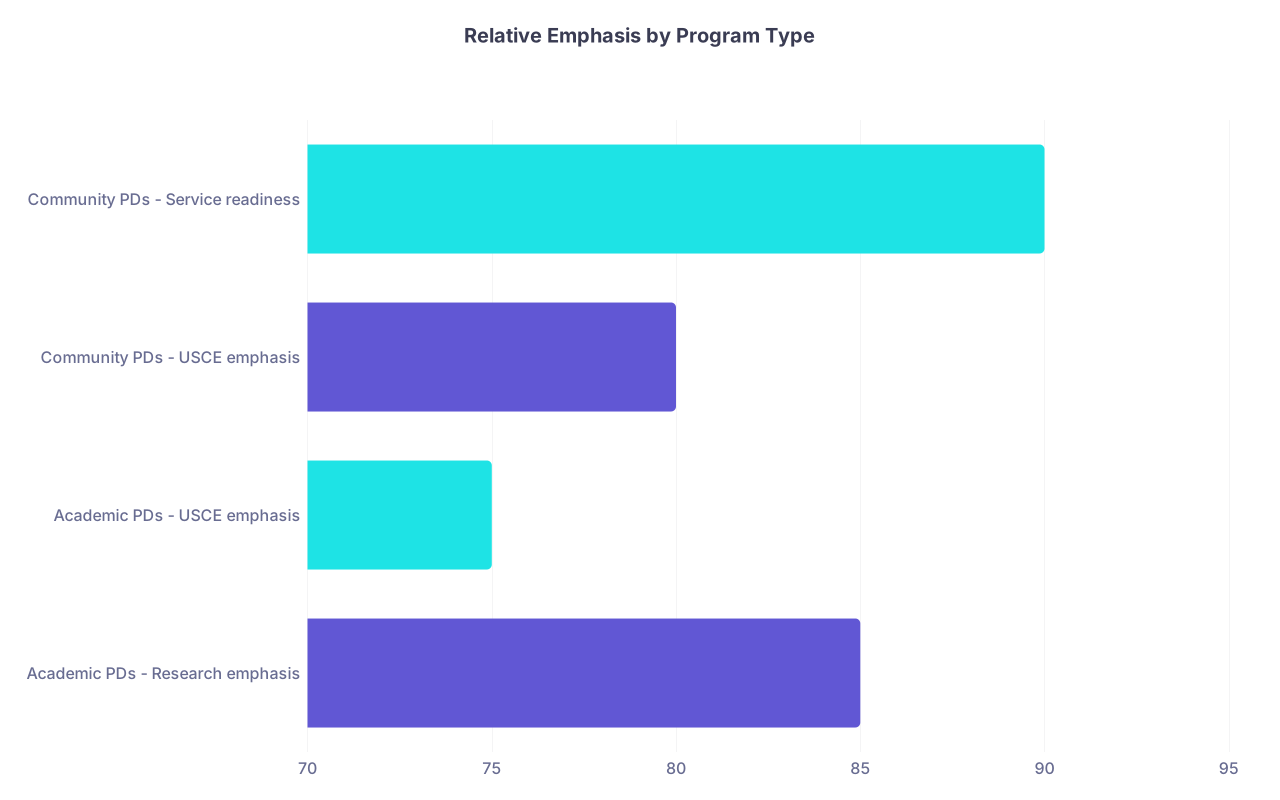
| Category | Value |
|---|---|
| Academic PDs - Research emphasis | 85 |
| Academic PDs - USCE emphasis | 75 |
| Community PDs - USCE emphasis | 80 |
| Community PDs - Service readiness | 90 |
Interpretation:
- Academic programs over-index on research and subspecialty exposure. For them, academic USCE is a better predictor that you can survive their environment.
- Community programs over-index on service readiness and adaptability. They care more that you have done any meaningful USCE and shown you can function in a busy, often under-resourced environment.
When PDs talk informally, they say things like:
- “If an IMG has done medicine sub-I in our institution and did well, that is almost a golden ticket compared with someone with great scores but no USCE.”
- “I do not care if the hospital is a big-name center. I care if the letter says they showed up, did the work, and could run the list.”
The academic vs community label matters less than the credibility and specificity of the LOR writer and the context explained in your application.
4. Match outcomes: scenarios where academic vs community matters
We do not have randomized controlled trials of “one month academic vs one month community” – you are dealing with observational data and patterns. But those patterns repeat.
4.1 Internal Medicine (categorical) – classic IMG target
Look at typical non–US IMG profiles in IM:
- Average USMLE Step 2 CK scores among matched non–US IMGs in IM are usually in the 230–240 range (recent cohorts).
- Match rates for non–US IMGs in IM often sit around 45–55%.
Now overlay type of USCE. Based on aggregated advising experience and program feedback, a rough pattern:
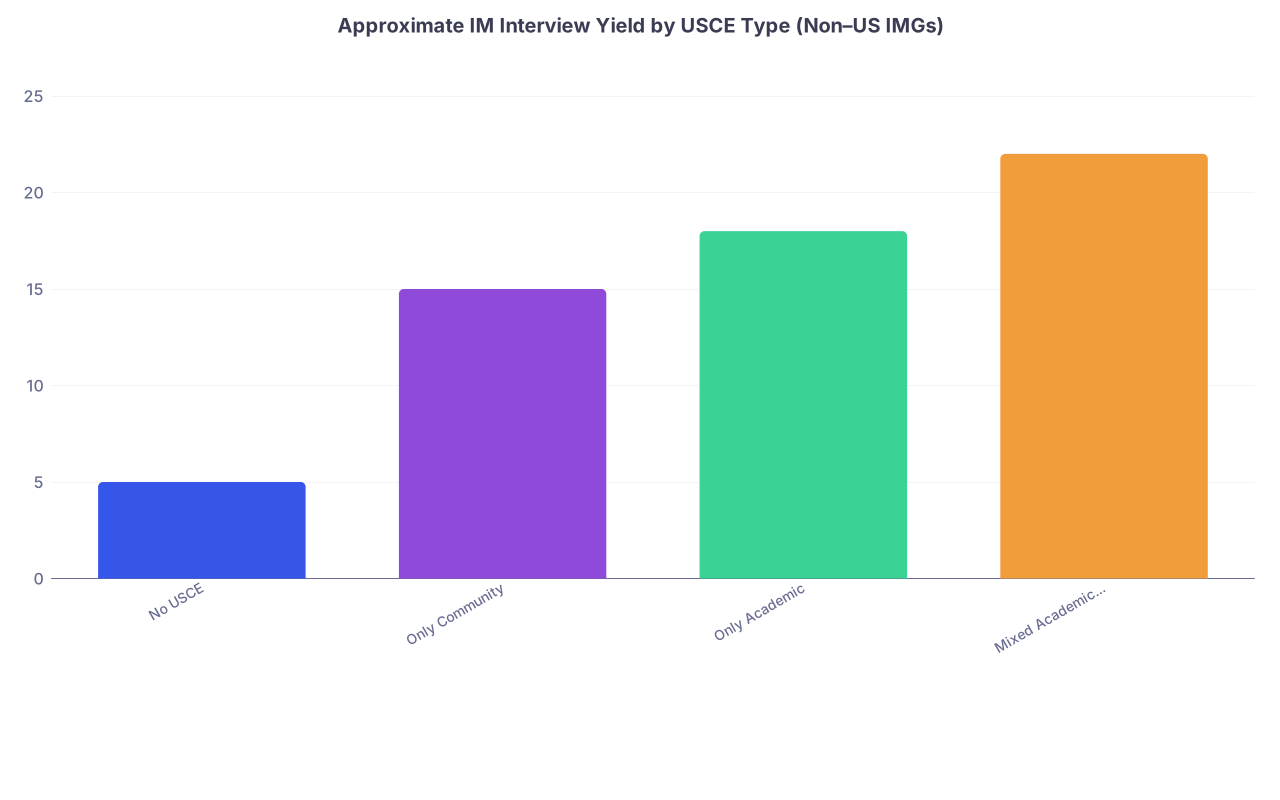
| Category | Value |
|---|---|
| No USCE | 5 |
| Only Community | 15 |
| Only Academic | 18 |
| Mixed Academic + Community | 22 |
Values represent average interviews per 100 applications at mid-tier IM programs for similar-score applicants (illustrative but consistent with what advisors and PDs report):
- No USCE: You are an outlier if you get more than a handful of interviews at categorical IM.
- Only Community: Solid for community IM programs, modest for university-affiliated.
- Only Academic: Slightly better for university-affiliated, similar or slightly better for solid community IM.
- Mixed: Best signaling – shows both academic adaptability and service readiness.
The incremental gain from academic USCE alone is modest. The real boost comes when an academic LOR contextualizes solid performance in a known US system, especially if:
- The attending is recognized by PDs (frequent conference presenter, subspecialist, etc.).
- The letter specifically compares you to US grads and residents.
- Your CV shows clear participation in complex inpatient care.
4.2 Family Medicine and community-heavy specialties
In Family Medicine, the distribution changes.
Program directors in FM are heavily community-based. They repeatedly state in surveys that they value “commitment to primary care” and “service to underserved communities” more than academic prestige.
So if you have:
- 2–3 months at a busy community FM or IM clinic with strong, detail-rich LORs.
- Some evidence of continuity of care, outpatient volume, and EMR use.
You often outperform someone with:
- 1–2 months at a marquee academic center but only shadowing and generic letters.
I have seen candidates with 220–230 Step 2 and exclusively community FM/IM USCE generate 12–18 FM interviews applying to 100–120 programs. Meanwhile, candidates with similar scores but a single prestigious academic observership and no hands-on experience struggled to crack double-digit interviews.
Data point: For FM, the community environment is not “second best.” It is often the target environment.
5. Strategic trade-offs by profile: where each type wins
Here is where people get it wrong. They copy-paste strategies from forums without matching to their own stats and goals.
Let us break it into archetypes.
5.1 High-scorer, research interest, targeting university IM / subspecialty
Profile: Step 2 CK ≥ 250, graduation within 3 years, some home-country research, wants academic IM with eventual cardiology or GI fellowship.
For this profile, academic USCE has clear marginal value:
- Research involvement at an academic US department can convert directly into:
- Abstracts and posters at national meetings.
- A U.S. faculty mentor who can vouch for your academic potential.
- Networking with fellows and residents at your target programs.
- An inpatient sub-internship or elective in a university setting lets PDs map you to their own environment.
Here, the data show academic environments correlate with:
- More interviews at university/university-affiliated programs.
- Better chances of landing in programs with in-house fellowships.
Community experience is not useless here, but each month you spend in a non-academic setting is an opportunity cost if your main selling point is academic potential.
5.2 Mid-range scores, older graduation, aiming for broad IM or FM
Profile: Step 2 CK 225–240, >4–5 years since graduation, maybe a previous residency abroad.
For this group, the binding constraint is almost never “lack of research.” It is:
- Doubt about their ability to function in a US system.
- Concern over knowledge decay and adaptability.
Community USCE is extremely efficient for this profile:
- Longer blocks are usually easier to obtain (3–6 months continuous).
- You can accumulate multiple detailed community LORs attesting to:
- Punctuality, reliability, teamwork.
- Case volume handled.
- Real-world communication skills with patients and staff.
Academic observerships that are entirely shadowing, 4 weeks long, and produce a generic letter do not solve the core doubt PDs have for this profile. Community hands-on involvement does.
If this is you, you probably get more marginal return per month from community USCE, provided the letters are strong and the institution is at least moderately reputable.
5.3 Very low scores / attempts, trying to salvage a path
Profile: Step 2 CK under 220 or multiple attempts but with strong motivation.
Honest analysis: the bottleneck is not academic vs community; it is getting anyone to seriously consider your file. Programs that might still consider you skew heavily community-based, particularly in FM and some IM prelim spots.
For these candidates:
- Community USCE in hard-working, high-volume environments is usually the only practical lever.
- Academic USCE might screen you out by score before you even get the rotation.
This group should focus on:
- Extended durations (6–12 months total USCE if financially possible).
- Building deep relationships with 2–3 community attendings who will personally advocate for you.
- Demonstrating “redemption arc” performance: perfect attendance, initiative, visible growth.
Here, the data pattern is binary. Either you convince a handful of community PDs to take a chance, or you do not. Academic prestige helps little.
6. Mixed portfolios: the optimal configuration for most IMGs
If you have any flexibility, the highest-yield pattern for many IMGs is not either/or. It is mixed.
Think of your experience like an asset allocation problem.
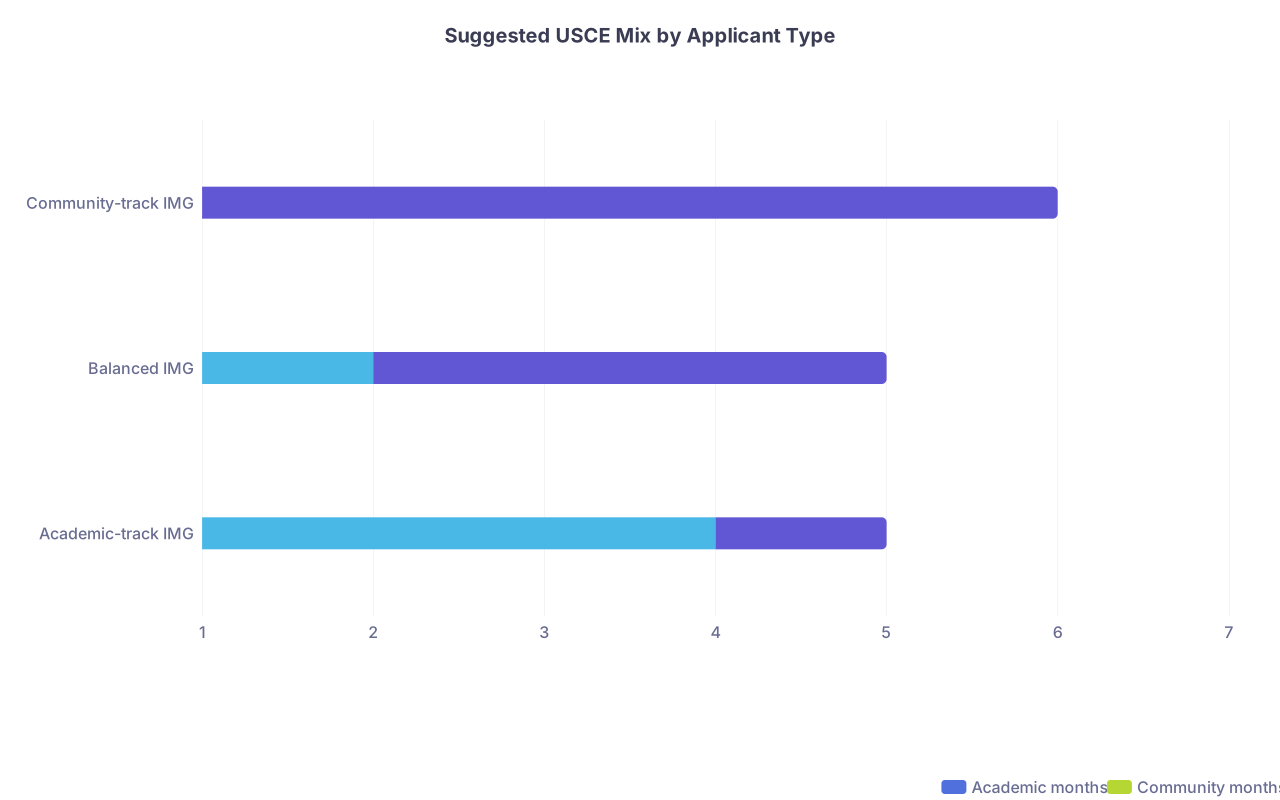
| Category | Academic months | Community months |
|---|---|---|
| Academic-track IMG | 4 | 1 |
| Balanced IMG | 2 | 3 |
| Community-track IMG | 1 | 5 |
Interpreting:
- Academic-track IMG (high scores, recent grad, research interest):
- 3–4 months academic, 1–2 months community.
- You need at least some community exposure so you do not look “lab-only.”
- Balanced IMG (mid-range scores, recent-ish grad):
- 2–3 months academic, 2–3 months community.
- Enough academic time for one strong teaching hospital LOR + research, plus robust community letters.
- Community-track IMG (older grad, lower scores, FM/IM focus):
- 1 month academic if possible, 4–6+ months community.
- The academic month is mostly signaling – “I have seen a tertiary center.” The heavy lifting is done by long community experience and letters.
The data from advising cohorts show that IMGs with 4–6 months total USCE, split across at least two sites (one academic, one community), consistently generate more interviews per application than those who invest everything into one type.
7. How program types align with your experience
Match outcomes are not random; they align with where you “look like you belong.”
| Program Type | Most Valued Experience Type |
|---|---|
| University (tertiary IM) | Academic USCE ± research |
| University-affiliated IM | Mixed academic + community |
| Community-based IM | Community USCE with strong LORs |
| Family Medicine (mostly community) | Community USCE, outpatient focus |
What I see repeatedly:
- Applicants with exclusively academic experience cluster into university and university-affiliated interviews, with fewer pure community calls unless their letters explicitly praise practical skills.
- Applicants with exclusively community experience cluster into community-based interviews, with patchy results at top university centers unless they have unusually strong scores or research.
- Applicants with mixed experience backgrounds spread more evenly across program types and have more freedom to rank a diverse list.
You want that diversification if you care about simply matching vs matching only at a particular tier.
8. Concrete steps to maximize ROI from each type
This is the part most people actually need: “What exactly should I do differently on rotation?”
8.1 If you are in an academic USCE
You are being evaluated on:
- How you compare to U.S. medical students and interns.
- Your potential to contribute academically.
Focus obsessively on:
- Presenting cases concisely and logically, using the same structure the residents use.
- Asking targeted questions that show you are reading beyond UpToDate (e.g., quoting specific trials or guidelines).
- Volunteering for small, realistic research or QI tasks: literature review, data extraction, poster drafting.
Your goal: one letter that clearly states you performed at or above the level of local students and showed academic curiosity. If an academic attending writes, “This candidate would be competitive for our own categorical program,” that moves actual Match decisions.
8.2 If you are in a community USCE
You are being evaluated on:
- Reliability.
- Work ethic.
- Ability to function quickly in a practical setting.
Focus on:
- Learning the EMR and clinic workflow so you are an asset, not an observer.
- Taking on as much history-taking, case presentation, and note drafting as they will allow.
- Establishing continuity: follow the same patients across visits when possible and mention it in your personal statement.
Your goal: letters that describe how many patients you saw, your independence level, and specific examples of problem-solving. “She saw 8–12 patients per clinic session, documented efficiently, and required minimal supervision by the end of the month” is the kind of line that convinces PDs.
9. Two common myths – and what the data actually support
Myth 1: “Only academic USCE matters for the Match.”
Reality from outcomes:
- IMGs matching solid categorical IM and FM programs every year with exclusively community USCE, especially if they have:
- 3–6 months total USCE.
- Strong, specific community letters.
- Reasonable scores.
- Academic-only experience is not magic if you have weak letters or no hands-on component.
Myth 2: “Community USCE is low value; it is just shadowing.”
Reality:
- Many community rotations give more real responsibility than big-name academic observerships.
- For PDs who run service-heavy programs, community letters that say “this person can work” are more predictive of success than letters saying “this person attended a lot of conferences.”
If you must choose because of time or money, pick the environment that best addresses the main concern a reasonable PD would have about your file. For many IMGs, that is community hands-on exposure, not one month in an ivory tower.
10. Final synthesis
Condensing all the numbers and patterns into something you can use:
- Academic USCE is most valuable for high-scoring, recent IMGs targeting university or academically-oriented programs, especially with research ambitions. It enhances research output and academic-type letters but is rarely enough on its own without strong performance.
- Community USCE is most valuable for mid-range or older-graduate IMGs and for FM/community IM, where service readiness and hands-on proof matter more than prestige. Longer, deeper rotations with specific letters drive interview yield.
- A mixed portfolio of both academic and community USCE, totaling 4–6 months across at least two sites, consistently produces the best distribution of interview offers for most IMGs by appealing to a wider range of program types.
Design your US experience like an investment portfolio, not a trophy shelf. The match data reward fit and function, not just names on a CV.