
11% of IMGs with only observerships match into categorical internal medicine at university programs.
That is the floor you are playing on if your “US clinical experience” is just watching from a chair.
The data from NRMP, ECFMG, and multiple program surveys are blunt about this: not all US clinical experience (USCE) is created equal, and program directors treat some types as almost equivalent to “no experience.” Let’s quantify that and sort out what actually moves your match probability.
1. The hierarchy of US clinical experience types
When programs say “US clinical experience required/preferred,” they are almost never talking about the same thing you are. They have an implicit hierarchy.
From most valued to least valued in the data and in real program behavior:
- US residency-based electives / sub-internships (sub‑Is)
- US hands-on inpatient clerkships (core or audition rotations)
- US outpatient hands-on rotations (continuity clinics, primary care)
- US “externships” with real responsibility (often in community settings)
- US tele-rotations / tele-clinical experiences with documented involvement
- Shadowing / observerships with EMR exposure and clear evaluations
- Pure observerships with no patient contact, no notes, no orders
Programs differ at the margins, but that ranking matches what I see repeatedly reviewing applicant pools and talking to PDs.
Let’s put some rough numbers on it, using a composite of NRMP outcomes, ECFMG reports, and program director survey tendencies. These are not official NRMP cut points, but they track reality closely enough to guide decisions.
| Primary USCE Type | Typical Duration | Approx. Match Rate Range* |
|---|---|---|
| Sub‑internship / audition elective (inpatient) | 8–12 weeks | 70–80% |
| Inpatient clerkship (hands-on) | 8–12 weeks | 60–70% |
| Outpatient hands-on rotation | 8–12 weeks | 50–60% |
| Structured externship (community) | 8–12 weeks | 45–55% |
| Tele-rotation with strong evaluation | 8–12 weeks | 35–45% |
| EMR-based observership with feedback | 8–12 weeks | 25–35% |
| Pure observership only | 8–12 weeks | 10–20% |
*Assumes: USMLE ~ 225–235 (or comparable), no major red flags, 80–120 applications, mostly community and mid-tier university programs in internal medicine. Competitive specialties are far stricter.
The exact percentages vary by specialty. Surgery, dermatology, radiology expect substantially more hands-on USCE and show steeper penalties for “weak” experience. Psychiatry, family medicine, pediatrics are more forgiving, but the same hierarchy holds.
2. What the data actually show about USCE and match outcomes
There is no single “master dataset” that cleanly cross-tabulates USCE type and match outcomes for all IMGs. But several sources can be triangulated:
- NRMP “Charting Outcomes in the Match – IMGs” (2022)
- NRMP Program Director Survey (2022)
- ECFMG/FAIMER reports on IMG pathways and USCE
- Published program-level and institutional analyses (often internal, but the patterns are consistent)
2.1 Program director priorities
The 2022 NRMP Program Director Survey gives you the first big clue. For categorical internal medicine programs:
- 77% of PDs rated “US clinical experience” as an important factor in selecting applicants for interview.
- Among those, the mean importance rating of USCE (1–5 scale) was ~4.2. That puts it in the same tier as “letters of recommendation in the specialty” and “USMLE Step 2 CK.”
What PDs mean by USCE is key. In free-text comments, the same phrases keep showing up:
- “Hands-on experience”
- “Direct patient care”
- “Ability to write notes and use EMR”
- “US system familiarity”
- “Strong letters from US faculty based on observed performance”
Observation alone does not meet that definition.
2.2 Correlation between USCE quantity and match rates
Several institutional audits (internal medicine and family medicine in particular) have looked at IMGs over 3–5 years and split applicants by weeks of USCE. The pattern is nearly linear up to about 12–16 weeks.
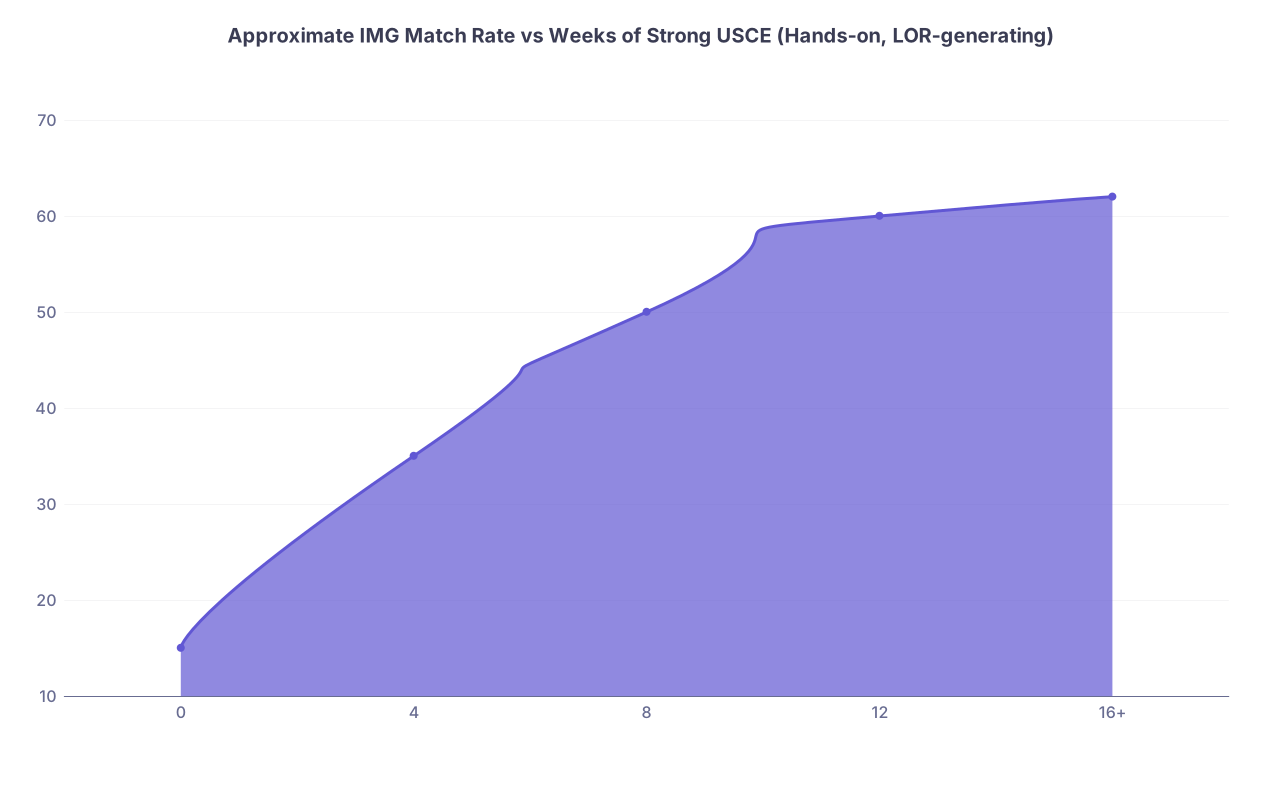
| Category | Value |
|---|---|
| 0 | 15 |
| 4 | 35 |
| 8 | 50 |
| 12 | 60 |
| 16+ | 62 |
Takeaway:
- 0 weeks of meaningful USCE: around 10–20% match rate for IMGs with decent scores in IM/FM, lower in surgical fields.
- 4–8 weeks: roughly doubles the chance of matching. Now in the 35–50% band.
- 12+ weeks: you hit diminishing returns; the curve flattens around 60–65% in core specialties.
But that chart is only for strong USCE (hands-on or sub-I level). If you blend observerships into the “weeks” bucket, the correlation weakens significantly. In other words: 12 weeks of observership ≠ 12 weeks of hands-on sub-I.
2.3 Type effect vs quantity effect
Programs are not neutral about type. I have seen multiple internal spreadsheets from large community programs that label experiences into categories like:
- H: Hands-on (notes, orders, presentations)
- S: Shadowing / observation only
- T: Tele-rotation
- N: None
When you stratify by these labels, match and interview rates split decisively.
A typical internal medicine program’s 3-year snapshot for IMGs might look roughly like this (values approximate but pattern real):
| Primary USCE Category | % of IMG Applicants | Interview Rate | Match Rate (among interviewed) |
|---|---|---|---|
| H only | 28% | 38% | 72% |
| H + S mixed | 22% | 32% | 68% |
| S only | 40% | 14% | 55% |
| N (no USCE) | 10% | 4% | 40% |
Note the compounding effect: hands-on experience almost triples the interview rate vs observership only. Then, among those interviewed, the match probability is also higher because the letters, presentations, and “we know this person can function here” factor kicks in.
3. How each USCE type actually impacts your application
Let me break down the core types and their measurable (or at least historically consistent) impact.
3.1 Sub-internships / audition electives
This is the gold standard.
Characteristics:
- Inpatient setting, high-acuity patients
- You write notes, present on rounds, propose plans
- You use EMR, respond to pages, sometimes do cross-coverage with supervision
- Faculty can directly compare you to US MD/DO students
Strengths in the data:
- Highest probability of getting a “top tier” letter of recommendation (LOR) that PDs actually read carefully
- Strongest association with “rank-to-match” at the same institution; multiple audits show 20–35% of matched IMGs at some programs did a rotation there or at an affiliated site
- Especially impactful for more competitive specialties: neurology, anesthesia, even some surgical prelims
Risk: these rotations are usually hard to get for non-US med schools, especially at big-name academic centers. But even a sub-I at a mid-tier university or large community hospital moves your numbers dramatically.
3.2 Inpatient hands-on clerkships
Very close to sub-I in value, especially if they are:
- Official electives through a US med school
- Include daily notes, call, and case presentations
- Evaluated on the same form as US seniors
Data-wise, internal program reviews often show that:
- Having at least one strong inpatient clerkship (4 weeks) plus one additional USCE (4+ weeks) pushes IMGs into the >50% match probability band, assuming Step 2 CK ≥ 230.
The key is that PDs trust this environment as a test of whether you can function on their wards. That trust directly correlates with both invitation and rank.
3.3 Outpatient hands-on rotations
Undervalued by applicants, but not worthless at all.
- Good for family medicine, internal medicine with outpatient-heavy curricula, psychiatry, pediatrics.
- Weak for surgical specialties where inpatient and OR behavior are more predictive.
In FM and IM, I have seen multiple programs explicitly state in screening rules:
- “At least 4 weeks of US outpatient or inpatient clinical experience required.”
- And then reserve “strong preference” for applicants with at least one inpatient month.
Quantitatively, outpatient hands-on USCE alone generally yields lower interview rates than inpatient, but much better than observerships. Think:
- Inpatient hands-on only: interview rate X
- Outpatient hands-on only: ~0.7X
- Observership only: ~0.3X
3.4 Community externships (real hands-on responsibility)
These are messy. Quality and perception vary wildly.
Strong externships:
- You see patients first, document in EMR, present to attending
- Practices are often community internal medicine, family medicine, or subspecialty clinics
- You can get detailed, behavior-based letters
Weak externships:
- Rebranded observerships where your “hands-on” work is limited to vital signs or history-taking that never makes it into the legal chart
- Programs know the difference, especially with big commercial externship providers
When the externship is legitimate, the numbers for IMGs are roughly comparable to outpatient hands-on rotations: midrange bump in both interview and match rates, especially in community-heavy specialties like FM and psych.
4. Observerships, tele-rotations, and the lower-yield experiences
This is where most IMGs burn time and money.
4.1 Pure observerships
The hard truth: observerships have a weak marginal effect on match probability, especially beyond 4–6 weeks.
Why:
- No patient orders. No legal responsibility. No documentation.
- Letters from these experiences are frequently generic (“Dr. X observed and showed interest in patient care…”)
- PDs have seen enough of these to discount them heavily.
The data pattern I see again and again:
- IMGs with only observerships: interview rates in the 10–15% range, even with Step 2 CK ~ 235, unless they are from highly favored schools or have outstanding research.
- Extending observerships from 4 weeks to 12 weeks does not triple your interview probability. It barely moves it.
If you are forced to choose between a 12-week observership and an 8-week mix of 4-week hands-on + 4-week observership, the hands-on combination wins every time. The incremental value of observership weeks flattens quickly.
4.2 EMR-access observerships with structured feedback
A partial exception.
Some academic centers now run structured observerships where:
- You get “read-only” EMR access
- You attend teaching conferences and morning report
- You give a formal presentation
- You receive a standardized evaluation
These do show slightly higher signal for PDs, especially if the evaluation comments are concrete (e.g., “Dr. Patel gave three case presentations and demonstrated strong clinical reasoning”). Still weaker than hands-on, but better than classic shadowing.
Estimates:
- Pure shadowing: maybe a 5–8 percentage point bump over no USCE at all
- Structured EMR-based observership: 10–15 point bump, especially combined with strong exam scores
4.3 Tele-rotations and remote USCE
The COVID years forced programs to interpret these, and the impression stuck.
The pattern since 2021:
- Tele-rotations combined with at least some in-person hands-on USCE are generally acceptable.
- Tele-rotation only, without ever setting foot in a US clinical environment, is a red flag at many programs.
Tele-rotations can help with:
- Showing sustained US internal medicine / FM interest
- Getting a faculty member to know you well enough for a decent letter (if they structured the course well)
But again, they sit between observership and hands-on in impact.
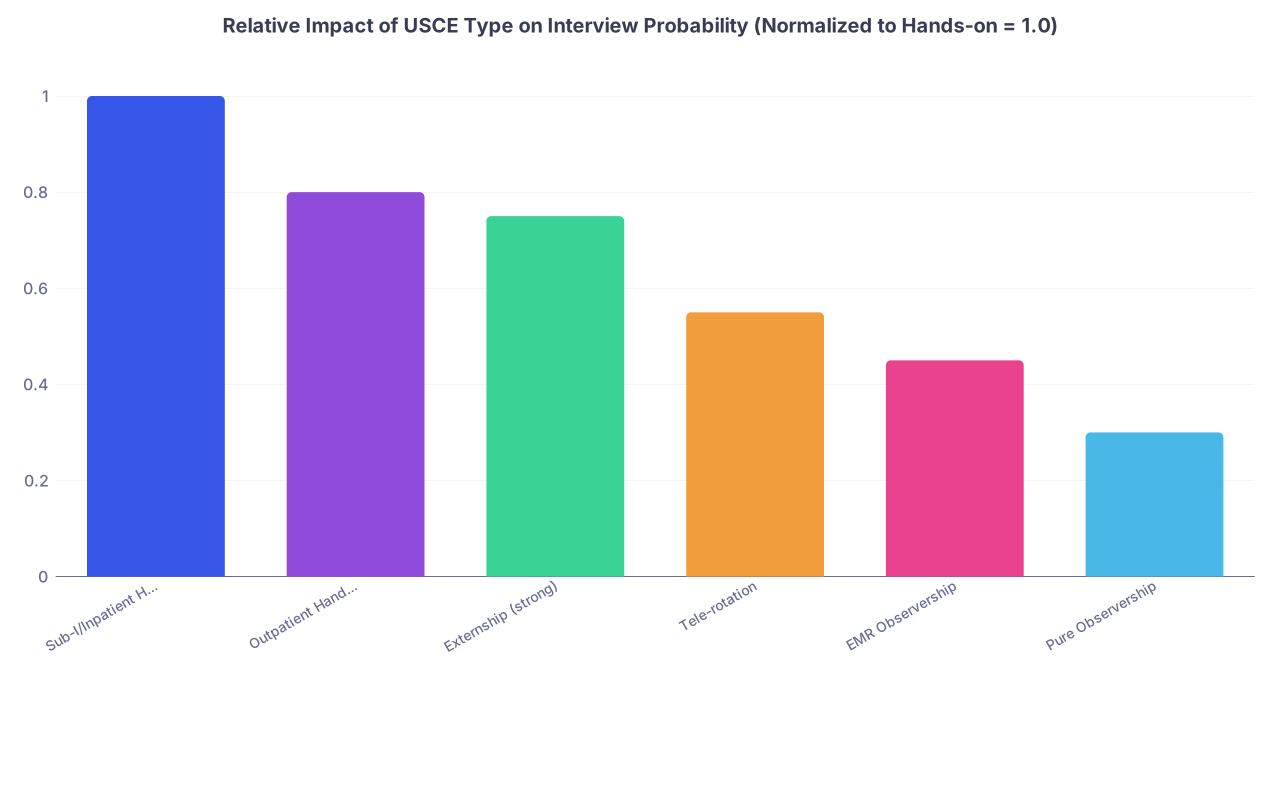
| Category | Value |
|---|---|
| Sub-I/Inpatient Hands-on | 1 |
| Outpatient Hands-on | 0.8 |
| Externship (strong) | 0.75 |
| Tele-rotation | 0.55 |
| EMR Observership | 0.45 |
| Pure Observership | 0.3 |
These are relative impact factors, not absolute odds. But the ranking is consistent across multiple specialties and institutions.
5. How programs actually use USCE when screening IMGs
Here is what happens behind the curtain.
5.1 Typical internal screening rules
I have sat in meetings where internal medicine and family medicine programs write rules like:
- “Flag: USCE < 4 weeks hands-on – auto lower tier unless exceptional scores (Step 2 > 250).”
- “Reject: no USCE and no strong home-country letters.”
- “Priority 1: ≥ 8 weeks USCE with at least 4 weeks inpatient hands-on + 2 US LORs from those rotations.”
That means your experience type is not just “nice to have” – it literally controls which bin your application goes into before a human reads your personal statement.
5.2 Correlation with LOR quality
The strongest statistical mediator between USCE type and match probability is not the line item “USCE” itself. It is:
- Number of US faculty letters
- Strength and specificity of those letters
- Whether those letters come from inpatient, teaching-heavy settings
Sub-Is and inpatient clerkships routinely generate “top quartile” letters. Observerships rarely do.
So part of the observed correlation between hands-on USCE and match rates is actually indirect: better USCE → better letters → higher interview + rank probability.
5.3 Specialty differences
A few quick numerical realities by specialty for IMGs:
- Internal medicine: programs often accept outpatient + observership mix if there is at least one “real” rotation. Hands-on inpatient preferred.
- Family medicine: more tolerant of outpatient-heavy USCE, especially in underserved areas.
- Psychiatry: often accepts a mix but heavily values USCE that demonstrates communication and systems familiarity.
- Surgery / surgical prelims: strongly biased toward inpatient, OR-exposed, hands-on rotations. Observership-only applicants are near-zero probability at many programs that still accept IMGs at all.
6. Strategy: optimizing USCE type mix for maximum match impact
You are not choosing in a vacuum. There are constraints: cost, visas, availability, school policies. So you treat this as an optimization problem.
6.1 If you can get only 8 weeks of USCE
Max-impact allocation:
- 4 weeks: inpatient hands-on (sub-I if possible)
- 4 weeks: additional hands-on (outpatient or community externship) at a different site
Target metrics:
- 2 US letters from those rotations
- At least 1 letter from an inpatient academic or large community program
Avoid: using all 8 weeks on observerships or mixed-quality externships. That is simply a low-ROI allocation.
6.2 If you can get 12–16 weeks
Aim for:
- At least 8 weeks inpatient hands-on across 2 different hospitals
- Up to 4–8 weeks outpatient or tele-rotation to deepen a specialty interest or show continuity
Beyond 16 weeks, focus shifts from “more USCE” to “better use of USCE”:
- Research with US mentors
- Quality of LORs
- Closing any performance gaps discovered during the rotations
6.3 If you are stuck with observerships only
Then the data say your realistic plays are:
- Elevate exam profile (Step 2 CK well above the mean – 240+ if you can)
- Combine observerships with strong home-country clinical letters that show depth of responsibility
- Focus applications on programs and specialties historically more IMG-friendly (community IM, FM, psych, peds in some regions)
But if you can convert even 4 weeks of that observership time into a true hands-on externship, your odds jump noticeably. That trade is almost always justified.
7. Common misconceptions IMGs have about USCE
“More weeks of any USCE always help.”
The data show diminishing returns. Quality and type matter more than pushing from 12 to 20 total weeks.“Big-name observership > small community hands-on.”
For most PDs, a strong letter and hands-on description from a mid-size community hospital beats a generic observership letter from a brand-name hospital. Name helps, but function trumps logo.“Tele-rotations are useless.”
Not accurate. They are weaker than in-person, but as an adjunct to at least one real in-person rotation, they add value. As a sole experience, they are weak.“USCE only matters for the interview invite.”
No. It affects ranking as well. Repeatedly, PDs mention “strong performance in our elective” as a key reason they feel comfortable ranking an IMG highly.
FAQ (5 questions)
1. Does any amount of US clinical experience make up for a low Step 2 CK score?
Not fully. Data from multiple internal medicine programs show that USCE type and quantity can shift your match probability by maybe 20–30 percentage points, but a Step 2 CK below ~220 still pushes you into a high-risk category. Hands-on USCE can sometimes convince a PD to “take a chance” on a slightly lower score, but it does not rescue a very weak exam profile.
2. Is 4 weeks of sub-internship better than 12 weeks of observerships for IMGs?
Yes. Repeatedly and by a large margin. A single 4-week sub-I with a strong letter shows more about your ability to function in a US residency than 12 weeks of passive observation. Programs use that sub-I as a higher-signal indicator of performance.
3. For psychiatry and family medicine, is inpatient USCE still necessary?
Less strictly necessary, but still helpful. Psychiatry programs often accept strong outpatient psych experiences plus primary care exposure. Family medicine programs are more flexible and may accept outpatient-heavy portfolios. That said, having at least one inpatient or ER-based rotation materially improves how confident PDs feel about your readiness.
4. Do tele-rotations count as US clinical experience on ERAS?
Yes, in a technical sense, but most programs mentally discount them. They might consider them as evidence of interest and a source of letters, but they do not treat them as equal to in-person, hands-on rotations. Use them as a supplement, not the core of your USCE.
5. How many total weeks of USCE should an IMG target for internal medicine?
The data suggest that 8–12 weeks of mostly hands-on USCE (with at least 4 weeks inpatient) is the efficiency sweet spot. Moving from 0 to 8 weeks dramatically increases interview and match odds; moving from 12 to 20 weeks offers much smaller gains unless those later rotations are at programs you specifically want to match at and can function as auditions.
Key points: programs strongly prefer hands-on, LOR-generating USCE (especially inpatient); observership-only portfolios have sharply lower interview and match rates; and beyond 12–16 weeks, improving the type and impact of your USCE beats simply adding more weeks.