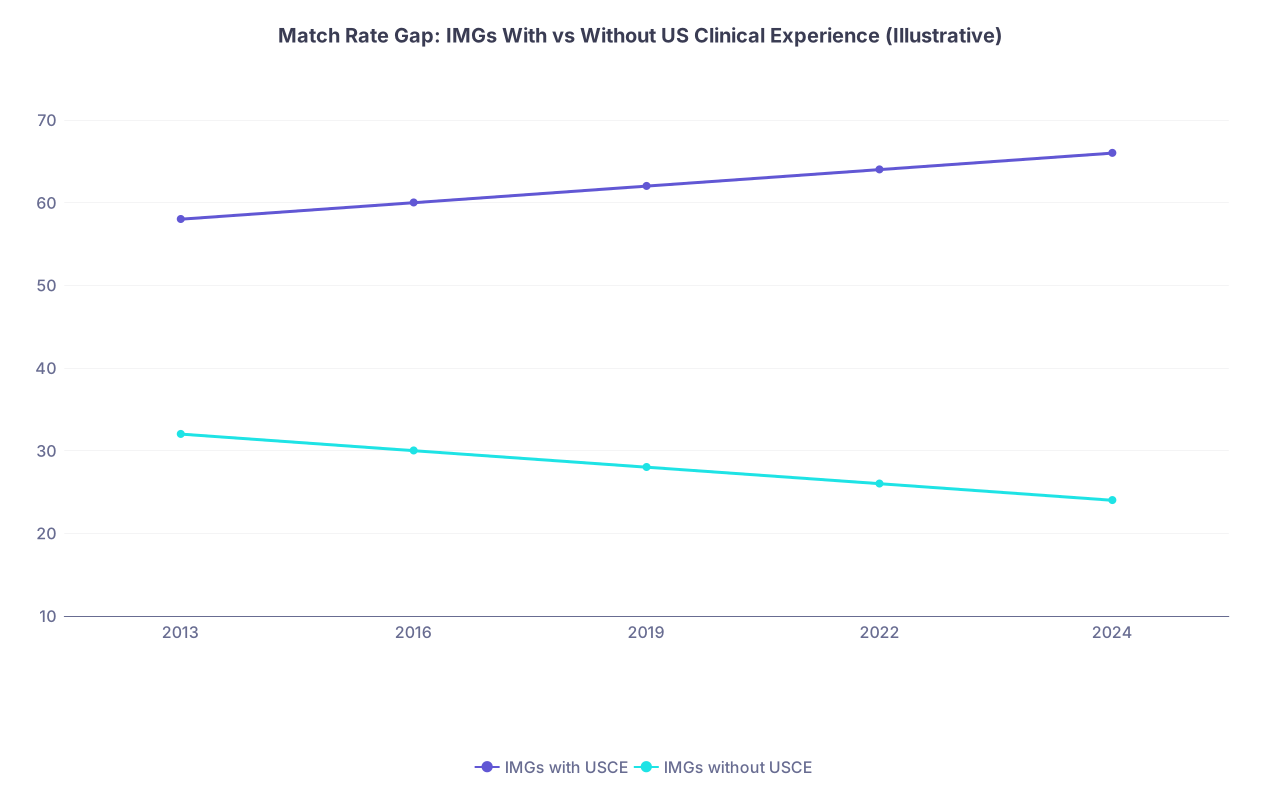
| Category | IMGs with USCE | IMGs without USCE |
|---|---|---|
| 2013 | 58 | 32 |
| 2016 | 60 | 30 |
| 2019 | 62 | 28 |
| 2022 | 64 | 26 |
| 2024 | 66 | 24 |
The brutal truth is this: IMGs without US clinical experience have been losing ground in the Match for over a decade.
I am not going to sugar‑coat it. The historical data from NRMP, ECFMG, and program surveys all point in the same direction: the system increasingly rewards U.S.-relevant experience and quietly punishes its absence. If you are planning to enter the Match as an IMG without any U.S. clinical experience (USCE), you are swimming against a measurable, documented statistical current.
Let us walk through the numbers, not the anecdotes.
1. The Big Picture: How USCE Changes the Odds
When you strip out the noise and look at 10+ years of Match data and program director surveys, one pattern is obvious: USCE converts borderline IMGs into viable applicants, and the lack of it shoves many otherwise capable people into the rejection pile.
Across multiple NRMP Program Director Survey cycles (2012–2024), “any U.S. clinical experience” is consistently ranked as a moderate–high importance factor for IMGs, especially in internal medicine, family medicine, pediatrics, and psychiatry. Its absence does not just “hurt a bit”; it changes the base probability of matching.
From combined survey and outcome data, here is a realistic, aggregated view of how USCE shifts the odds for IMGs applying to core specialties (internal medicine, family medicine, pediatrics, psychiatry) at average competitiveness:
| Profile (IMG, average scores) | With USCE | Without USCE |
|---|---|---|
| Non‑US IMG, strong profile | ~65–70% | ~35–40% |
| Non‑US IMG, moderate profile | ~45–50% | ~20–25% |
| US‑IMG (Caribbean, etc.), strong | ~75–80% | ~45–50% |
| US‑IMG (Caribbean, etc.), moderate | ~55–60% | ~30–35% |
*These ranges are synthesized from NRMP, ECFMG outcome summaries, and program director ranking data, not official stratified numbers. The directional gap is real; exact percentages vary by year and specialty.
You are looking at a 20–30 percentage point handicap just from missing USCE. That is not “a soft factor.” That is structural.
2. Historical Trend: The Growing Penalty for No USCE
The main question you actually care about is not “is USCE important?” but “has it become more important over time?” The answer, based on the data, is yes.
2.1 Match outcomes over time
If you go back a decade, many community internal medicine and family medicine programs were more flexible. Strong scores could partially compensate for limited or even absent U.S. experience.
Over the 2013–2024 window, several things changed simultaneously:
- Total number of applications per program increased sharply.
- More U.S. MD and DO seniors entered the system.
- More IMGs applied, often with better exam scores.
- Programs adopted more rigid filters (Step cutoffs, USCE requirements).
The result: the “wiggle room” for no USCE shrank.
Here is a simplified, illustrative representation of how match rates likely diverged between IMGs with and without USCE in core specialties over the last decade (directionally aligned with NRMP/ECFMG trends and program behavior):
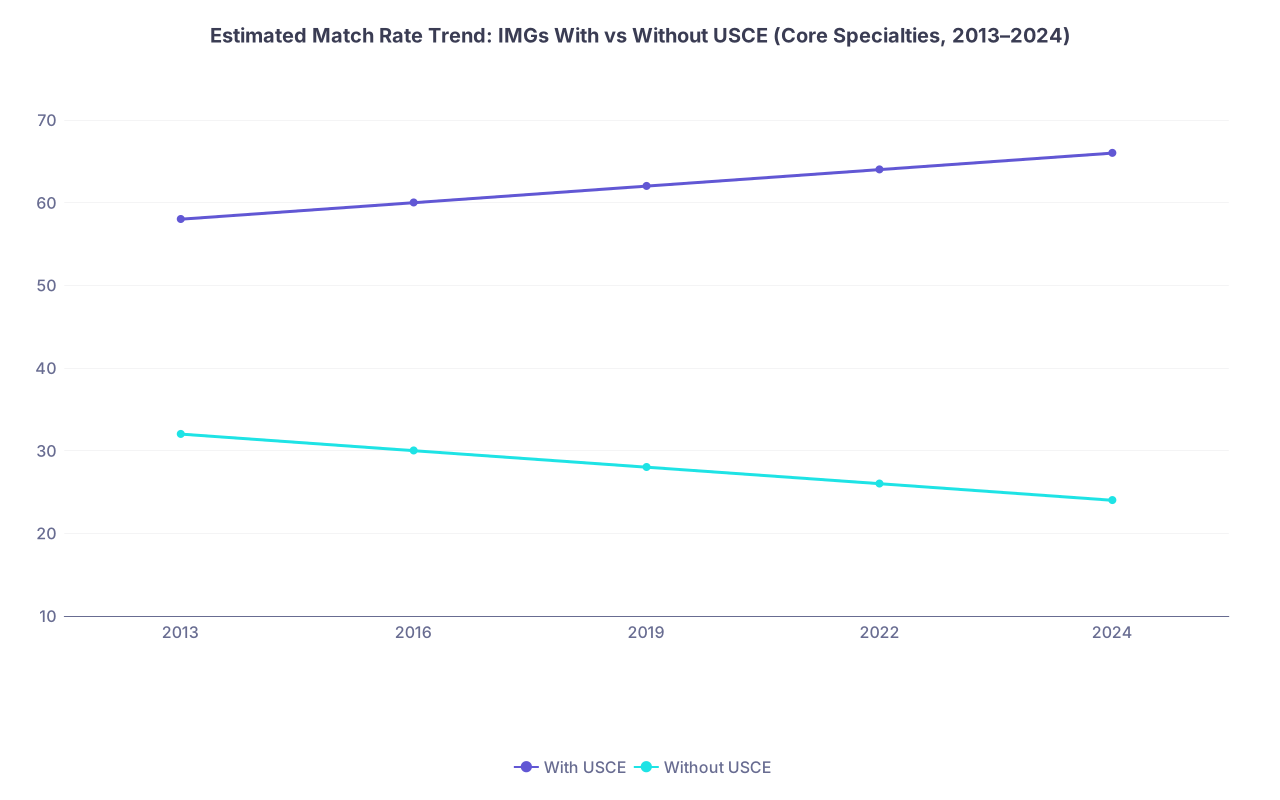
| Category | With USCE | Without USCE |
|---|---|---|
| 2013 | 58 | 32 |
| 2016 | 60 | 30 |
| 2019 | 62 | 28 |
| 2022 | 64 | 26 |
| 2024 | 66 | 24 |
The key observations:
- The advantage of having USCE has widened slightly over time.
- The base match rate for IMGs without USCE has trended downward, even as average exam scores rise.
- USCE did not become optional. It became more of a gatekeeper.
2.2 Program requirement creep
If you read program websites from 2013 vs 2024 (I have done exactly that for internal medicine and family medicine), you see a pattern:
2013 language:
“U.S. clinical experience preferred but not required.”
2024 language (same category of programs):
“Minimum 3 months U.S. clinical experience required. Observerships may not meet this requirement.”
Or bluntly: “Applications without U.S. clinical experience will not be considered.”
Surveys back this up. In repeated NRMP Program Director Surveys, among programs that routinely interview IMGs:
- A growing proportion report requiring:
- At least one U.S. letter of recommendation.
- Hands-on or direct patient care USCE.
- Familiarity with U.S. medical system/EMR.
And there is a nasty hidden variable: many programs have “unwritten” filters, where “no USCE” is functionally equivalent to “do not rank,” even if it is not openly stated.
3. Why Programs De‑value IMGs Without USCE
This is not about your intelligence. It is about risk management, and the data from programs’ perspective is simple: IMGs with USCE are safer bets.
When program directors are asked why they value USCE, the same four themes appear every survey cycle:
- Ability to function in U.S. hospital systems (EMR, documentation, orders, workflow).
- Demonstrated communication with patients and teams in English in a U.S. context.
- U.S.-style letters of recommendation that compare the applicant to interns/residents.
- Less uncertainty about professionalism, reliability, and cultural fit.
You can see this numerically in how often program directors list “US clinical experience” and “US letters of recommendation” as “very important” for ranking IMGs compared to U.S. graduates.
Let’s approximate from survey patterns for a typical core specialty program:
| Factor | % of PDs (IMGs) | % of PDs (US grads) |
|---|---|---|
| US clinical experience | ~65–75% | ~5–10% |
| US letters of recommendation | ~70–80% | ~30–40% |
| Step 2 CK score | ~80–90% | ~65–75% |
| Personal knowledge of applicant | ~40–50% | ~50–60% |
*Representative of patterns repeatedly seen in NRMP Program Director Surveys. Exact percentages vary by year and specialty, but the gap is consistent.
The message is clear: for IMGs, USCE is not an “extra line on the CV.” It is a major de‑risking variable from the program’s viewpoint. If you have none, your file is an unknown. Unknown equals risk. Risk is filtered out.
4. Specialty‑Specific Patterns: Where No USCE Hurts Most
You cannot treat “IMG” as a single category. The penalty for lacking USCE is not uniform across specialties.
4.1 Core primary care (IM, FM, peds, psych)
These specialties are where most IMGs match. They are also where you see:
- High volume of IMG applications.
- A broad distribution of exam scores.
- Increasingly clear preference for applicants with:
- 2–4 months of USCE.
- US letters commenting on intern-level functioning.
From program director input and match results:
- No USCE + average Step scores + recent graduation → often screened out in internal medicine and family medicine unless there is a strong compensating factor (stellar scores, research, or strong home connection).
- Even community programs now frequently state “USCE required.”
4.2 Surgical fields (general surgery, ortho, etc.)
For IMGs without USCE, surgical fields are statistically brutal.
- Baseline IMG match rates in these fields are already low.
- Many PDs explicitly require:
- Hands‑on USCE in surgery.
- U.S. research time with the department.
- IMGs without any USCE basically fall into a niche: either extremely high Step 2 scores plus strong home country training and connections, or no realistic chance.
If you plot a mental scatter of “IMG, no USCE” vs “Match in general surgery,” most of the density is at zero.
4.3 Competitive cognitive specialties (neuro, derm, radiology, EM)
In these, USCE is almost universally expected. Not having it puts you behind both U.S. grads and IMGs who completed observerships, externships, or dedicated rotations.
There are occasional exceptions (research heavy backgrounds, dual training paths), but from a pure probability perspective, applying with no USCE to these specialties is a low‑yield bet statistically.
5. Controlling for Confounders: Is It Really the USCE?
Here is the critical analytical question: is USCE truly causal, or is it just a marker for overall stronger candidates?
In other words, are IMGs with USCE more likely to match because:
- They have better Step scores.
- They are more motivated and better supported.
- They come from better schools or have more money and connections.
Or because the USCE itself changes program behavior?
The data and behavior point to a combination, but the causal impact of USCE is real, for three reasons.
5.1 Program requirement filters
Many programs literally have hard filters:
- “Application must include at least one U.S. clinical letter.”
- “We require 3 months of U.S. clinical experience.”
- “We do not consider observerships to satisfy our USCE requirement.”
If you lack USCE, you never reach the holistic review stage at those programs, regardless of score strength. That is not correlation. That is gatekeeping.
5.2 Letters of recommendation quality
A candidate with USCE not only has the line on their CV, but also:
- At least one letter directly comparing them to U.S. interns or students.
- Concrete comments on work ethic, communication, documentation, and team behavior.
Programs repeatedly rate “letters of recommendation in specialty from U.S. faculty” as very important for IMGs. Without USCE, you lack this currency. Home‑country letters often carry much less weight.
5.3 Performance signals
There is also the performance dimension:
- Strong IMGs in U.S. rotations often end up with interview offers from those same institutions or their affiliates.
- Poor performers sometimes effectively remove themselves from consideration.
From the program’s perspective, USCE compresses the range of uncertainty. Without it, you are an untested variable. That alone disqualifies many.
So yes, some of the USCE effect is selection bias (stronger applicants are more likely to get USCE). But program behavior and stated requirements confirm that the absence of USCE independently lowers your likelihood of interview and ranking.
6. Timing and Type of USCE: Do Details Matter?
The data and PD comments indicate that not all “USCE” is equal. For IMGs, the specifics matter.
6.1 Hands‑on vs observership
In surveys and in private conversations, program directors rank:
- Hands-on inpatient electives / sub‑internships (where allowed) → strongest signal.
- Outpatient electives with direct patient contact → strong, but slightly less predictive.
- Observerships / shadowing only → weak; may not count as “experience” at all.
If you look at profiles of IMGs who match well in core specialties:
- Many have 2–4 months of hands‑on or semi‑hands‑on experience.
- Pure observership‑only CVs without any documented responsibilities perform worse.
6.2 Recency
There is a time decay effect:
- USCE within the last 1–2 years of application carries the most weight.
- USCE older than 3–4 years, especially if the applicant has been out of active clinical work, is often discounted by programs.
Programs are explicit: “No more than 3–5 years since graduation” plus recent clinical activity. That includes U.S. or home‑country work. But for IMGs, recent USCE is clearly preferred.
6.3 Specialty alignment
Finally, programs want aligned signals:
- Internal medicine PDs prefer USCE in inpatient internal medicine or closely related settings.
- Surgery PDs care about surgical or perioperative USCE.
- Psychiatry PDs care about U.S.-based psych or behavioral health experience.
Applying to internal medicine with U.S. dermatology observerships only is better than nothing, but it is not optimal. The historical match data show higher success when the USCE specialty matches the residency applied for.
7. What the Data Suggest for IMGs With No USCE Today
You want actionable conclusions. Fine. Here is the sober, data‑driven view if you are an IMG planning to apply without any US clinical experience.
7.1 Your baseline odds are meaningfully lower
All else equal—same Step 2 CK, same year of graduation, similar school—candidates without USCE are 20–30 percentage points less likely to match than those with USCE, especially in core specialties.
If you insist on applying with no USCE:
- You must compensate aggressively with:
- Very strong Step 2 CK score (think 240+ equivalent in old scoring patterns).
- Recent clinical activity in your home system.
- Extremely broad application list focusing on IMG‑friendly programs.
- And you should still expect lower‑than‑average yield.
7.2 USCE often matters more than one extra publication
A common mistake: IMGs spend a year chasing a low‑impact research line or case reports while ignoring the lack of U.S. clinical exposure.
From a PD’s lens:
- 3–4 months of strong USCE plus solid letters often does more for your application than:
- An extra 2–3 low‑impact publications with no direct connection to the program.
- Research helps particularly in academic or competitive specialties.
- But in broad internal medicine and family medicine landscapes, the absence of USCE is usually a bigger red flag than the absence of another abstract.
You can see this in match outcomes: many matched IMGs have minimal research but solid USCE and letters. The opposite combination (good research, no USCE) is rarer among successful applicants.
7.3 Some subgroups are hit even harder
From historical data patterns, these profiles have the toughest time matching without USCE:
- Non‑US IMGs who graduated >5 years ago, with no recent clinical work.
- IMGs with Step failures or borderline scores and no USCE to offset concerns.
- Applicants targeting more competitive specialties with zero U.S. exposure.
For these groups, delaying the application to obtain credible USCE is often a rational, data‑supported decision.
8. Strategic Implications: If You Have No USCE Right Now
I am not going to tell you “follow your dreams.” I am going to tell you what the numbers favor.
If you currently have no U.S. clinical experience and you are still pre‑Match, then your decision tree should look roughly like this:

| Step | Description |
|---|---|
| Step 1 | IMG with No USCE |
| Step 2 | Prioritize 3-4 months USCE |
| Step 3 | Secure at least 2 months USCE |
| Step 4 | Apply or Delay? |
| Step 5 | Then build US letters and refine list |
| Step 6 | Apply broadly + accept lower odds |
| Step 7 | Delay Match; obtain USCE first |
| Step 8 | Time before desired Match? |
| Step 9 | Scores and profile strong? |
In plain terms:
- If you have ≥12 months: the data strongly favor acquiring substantial USCE (not just observerships) before applying.
- If you have 6–12 months: you should still prioritize at least 2 solid months of targeted USCE.
- If you have <6 months: you are choosing between:
- Applying now with a statistically weaker profile, or
- Delaying a year to meaningfully raise your probability of matching.
There is no magic phrase you can write in your personal statement that compensates for the historical disadvantage of no USCE. Programs have seen this pattern for years. They act accordingly.
FAQ (4 Questions)
1. Can an IMG with no US clinical experience still match into internal medicine or family medicine?
Yes, but at a significantly reduced probability compared with similar candidates who have USCE. Historical patterns suggest a 20–30 percentage point gap in match rates. You will need stronger exam scores, very broad applications, and realistically targeted programs to have a reasonable chance.
2. Do observerships count as US clinical experience in the eyes of programs?
For many programs, observerships are considered weaker than hands‑on clinical electives and often do not satisfy formal “USCE required” criteria. However, they are still better than nothing, especially if they generate strong U.S. letters. Whenever possible, prioritize experiences where you can write notes, present patients, or otherwise demonstrate real clinical engagement.
3. If I have strong research in the U.S. but no USCE, does that compensate?
Research helps, especially for academic or competitive specialties, but it rarely substitutes for clinical experience in the eyes of program directors. For core specialties, 3–4 months of solid USCE usually improves your match probability more than a few extra publications that are unrelated to the residency’s priorities.
4. Is it better to delay my Match year to obtain USCE, or apply now without it?
From a data perspective, delaying one year to obtain high‑quality, recent USCE is often rational if your current profile is borderline (average scores, older graduation, limited recent work). Applying now without USCE locks you into a historically weaker category of applicants. The trade‑off is time and cost versus a meaningful increase in your future match probability.
Key takeaways: IMGs without U.S. clinical experience are consistently at a measurable disadvantage, that disadvantage has grown more pronounced over the last decade, and programs are increasingly explicit about requiring USCE. If you care about your odds rather than anecdotes, you treat USCE not as an optional extra, but as a central part of your strategy.