
The biggest mistake IMGs make is assuming good performance automatically becomes a good letter of recommendation. It does not. Strong LORs are built month by month, on purpose.
You are not just “doing USCE.” You are running a 4–6 month project whose final deliverable is 2–4 outstanding, specific, residency-level letters. I am going to walk you through that project step by step.
I will assume:
- You have 4–6 months before ERAS submission.
- You have at least one US clinical experience lined up (observership, externship, research + clinic, or elective).
- You want letters that actually move your application, not generic “hardworking and pleasant” fluff.
Overview Timeline: From First Day to ERAS Submission
Start by seeing the whole arc. Then we will go month by month, week by week.
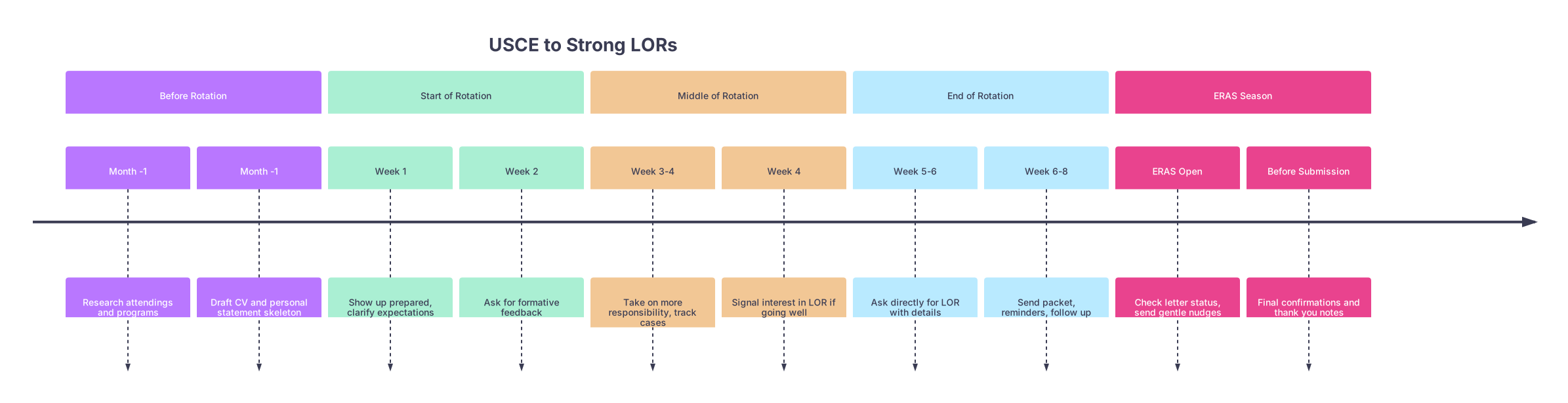
| Period | Event |
|---|---|
| Before Rotation - Month -1 | Research attendings and programs |
| Before Rotation - Month -1 | Draft CV and personal statement skeleton |
| Start of Rotation - Week 1 | Show up prepared, clarify expectations |
| Start of Rotation - Week 2 | Ask for formative feedback |
| Middle of Rotation - Week 3-4 | Take on more responsibility, track cases |
| Middle of Rotation - Week 4 | Signal interest in LOR if going well |
| End of Rotation - Week 5-6 | Ask directly for LOR with details |
| End of Rotation - Week 6-8 | Send packet, reminders, follow up |
| ERAS Season - ERAS Open | Check letter status, send gentle nudges |
| ERAS Season - Before Submission | Final confirmations and thank you notes |
Now let us break this into a clear month-by-month plan.
Month -1: Set Up Your USCE to Be LOR‑Friendly
At this point you should not be thinking, “I hope someone writes me a letter.” You should be designing your rotations around who can write letters and what they can legitimately say.
1. Choose rotations with letter potential
Prioritize:
- Supervising attendings who are:
- Core faculty
- Program directors (PDs) or associate PDs
- Clerkship directors
- Long-term attendings well-known in the department
- Settings where you can:
- Present patients
- Write notes (if externship / elective)
- Be observed repeatedly (not just shadowing in the back of the room)
- Interact with residents and fellows
Avoid:
- Rotations where you only follow residents with minimal attending contact.
- Pure “shadowing” with 10 students in the same room.
- Very short stints (1 week) that cannot justify a meaningful letter.
2. Prepare your “LOR kit”
By the end of this month you should have:
- A clean, updated CV (2 pages max)
- A working personal statement draft
- A one-page “Residency Target Sheet” with:
- Target specialty (e.g., Internal Medicine)
- Year you are applying
- List of key strengths you want highlighted (clinical reasoning, communication, work ethic, etc.)
- A simple list where you will track:
- Attending name
- Role (e.g., IM core faculty)
- Dates worked together
- Memorable cases / interactions
You are laying the foundation. Rotations start fast. If you do not prep now, you will be scrambling later.
Month 0: First Rotation – Build Observability and Trust
This is your first USCE month. Your main goal is not to impress by being perfect. It is to make your work visible and your growth obvious.

Week 1: Day 1–7 – Make yourself easy to evaluate
At this point you should:
Clarify expectations explicitly
On day 1 or 2, say to your main attending:“Dr Smith, I am an IMG planning to apply to Internal Medicine next cycle. I want to make the most of this rotation and improve as much as possible. How do you like students to function on your team?”
This does three things:
- Signals your residency goals.
- Gives permission for feedback.
- Plants the idea that you are on a trajectory toward letters.
Show baseline competence and reliability
- Be early. Every day.
- Have a small notebook. Write things down.
- After each new patient encounter, be ready with:
- 1–2 sentence summary
- Focused assessment and plan
- Do not present from memory if you are not ready. Better to glance at organized notes than to ramble.
Make yourself useful to residents
- Offer to help with:
- Calling family for updates (if allowed)
- Following up on labs
- Printing / organizing materials for rounds
- Ask residents:
“What would be most helpful for me to do on this team today?”
- Offer to help with:
Week 2: Day 8–14 – Ask for formative feedback
This is where IMGs often fail. They work hard, but no one notices how much they improve because they never frame their own growth.
Mid-week, pull your attending aside:
“Dr Lee, we have now worked together for about a week. Could you share one thing I am doing well and one thing I should improve, so I can focus on it for the rest of the rotation?”
Then:
- Write down the feedback.
- Change visible behavior based on it.
- Later, say explicitly:
“I have been working on shortening my presentations like you recommended. Does this feel closer to what you prefer?”
You are building a story: “This student seeks feedback and improves rapidly.” That is sentence #2 in many good LORs.
End of Month 0: Decide who is “letter eligible”
By now you will have met several attendings. Not everyone is a good letter writer for you.
You should mark as “potential LOR writer” any attending who:
- Has seen you consistently for at least 2 weeks.
- Has given you feedback at least once.
- Has seen you present or interact with patients.
Do not worry about asking yet. That comes later.
Month 1: Deepen Clinical Impact and Create “Stories” for Letters
Now you are known. Your badge is familiar. People have expectations. Time to give them concrete moments they can later write about.
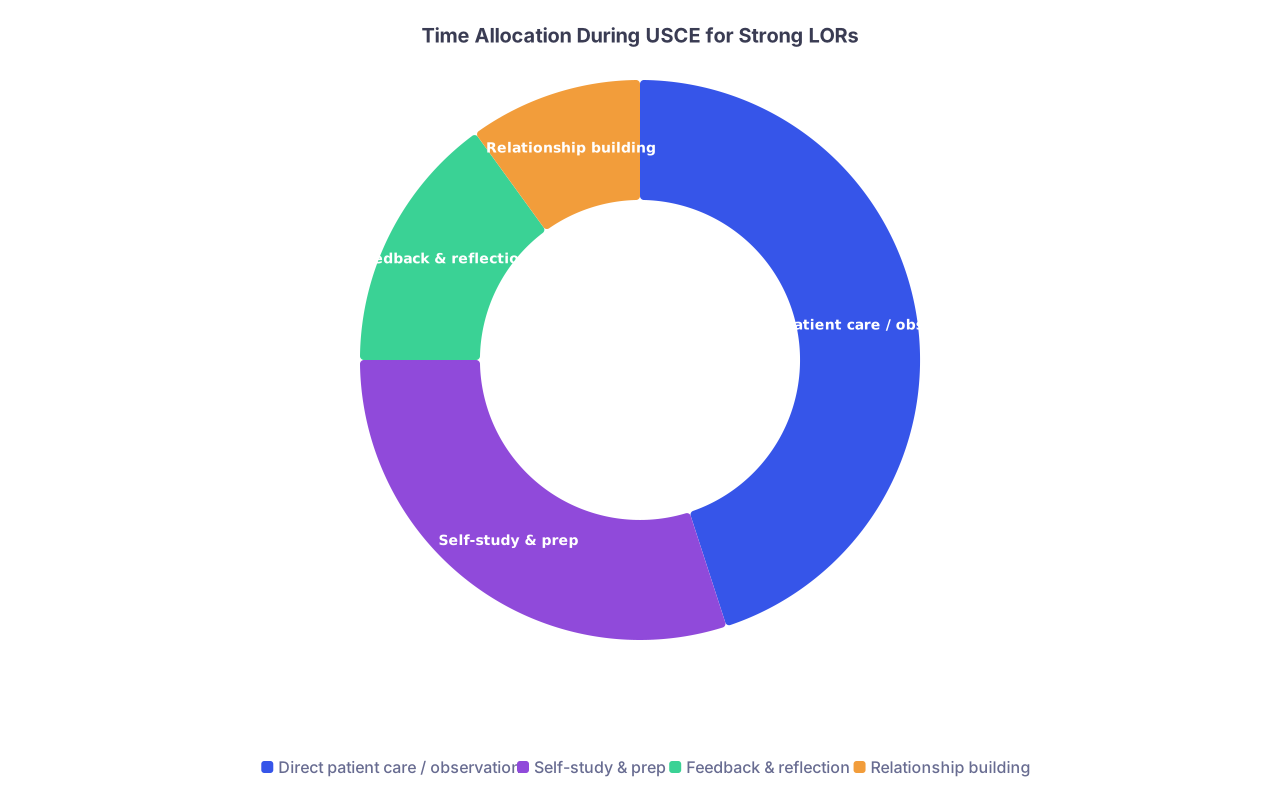
| Category | Value |
|---|---|
| Direct patient care / observation | 45 |
| Self-study & prep | 30 |
| Feedback & reflection | 15 |
| Relationship building | 10 |
Weeks 1–2 of Month 1: Own specific patients / tasks
At this point you should be:
- Following 2–4 patients closely (if allowed):
- Knowing their meds, overnight events, pending labs.
- Anticipating what your attending will ask on rounds.
- Volunteering for recurring tasks:
- Daily med recs.
- Discharge education.
- Follow-up phone calls under supervision.
Your goal is to create at least 2–3 “memorable stories”:
- The complicated heart failure patient where you caught an important detail.
- The non-English speaking patient you connected with using an interpreter.
- The combative patient who calmed down because you took time to listen.
These are the stories that become:
“For example, during our service, Dr X identified early sepsis in a patient whose presentation was initially subtle…”
Week 3: Start signaling LOR interest (soft signal)
You do not ask for a letter yet. You do make your trajectory clear.
Short conversation with a strong attending:
“Dr Hernandez, I have really appreciated working with you this month. I am planning to apply to Family Medicine this September. I am trying to grow into someone who would be a strong resident here. If you see specific areas I should focus on during the rest of the rotation to reach that level, I would be grateful for your guidance.”
Why this works:
- You respect their standard (“strong resident here”).
- You hint you are seeking residency-level endorsement.
- You invite targeted feedback, which creates more observable growth.
Week 4: Ask for summative feedback
End of this month, you want a sense of whether a strong letter is realistic.
Ask:
“We have now worked together for most of this rotation. From your perspective, am I functioning at the level you would expect from a strong future resident in this specialty? Any specific skills I should push further in the next couple of weeks?”
Listen carefully.
- If they respond with enthusiasm and concrete positives: this is a prime LOR candidate.
- If they are vague or lukewarm: they might write a neutral letter. Put them lower on your list.
Month 2: Convert Performance into Commitments
This is the month you actually secure the promises. Too many IMGs leave rotations with “Sure, I can probably do that” instead of “Yes, I will write you a strong letter for ERAS.”

Week 1 of Month 2: Track your highlights
You should now start building your “LOR talking points” document for each attending:
- 3–5 specific patients or cases you managed with them.
- 1–2 examples of feedback you received and how you improved.
- Any presentations or mini-teaching you gave.
- Any research / QI / extra initiative you took.
Keep it short, bullet-style. This will later go in the email you send when you formally request the letter.
Week 2: Choose your top 2–4 attendings
Rank potential writers:
| Attending Type | Priority for IMGs | Reason Strength |
|---|---|---|
| Program Director / APD | Highest | Directly involved in selection |
| Core Faculty (same field) | High | Knows resident expectations |
| Clerkship Director | High | Seen many students, letter carries weight |
| Community Attending | Medium | Good if strong, but less name power |
| Fellow / Resident only | Low | Cannot usually upload as official author |
Pick:
- 1–2 letters from academic or core faculty in your target specialty.
- 1 from another US specialty that saw your work ethic and professionalism.
- Optional: 1 research mentor if they can comment on work habits and communication.
Week 3: Ask directly, in person if possible
At this point you should explicitly ask. Face-to-face first.
Script:
“Dr Patel, I have really valued working with you these past weeks, especially on patients like Mr Johnson with the complex diabetes. I am applying to Internal Medicine this September and would be honored if you would consider writing a strong letter of recommendation for my residency applications.”
Then pause. Let them answer.
You are listening for:
- “Yes, I would be happy to write you a strong letter.” → Good.
- “I can write you a letter” (without “strong”) + hesitation → Might be lukewarm. Better than nothing, but not ideal.
- “I do not think I know you well enough” → Accept gracefully and thank them. Do not push.
If yes, follow with:
“Thank you, I really appreciate it. ERAS will send you an electronic request, but I can also email you my CV, personal statement draft, and a brief summary of our work together, if that would be helpful.”
Almost all attendings will say yes to that.
Week 4: Send the follow-up “LOR packet” email
Within 24–48 hours, send a concise email.
Subject: Letter of Recommendation for [Your Name] – Internal Medicine Residency
Body outline:
- Thank them again.
- Remind them of timeline (e.g., “ERAS opens in June; I plan to submit in September.”).
- Attach:
- CV
- Personal statement draft
- One-page bullet list of:
- Dates of rotation
- Your role (observership, externship, sub‑I)
- 3–5 specific cases / stories
- Strengths you hope they might comment on (worded respectfully, not as demands)
This is where you quietly shape the content of the letter without ever telling them what to write.
Month 3: Manage Logistics and Protect Deadlines
By now you have verbal commitments. Your job shifts from “earn the letter” to “make sure it gets written and uploaded on time.”
Week 1: ERAS letter slots and identifiers
At this point you should:
- Create your ERAS account (if available for your season).
- Add each letter writer with:
- Correct full name and title
- Institutional affiliation
- Generate the LOR request forms / links.
Double-check emails and titles. I have seen letters mis-assigned because of simple spelling errors.
Week 2: Send formal ERAS requests
Email your attendings again, this time with the ERAS link or form.
Short email:
Dear Dr Kim,
Thank you again for agreeing to write a strong letter of recommendation for my Internal Medicine residency applications.
I have now added you as a letter writer in ERAS. You should receive an email from ERAS with a secure link for uploading the letter.
My application submission target is [date], so a letter upload by [2–3 weeks before that date] would be ideal, if your schedule allows.
Thank you again for your support.
Sincerely,
[Your Name]
Notice: you give a soft deadline a couple of weeks before you truly need it.
Week 3–4: Light reminders, not harassment
If you see “Not Received” in ERAS 2–3 weeks after sending:
- First, check spam / junk folder with your attending’s admin if possible.
- Then send a polite, brief reminder:
Dear Dr Lopez,
I hope you are doing well. I wanted to gently follow up regarding the residency letter of recommendation. ERAS still shows it as not yet received, and I know your schedule is very busy.
My target submission date is [date], so a letter upload by [one week from now] would be very helpful, if feasible.
Thank you again for your time and support.
Best regards,
[Your Name]
Do not send reminders every three days. That just annoys people.
Month 4 and Onward: Final Checks, Updates, and Professionalism
You are nearing application season. The letters that exist now are mostly what programs will see.
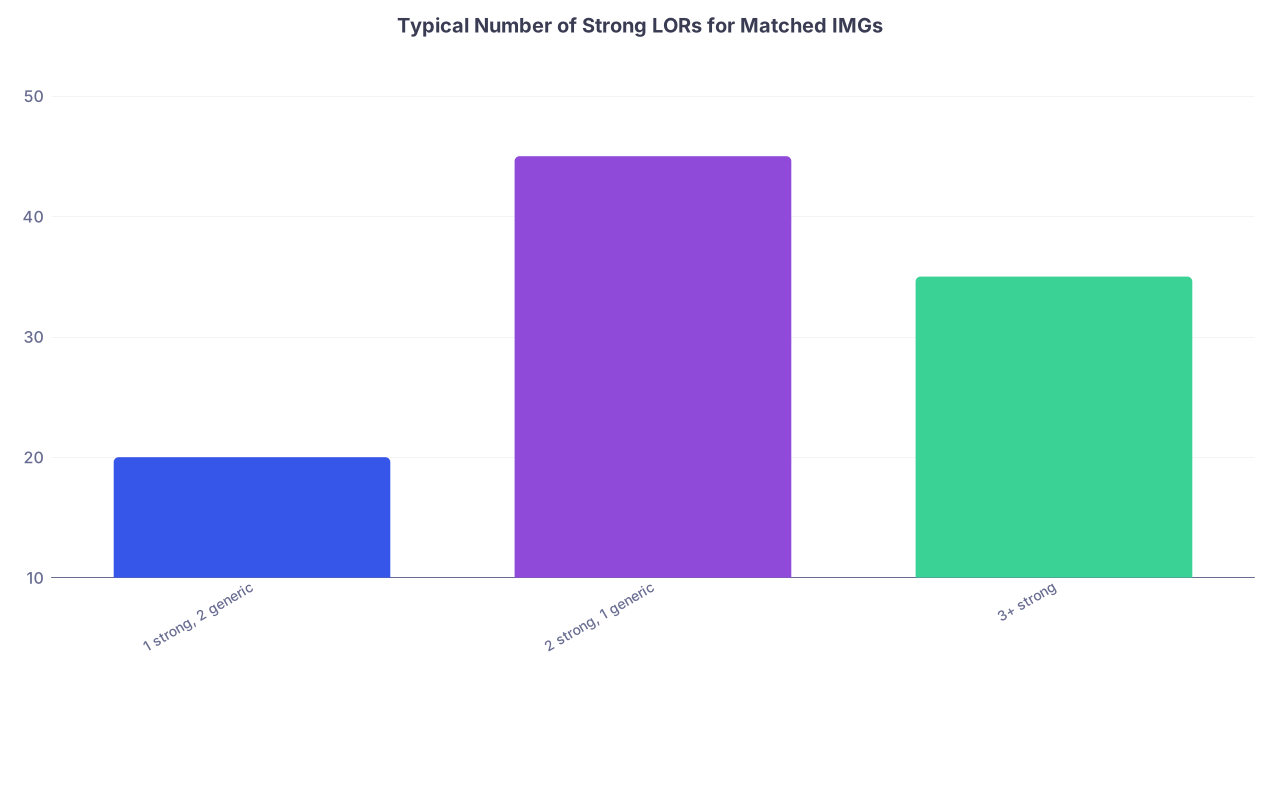
| Category | Value |
|---|---|
| 1 strong, 2 generic | 20 |
| 2 strong, 1 generic | 45 |
| 3+ strong | 35 |
Early in Month 4: Verify and plug gaps
You should:
- Log into ERAS and verify:
- Which letters are “Received”
- Which are “Not Received”
- Decide if you need a backup writer:
- If one attending is unresponsive and you still have another rotation ongoing, consciously invest in that current attending as a potential extra letter.
If a very strong attending has not uploaded the letter but you know they intend to, it is usually worth one more reminder 10–14 days before your final submission date.
Late Month 4: Maintain relationships
Even after letters are uploaded:
- Send a short thank-you email after your ERAS submission:
“I wanted to let you know that I have now submitted my ERAS application and included your letter for my Internal Medicine programs. Thank you again for your support and mentorship.”
- Later, when interview invitations come in:
- It is smart to send a quick update to your strongest letter writers. They often enjoy hearing where you are interviewing.
- After Match Day:
- One more email: where you matched, your gratitude. This keeps doors open for future fellowship letters or networking.
Daily / Weekly Habits That Quietly Strengthen Letters
Across all these months, a few consistent behaviors get mentioned again and again in strong LORs for IMGs:
- Daily:
- Look up each new diagnosis you see. Read at least one UpToDate or guideline summary.
- Prepare one question per day to ask your attending or resident, showing you are thinking at a higher level than just “what is the dose.”
- Weekly:
- Ask for mini-feedback: “Is there one thing I can do better on rounds this week?”
- Write down one patient story that shows your communication or reasoning skills.
- Once per rotation:
- Give a brief 5–10 minute presentation on a topic relevant to your patients.
- Attendings love: concise, organized, clinically anchored teaching.
- These often make it into letters.
- Give a brief 5–10 minute presentation on a topic relevant to your patients.
You are essentially feeding your future letter writer material without ever saying it out loud.
Red Flags That Turn into Weak LORs (Catch These Early)
If, during any month, you notice:
- Attendings barely know your name after 2 weeks.
- You are constantly late or disappear without telling anyone.
- You never ask questions or seem intellectually curious.
- Nurses avoid you or complain about your communication.
Then at this point you should:
- Stop assuming this rotation will give you a strong letter.
- Fix what you can immediately (punctuality, communication).
- Consciously aim your letter strategy toward other rotations or mentors.
I have seen too many IMGs cling to a “maybe” letter from an indifferent attending instead of investing in someone who actually believes in them.
Put It All Together: Your LOR Conversion Blueprint
To make this painfully clear, here is the practical arc:
Month -1
- Choose rotations + attendings with real letter potential.
- Prepare CV, personal statement draft, and tracking sheet.
Month 0
- Make yourself visible and reliable.
- Ask for early feedback and show you can improve.
Month 1
- Create memorable clinical stories.
- Signal your residency plans and openness to guidance.
- Get summative feedback to gauge enthusiasm.
Month 2
- Identify top 2–4 attendings.
- Ask explicitly for “strong” letters.
- Send tailored LOR packets with cases and highlights.
Month 3
- Set up ERAS slots and send official requests.
- Use respectful reminders and clear soft deadlines.
Month 4+
- Confirm uploads.
- Maintain relationships with thank-you notes and updates.
Strong LORs for IMGs are rarely accidents. They are the predictable output of this kind of deliberate, month-by-month work.
Today’s step: open a blank document and create your “LOR Target List” with three columns—Attending Name, Role/Program, and Specific Cases I Want Them to Remember. Fill in everything you know now, and you will already be ahead of most IMGs starting USCE next month.