
The biggest mistake IMGs make is stacking US clinical experience randomly and hoping program directors “get it.” They do not. Timing and sequencing matter as much as the experience itself.
You are not just collecting rotations. You are building a story on a clock. If you are serious about the Match, you need to treat your home-country and US clinical experience like a Gantt chart, not a scrapbook.
Below is the practical, time-based guide I wish most IMGs had two years before they applied.
First, Know What You’re Solving For
Before we go month‑by‑month, anchor the core problem.
Residency programs care about three things with your clinical experience:
- Recency – What have you done in the last 6–12 months?
- Relevance – Is it in the US system? In the specialty you are applying for?
- Continuity – Are there unexplained gaps or erratic jumps?
Your timeline has to:
- Keep continuous, explainable clinical activity (home or US)
- Layer US clinical experience (USCE) close enough to ERAS submission to be “fresh”
- Generate US-based letters of recommendation (LoRs) in time to upload before programs start reviewing
If your rotations are excellent but your timing is off, you will look outdated, unfocused, or both.
High-Level Timeline: 24 Months Before Match to Match Day
Assume a September ERAS submission and March Match Day. Adjust by 3–6 months if you are ahead or behind, but the sequencing logic stays the same.
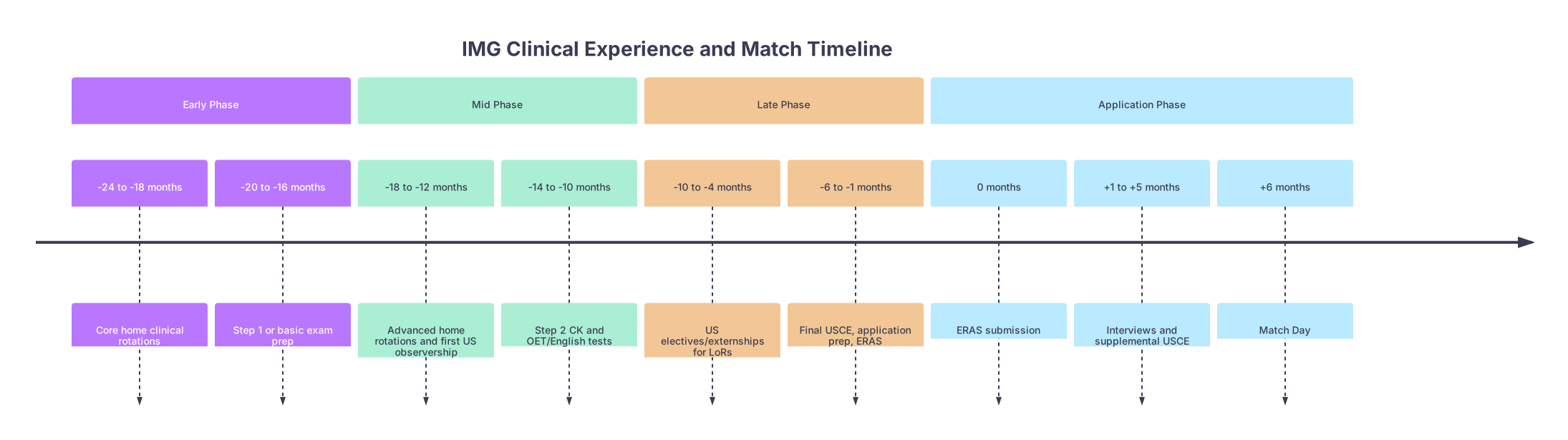
| Period | Event |
|---|---|
| Early Phase - -24 to -18 months | Core home clinical rotations |
| Early Phase - -20 to -16 months | Step 1 or basic exam prep |
| Mid Phase - -18 to -12 months | Advanced home rotations and first US observership |
| Mid Phase - -14 to -10 months | Step 2 CK and OET/English tests |
| Late Phase - -10 to -4 months | US electives/externships for LoRs |
| Late Phase - -6 to -1 months | Final USCE, application prep, ERAS |
| Application Phase - 0 months | ERAS submission |
| Application Phase - +1 to +5 months | Interviews and supplemental USCE |
| Application Phase - +6 months | Match Day |
We will walk this in detail.
18–24 Months Before ERAS: Build Your Clinical Foundation at Home
At this point you should focus almost entirely on strong, continuous home-country clinical experience and exam planning. USCE is tempting, but if you chase it too early you waste the “recency” window.
Your goals in this phase:
- No major clinical gaps on your CV
- Strong evaluations and potential LoR writers in your home country
- Enough exposure to choose a specialty direction (IM, FM, neuro, etc.)
What you should be doing month‑by‑month
Months -24 to -20
- Complete core rotations in:
- Internal Medicine
- Surgery
- Pediatrics
- OB/GYN
- Psychiatry
- Ask attendings about:
- Detailed feedback
- Future letters if things go well (“Doctor, I am planning for US residency. If I continue to perform at this level, may I approach you later for a letter?”)
Months -20 to -18
- Start USMLE Step 1 / foundational exam prep (or Step 2 if Step 1 is already done / pass-fail in your context).
- Keep at least half-time clinical activity:
- Outpatient clinics
- Ward duties
- Emergency shifts
- Avoid:
- Long, unexplained 6–12 month gaps “only studying” unless your scores are stellar. Programs hate ghost years.
At this stage, USCE is not urgent. Your home experience is doing the heavy lifting to show you are a real clinician, not just a test-taker.
12–18 Months Before ERAS: Transition Phase – Still Home-Heavy, Start US Exposure
At this point you should transition from pure home experience to a hybrid: still mostly home-based, but with your first US exposure if possible.
Your exams and your first US contacts start here.
Primary goals:
- Finish or be close to Step 1
- Start Step 2 CK prep
- Get 1–2 home-country LoRs
- Add 1 brief US observership or remote experience to show US interest
Month‑by‑month structure
Months -18 to -16
- Finish intensive prep for Step 1 (if relevant) or move into Step 2 CK content.
- Clinically:
- Advanced rotations or sub-specialty home rotations in your target specialty
- Example: If aiming for internal medicine, rotate through:
- Cardiology
- Gastroenterology
- Nephrology
- Identify 2–3 home attendings for LoRs.
Months -16 to -14
- Sit for Step 1 (if needed).
- Immediately revert back to visible clinical work:
- Hospitalist assistant, junior doctor posts, or internship
- Document everything with dates, departments, and supervising physicians
- Plan one short US observership (2–4 weeks):
- Non-core but related specialty is fine (e.g., IM observership at a community hospital, outpatient clinic in FM).
Why only an observership now?
Because the powerful, LoR-generating USCE needs to sit within 3–8 months of ERAS submission. Anything earlier risks going “stale” in the eyes of reviewers. This early observership is mainly a signal of interest and a learning experience for you.
6–12 Months Before ERAS: The Critical USCE Window
This is where most IMGs either build a compelling story or wreck it.
At this point you should:
- Have Step 1 (if required) and Step 2 CK scheduled or done
- Have OET/TOEFL/IELTS on your radar if required
- Shift clinical focus heavily toward USCE that will yield LoRs
- Maintain at least some ongoing home clinical activity around your US blocks
Ideal clinical sequencing in this phase
You want back-to-back or closely spaced US rotations that:
- Are in your chosen specialty or a closely related field
- Have attendings familiar with writing US residency LoRs
- Finish no later than 1–2 months before ERAS submission so letters can be uploaded
| Month Range | Primary Focus | Location |
|---|---|---|
| -10 to -8 | Home specialty rotation + CK | Home country |
| -8 to -6 | First major US elective | US |
| -6 to -4 | Second US elective/externship | US |
| -4 to -3 | Return to home clinical work | Home country |
| -3 to -1 | Final short USCE + LoR push | US |
Months -12 to -10
- Take Step 2 CK or at least schedule it so your score posts before or close to ERAS.
- While studying, do not fully stop clinical work:
- 1–2 days per week outpatient
- Or part-time ward coverage
Programs are much more forgiving of “reduced clinical time for exams” than of zero activity.
Months -10 to -8
First major US clinical rotation (ideally hands-on if possible):
- Best options:
- Electives during final year (if still a student)
- Externships with direct patient contact (for graduates, where allowed)
- Focus:
- Core specialty you will apply for (e.g., Internal Medicine elective for IM applicants)
- Start building LoR #1:
- By week 3, ask your attending if they feel comfortable writing a “strong letter” if your performance continues. Do not wait until the last day.
If you cannot travel yet, use this window for:
- Tele-rotations with US physicians
- Structured US-like experience (e.g., chart review, virtual clinics)
These are weaker than in-person USCE, but they beat having nothing.
Months -8 to -6
Second USCE block:
- Aim for:
- A different institution or department to show breadth
- Another potential LoR writer
- Try to vary settings:
- If first was big academic center, second could be a strong community hospital
- This is your chance for LoR #2 (and sometimes #3).
By the end of this period, a competitive IMG targeting IM or FM often has:
- 2–3 solid US LoRs
- 1–2 home-country LoRs (you will pick the best 1–2 for ERAS)
Months -6 to -4
At this point you should return to home-country clinical work to avoid a US-only bubble and any obvious gaps.
- Work as:
- Junior doctor
- House officer
- MO/resident in training
- Ideally in the same specialty as your USCE.
Use this time to:
- Strengthen your clinical narrative:
- “I applied IM principles across two systems: X hospital in India and Y community hospital in New York.”
- Clean up CV, start ERAS draft, and outline your Personal Statement with specific USCE examples.
Months -4 to -1
This is your final USCE pass before ERAS goes live.
- If you already have strong US LoRs (2–3), this block can be:
- Shorter (2–4 weeks)
- Focused on a slightly different setting (e.g., ICU, outpatient, subspecialty)
- If you still lack strong LoRs:
- Book one more substantial rotation (4–8 weeks) with a known LoR-friendly mentor or program.
You want your last USCE to end:
- No later than early August for a mid‑September ERAS submission
- So letters can be written, uploaded, and processed
ERAS Submission Month (0): How Your Timeline Looks to a PD
On ERAS day, a program director sees dates, not your intentions. Your sequence should read clearly:
- Continuous clinical involvement
- USCE clustered in the last 6–10 months
- Specialty consistency
Here is how a strong combined timeline typically appears on CV:
| Period | Experience Type | Location |
|---|---|---|
| 2019–2021 | Core rotations | Home country |
| 2021–2022 | Internship / junior doc | Home country |
| Jan–Feb 2023 | IM observership | US |
| May–Jun 2023 | IM elective (inpatient) | US |
| Jul–Aug 2023 | IM outpatient externship | US |
| Sep–Nov 2023 | Internal Medicine MO | Home country |
| Dec 2023 | IM tele-rotation + PS/ERAS prep | Mixed |
Everything points in one direction: internal medicine, recent, continuous.
After ERAS Submission: Using Clinical Time Strategically
Application submitted does not mean clinical experience stops mattering. Programs will ask what you were doing while waiting for interviews.
At this point you should:
- Maintain some clinical activity, home or US
- Avoid long idle periods playing “refresh email” with ERAS
Months +1 to +5 (Interview Season)
Options that fit well here:
- Short US observerships between interview dates (even 1–2 weeks are fine)
- Ongoing home-country work:
- Hospitalist role
- Outpatient clinician
- Research + part-time clinic
If you secure late USCE (after letters are already submitted):
- Mention it in:
- Interview updates
- Email updates to programs (only 1–2 targeted updates, not spam).
- It can still:
- Show continued engagement with US system
- Provide talking points for interviews
Month +6: Match Day and Beyond
If matched:
- Your timeline did its job.
- Keep working clinically in your home country until you start residency; do not vanish into “vacation only” for 6+ months.
If unmatched:
- You must re-sequence, not just “do more.”
- Look at:
- Were your USCE experiences too old?
- Were there 6–12 month gaps?
- Did your clinical work not align clearly with your chosen specialty?
Then rebuild:
- 1–2 fresh USCE rotations in the target year
- Tighten any home-country gaps with consistent work
- Update LoRs if your old ones are >18–24 months by next ERAS
Special Scenarios and How to Sequence Them
Scenario 1: You are still a student with electives available
At this point you should use your final-year electives strategically.
- Schedule US electives:
- 6–9 months before ERAS if you are applying immediately after graduation
- Keep your school’s home rotations:
- Before and after USCE, in the same specialty if possible
- Goal:
- Graduate with a clean story: “Final year: IM at home → IM in US → IM sub-specialty at home.”
Scenario 2: You are a graduate with a 2–3 year gap
You do not fix a big gap with one observership the month before ERAS.
- Step 1:
- Restart continuous home clinical work immediately (even if low-paid)
- Step 2 (after 3–6 months of continuous work):
- Plan 2–3 USCE blocks across 6–9 months
- Step 3:
- Keep home work going between US trips.
Your sequence must show “I re-entered and stayed in active clinical practice,” not “I popped in for a few weeks in the US and disappeared again.”
Visual: Balancing Home vs US Clinical Time
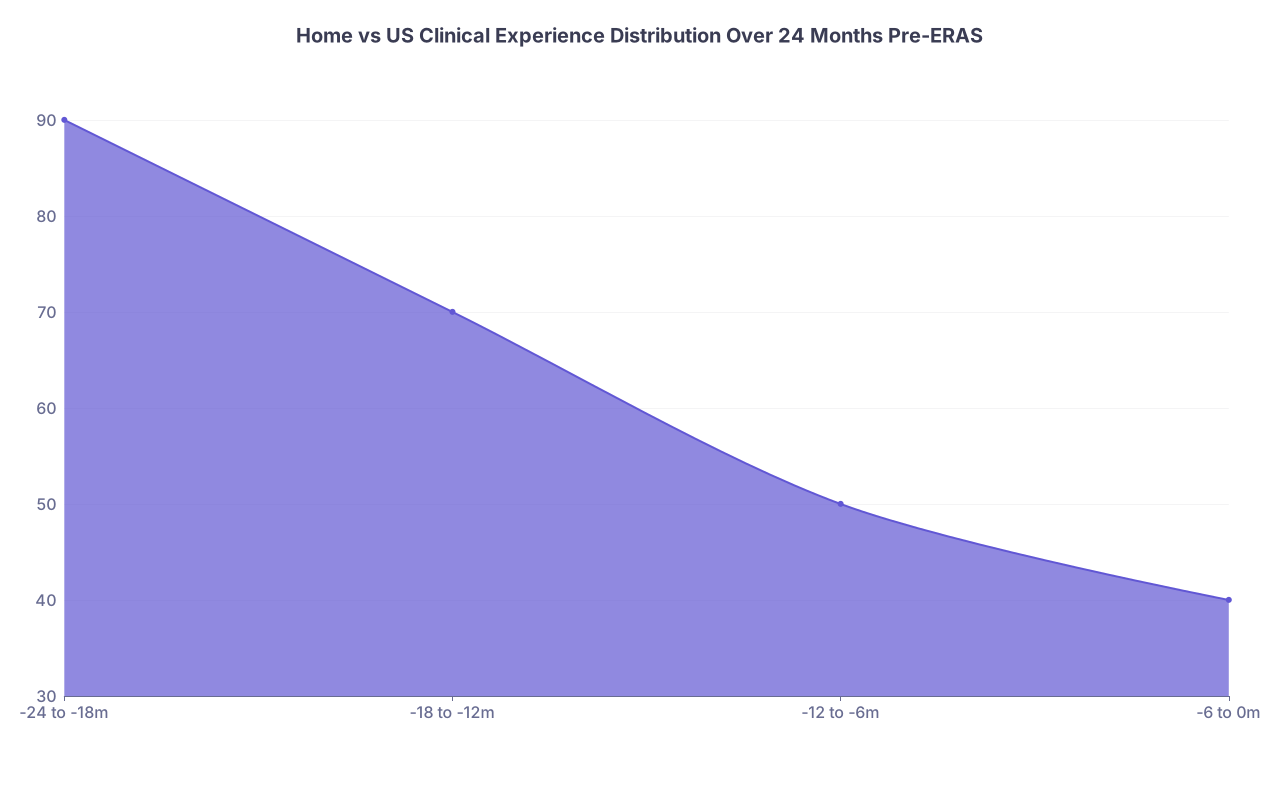
| Category | Value |
|---|---|
| -24 to -18m | 90 |
| -18 to -12m | 70 |
| -12 to -6m | 50 |
| -6 to 0m | 40 |
(Think of this as percentage of time in home clinical work. US experience replaces some of it gradually, but never drops home experience to zero for long stretches.)
Final Checklist by Phase
If you want a simple “at this point you should…” summary, use this.
18–24 Months Before ERAS
- Be in steady home clinical rotations
- Start/continue USMLE prep
- Identify home LoR writers
12–18 Months Before ERAS
- Complete at least one key exam (Step 1 or starting Step 2 CK)
- Do advanced home specialty rotations
- Consider one early US observership for exposure
6–12 Months Before ERAS
- Take Step 2 CK
- Do 2 solid USCE rotations in chosen specialty
- Secure 2–3 US LoRs
- Maintain some home clinical work between US blocks
0–6 Months After ERAS
- Continue clinical activity (home or US)
- Use short observerships/tele-rotations to show ongoing engagement
- If unmatched, plan fresh, well-timed USCE and eliminate new gaps
Core Takeaways
- Sequence matters: cluster your strongest USCE within 6–10 months of ERAS, not years earlier.
- Never abandon your home-country clinical work; continuity is almost as important as US exposure.
- Every rotation should move the same story forward: one specialty, two systems, recent and active.