

Clinical evaluation forms are not “just paperwork.” They are quiet gatekeepers that decide whether your strong CV actually converts into an interview or quietly lands in the “maybe later” pile.
Let me break this down specifically for IMGs: program directors trust numbers and patterns they understand. Your Step scores used to do most of the heavy lifting. With Step 1 now pass/fail and clinical grade inflation everywhere, structured clinical evaluations and their subscores have become one of the few remaining objective-looking tools. If you are an IMG, what those subscores say – and how your letter writers describe them – can make or break your application.
This is not about generic “do well clinically” advice. I am going to walk through exactly which components matter most, how U.S. programs mentally weight them, where IMGs commonly get hurt, and how to strategically protect yourself.
1. How Program Directors Actually Use Clinical Evaluations
If you imagine a PD reading your entire evaluation form line by line, you are already off track. They do not have time. They skim for:
- Global ratings and rank categories
- A small cluster of subscores that map onto “Can this person function as an intern without chaos?”
- Patterns across rotations and letters
Most U.S. school evaluation forms – and the forms attached to elective/observership/away rotations for IMGs – follow a similar structure:
- A global rating (e.g., “outstanding / above expected / meets expected / below expected”).
- A set of subscores, usually in domains like:
- Medical knowledge
- Clinical reasoning / problem solving
- History taking and physical exam
- Documentation / notes
- Professionalism / reliability
- Communication (with team / with patients)
- Teamwork / systems-based practice
- A narrative comment box
Here is the unspoken truth: some of these domains are “nice to have,” some are “must not be bad,” and a few are absolutely critical, especially for IMGs.
2. The Subscores That Quietly Matter the Most
I will rank these the way I have watched attendings and PDs implicitly rank them when talking about applicants, especially IMGs.
2.1 Professionalism / Reliability / Work Ethic
This is the non-negotiable category. You can survive being “average” in knowledge. You will not survive a hint of unreliability.
What PDs are looking for here:
- Shows up on time (or early)
- Completes tasks without drama or reminders
- Responds to pages / messages promptly
- Honest about mistakes
- Accepts feedback without defensiveness
- No boundary problems, disrespect, or “attitude”
For IMGs, this subscore is under a microscope. Why?
- They may not know your school’s grading rigor.
- They may have had a previous IMG who was brilliant but unreliable. That one memory colors how they read your file.
- Visa and hiring risk make them extra cautious about anyone who looks like a “possible problem.”
A single “meets expectations” in Professionalism when the rest of your subscores are “above expectations” is quietly concerning. “Below expectations” here is essentially a red flag. Programs will rarely say that clearly, but off-record conversations between PDs absolutely do.
Classic language that kills you:
- “Occasional issues with timeliness.”
- “Needed reminders to complete notes.”
- “At times appeared disengaged or distracted.”
- “Sometimes resistant to feedback.”
If you see anything like that in a draft letter, you must fix it before it leaves the building. That is not negotiable.
2.2 Clinical Reasoning / Judgment / Problem Solving
This is second only to professionalism. Programs do not want an intern who just copies plans from UpToDate. They want to see:
- Can you take an overnight phone call and make a sensible initial plan?
- Can you recognize when a patient is sick and escalate appropriately?
- Do you understand “sick vs not sick,” not just lists of differentials?
Evaluations often phrase this as:
- “Clinical reasoning”
- “Assessment and plan formulation”
- “Diagnostic reasoning”
- “Judgment under uncertainty”
For IMGs, this subscore also acts as a proxy for “How well do you understand U.S.-style medicine?” and “Can you adapt from your training context?”
Patterns that look strong:
- Multiple rotations with “outstanding” in reasoning/judgment
- Comments like “functions at intern level,” “anticipates next steps,” “excellent clinical judgment for level”
A mediocre but safe pattern: “meets expectations” on a first U.S. rotation, then “above expectations” as you gain familiarity. That tells a story of growth and adaptability.
Terrible pattern: high medical knowledge score, low or “meets” clinical reasoning. Translation in PD’s mind: “book smart, cannot apply.” They assume you will struggle when alone at night.
2.3 Communication with Team / Initiative / Teachability
This is the third critical pillar. PDs are asking: “Will the residents hate working with this person?”
Subdomains that matter:
- Verbal communication on rounds: clear, concise, not rambling
- Responsiveness to pages, messages
- Ability to ask for help early, not when things are collapsing
- Willingness to learn, ask questions, and accept correction
Comments that help you:
- “Quickly integrated into the team.”
- “Communicates clearly and effectively.”
- “Highly responsive and reliable communicator.”
- “Actively sought feedback and improved over the rotation.”
Red flag comments:
- “Sometimes had difficulty communicating plans.”
- “Occasionally failed to update the resident about changes.”
- “Could be more concise and focused in presentations.”
If you are not a native English speaker, this domain is where you feel especially vulnerable. Program directors know language accents vary; what they cannot tolerate is unsafe communication: missed handoffs, unclear orders, confusing calls.
3. Subscores That Are Secondary (But Still Matter)
These domains are rarely dealbreakers on their own, but they are strong modifiers of your overall impression.
3.1 Medical Knowledge
Yes, knowledge matters. But the obsession with knowledge alone is mostly a student thing, not a PD thing.
Knowledge subscores help in two ways:
- Corroborate your Step 2 CK score. A CK 250 with “meets expectations” in knowledge across multiple rotations makes PDs wonder whether you test well but perform average in real life.
- Help explain a borderline Step score. A CK 222 with “outstanding” knowledge and strong reasoning subscores across U.S. rotations suggests underperformance on test day, not chronically weak ability.
What PDs want is alignment: your standardized tests and your “medical knowledge” subscores should tell a consistent story.
IMG trap: many IMGs are excellent at memorization and exam performance. If your evaluations over-emphasize “reads a lot” and “knows a lot of facts” but are vague about reasoning and teamwork, it can unintentionally hurt you. It makes you look like a library, not a doctor.
3.2 History and Physical Exam Skills
These are important, but they are rarely the top concern unless you are catastrophically bad.
Strong wording:
- “Thorough, hypothesis-driven H&P.”
- “Consistently identifies key findings.”
- “Efficient yet comprehensive physical exam.”
For IMGs, this often intersects with style differences. Some foreign systems emphasize extremely detailed exams that may appear inefficient in the U.S. context. If your evaluator writes “tends to include unnecessary detail” or “needs to focus on relevant positives/negatives,” that is not fatal but does raise a “needs U.S. style adjustment” flag.
A good attending frames this as growth: “By the end of the rotation, had adapted to a more concise, problem-focused exam and presentation.” That is exactly what you want.
3.3 Documentation / Notes / Organization
This one matters more than most IMGs realize. Notes are operational. Bad notes slow down the entire team.
Common subcomponents:
- Timeliness of notes
- Clarity and accuracy of documentation
- Logical structure of assessment and plan
- Appropriate use of templates, no copy-paste disasters
Strong comments:
- “Notes were clear, concise, and ready for resident co-sign before rounds.”
- “Documentation was accurate with excellent synthesis.”
PD signal: this person will not cause billing issues, compliance problems, or medicolegal headaches.
Weakness patterns that worry PDs:
- “Notes sometimes delayed.”
- “Required frequent correction for structure or content.”
- “Tended to copy forward without critical update.”
For IMGs unfamiliar with U.S. EHR systems, your first rotation might be shaky here. That is fine if your later rotations show clear improvement and no patient-safety-related issues.
4. The Subscores That Usually Matter Least (Unless Extreme)
There are domains that are nice extras but rarely central for IMGs trying to land interviews.
4.1 Teaching / Leadership
If you are a student or observership participant, no one expects you to be a teaching machine. A “meets expectations” here is fine. An “above expectations” is a bonus.
Where it helps: higher-tier academic programs value future clinician-educators. If your forms emphasize “takes initiative to teach peers and junior students” that supports a fit with academic, teaching-heavy residencies.
But do not kill yourself over this. It is not the main filter.
4.2 Research / Scholarship Inside the Evaluation Form
Some clerkship forms awkwardly include “Research / scholarly activity” as a subscore. PDs rarely give this much weight on a rotation-specific form. They look at your CV for research, not your clinical evals.
If it is mentioned positively (“presented a mini QI project,” “reviewed literature to answer clinical questions”), it slightly boosts the impression of curiosity and initiative. That is all.
5. How Different Specialties Weight Subscores for IMGs
Let us be more granular. A family medicine PD and a surgery PD are not hunting for exactly the same signal.
| Specialty | Most Critical Subscores | Secondary But Helpful |
|---|---|---|
| Internal Med | Professionalism, Reasoning, Teamwork | Knowledge, Documentation |
| Family Med | Professionalism, Communication | Reasoning, Cultural skills |
| Surgery | Professionalism, Work Ethic | Technical potential, Team |
| Pediatrics | Professionalism, Communication | Family interaction, Empathy |
| Psychiatry | Professionalism, Communication | Insight, Documentation |
For IMGs:
- Internal medicine: they are obsessed with reliability and judgment. A comment like “already functioning at the level of a PGY-1” is gold.
- Family medicine: communication with patients and team, cultural sensitivity, and flexibility in outpatient + inpatient environments stand out.
- Surgery: any hint of being “fragile,” “easily overwhelmed,” or “slow to respond” is lethal. Work ethic and team fit dominate.
- Pediatrics: bedside manner, communication with families, and professionalism around children and parents become focal.
- Psychiatry: communication clarity, boundaries, insight, and documentation are the main safety concerns.
6. Why Global Ratings Alone Are Not Enough for IMGs
You might think: “If I get ‘Honors’ or ‘Outstanding’ overall, I am fine.” Not as an IMG.
Here is the problem:
- Grade inflation: At some U.S. schools, “Honors” basically means “still breathing and showed up.” Programs know this.
- Inconsistent scales: One school’s “meets expectations” equals another’s “above expectations.”
- IMG bias: For foreign institutions, PDs often do not understand your grading system at all.
Subscores cut through that noise. When PDs are burned by a prior experience (“We ranked an IMG high who then struggled with professionalism”), they start scrutinizing the professionalism and communication subscores across every evaluation and every letter. They will even pick up the phone and call U.S. clinicians who supervised you.
7. Specific Phrases That Help or Hurt IMGs
Let me translate the code words for you.
7.1 Green-Flag Language
When PDs read these about an IMG, they relax:
- “Functions at the level of an intern.”
- “Would be thrilled to have this student as a resident.”
- “Top 5–10% of students I have worked with in the last X years.”
- “Required minimal supervision for level of training.”
- “Outstanding professionalism; always early, always prepared.”
- “Exceptional team player; universally liked by nurses and residents.”
- “Adapted quickly to U.S. clinical environment and documentation systems.”
Those phrases usually map to high subscores in professionalism, reasoning, and communication.
7.2 Yellow-Flag Language
These do not kill you, but they make PDs cautious, especially for IMGs:
- “Quiet but hard working.” (Are they disengaged? Poor communication?)
- “Improved after feedback.” (Why did they need significant feedback? Was there an issue?)
- “Would benefit from continued development of clinical reasoning.”
- “Sometimes struggled with time management.”
If you see this kind of wording in a draft, ask your writer to specify growth and end-state. For example, “Initially struggled with time management, but by mid-rotation was reliably completing tasks and notes on time.” That turns a yellow flag into a story of improvement.
7.3 Red-Flag Language
If any of this appears in your final letter or eval, many programs will auto-screen you out:
- “Concerns about professionalism.”
- “Occasional lapses in reliability.”
- “At times did not accept feedback well.”
- “Required closer supervision than peers.”
- “I cannot fully endorse without reservation.”
For IMGs, even softer versions of these phrases can be deadly, because the perceived risk is already higher due to training, distance, and visa layers.
8. How PDs Mentally Weight Subscores vs Other Data
Think of a PD sitting in front of three applications:
- Candidate A: AMG, CK 245, solid clerkship comments, no U.S. IMG issue.
- Candidate B: IMG, CK 255, average U.S. rotation with “meets expectations” and bland comments.
- Candidate C: IMG, CK 238, superb U.S. rotation with “outstanding professionalism, intern-level performance, would strongly recommend.”
Candidate C frequently wins over Candidate B in internal medicine and family medicine. Why? Because PDs have learned that they can teach knowledge; they cannot fix entitlement, poor systems sense, or unreliability.
To make this explicit:
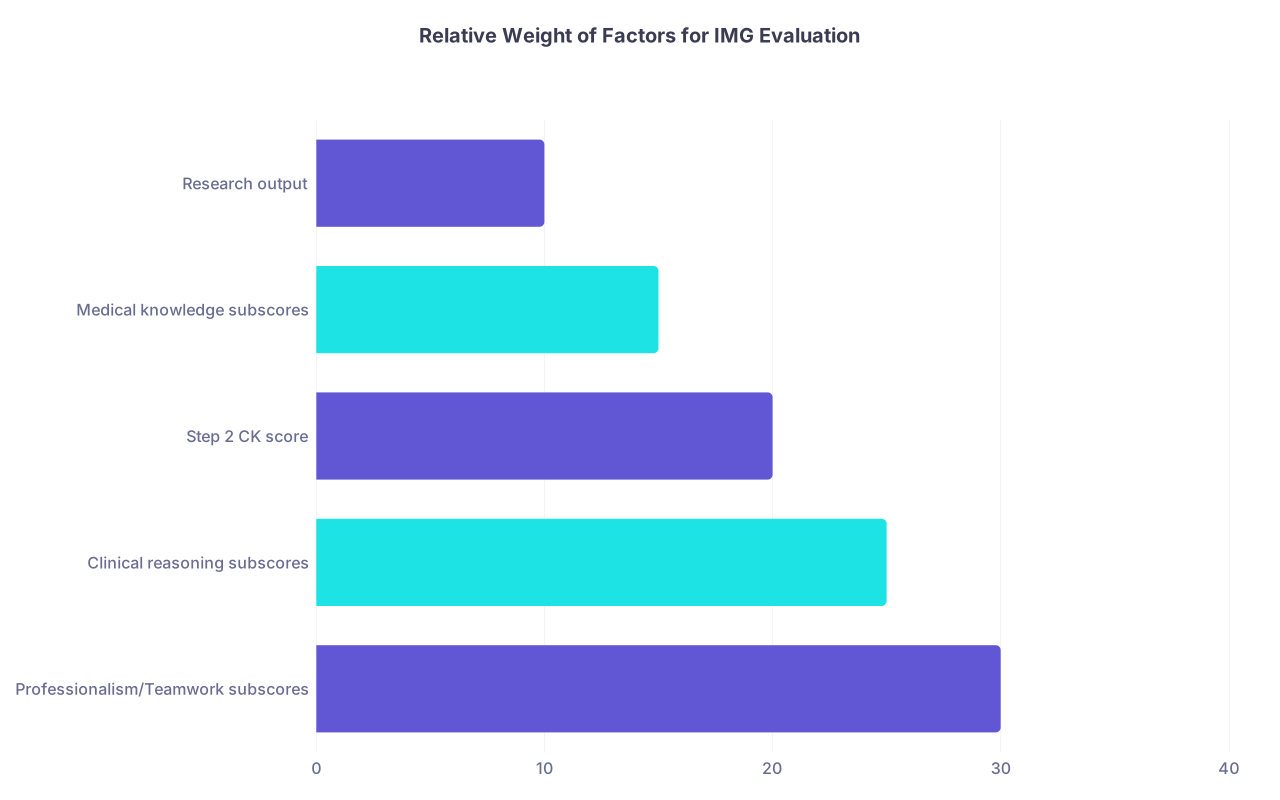
| Category | Value |
|---|---|
| Professionalism/Teamwork subscores | 30 |
| Clinical reasoning subscores | 25 |
| Step 2 CK score | 20 |
| Medical knowledge subscores | 15 |
| Research output | 10 |
This is not a formal algorithm, but it is close to how they talk behind closed doors, especially for specialties where IMGs are common (IM, FM, peds, neurology, psych).
9. How to Shape Strong Subscores as an IMG (While You Are on Rotation)
You cannot retroactively fix old evaluations, but you can absolutely control what your next U.S. rotation looks like.
9.1 Protect Professionalism Like Your Life Depends on It
Because professionally, it does.
Concrete actions:
- Be early. Not on time. Early. Especially for an IMG on a first U.S. rotation.
- Volunteer for the unglamorous tasks: calling families, updating collateral data, dealing with paperwork.
- Close the loop on every task. If a resident asks you to call a consult, you do it, document it, and then tell them it is done.
- Answer pages promptly. If you miss a page, apologize once, fix your workflow, and do not repeat it.
Nurses and residents will talk about you. Those hallway comments filter back to attendings and shape those professionalism subscores more than you think.
9.2 Demonstrate Clinical Reasoning Explicitly
Many IMGs have the right thinking but do not show it in the U.S.-style format, so attendings under-rate their reasoning.
Do this on rounds:
When you present:
- State the problem list, not the story again.
- For each major problem, state:
- Brief differential (2–3 sensible items, not 15).
- Your leading diagnosis.
- One or two key tests or interventions you would do next and why.
If you are unsure, still commit: “My leading concern is X because of Y and Z, but I would also consider A if B develops.” Attendings reward structured thinking, not perfection.
9.3 Over-communicate Early, Then Normalize
First week of a new system? Err on the side of over-communicating:
- “I updated the family; they understand and agree with the plan.”
- “I called nephrology; they will see the patient this afternoon.”
- “I changed the order as you suggested and double-checked the doses.”
As the team learns you are reliable, you can scale back to normal levels. This makes your communication subscores skyrocket.
10. Translating Your Subscores into Application Strength
When ERAS and PDFs flatten everything into a couple of pages, you must make sure key subscores and phrases show up where PDs actually look.
10.1 MSPE / Dean’s Letter (for IMGs with U.S.-equivalent documents)
If you have an MSPE-style document from a U.S. or Caribbean school, it should highlight:
- Rotation narratives that emphasize professionalism and reasoning.
- Any “outstanding” ratings in those categories.
- Comparative statements: “Top third of class,” “Top 10% of students I have supervised.”
If your school’s MSPE is weak or generic (common in some Caribbean schools), your best weapon becomes individual U.S. LORs from rotations with strong subscores.
10.2 Letters of Recommendation
You want letters that explicitly reflect the strongest parts of your evaluation form. Ideally:
- One letter from a rotation where you were rated outstanding on professionalism/teamwork.
- One from where you were praised for clinical reasoning/judgment.
- If possible, one from a U.S. academic attending who says “functions at intern level.”
If you can, show your evaluator your evaluation form and say, “These domains seem most important for my residency applications. If you genuinely agree, would you feel comfortable highlighting them?” Many attendings appreciate the clarity.
11. Dangerous Misconceptions IMGs Have About Evaluations
I have seen the same mistaken assumptions cause damage over and over.
Misconception 1: “High test scores will compensate for mediocre clinical evaluations.”
Reality: For IMGs, high test scores get you past the first screen. Weak professionalism or reasoning subscores can still quietly eliminate you later.
Misconception 2: “If no one yelled at me, I must be doing fine.”
Reality: Many attendings will not openly criticize students. They just check “meets expectations” and write a careful, lukewarm evaluation. That is how you end up in the middle of a rank list, or not on it at all.
Misconception 3: “My school evaluation form is different, so this does not apply.”
Reality: Even if the boxes are different, PDs still search for the same signals: reliability, clinical sense, communication. They map your form onto those mental categories whether your school likes it or not.
12. What To Do If You Already Have a Weak Evaluation
Sometimes the damage is done. You had a bad rotation, a misaligned attending, or a steep learning curve. You cannot delete an official evaluation. But you can dilute its impact.
Steps:
- Get more U.S. clinical experience with known IMG-friendly attendings.
- Target rotations where you can work closely with one attending (not 10) so they really see your growth.
- Ask for explicit feedback mid-rotation: “I am applying to residency this cycle. Are there any concerns you have about my professionalism, reasoning, or teamwork that I can improve now?”
- If a prior evaluation was weak on professionalism or reasoning, ask a later attending, “Do you feel comfortable commenting on my growth in those areas in your letter?” You are giving them a narrative arc to write.
A later, stronger evaluation can reframe an earlier mediocre one as part of your learning curve, not your ceiling.
13. Pulling It Together: What Actually Matters Most
Let me summarize the hierarchy for IMGs, without the polite language:
- Professionalism / reliability: Do they trust you alone with patients at 2 a.m.? Any doubt here and you are in trouble.
- Clinical reasoning / judgment: Can you make sensible decisions without constant hand-holding?
- Communication / teamwork: Will you slow down or support the team?
- Documentation / notes: Will your notes keep the system safe and legal?
- Knowledge and H&P: Important, but they matter more as supporting evidence than as primary filters.
If your evaluation forms clearly and repeatedly say: “This IMG is reliable, clinically sound, a good teammate, and essentially an intern already,” you will beat many applicants with prettier exam scores but weaker subscores.
To make this mental model easy to remember:

| Step | Description |
|---|---|
| Step 1 | Clinical Evaluation |
| Step 2 | High Risk - Screen Out |
| Step 3 | Borderline - Needs Support |
| Step 4 | Moderate Concern |
| Step 5 | Strong Candidate |
| Step 6 | Professionalism strong? |
| Step 7 | Clinical reasoning strong? |
| Step 8 | Communication and teamwork solid? |
And just to emphasize how much IMGs rely on these evaluations when competing with AMGs:
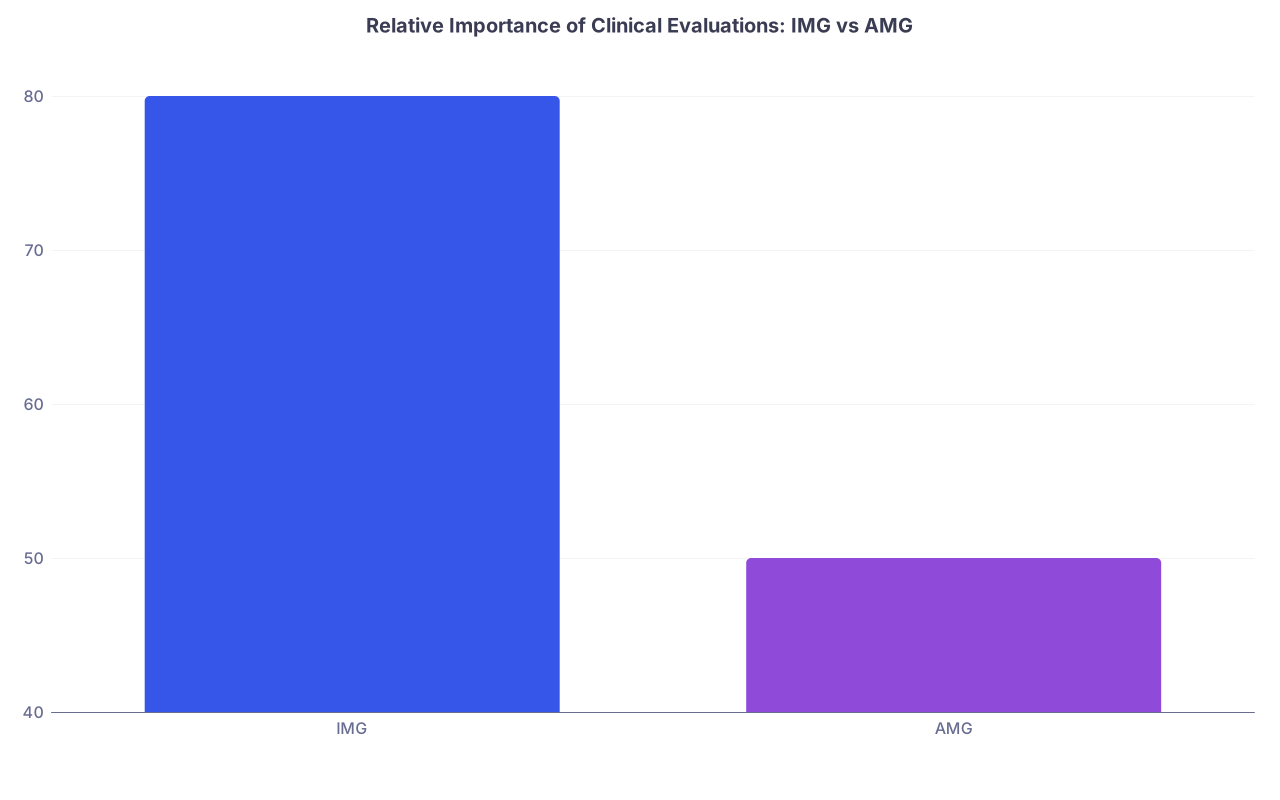
| Category | Value |
|---|---|
| IMG | 80 |
| AMG | 50 |
Rough, but true: your clinical evaluations and subscores carry more weight than for your U.S. classmates, because they are how PDs decide whether to trust training they did not directly oversee.
With these subscores understood and targeted, your next job is to align them with the rest of your application: your Step 2 CK, your personal statement, and your letters. That is where you turn strong evaluations into actual interviews and a rank list that works in your favor. But that is its own strategy session for another day.


