
The biggest mistake IMGs make with US clinical experience is treating it like a checklist, not a translation exercise.
You do not get points just for “doing a rotation in the US.” Program directors care about how clearly your USCE maps to the ACGME core competencies they are required to evaluate: patient care, medical knowledge, practice-based learning and improvement, interpersonal and communication skills, professionalism, and systems-based practice.
Let me break this down specifically.
Why USCE Only Matters If You Translate It
Most IMGs collect letters and lines on a CV, then wonder why they are still filtered out. On the program side, I have seen hundreds of ERAS applications where the “US Clinical Experience” section is essentially useless:
“Four-week observership in internal medicine at XYZ Hospital. Attended rounds and clinics.”
That tells me nothing. It does not help me justify ranking you when my CCC and PEC are literally organized around the ACGME competencies.
Programs are judged on whether their residents achieve competency milestones. So every serious PD is reading your file through one filter: “Can this person show me evidence that they already function, or can quickly function, along these six competencies in our system?”
You need to turn:
- “I saw patients on a US rotation”
into:
- “Here is concrete, competency-based evidence that I function in the US system and already align with how you train and evaluate residents.”
That is the translation problem. If you solve it, your USCE becomes a force multiplier. If you do not, it is background noise.
First, let us get crisp on the competencies, then we will walk specialty-specific, rotation-specific, and document-specific examples.
Quick Reality Check: What Programs Actually Evaluate
Here is what matters at the residency selection table when people argue for or against an IMG with USCE.
| Evidence Type | How Programs Use It |
|---|---|
| LORs from US faculty | Primary proxy for ACGME competencies |
| Narrative in ERAS experiences | Context for level of responsibility |
| Personal statement episodes | Depth of reflection, professionalism |
| Interview stories | Live test of communication & insight |
| USCE setting (academic vs. private) | Perceived rigor & supervision |
Nobody sits there reciting the ACGME language. But you will hear versions of:
- “Can they handle floor patients from day one?” → Patient Care, Systems-Based Practice
- “Do they know basic US workup and guidelines?” → Medical Knowledge
- “Will they drown with feedback?” → Practice-Based Learning
- “Will I trust them calling patients and nurses at 2 AM?” → Communication, Professionalism
So your job: structure every mention of USCE to answer those questions using competency-aligned language.
ACGME Competencies in Plain Language for IMGs
You do not need the full bureaucratic description. You need the version that maps to what you did on rotation.
1. Patient Care
Not: “I saw patients.”
Instead: Can you:
- Gather focused and comprehensive histories in English.
- Perform targeted physical exams aligned with US practice.
- Formulate assessments and plans that make sense in this system.
- Present on rounds in a structured way (SOAP, one-liner, problem list).
For IMGs, the key is level of responsibility. Were you just “shadowing,” or were you actually participating?
Examples you want to surface:
- “Independently obtained histories and performed focused exams on 5–8 medicine inpatients daily, then presented to residents and attendings using a problem-based format.”
- “Participated in outpatient management of chronic diseases, including adjusting insulin regimens under supervision and educating patients on home glucose monitoring.”
2. Medical Knowledge
This is not just “I passed Step 2.” It is: can you apply knowledge in real US clinical situations?
Evidence looks like:
- Presenting brief, evidence-based plans on rounds.
- Reading UpToDate or guidelines and adjusting your thinking.
- Understanding US-style differentials and workup sequences.
On paper, it often shows up as:
- “Prepared and delivered 3 ten-minute evidence-based presentations on COPD exacerbation management, community-acquired pneumonia, and atrial fibrillation anticoagulation, incorporating ACC/AHA and IDSA guidelines.”
That line tells me much more than “Honors in Internal Medicine rotation.”
3. Practice-Based Learning and Improvement
This is the most ignored competency by IMGs and also one of the easiest to demonstrate if you are deliberate.
Programs want residents who:
- Seek feedback.
- Change behavior based on that feedback.
- Use data or literature to improve.
On a rotation, that might look like:
- Getting told your presentations are unfocused on day 1, then tightening them up by day 3 and explicitly acknowledging that change.
- Noticing you struggle with US hypertension guidelines, then reading JNC/ACC-AHA and adjusting your plans accordingly.
On your application, you need stories like:
- “After feedback about over-detailed presentations, I adopted a structured one-liner and problem-based approach, confirmed expectations with my senior resident, and received positive evaluations regarding clarity and efficiency by the end of the rotation.”
That is practice-based learning in real language.
4. Interpersonal and Communication Skills
For IMGs, this is where a lot of PD anxiety lives. They worry about:
- Accent and language understanding.
- Ability to speak with nurses, consultants, patients, and families without confusion or conflict.
- Written documentation (notes, handoffs).
USCE is your chance to show:
- You communicated with patients independently.
- You interacted with nursing staff and allied health.
- You handled difficult or emotional conversations with supervision.
Examples to pull out:
- “Independently counseled patients on new diagnoses of diabetes and CHF using teach-back methods; my attending specifically commented on my clarity and rapport in the end-of-rotation evaluation.”
5. Professionalism
If you think “I showed up and worked hard” is enough, you are underestimating this one. Programs have been burned by unprofessional residents. They screen aggressively for:
- Reliability (notes done, patients seen, on time).
- Integrity (no exaggeration, no cutting corners).
- Respectful behavior with nurses, staff, and peers.
- Handling of conflict or errors.
You want explicit professionalism signals in LORs and your own narrative:
- “Consistently arrived before the team, pre-rounded on assigned patients, and updated sign-outs before leaving the hospital.”
- “Managed a situation where a family was upset about wait times by listening, acknowledging their frustration, and involving my resident early rather than escalating.”
6. Systems-Based Practice
Most IMGs are weakest here because the US system is structurally different. That is exactly why PDs value USCE that clearly hits this competency.
You want to show:
- You understand basic US hospital and clinic workflows (EMR, orders, consults).
- You recognize costs, insurance, discharge planning, and multidisciplinary care.
- You worked with case management, social work, pharmacy, or PT/OT.
For instance:
- “Participated in daily multidisciplinary rounds with nursing, case management, and pharmacy, contributing to discharge planning for patients with limited insurance coverage.”
That tells me you are not going to stare blankly when I say “Did you speak with case management?”
Using USCE to Demonstrate Progressive Responsibility
Not all USCE is equal. PDs care about the level of responsibility.
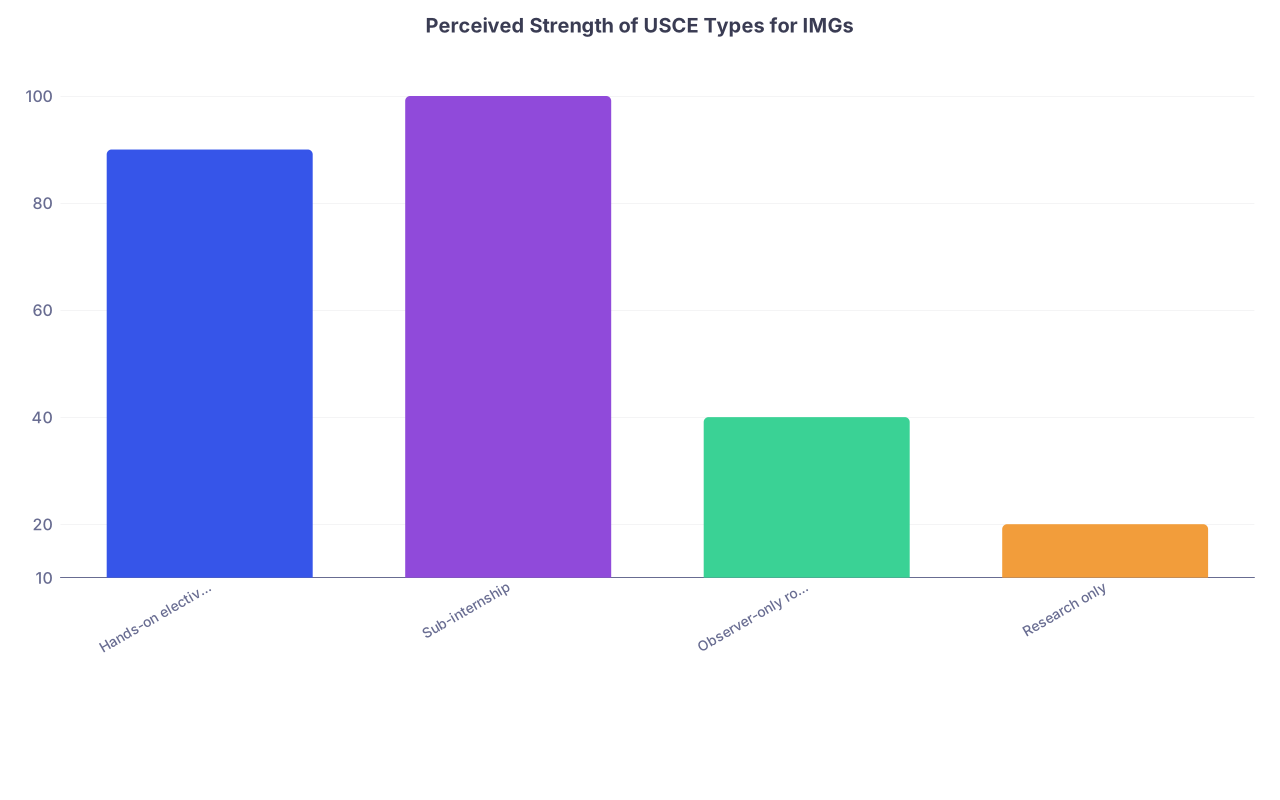
| Category | Value |
|---|---|
| Hands-on electives | 90 |
| Sub-internship | 100 |
| Observer-only rotation | 40 |
| Research only | 20 |
Roughly how programs feel (not exact numbers, but directionally right):
- US sub-internship / acting internship in your chosen specialty → gold standard.
- Hands-on elective with notes, orders (even if not signed), and presentations → strong.
- Pure observership with no direct patient contact → weak on patient care but can still show other competencies if framed well.
- Research-only “US experience” → barely counts as clinical at all.
If all you have is observerships, you cannot magically turn them into “I admitted patients.” But you can still map them to competencies intelligently.
For each rotation, ask:
- What concrete tasks did I do that relate to each competency?
- What changed in how I functioned from week 1 to week 4?
- What did the attending or resident explicitly comment on?
Then describe that.
How to Write USCE Descriptions in ERAS Using Competencies
Let’s say you did a four-week internal medicine elective at a mid-tier academic hospital.
Wrong way (I see this constantly):
“Four-week clinical elective in internal medicine. Observed patient care in inpatient and outpatient settings. Participated in rounds.”
Translated: Nothing. I have no idea what you actually did.
Competency-based rewrite:
“Four-week inpatient internal medicine elective at [Hospital Name], a [university-affiliated/community] teaching hospital. Pre-rounded and obtained focused histories and exams on 4–6 patients daily, presented on rounds using a problem-based format, and proposed assessment and plan which were refined with the team. Wrote draft notes in the EMR and used UpToDate to prepare brief evidence-based discussions on COPD exacerbation management and anticoagulation in atrial fibrillation. Communicated plans directly to patients and nursing staff under supervision and participated in multidisciplinary discharge planning rounds.”
You just covered:
- Patient Care
- Medical Knowledge
- Practice-Based Learning
- Interpersonal & Communication Skills
- Systems-Based Practice
- Professionalism (implicitly via responsibilities)
Now do the same thing for other rotations.
Rotation-by-Rotation: What to Highlight by Competency
Different rotations emphasize different competencies by default. Use that.

Inpatient Internal Medicine
Natural strengths:
- Patient Care, Medical Knowledge, Systems-Based Practice.
Concrete things to describe:
- Number of patients followed daily.
- Frequency and type of presentations (new vs follow-up).
- Any exposure to cross-cover or night float (even shadowing).
- Interaction with consultants (cardiology, ID, nephrology).
- Use of EMR for notes and order entry (even if not final signer).
Example integration:
- “Followed 5–7 complex inpatients daily with conditions such as decompensated heart failure and sepsis; developed prioritized problem lists and presented focused SOAP notes on rounds. Contacted cardiology and nephrology services to clarify recommendations and reconciled conflicting advice with the primary team under supervision.”
Outpatient Clinic (IM/FM/Peds)
Natural strengths:
- Interpersonal & Communication, Systems-Based Practice, Professionalism.
Highlight:
- Visit volume per half-day.
- Preventive care (screening, vaccines).
- Chronic disease management and medication reconciliation.
- Insurance/authorization issues and referrals.
- Patient education and shared decision-making.
Example:
- “Saw 6–8 patients per clinic session alongside attending, focusing on chronic disease management (diabetes, hypertension, asthma). Performed medication reconciliation, reviewed home blood pressure logs, and counseled patients using lay language and teach-back. Coordinated referrals for colon cancer screening and ophthalmology, considering insurance limitations.”
Emergency Medicine
Natural strengths:
- Patient Care under time pressure, Systems-Based Practice, Communication.
Highlight:
- Acuity, triage, handoffs.
- Procedural exposure (even observing if you can frame your understanding).
- Interprofessional communication with nurses, trauma team, consultants.
- Safety and escalation behavior.
Example:
- “In a high-volume urban ED, participated in initial assessment and triage-level decision-making for patients with chest pain, shortness of breath, and abdominal pain. Presented cases to EM residents, formulated preliminary differentials and workup, and observed or assisted with procedures such as central line placement and laceration repair. Gave handoffs using SBAR format to inpatient teams.”
Specialty Rotations (Neuro, Psych, Surg, etc.)
You still map to the same competencies. For instance, psychiatry:
- Patient Care → risk assessment, safety plans.
- Communication → sensitive interviewing.
- Systems-Based → involuntary holds, social support, community resources.
Example line:
- “Conducted extended psychiatric interviews for patients with major depressive disorder and psychosis, assessing suicide risk and protective factors, presenting to the attending, and collaborating with social work to arrange safe discharge plans.”
Letters of Recommendation: Coaching Faculty to Speak ACGME
You cannot write your own LOR, but you can steer the content by how you work and what you provide as a summary.
Most US faculty are familiar with ACGME language, especially in academic centers. When you send them a polite summary of your activities, you can structure it around the competencies without saying, “Please mention the ACGME competencies.”
You frame it as:
- “Here is a brief summary of what I did on the rotation to help jog your memory.”
Organize it like this (but do not label the competencies explicitly; use headings or bullets):
- Clinical responsibilities: X patients/day, pre-rounding, presentations, notes.
- Learning and feedback: specific episodes where you improved.
- Teamwork and communication: working with nurses, patients, families.
- Professionalism: reliability, time management, any extra initiatives.
A strong LOR for an IMG usually has at least one explicit sentence that screams competency alignment, for example:
- “In my opinion, [Name] is already functioning at or above the level of a US fourth-year medical student across the ACGME competencies, particularly in patient care, communication, and professionalism.”
Or more naturally:
- “Compared with US students at our institution, [Name] performed at an above-average level in clinical reasoning, communication with patients and staff, and responsiveness to feedback.”
Those sentences do a lot of work.
Personal Statement: One Clinical Story, Six Competencies
Most IMG personal statements are generic biography essays. You waste your best leverage point.
Pick one or two episodes from USCE and unpack them through the competency lens.
Example structure:
- Situation: “On my internal medicine elective, we admitted a 56-year-old patient with uncontrolled diabetes and foot infection.”
- Your role (Patient Care, Communication): you took the history, examined, presented.
- Knowledge & Learning: you looked up guidelines on diabetic foot infections, adjusted your plan.
- Systems-Based: you realized discharge required home wound care and insurance approval, so you spoke with case management.
- Professionalism: you followed up on labs, checked in with nursing, documented clearly.
- Reflection: what this taught you about practicing in the US system and why it confirmed your interest in that specialty.
You never need to write the phrase “ACGME competency.” But the people reading will recognize what you are showing them.
Interview: Answering with Competency Language Without Sounding Robotic
On interview day, you are being silently scored on these competencies.
Common questions give you an opening:
- “Tell me about a challenging clinical situation from your US experience.”
- “What feedback have you received during your US rotations, and how did you respond?”
- “How have your US rotations prepared you to start residency here?”
You answer with structure:
- Brief case/episode (not a full H&P).
- Your actions mapped to 2–3 competencies.
- Reflection on what changed in your behavior.
For instance:
“On my medicine elective, I struggled initially with making my oral presentations concise. My resident told me after the first day that I was including too much background and not enough assessment. That evening I looked up examples of one-liners and problem-focused presentations, wrote out my structure, and asked him the next morning if it matched what he wanted. Over the next week, I focused on leading with my assessment and plan and limiting data to what changed management. At the end of the rotation, both he and the attending commented that my presentations were ‘much more resident-level.’ That experience made me more deliberate about seeking and applying feedback, which I know will be essential in internship.”
You just hit: practice-based learning, communication, professionalism.
If Your USCE Is Limited or Weak: How to Salvage It
Some of you will not have hands-on electives. Some will only have observerships.
You cannot pretend you did more than you did. PDs can smell that. But you can:
- Emphasize competencies that observerships legitimately build: systems-based practice, communication in team settings, practice-based learning, professionalism.
- Use concrete experiences: case conferences, QI meetings, clinic flow observations, EMR exposure.
- Pair USCE with strong home-country clinical experience that shows patient care, and explain briefly how you translated those skills into the US context.
Example ERAS entry for an observership:
“Four-week observership in internal medicine at [Hospital]. Attended daily rounds and case discussions, observed resident and attending workflows in the EMR, and studied US guidelines for common inpatient conditions such as pneumonia and heart failure. Shadowed multidisciplinary rounds with nursing, pharmacy, and case management, focusing on discharge planning in the context of US insurance and social support systems.”
Then in your personal statement or interview, bridge:
“In my home institution, I had primary responsibility for inpatient care, including admitting and managing patients. During my US observership, I focused on understanding how those same clinical principles are applied within the US system, particularly the use of EMRs, multidisciplinary teams, and insurance-driven constraints.”
It is honest but still shows intentional systems learning.
A Simple Mental Checklist: Did I Translate This?
Before you finalize your ERAS entries, PS, and CV, ask for each USCE item:
- Have I shown concrete behaviors, not just settings?
- Does this line clearly demonstrate at least 2 ACGME competencies?
- Could a PD quote a sentence from this to argue I am “residency-ready” in their committee meeting?
If the answer is no, rewrite.
One last visual to keep in your head:

| Step | Description |
|---|---|
| Step 1 | Raw US Clinical Experience |
| Step 2 | Identify Specific Tasks |
| Step 3 | Map Tasks to Competencies |
| Step 4 | Rewrite ERAS Entries |
| Step 5 | Select Stories for PS |
| Step 6 | Prep Interview Examples |
| Step 7 | Application Shows Competency |
That is the actual process.
The 3 Things You Should Not Forget
- USCE only helps if it is translated into competency language with concrete actions, not vague “observed patient care” clichés.
- Every major document (ERAS experiences, LOR summaries, personal statement, interview answers) is a chance to show you already function along ACGME lines in the US system. Use all of them deliberately.
- You are not selling “I did a month in the US.” You are selling: “Here is evidence that I can walk onto your wards and operate like a competent, coachable, professional intern on day one.”