It is December. You are staring at your ERAS application, trying to explain what you actually learned in those 3 US clinical rotations besides “I saw patients and presented on rounds.” You keep seeing the ACGME core competency “Systems-Based Practice” in program descriptions and evaluation forms—but your brain goes blank when you try to map your USCE to it.
This is where a lot of IMGs lose ground. Not because they do not understand medicine. Because they do not speak “systems language.”
Let me walk through exactly how to use your US clinical experience to prove to program directors that you understand systems-based practice—and that you can function inside the complex, messy, expensive machine that is US healthcare.
1. What Programs Actually Mean by “Systems-Based Practice”
Forget the vague textbook definitions for a minute. Think about what an overworked program director in Internal Medicine at, say, Maimonides or Henry Ford, actually wants to know:
“Will this applicant:
- Understand how our system works.
- Use resources appropriately.
- Not blow up my length-of-stay numbers.
- Not order every test ‘just to be safe’ because that is normal in their home country.
- Not fight the nurses, case managers, or insurance utilization review people.
- Help the team move the patient safely through admission → treatment → disposition?”
All of that is wrapped under “Systems-Based Practice” (SBP).
Formally, ACGME breaks SBP into things like:
- Working in various health care delivery settings and systems.
- Coordinating care within the system.
- Advocating for quality patient care and optimal patient care systems.
- Working in interprofessional teams.
- Identifying system errors and contributing to solutions.
- Cost awareness and risk–benefit decision-making.
If you want to matter as an IMG applicant, you have to convert your USCE into evidence that you can do these things.
2. Why US Clinical Experience Is the Best Vehicle to Show SBP
You cannot convincingly demonstrate systems-based practice from:
- Online observerships.
- Pure research roles.
- Generic “clinical experiences” in your home country.
You need actual exposure to how US hospitals function: the insurance games, discharge planning battles, EMR-driven workflows, and multidisciplinary team dynamics.
That is where hands-on (or at least embedded) US clinical experience becomes your main weapon.
Let me be blunt:
If your LORs and ERAS entries read like:
- “She is clinically excellent. Reads a lot. Good with patients.” and say absolutely nothing about:
- Teamwork with nursing/social work.
- Understanding of system constraints.
- Cost-conscious ordering.
- Use of consults, case management, quality/safety protocols.
You are wasting your USCE.
You had the exposure. You just did not frame it in SBP terms.
3. The Anatomy of Systems-Based Practice in Daily USCE
I will break systems-based practice into concrete, observable behaviors you can actually point to from your US clinical experience.
3.1 Resource Utilization and Cost Awareness
What this looks like on rotation:
- Discussing why you are ordering a CT vs MRI vs ultrasound.
- Avoiding “defensive” or duplicate labs when recent results exist.
- Understanding that in the US, each extra day in the hospital is expensive and scrutinized.
- Thinking twice before ordering “full cancer workups” in someone with obvious terminal disease.
Example from a real IM rotation:
A student kept ordering daily CBC, BMP, LFTs, coagulation profile “just in case” on stable patients. The attending finally told him, “Every tube you draw is money and anemia; this is not a teaching hospital in your country where labs are cheap.”
How you use USCE:
- “During my inpatient IM clerkship at XYZ Medical Center, I learned to review existing lab trends before placing new orders and to propose cost-conscious diagnostic plans during rounds (for example, spacing out daily labs to every 48 hours in clinically stable patients).”
3.2 Care Transitions and Discharge Planning
In the US, discharge is not “the last 10 minutes” of the hospitalization. It is a multi-day systems problem involving:
- Insurance approval for rehab or SNF.
- Medication reconciliation with pharmacy.
- Home health orders.
- Transport.
- Follow-up appointments.
As an IMG, your home system may not work like this at all. That is exactly why USCE is gold.
You should be involved in:
- Listening to case management discussions during interdisciplinary rounds.
- Helping arrange follow-up (primary care, specialist, wound clinic).
- Understanding why some patients cannot be discharged because “insurance has not authorized home oxygen” yet.
You then frame this as SBP.
Example line for ERAS:
“On my internal medicine sub-internship at ABC Hospital, I routinely followed patients through the discharge process, participated in multidisciplinary rounds with case management and social work, and helped anticipate barriers such as medication cost and home support.”
3.3 Working With Interprofessional Teams
Systems-based practice is not you alone making brilliant plans. It is you functioning inside an interdependent team:
- Nurses.
- Pharmacists.
- Case managers.
- Social workers.
- Physical / occupational therapists.
- Respiratory therapists.
Program directors know that some IMGs come from very hierarchical systems where:
- Nurses do not question physicians.
- Social work barely exists.
- Discharge means “you can go now.”
So your USCE has to show that you can:
- Accept and integrate nursing input.
- Communicate clearly with consultants.
- Collaborate, not command.
Example: “I observed how the team adapted the care plan for a heart failure patient after the physical therapist identified that the patient could not safely climb the 3 flights of stairs to their apartment. This altered our discharge disposition from home to short-term rehab. I later presented the case focusing on the role of interprofessional input in safe discharge.”
That is pure SBP.
3.4 EMR Use and System Workflows
US healthcare runs on EMRs and order sets. These are not just documentation tools; they encode systems-based practice:
- Admission order sets with VTE prophylaxis prompts.
- Sepsis protocols triggered by vitals and labs.
- Clinical decision support alerts.
- Best practice advisories for vaccinations, screening, etc.
During USCE, many IMGs just learn “how to write a note.” You should also learn:
- How order sets reduce errors.
- How clinical decision support can both help and overwhelm.
- How documentation links to billing and quality metrics.
You then say so.
Example wording: “During my US clinical experience, I became familiar with EPIC-based order sets for common conditions such as sepsis and pneumonia, and I learned how standardized workflows support guideline-concordant, cost-effective care and reduce omissions (for example, automatic VTE prophylaxis prompts).”
That signals that you understand the system, not just the disease.
3.5 Quality, Safety, and Reporting Culture
Systems-based practice includes recognizing:
- Near-misses.
- Adverse events.
- Process failures.
And then participating in:
- Safety huddles.
- Root cause discussions (even informally).
- Using checklists and standardized procedures.
If you were present during:
- A medication error review.
- A fall risk event.
- A central line insertion checklist discussion.
You should extract that as SBP content.
Example: “On my cardiology rotation, I observed how the team responded after a near-miss involving a high-risk anticoagulant dosing error. The pharmacist led a brief huddle, the incident was reported through the hospital’s safety system, and the team reviewed double-check protocols. This showed me how system-level processes are used to reduce future risk rather than assigning individual blame.”
That is exactly what US PDs want an IMG to understand before they arrive.
4. Converting USCE into Systems-Based Practice in ERAS
Now the crucial part: you actually have to write this into your application. Otherwise, it is invisible.
4.1 Where SBP Should Show Up
You should hit systems-based practice in at least four places:
- ERAS Experience Descriptions (for each USCE position).
- Personal Statement (one or two focused examples is enough).
- Letters of Recommendation (guided by your conversations and behavior).
- Interview Answers (“Tell me about a time…” stories).
Let us break those down.
4.2 ERAS Experience Entries: Stop Wasting the Character Limit
Most IMG entries for USCE look like this:
“Observed patient care, took histories, performed physical exams, presented during rounds, and researched medical conditions.”
This is useless. Every applicant did that.
Instead, deliberately include one or two SBP-focused sentences for each USCE role.
Example transformation:
Weak: “Clinical externship in internal medicine at XYZ Hospital. Took histories, performed physical exams, presented patients, and attended teaching conferences.”
Stronger (SBP-focused): “Clinical externship in internal medicine at XYZ Hospital (EPIC-based, tertiary care center). Assisted in managing 6–10 inpatients daily, including participating in interdisciplinary discharge planning rounds with case management and social work. Observed how insurance coverage, outpatient access, and home support affected decisions about rehab placement, home health, and medication selection.”
Another example, outpatient:
Weak: “Outpatient cardiology observership. Observed clinic visits and helped with charting.”
Better: “Outpatient cardiology observership in a large multi-specialty group. Shadowed the process of coordinating care between primary care, cardiology, and anticoagulation clinic, and saw how prior authorizations and formulary restrictions affected medication choice for conditions such as heart failure and atrial fibrillation.”
4.3 Personal Statement: One Strong SBP Case Story
You do not need to turn your personal statement into a policy essay. You need one or two well-chosen stories that show you “get” the system.
Choose:
- A patient case where system factors clearly influenced care or discharge.
- Something that contrasts your home country system with the US.
- A moment you changed your behavior because you recognized a systems issue.
Example narrative skeleton:
- Patient with recurrent DKA admissions.
- Medically straightforward; insulin non-adherence due to cost and unstable housing.
- You watched the team coordinate social work, pharmacy, and community resources.
- You realized solving DKA was not just insulin dosing; it was system navigation.
- Tie this to why you want to train in the US and develop as a physician who works at both bedside and system level.
You are not writing “I learned systems-based practice.” You are showing it.
4.4 Letters of Recommendation: Feeding Your Attending the Right Material
Most attendings are busy and will default to generic praise. You can nudge them—carefully.
When they agree to write a letter, you can say something simple like:
- “If possible, I would be grateful if you could comment on how I worked with the team and learned about the US health care system, such as discharge planning and interprofessional communication. That is an area residency programs emphasize.”
Then your job, during the rotation, is to actually behave in ways they can honestly comment on:
- Volunteer to attend interdisciplinary rounds.
- Ask questions that show systems interest: “How do we decide home vs SNF?” “What happens if insurance denies this?”
- Offer to help with med rec, follow-up checklists, etc.
You want letter sentences like:
- “She quickly understood our EPIC workflow and how to coordinate with nursing and case management in planning early discharges.”
- “He demonstrated awareness of cost and system limitations when suggesting diagnostic plans and always discussed resource use in his presentations.”
That is gold.
5. How to Talk Systems-Based Practice in Interviews
Programs will not always say “Tell me about systems-based practice.” They will ask:
- “Tell me about a time you worked in a team.”
- “Tell me about a system challenge you noticed in your US experience.”
- “What differences did you notice between US healthcare and your home country?”
- “How do you approach ordering tests in a cost-conscious way?”
If you prepare your USCE stories around SBP, you can answer all these cleanly.
5.1 A Simple SBP Story Framework (Use Your USCE)
Use this 4-step skeleton:
- Context – Rotation, setting, patient type.
- System issue – Insurance, discharge barrier, resource limit, communication breakdown.
- Your role – What you did, observed, or adjusted.
- Learning – What this taught you about the US system and how you would apply it as a resident.
Example answer:
Question: “What differences did you notice about US healthcare?”
Answer (condensed):
“On my internal medicine rotation at a community hospital, I cared for an older patient admitted with COPD exacerbation. Medically, she improved quickly, but discharge was delayed because she could not afford her inhalers at home and had no transportation to follow-up visits. I watched the team involve social work, respiratory therapy, and a pharmacy assistance program to secure affordable medications and set up home health. Where I trained originally, we admitted and discharged much more based on clinical status alone, with fewer formal processes around insurance and social support. This experience showed me that in the US, safe care requires understanding insurance, community resources, and team roles, not just the disease itself. As a resident, I plan to think about discharge barriers early and engage the team proactively.”
Clean. Systems-focused. Uses real USCE.
5.2 What To Avoid Saying
Common IMG pitfalls:
“In my country we admit everyone and do a full workup because it is cheap.”
→ Sounds like you are going to overuse resources in the US.“I do not worry about insurance where I come from, so I just focus on the patient.”
→ In the US, insurance is part of focusing on the patient.“I found it frustrating how insurance denies care.”
→ Everyone knows. The useful applicant is the one who learned how to work within that constraint, not just complain.
You want to sound like:
- You understand the constraints.
- You respect them.
- You still advocate intelligently for patients inside that structure.
6. Structuring Your USCE to Maximize Systems Exposure
If you still have USCE ahead of you, you can deliberately choose and use it to deepen SBP.
6.1 Choose Rotations That Highlight Systems
Some rotations naturally hit SBP harder than others.
| Setting | SBP Strengths |
|---|---|
| Inpatient Internal Med | Discharge planning, interprofessional teams, length of stay |
| Family Medicine Clinic | Care coordination, referrals, preventive care systems |
| Emergency Department | Triage, resource prioritization, patient disposition |
| Cardiology / Pulm IM | Chronic disease management, prior auth, device approvals |
| Geriatrics / Rehab | Placement decisions, functional status, family dynamics |
If you only do subspecialty observerships where you sit in a clinic and watch, your SBP stories will be weaker than someone with an inpatient IM or FM experience.
6.2 During Rotations: What You Should Actually Pay Attention To
Do not just memorize pathophysiology and treatment. Start asking:
- Who decides if this patient goes to SNF vs home?
- Why did insurance deny this imaging test?
- What happens if the patient cannot afford this DOAC?
- How do we ensure follow-up actually happens?
- How does the team prevent readmission for this condition?
Keep a small note file on your phone (HIPAA-safe, without identifiers) with:
- “System lessons” and short case tags.
- Example: “DKA – insulin affordability + social work + community RX cards.”
These become your later ERAS bullets and interview stories.
7. Concrete Example: Two IMGs, Same USCE, Very Different SBP Signal
To make this painfully clear, here is a comparison.
IMG A – Wasted USCE
ERAS entry:
- “4-week observership in internal medicine. Took histories, presented cases, attended rounds and lectures.”
Personal statement:
- “During my US experience I saw many complex cases and learned a lot of medicine. The health care system is very advanced and uses many technologies.”
Interview answer:
- “In the US, I noticed doctors document a lot and use computers. It was different but I adapted.”
Program director impression:
- Clinically fine, but no demonstrated understanding of how the system works. Possible liability in resource use and team function.
IMG B – Same Hospital, Strong SBP Signal
ERAS entry:
- “4-week internal medicine observership in a 500-bed community teaching hospital using EPIC. Followed 6–8 inpatients daily, attended interdisciplinary rounds with case managers and social workers, and observed how insurance coverage and home support affected discharge timing and rehab placement decisions.”
Personal statement:
- Describes one case where discharge was delayed due to home oxygen approval and how the team managed this. Reflects on planning discharge from day 1 of admission.
Interview answer to “What did you learn about US healthcare?”:
- Talks specifically about prior authorizations, rehab placement decisions, and the role of interprofessional team members in avoiding readmissions.
Program director impression:
- This applicant understands how the US system actually operates, will fit better into our workflow, and will probably not fight the nurses about discharge decisions.
Same hospital. Same 4 weeks. Completely different leverage.
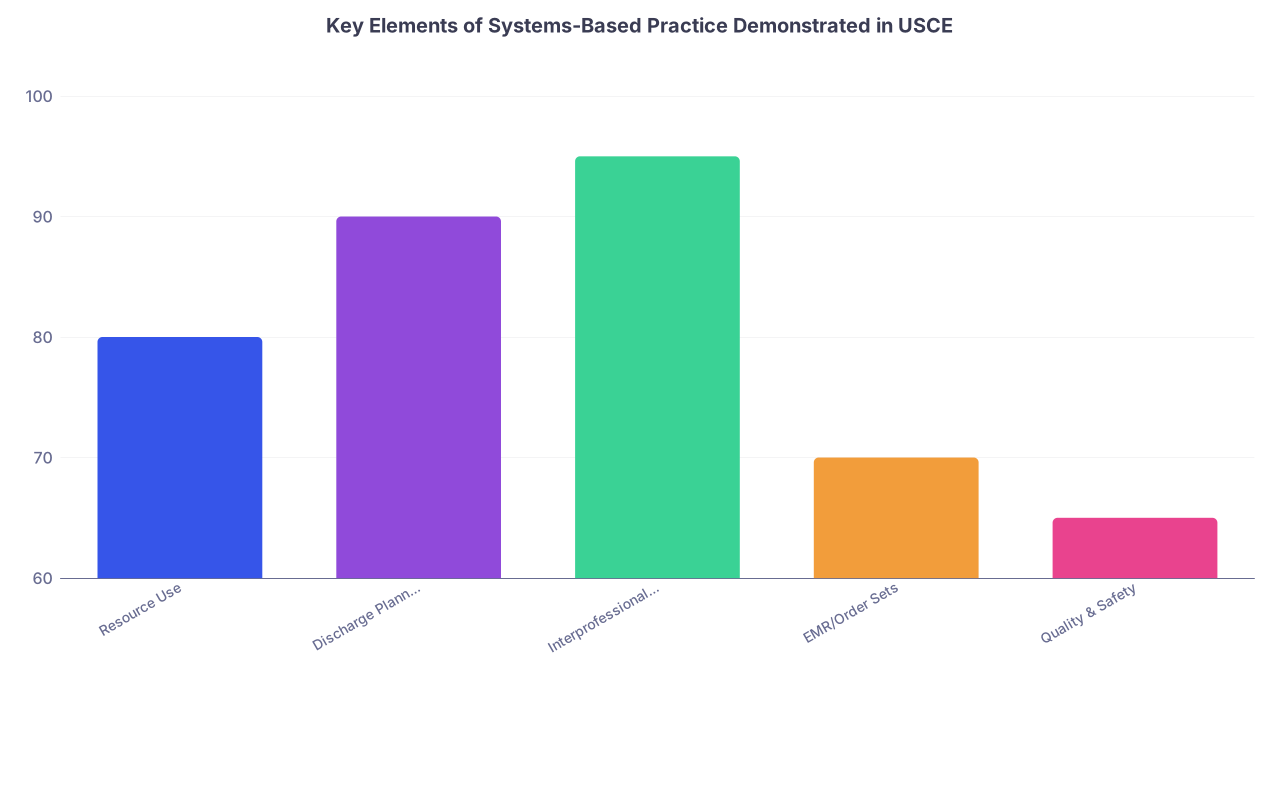
| Category | Value |
|---|---|
| Resource Use | 80 |
| Discharge Planning | 90 |
| Interprofessional Teamwork | 95 |
| EMR/Order Sets | 70 |
| Quality & Safety | 65 |
8. Turning Home Country Experience into a Systems Asset (Without Lying)
You cannot fake US systems exposure if you did not have it. But you can intelligently link your home system experience to SBP concepts you saw in the US.
Example:
- You worked in a government hospital with limited imaging availability.
- You had to prioritize CT use or manage with ultrasound and good clinical exam.
- During USCE, you saw similar thinking about resource use when insurance limited advanced imaging.
You can say: “In my home hospital, I learned to prioritize diagnostic testing because of true resource scarcity. During my US rotations, I recognized a similar need to be thoughtful, this time due to cost and insurance constraints. In both systems, I have learned to justify tests based on clear clinical questions rather than habit.”
You have linked:
- Your background.
- US experience.
- Systems-based thinking.
That is smarter than pretending everything was exactly like the US.

| Step | Description |
|---|---|
| Step 1 | US Clinical Experience |
| Step 2 | Observe System Processes |
| Step 3 | Extract SBP Stories |
| Step 4 | ERAS Experience Entries |
| Step 5 | Personal Statement Cases |
| Step 6 | Letter Writer Talking Points |
| Step 7 | Interview Answers |
| Step 8 | Stronger SBP Signal |
9. Quick Checklist: Are You Actually Demonstrating Systems-Based Practice?
Before you submit ERAS, ask yourself:
For each major USCE:
- Do I explicitly mention anything about:
- Discharge planning or care transitions?
- Interprofessional or multidisciplinary teams?
- EMR workflows, order sets, or protocols?
- Insurance / cost / access issues affecting care?
- Quality or safety processes (checklists, huddles, incident reviews)?
Across my application:
- Is there at least one strong narrative showing:
- A patient case where system factors mattered.
- My active engagement with or learning from that system.
- Reflection on how this will affect my behavior as a resident?
If the answer is “no,” then your US clinical experience is underutilized. You are handing programs an empty shell instead of proof that you can function in their environment.
FAQs (Exactly 6)
1. I only did observerships (no hands-on). Can I still show systems-based practice?
Yes, if you paid attention and can describe what you saw in specific, practical terms. Focus less on “I examined the patient” and more on:
- How the team made discharge decisions.
- How insurance or social factors influenced care plans.
- How nurses, case managers, and pharmacists contributed. You can still present strong SBP examples from observation, as long as your stories are concrete and accurate.
2. My home country system is completely different. Should I highlight that or avoid it?
Highlight it, but tie it to how you learned to adapt in the US. For example:
- “In my home hospital, rehab facilities barely exist, so families provide most post-discharge care. In the US, I learned how SNF and home health services work and how the team decides between them.” The key is to show flexibility and insight, not judgment. Contrast is fine; resistance is not.
3. How can I get my letter writers to comment on systems-based practice without sounding pushy?
After they agree to write a letter, send a short, polite email with:
- Your CV.
- A brief reminder of your rotation.
- 2–3 bullet points of what you focused on (for example, discharge planning, working with nurses, learning US insurance issues). You are not scripting them. You are jogging their memory and signaling what programs care about. Most attendings appreciate this.
4. What if my USCE was in a very small clinic without case management, social work, or complex systems?
Then lean into what you did see:
- Referral patterns (how PCP coordinates with specialists).
- Use of EMR for reminders, refills, and results.
- How uninsured or underinsured patients were managed (sliding scale, community resources). You can still talk systems—just at an outpatient and primary care level.
5. Will programs see it as “trying too hard” if I use the phrase ‘systems-based practice’ explicitly?
Using the exact phrase once or twice is fine, but do not overdo it. The content matters more than the label. Instead of writing, “I demonstrated systems-based practice,” write, “I participated in multidisciplinary discharge planning rounds and learned to anticipate barriers such as medication cost and home support.” The evaluator will mentally tag that as SBP.
6. How many SBP examples do I actually need in my application?
Quality beats quantity. As a baseline:
- 1–2 strong SBP-focused sentences per major USCE entry in ERAS.
- 1 clear SBP patient story in your personal statement.
- 2–3 flexible SBP stories you can adapt for behavioral interview questions. If you hit those, you are already well ahead of most IMG applicants at the same level.
Key takeaways:
- Systems-based practice is not abstract theory; it is how you function inside US healthcare—use your USCE to prove you understand that.
- Translate your rotations into specific, system-oriented stories about discharge, team-based care, cost, EMRs, and safety.
- Make sure this signal appears in your ERAS entries, personal statement, letters, and interviews—or your US clinical experience will not work as hard for you as it should.