
It is late August. ERAS opens in two weeks.
You are staring at your CV, and under “US Clinical Experience” there are three observerships, one hands-on externship, and a research position that may or may not count as “clinical.” You keep seeing programs say “we require hands-on USCE” and others say “US clinical exposure preferred.” You are not completely sure where your experiences fit—or which ones will actually move the needle.
Let me break this down specifically: hands-on vs observership is not a superficial distinction. Program directors use it as a rough filter for readiness, liability risk, and how seriously you have tested yourself in the US system. But the nuance matters. A well-structured observership can be more valuable than a chaotic, low-quality “hands-on” rotation. And different specialties and program tiers care about this very differently.
We will dissect that.
1. What Program Directors Mean by “Hands-On” vs “Observership”
Forget the terminology for a moment. Think about what PDs really want: evidence that you can function safely, efficiently, and culturally appropriately in a US hospital. Then the labels start to make sense.
Hands-On USCE – What It Actually Is
Hands-on clinical experience typically includes:
- Direct patient contact
- Documented clinical responsibility (with supervision)
- Your name appearing somewhere in the care chain: notes, orders (pended), handoffs, or call lists
Common formats:
- US externship for IMGs
- Sub-internship (sub-I) / acting internship (AI)
- Elective rotations during final year of med school (for still-enrolled IMGs)
- Transitional or preliminary spots (for those already in a program)
Concrete markers that PDs look for in hands-on USCE:
- You wrote notes in the EMR (even if co-signed)
- You presented patients on rounds as a primary provider
- You called consults or gave sign-out
- You participated in procedures beyond “watching”
If your experience did not allow any of this, it is not truly hands-on, regardless of what the certificate says.
Observership – What It Actually Is
Observerships, shadowing, or “clinical observation” roles typically include:
- No direct patient care
- No documentation in EMR
- No orders, prescriptions, or billing under your name
- You are legally and institutionally classified as an observer
You:
- Watch bedside exams and procedures
- Listen to handoffs and plan discussions
- Attend clinic and rounds
- Discuss cases with the attending, often after the encounter
From a PD’s perspective: observership shows exposure, not performance.
Why They Care About The Distinction
Liability and functionality.
Hands-on USCE tells them:
- You have at least some familiarity with US documentation, workflow, and communication norms
- Someone was willing to trust you enough to let you touch their patients and chart
- Your letters can credibly mention “clinical judgment,” “work ethic on the wards,” and “team functioning”
Observership tells them:
- You made the effort to enter the system and watch it
- You at least know how rounds look, what an Epic/PowerChart screen vaguely resembles, and how teams communicate
- But no one has seen you carry a patient load in the US. That still remains unproven.
This is why some programs list “Hands-on USCE required” as a hard filter.
2. How Different Programs Interpret USCE Requirements
Not all programs read your CV the same way. A community FM program in the Midwest is not judging you like a top-tier academic neuro residency.
Let us be granular.
| Program Type | Hands-On Required? | Observership Value | Notes |
|---|---|---|---|
| Community Internal Medicine | Often yes | Moderate | 2–4 months hands-on preferred |
| University Internal Medicine | Prefer yes | Some | Strong letters > label |
| Family Medicine (Community) | Usually yes | Moderate | Outpatient hands-on huge plus |
| Psychiatry | Mixed | Moderate–High | US exposure + empathy valued |
| General Surgery | Strong yes | Low–Moderate | Real OR/ward responsibilities |
| Neurology | Prefer yes | Moderate | Stroke/call exposure valued |
This is approximate, but it tracks with what PDs say in surveys and what you actually see on program websites.
Community vs University Programs
Community programs:
- Often more rigid on “hands-on USCE” because they have fewer resources to train someone from scratch in EMR, workflow, and culture.
- They want someone who can step onto the floor and not be lost the first month.
- They also often rely more on IMGs, so they have learned (the hard way) which filters predict who will struggle.
University programs:
- Often more flexible if you compensate with research, strong academic profile, and powerful LORs from known faculty.
- They may accept high-quality observerships at academic centers if your letters show serious engagement and insight, not just passive watching.
I have seen applicants match at solid university IM programs with 0 “formal” hands-on USCE but 3 high-level observerships with heavy case discussion, involvement in QI/research, and letters from big-name attendings who clearly knew them. That is the exception, not the rule—but it happens.
3. What Hands-On USCE Actually Signals On Your Application
Do not romanticize it. Hands-on is not “better” because you touched more patients. It is better because it lets your evaluators answer very specific risk questions.
Risk Question 1: Can You Function On Day 1?
PDs worry about:
- Will you freeze during your first cross-cover call?
- Can you write a coherent SOAP note and assessment/plan without 90 minutes per patient?
- Do you know what “page me if SBP stays above 180 despite maxed labetalol” actually means operationally?
Hands-on USCE—if real—generates LOR phrases like:
- “She independently followed a panel of 6–8 patients and presented concise, accurate updates on rounds.”
- “He demonstrated rapid improvement in EMR documentation and could reliably generate thorough, organized daily notes.”
- “She actively participated in cross-cover and triage discussions and showed sound clinical reasoning for her level.”
Those sentences reduce the PD’s anxiety. That is the currency.
Risk Question 2: Are You a Cultural Misfit?
A lot of struggle for new IMGs is not knowledge. It is:
- Hierarchy differences (you do not argue with the attending like you did with senior consultants back home).
- Expectations on autonomy and when to escalate.
- Team dynamics with nurses, APPs, social work, case management.
Hands-on USCE gives:
- Evidence of how you handle feedback, conflict, and nursing pushback.
- Examples of how you adapt to interprofessional culture.
Strong hands-on letters often mention: “excellent rapport with nursing staff,” “adapted quickly to the US system,” “communicated respectfully with patients and team.” Those comments stabilize you in the PD’s mind.
Risk Question 3: Are Your Clinical Skills Current?
If you graduated in 2018 and have not touched a patient in 5 years, you are high-risk—unless you show recent, real clinical responsibility.
Hands-on USCE is the easiest way to demonstrate that you are not clinically “stale.” Programs that say “graduation within 5 years” sometimes soften this if you have continuous, substantial hands-on practice (even outside the US), but recent USCE makes their decision easier.
4. Where Observerships Actually Shine (When Done Properly)
Here is where people get this wrong. Observerships are not useless. Bad observerships are useless.
What A High-Yield Observership Looks Like
Features of a strong observership:
- You are assigned to one attending or a small group consistently
- You attend all rounds, clinics, and conferences—not just the “cool” days
- The attending quizzes you and expects pre-round prep and reading
- You discuss assessment and plans in detail after seeing or hearing the case
- You get involved in QI, research, or case write-ups
- By the end, your attending genuinely knows your thinking and work habits
That kind of observership can produce:
- Letters that address your reasoning, reliability, curiosity, and team presence
- Insightful personal statement material that sounds like you actually lived in a US hospital, not just peeked in
What A Low-Yield Observership Looks Like
Red flags:
- You “float” between 6 attendings in 4 weeks and no one knows you well
- You show up at 10 am, watch 3 patients in clinic, and go home
- No structured expectations, just “feel free to follow whoever you want”
- The attending’s letter is two paragraphs of generic fluff: “He was punctual and observed clinical care…”
PDs recognize this instantly. That letter does not help you. Sometimes it hurts because it telegraphs that you did the bare minimum.
When Observerships Are Strategically Powerful
Observerships shine in:
Early exposure phase
You are still a student or a recent grad figuring out US medicine. You need to see if this system fits you at all. Observerships let you sample fields without committing to expensive externships.Specialty exploration
Especially useful when transitioning from one field to another (e.g., surgery in home country → switching to IM or anesthesia in US). A short, intense observership in the new specialty gives you language and context.Building academic connections
Observerships at major academic centers can plug you into research and mentorship that would never happen via a community externship. That can be transformative for competitive specialties.When hands-on options are limited
Visa status, licensing constraints, or geography may block formal hands-on roles. A high-quality observership is then your best available lever.
5. Quality vs Label: Not All “Hands-On” Rotations Are Equal
Here is the part most applicants do not appreciate enough: a garbage “hands-on” externship can be less valuable than a robust observership.
Types Of Low-Value “Hands-On” Experiences
You pay a third-party company for an “externship” that:
- Puts you in a clinic where you room patients and take vitals, but never truly discuss management
- Has you write “notes” that never enter the EMR and are never meaningfully reviewed
- Gives you almost no direct teaching
- Produces a mediocre, template-like letter
Technically “hands-on.” Practically low yield.
Programs can often smell these. They know which companies churn out dozens of externs each month. They also know which clinics are glorified scribe positions without real cognitive engagement.
On the flip side, I have seen observerships at places like Mayo, Cleveland Clinic, and major academic IM departments produce pointed, high-signal letters that clearly outrank some community “externship” letters in value.
So Which Should You Choose With Limited Time/Money?
If you must choose, ask yourself:
- Will I have real responsibility and feedback?
- Will the supervising physician know me well enough to write a specific letter?
- Is this aligned with the specialty and program types I am targeting?
If an observership at an academic department with clear teaching, structured expectations, and realistic access to a letter from a reputable faculty is competing against a vague, low-structure “externship” at a random clinic, I will take the observership every time.
Hands-on is not inherently superior. High-yield is superior.
6. How Many Months Of USCE And Which Mix Is Ideal?
You want a number. That is reasonable.
For Internal Medicine / Family Medicine
For a typical IMG targeting community or mid-tier university IM/FM:
- Total USCE: 3–6 months is a realistic, strong target
- Hands-on: 2–3 months hands-on is usually enough for many community programs, especially if:
- At least 1 rotation in the US matches your target setting (e.g., community hospital IM service)
- You have 2 strong US-based clinical letters
Observerships can then supplement:
- Additional 1–3 months of observerships, especially at academic centers, can help boost your letters and show broader exposure.
For Surgery / Surgical Subspecialties
More demanding:
- Hands-on requirement is heavier and more strict
- 3–6 months minimum hands-on in surgery or surgical IM-like setups
- Observerships are relatively weaker unless they are at top academic centers and tied to research.
Real talk: if you are an IMG with only observerships and no hands-on in surgery, most programs will not even review you.
For Psychiatry / Neurology
Somewhat flexible:
- 2–3 months total USCE, mix of hands-on and strong observerships, can be enough
- Programs tend to value personality fit, communication, and long-term interest highly
- Observerships in outpatient and inpatient psych/neuro, with documented engagement, are much more accepted.
For Those With Older YOG Or Gaps
If your year of graduation is older (>5–7 years):
- You should aim for recent, continuous USCE, ideally hands-on
- Observerships help but will not fully compensate for no real clinical work in years
- If you have been practicing in your home country, recent, serious practice + USCE (even partly observational) can still work, but you must show recency and depth.
7. How To Present Hands-On vs Observership On ERAS Without Overplaying It
PDs dislike CV inflation. Calling a shadowing gig “Externship” when you never touched a patient or chart is a fast way to lose credibility.
Labeling On ERAS
Use this basic scheme:
- “Clinical Externship – Internal Medicine (Hands-On)”
- “Sub-Internship – Family Medicine (Hands-On)”
- “Clinical Observership – Cardiology”
- “Clinical Observership – Neurology (Academic Center)”
Then, in the description:
- For hands-on: explicitly mention “direct patient contact,” “EMR documentation,” “presented on rounds,” “participated in…”.
- For observership: emphasize depth of exposure, case discussions, conferences, research/QI projects.
Do not try to sneak “hands-on” into something that was not. If the program calls to verify and hears “the observer did not participate in patient care,” you look dishonest. Some PDs remember those names.
Maximizing The Perceived Value Of Observerships
You cannot magically make observerships hands-on. But you can frame them as serious learning experiences, not tourist visits.
Focus on:
- Complex case exposure: “Followed ~30 inpatient cardiology cases per week, including ACS, HFrEF, endocarditis…”
- Structured teaching: “Participated in daily teaching rounds, weekly M&M, journal club.”
- Cognitive work: “Prepared and presented case discussions, differential diagnoses, and management plans to attending (non-documenting role).”
- Projects: “Contributed to retrospective chart review on stroke outcomes, abstract submitted to national conference.”
This is how you make an observership sound like legitimate clinical maturation rather than “I just showed up and watched.”
8. Strategy: Choosing And Sequencing Your Experiences
If you are 1–2 years out from applying, here is a pragmatic way to think about it.

| Step | Description |
|---|---|
| Step 1 | Start - No USCE |
| Step 2 | Early Observerships |
| Step 3 | Targeted Hands-On First |
| Step 4 | High-Yield Only |
| Step 5 | Academic Observership + Research |
| Step 6 | Hands-On Externships |
| Step 7 | 1-3 Hands-On Rotations |
| Step 8 | Supplement with Observership if possible |
| Step 9 | Best Single Hands-On or Top Observership |
| Step 10 | Apply with Mixed Portfolio |
| Step 11 | Time before ERAS |
If You Have 12+ Months Before Applying
Ideal plan for IM/FM/psych/neurology:
- Start with 1–2 months of strong observership at academic institutions.
- Learn system, build connections, maybe start research.
- Then do 2–3 months of hands-on externships/sub-Is in your target specialty and setting.
- Aim for at least 2 letters from hands-on, 1 from an academic observership or research mentor.
If You Have 6–12 Months
You must be more selective.
- Prioritize 2–3 months of hands-on in your target specialty.
- Add 1–2 months of observership if you get access to a strong academic mentor or research.
- Do not scatter across 5 specialties. Depth > breadth.
If You Have <6 Months
You are in salvage mode; you cannot do everything.
- One very strong, well-structured hands-on rotation OR
- One extremely strong, academically-connected observership with research and a powerful letter
Better to have one or two high-impact experiences than four shallow ones.
9. Specialty-Specific Nuances: A Quick Snapshot
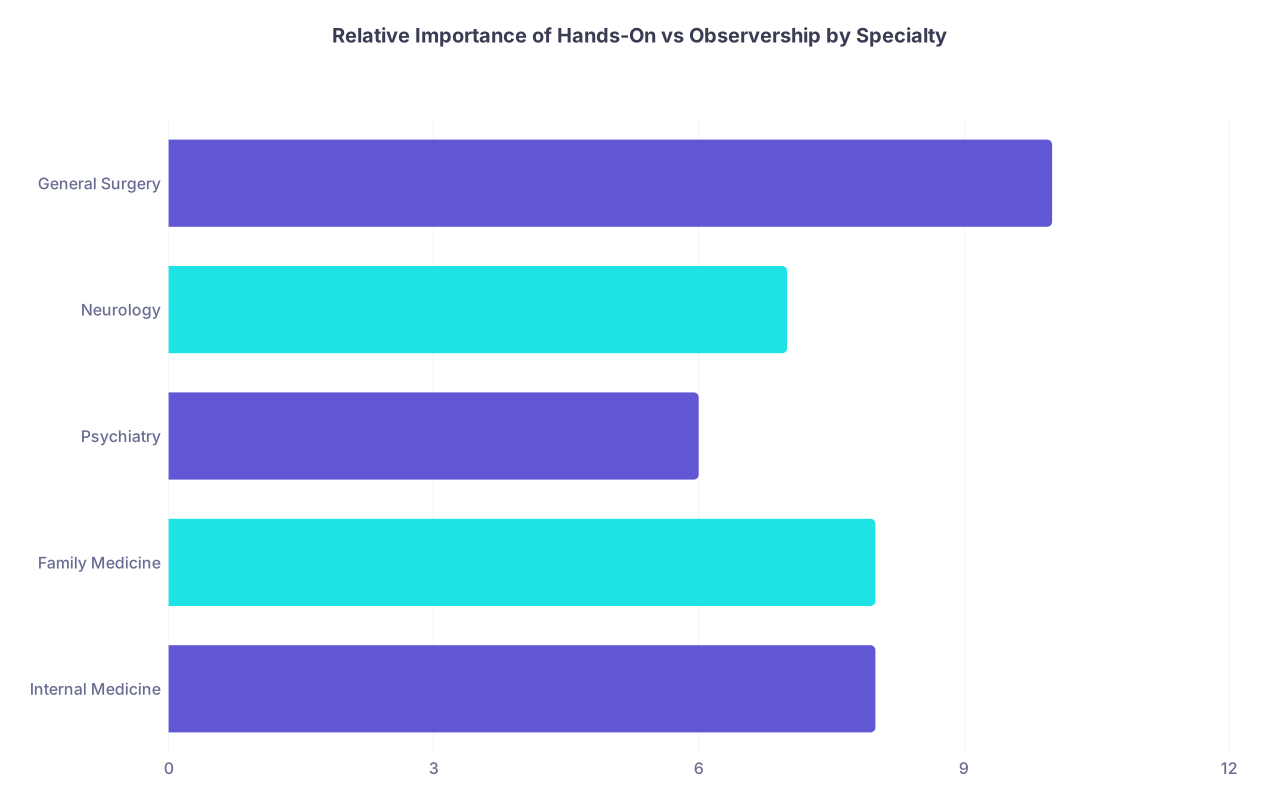
| Category | Value |
|---|---|
| Internal Medicine | 8 |
| Family Medicine | 8 |
| Psychiatry | 6 |
| Neurology | 7 |
| General Surgery | 10 |
(Scale 1–10: how strongly programs lean toward needing hands-on vs being satisfied with observership-heavy portfolios.)
Internal Medicine
- Strong preference for at least some hands-on
- Observerships at academic centers recognized and valued, especially if letters strong
- ICU, wards, and continuity clinic exposures are ideal
Family Medicine
- Outpatient hands-on rotations are particularly valuable
- Programs like to see you in primary care settings similar to their own
- Observerships are secondary unless tied to clear responsibility or community integration
Psychiatry
- Many programs accept mixed hands-on/observership profiles
- Emphasis on communication skills, empathy, and capacity for longitudinal care
- Strong psych observership letters can carry serious weight
Neurology
- Hands-on stroke service, general neuro, or neuro ICU rotations helpful
- Observerships with structured teaching in large centers valuable, especially with research
General Surgery
- Programs heavily biased toward real, hands-on OR/ward work
- Observerships mostly meaningful only at large academic centers if associated with research and strong letters
- Without hands-on, chances are low at most places
10. Red Flags And Common Mistakes With USCE
I have seen the same patterns hurt IMGs over and over.
1. “Collecting Certificates” Mindset
Fourteen short observerships are not impressive. They telegraph indecision, superficial engagement, and maybe a focus on optics over substance.
Better: 3–5 well-chosen, deep experiences with continuity and meaningful roles.
2. Inflating Roles
Labeling shadowing as externship. Claiming to “manage patients” when you only watched. PDs hold grudges about dishonesty. Trust is everything.
3. Unaligned Specialty Experience
Applying to IM with 6 months of USCE, all orthopedic and neurosurgery observerships. The question they ask: “Why IM, and why now?” You will struggle to answer convincingly.
At least 2–3 months should clearly match the specialty you are applying to.
4. Weak Letters From Overcrowded Rotations
Everyone wants rotations with famous names. But if you are one of 8 observers/externs crowding one attending, your letter will likely be generic.
Sometimes the best letters come from less famous community attendings who actually saw you work at 6 am daily for four weeks.
11. Putting It Together: When Is Observership “Enough” And When Is Hands-On “Non-Negotiable”?
If your question is: “Can I match with only observerships?” the honest answer is: yes, sometimes, but not commonly, and mostly in specific contexts:
- Strong academic observerships with sharp, personalized letters
- Solid research with publications/presentations in your target field
- Reasonable YOG, good exam scores, and clear narrative of commitment
For many community-heavy specialties—IM, FM, surgery—hands-on USCE is not just a bonus; it is a quasi-screening tool. Absence of any hands-on severely limits what doors even open to you.
On the flip side, chasing “hands-on” for the label—without assessing depth, teaching, and letter potential—is a mistake.
The right move is not “hands-on vs observership.” It is:
- High-yield vs low-yield
- Aligned vs scattered
- Real responsibility vs passive watching
You build a portfolio, not a collection of buzzwords.

FAQ (Exactly 4 Questions)
1. If I can afford only one rotation, should I choose a hands-on externship or a big-name observership?
If it is truly one rotation only and you are aiming for IM/FM/psych/neurology, I would usually choose a solid, structured hands-on externship in your target specialty at a decent community or university-affiliated program. You need at least one experience that proves you can function clinically. The exception: if you have high scores, some home-country experience, and can secure a top-tier academic observership with real teaching and research potential, that can sometimes beat a low-quality externship. But do not sacrifice responsibility for prestige if your profile is already borderline.
2. Does tele-rotation or virtual observership count as USCE?
For most PDs, no. Virtual exposure during peak COVID was tolerated because everyone understood the constraints. Now, it is essentially background noise. You can mention it, but it does not replace in-person USCE. It may slightly help your narrative or show early interest, but it will not satisfy a “hands-on USCE required” box, and it rarely generates strong letters.
3. Will an observership help if my graduation year is very old (e.g., >7–10 years)?
On its own, not much. For older graduates, the critical question is: have you been actively practicing clinically? If yes, observerships can show adaptation to the US system and help you transition specialties. If you have been out of practice entirely, a few months of observership will not magically erase a long clinical gap. In that scenario, you need substantial, recent, real clinical work (home country or US) plus USCE; otherwise many programs will auto-screen you out.
4. How many letters should come from hands-on vs observership experiences?
For most IMG applicants, a strong pattern is:
- At least 2 letters from US-based clinical experiences
- Ideally, 1–2 from hands-on rotations where you carried patients, wrote notes, and got real feedback
- A third letter can be from a high-quality observership (especially at an academic center) or from research in your field
If all three letters are from observerships and none mention genuine clinical responsibility anywhere (US or home country), you look untested. If at least one letter clearly describes you functioning in a clinician role—even outside the US—that helps anchor the rest.
Key Takeaways
- Hands-on vs observership is not about prestige. It is about how much real responsibility and evaluation you can show.
- High-quality observerships at serious academic centers can outperform low-yield “hands-on” externships that offer little teaching or insight.
- For most IMGs, a mixed portfolio—2–3 months real hands-on plus 1–3 months of strong observerships—is the most effective and realistic route into the US residency system.