
The biggest mistake IMGs make with US clinical experience is treating every rotation like a generic checkbox instead of a story of progressive responsibility.
You are not just collecting letters. You are building a trajectory. And program directors can tell, in about 30 seconds, whether that trajectory exists or not.
Let me break this down specifically.
What “Progressive Responsibility” Actually Means in US Eyes
US programs are obsessed with one question: “Can this person function as an intern on Day 1?”
They do not answer that by asking how many months of USCE you have. They answer it by looking for progression:
- Did you move from observer to active participant?
- Did you go from copying notes to independently formulating plans?
- Did you evolve from “shadowing” to “owning” patients under supervision?
- Did your roles and expectations increase rotation after rotation?
In US residency-speak, “progressive responsibility” means:
- Increasing complexity of clinical tasks.
- Increasing autonomy in decision-making (still supervised).
- Increasing accountability for follow-up and continuity.
- Increasing leadership in the team (even at the student level).
If your US rotations look like this:
- 3 months of “observerships”
- 2 months of “externships”
- 1 research month
…with no documented change in responsibility, that is weak.
If they look like this:
- Month 1–2: Observer → focused on basic clinical exposure
- Month 3–4: Hands-on extern → pre-rounds, writing drafts, presenting
- Month 5–6: Senior elective / sub-I style → “owning” a small list, leading presentations, follow-up
…that is exactly what PDs are looking for.
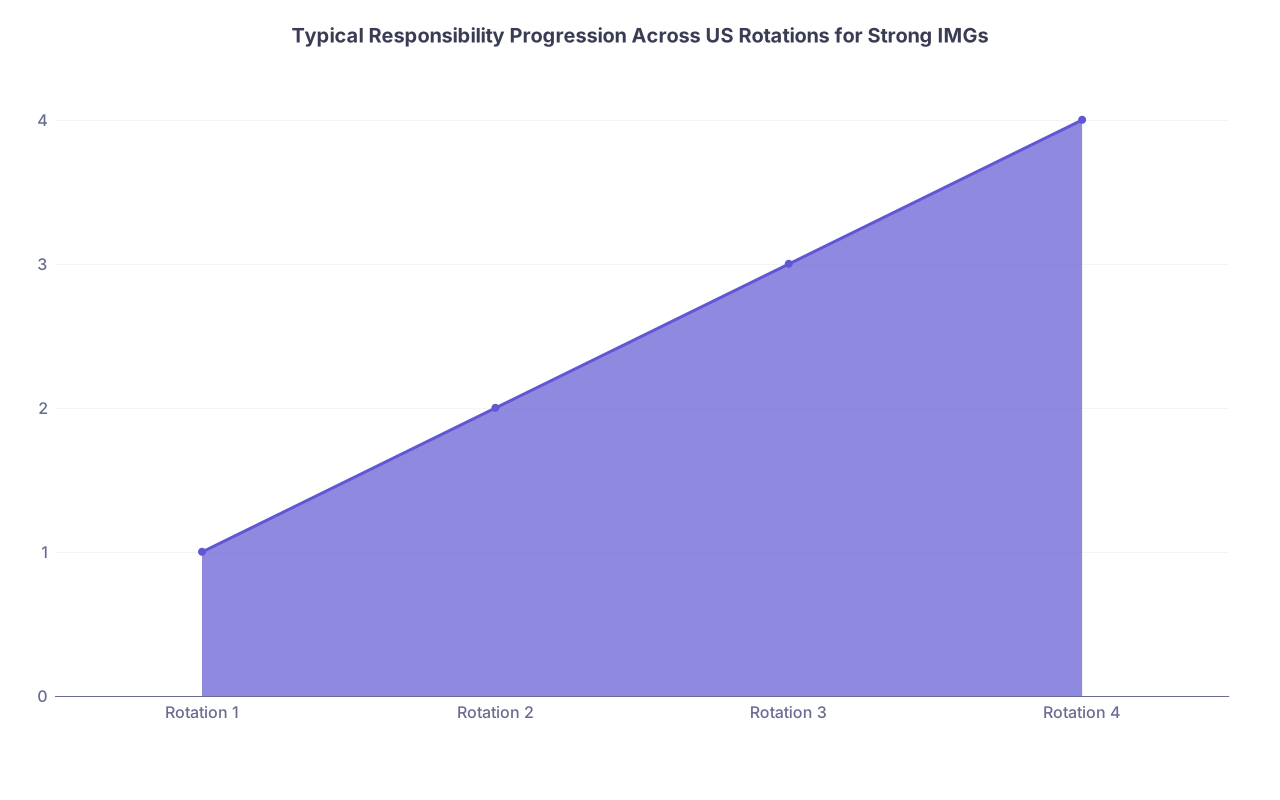
| Category | Value |
|---|---|
| Rotation 1 | 1 |
| Rotation 2 | 2 |
| Rotation 3 | 3 |
| Rotation 4 | 4 |
(Where 1 = pure observer, 4 = near-intern level responsibilities.)
Your job is to engineer and then clearly show that progression.
Step 1: Design Your Rotations Like a Ladder, Not a Pile
Most IMGs take whatever rotations they can get, in whatever order. That is understandable. It is also strategically sloppy.
You want your rotations to look intentional. Like you climbed levels.
Build a responsibility gradient
If you have control over scheduling, aim for something like this:
Level 1 – Introductory/Observer
- Purpose: Learn US system, documentation style, basic rounding structure.
- Typical roles: Observe encounters, help with data gathering, basic presentations.
- Best early: First US rotation, especially if you are unfamiliar with US hospital workflow.
Level 2 – Core Hands-on Externship
- Purpose: Show you can function within a US team with real tasks.
- Roles: Pre-rounds, collect data, draft notes, present on rounds, call consults (supervised).
- This is where you should live for most IMGs trying to match.
Level 3 – High-responsibility Elective / Sub-I–style
- Purpose: Demonstrate near-intern functioning.
- Roles: “Own” 3–5 patients, present comprehensively, propose plans, follow results, update families, coordinate discharges.
| Rotation Order | Type | Responsibility Level |
|---|---|---|
| 1 | Community IM observership | Level 1 |
| 2 | University IM externship | Level 2 |
| 3 | IM subspecialty elective | Level 2–3 |
| 4 | IM sub-I style elective | Level 3 |
If you are late in the game and already did low-responsibility rotations, fine. You can still frame them as your “foundation” and then emphasize later, higher-level experiences.
Avoid the “same thing x4” problem
If all your rotations sound the same—“I saw patients, I rounded with the team, I presented cases”—you look flat. No arc.
Ask yourself for each successive rotation:
- What am I doing now that I could not have managed two months ago?
- What new responsibilities did I ask for or was I granted?
- How did my scope of practice expand?
If you cannot answer those, you probably are not progressing. Or you are, but nobody will know because you are not documenting it.
Step 2: Maximize Responsibility Within Each Rotation
You cannot control every program. But inside almost any US rotation, there is room to quietly move from passive to active.
Here is how you actually do that, day to day.
Week 1: Show basic reliability, then ask for the first step up
Your first 3–5 days are your credibility test.
Do this first:
- Arrive earlier than everyone else.
- Know your patients’ overnight events without being asked.
- Always have vitals, labs, and imaging pulled up.
- Never be empty-handed: carry a small notebook with organized patient summaries.
Then you ask very specific, targeted questions to increase responsibility:
Instead of:
“Can I do more?” (too vague)
Say:
“Dr. Smith, I have been following Mr. X closely. Would it be acceptable if I pre-round on him and Ms. Y tomorrow and prepare a brief SOAP-style presentation for rounds?”
Concrete. Contained. Low risk for them. High signal for you.
Week 2: Move from “reporting” to “proposing”
The next step is not doing procedures. It is clinical thinking.
When you present:
Weak: “Sodium is 128. Creatinine is 2.5. He is a little short of breath.”
Strong: “Sodium has fallen from 132 to 128 over 24 hours, likely hypervolemic hyponatremia in the setting of CHF. I would suggest fluid restriction, adjust diuretics, and monitor sodium q6–8h. I would also like to trend his weight and input/output more closely.”
You are not just listing data. You are making a plan. Always end with “Does that seem reasonable?” or “Would you recommend a different approach?” to signal respect for hierarchy.
You write this level of thinking into your notes, even if they are “for learning only.”
Week 3–4: Own a mini-panel and close the loop
By the second half of the rotation, you want phrases like this to be true and observable about you:
- “She always knows what happened to her patients’ consults.”
- “He follows up labs without being prompted.”
- “She updates families and documents those conversations.”
- “He calls the nurse back and adjusts the plan when things change.”
Make yourself the first person the intern or resident thinks of when something happens with “your” patient.
I have seen IMGs do this well on busy medicine services: they quietly make a list of:
- Labs to be checked later in the day
- Imaging reports pending
- Consults requested
- Family meetings planned
Then, before leaving, they go down that list and verify outcomes. That is exactly what interns do. And attendings notice.

Step 3: Turn Responsibility into Letters That Actually Prove Something
Most IMGs collect nice, bland letters that say very little:
“X is hard-working, punctual, and a pleasure to work with.”
That is background noise. Everyone has that.
You want letters that specifically document progression and responsibility. That is the gold.
Prime your attendings (without being annoying)
Near the end of the rotation—about 7–10 days before finishing—ask for feedback and mention your trajectory. For example:
“Dr. Patel, I was hoping for some feedback. At the beginning of the month I focused on learning the system and presenting clearly. These last two weeks, I tried to take more responsibility for a small group of patients, including following their labs, adjusting plans with the residents, and updating families. Are there areas where I could function more like an intern?”
You just:
- Reminded them that your role expanded.
- Put “function more like an intern” in their head.
- Gave them usable language for the letter.
Then, when you formally ask for a letter:
“I am applying to internal medicine and your rotation was the first where I felt I was functioning close to an intern level. If you feel you can comment on my progression and my ability to handle increasing responsibility, I would be honored to have your support.”
You did not write the letter for them. But you pointed their attention exactly where you want it.
What strong letters for IMGs actually say
You are looking for content like this (paraphrased, obviously):
- “At the beginning of the rotation, she was understandably cautious. In the second half, she began to independently pre-round on 3–4 patients, systematically synthesize data, and propose management plans that were appropriate and safe.”
- “By the end of the month, he functioned at the level of a very strong sub-intern; I would be comfortable with him as an intern on my service.”
- “She demonstrated ownership of her patients by following up labs, calling consults under our supervision, and providing thoughtful updates to families.”
- “His responsibilities increased beyond typical student expectations because he consistently demonstrated sound judgment and reliability.”
If your letters do not include anything concrete about “responsibility,” “ownership,” “intern level,” “progression,” you left money on the table.
Step 4: Document Progression Explicitly in Your CV, ERAS, and Personal Statement
Stop assuming program directors will “infer” progression from dates. They will not. You need to spell it out.
On your CV and ERAS experiences
Do not write this:
“Clinical externship, Internal Medicine – Observed patients in clinic and hospital. Participated in rounds. Presented patients.”
That describes 5000 IMGs. It does nothing for you.
Describe your responsibilities with escalating language, especially in later rotations. For example:
Early rotation (foundation-type):
“Observership – Internal Medicine, Community Hospital
- Observed inpatient and outpatient care in a US community hospital.
- Learned US documentation standards, EMR navigation, and multidisciplinary rounding structure.
- Assisted with collection of patient histories and review of labs/imaging under supervision.”
Later, higher-responsibility externship:
“Clinical Externship – Internal Medicine, University Hospital
- Independently pre-rounded on 3–5 patients daily, collected interval history, and reviewed vitals, labs, and imaging.
- Presented full SOAP-style notes on rounds and proposed initial assessment and plan for each active problem.
- Drafted daily progress notes and admission H&Ps for resident review and co-signature.
- Coordinated follow-up of critical labs and consult recommendations and communicated updates to the team.”
Highest level / sub-I style:
“Advanced Clinical Elective – Internal Medicine (Subinternship-style)
- Functioned in a near-intern role by ‘owning’ a small panel of 4–6 patients under resident/attending supervision.
- Led bedside presentations, created initial management plans, and adjusted treatment based on evolving clinical status.
- Communicated daily with nursing staff and families, and participated in discharge planning and medication reconciliation.
- Received direct feedback from the attending that my performance was at or above typical subintern level.”
Keywords like “independently,” “proposed,” “owned,” “coordinated,” “led” show increasing responsibility.

In your personal statement
You do not want to list all rotations again. You want to show that you grew.
Bad version:
“I completed several rotations in the US where I learned about patient care, teamwork, and communication.”
Strong version:
“During my first US observership, I needed my resident to walk me through even basic admission orders. Four months later, on my advanced medicine elective, I was pre-rounding on a small list of patients, presenting full assessments, and proposing initial management that my attending largely accepted with only minor adjustments. That progression—from quiet observer to someone my team trusted with real responsibilities—confirmed that I am ready to function as an intern.”
Sequence. Contrast. Responsibility.
You can even briefly tie different levels:
- First rotation: focus on basics, culture, EMR.
- Second: start presenting, drafting notes, proposing plans.
- Third: near-intern responsibility, ownership.
Make it clear this was not accidental. It was intentional growth.
Step 5: Use Interviews to Cement the Narrative
If your application suggests progression, your interview needs to seal it.
Program directors will not ask, “Tell me about your progressive responsibility.” They will ask:
- “What did you do on your US rotations?”
- “How hands-on were your experiences?”
- “Can you give an example of a time you managed a difficult patient?”
You answer those with a subtle time progression built in.
Answering “What did you do on your rotations?”
Do not give a generic blob. Give a timeline.
Try something like this:
“Initially, my US experience started with a community hospital observership, where my main role was to understand the US system and observe rounds. As I became more comfortable, my next rotation at [Program] gave me the chance to pre-round on 3–4 patients, prepare presentations, and draft notes. By the time I reached my advanced elective at [Other Program], I was functioning in a sub-intern style role, ‘owning’ a small list of patients, following their labs, proposing plans, and coordinating with nursing and consult teams under supervision.”
You just walked them through your responsibility ladder in 3 sentences.
Answering “How hands-on were you?”
Be concrete. Mention numbers and tasks.
Weak:
“It was quite hands-on. I saw patients and presented.”
Stronger:
“In my last two US rotations, I pre-rounded on about 4–6 patients each day. I would see them independently first, gather interval history, check vitals, labs, and imaging, and then present to the intern and attending with a proposed assessment and plan for each problem. I also drafted the daily progress notes and several new admission H&Ps for review and co-signature.”
That sounds like an intern. That is the point.
Answering “Tell me about a challenging patient”
Use it to silently highlight responsibility and follow-through:
- Your role at the start of the case
- The decisions you proposed
- How you tracked outcomes or followed up
- How you communicated with the team/nursing/family
Not just “we decided x,” but “I suggested x, discussed it with my senior, and then followed up on y.”

| Step | Description |
|---|---|
| Step 1 | Observer |
| Step 2 | Hands-on extern |
| Step 3 | Advanced elective |
| Step 4 | Subintern level tasks |
Step 6: Align Your Story with US Competencies
US program directors think in ACGME competency language, whether they say it out loud or not. You can subtly map your responsibilities to these without sounding forced.
Focus on three that are easiest for IMGs to demonstrate:
Patient Care
Show that over time you:- Moved from just writing down findings to synthesizing them.
- Began anticipating needs (e.g., pain control, DVT prophylaxis).
- Took initiative in follow-up and coordination.
Medical Knowledge
Show progression from:- Reading guidelines reactively after rounds.
- To bringing articles proactively to team.
- To making evidence-based suggestions in your plan.
Systems-based Practice & Interpersonal Skills
For IMGs, this is a big one. Show you:- Learned how to work with US nursing, case management, consults.
- Improved communication with families and multidisciplinary teams.
- Navigated the EMR efficiently and safely.
When you describe experiences, connect them briefly:
“On my first rotation, I largely observed how the resident communicated updates to the family and coordinated with case management. By my final elective, I was the one calling the cardiology consult, updating the family after our discussion, and documenting both conversations under attending supervision.”
That is systems-based practice plus interpersonal skills wrapped in one progression.
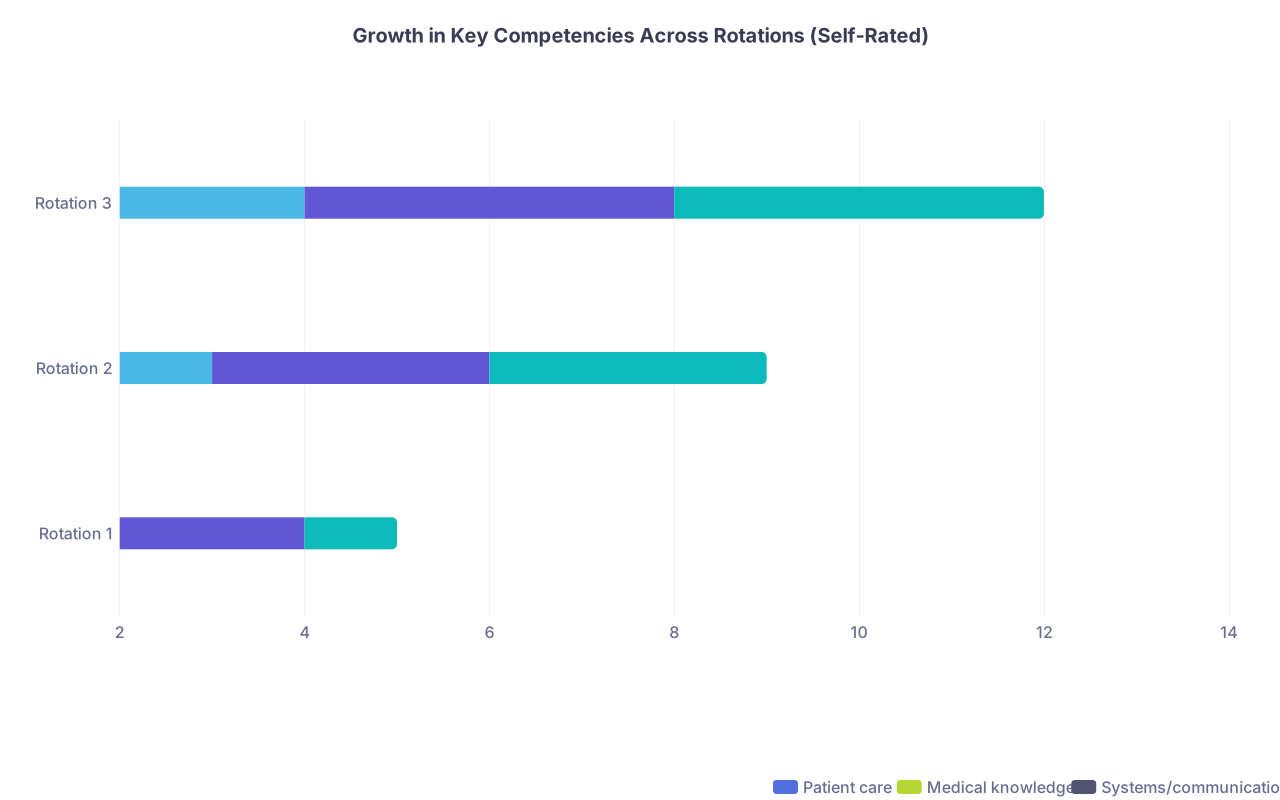
| Category | Patient care | Medical knowledge | Systems/communication |
|---|---|---|---|
| Rotation 1 | 2 | 2 | 1 |
| Rotation 2 | 3 | 3 | 3 |
| Rotation 3 | 4 | 4 | 4 |
Step 7: Common Mistakes IMGs Make (And How to Fix Them)
Let me call out the patterns I keep seeing that kill the “progression” narrative.
Mistake 1: Calling everything an “externship” when it was mostly shadowing
PDs are not stupid. If you had no EMR access, no notes, no orders, and you “mostly observed,” it was not a hands-on externship.
Fix:
Be honest on paper, but emphasize what you did do. Then, make sure your later rotations are truly hands-on and clearly described as such.
Mistake 2: Four identical-looking rotations in the same specialty with vague duties
“Participated in rounds, saw patients, presented.” On all four. That reads like copy-paste.
Fix:
Differentiate:
- First: orientation, observation, basic presentations.
- Second: consistent patient follow-up, more independent data gathering.
- Third: note drafting, plan proposals, more complex patients.
- Fourth: near-intern tasks, ownership, leadership.
Rewrite descriptions to show a staircase, not four flat steps.
Mistake 3: No continuity, just random specialties
An IMG applying to internal medicine with:
- 1 month cardiology observership
- 1 month radiology observership
- 1 month surgery observership
- 1 month dermatology research
…looks scattered and unserious for IM. Even if they learned something everywhere.
Fix:
If you already did this, anchor them:
- Emphasize the IM-relevant skills (cardio in IM, perioperative medicine for medicine patients, dermatology lesions in primary care).
- But make sure your recent and most responsible rotations are actually in your target specialty, and highlight those much more.
Mistake 4: Letting faculty write generic letters
If your attending barely remembers you, your letter will sound like a template. That is a problem.
Fix:
- Take responsibility early: ask for feedback, increase your role.
- Near the end, remind them of specific things you did (without being obnoxious). “I appreciated being allowed to independently follow Mr. X and Ms. Y; that experience of managing their fluid status and discharge planning was very meaningful to me.”
- Choose attendings who directly supervised you, not the famous name who saw you twice.

Final Thoughts
Progressive responsibility for IMGs is not just a buzz phrase. It is the single most convincing way to prove you can handle intern-level work in a US residency.
Three things to remember:
- Design and describe your rotations like a ladder, not a random pile—early low-responsibility, then clearly higher-responsibility roles.
- Inside each rotation, actively push your role from observer to thinker to owner—then make sure your letters and ERAS descriptions document that shift.
- In your personal statement and interviews, tell a clear before–after story: from cautious observer in your first USCE to near-intern on your final elective.
If you get those three right, your rotations stop being just “months in the US” and start becoming your strongest argument that you truly are ready for residency.