

The way most IMGs handle case logs and procedure tracking is sloppy, inconsistent, and costly. It quietly kills otherwise competitive applications.
You can fix that. But you have to stop treating logs as an afterthought and start treating them as legal-grade documentation of your US clinical experience.
Let me walk you through how to do this properly.
1. Why Case Logs Matter More for IMGs Than for AMGs
American grads have a built‑in advantage: their entire education is already “inside the system.” Your foreign transcript, clerkship summaries, and school letters are not.
Programs look at IMGs and immediately ask three questions:
- Can this person function safely in a US hospital?
- Has anyone in the US actually seen them work and is willing to vouch for them?
- Are their experiences real, recent, and substantial—or just a 2‑week observership dressed up as “clinical training”?
Case logs and procedure logs answer those questions in a way that is:
- Verifiable
- Quantifiable
- Time‑stamped
- Consistent with what your letter writers and CV say
Without that, you are basically saying, “Trust me, I did a lot of things in the hospital.” That does not work in a risk‑averse system.
A clean, structured case/procedure log:
- Gives your US letter writers concrete details to cite
- Helps you write precise, credible descriptions in ERAS
- Protects you if an interviewer digs into your experience
- Demonstrates professionalism and familiarity with US-style documentation
Residents in the US live in an environment of metrics and logs—AAMC case logs, procedure minimums, duty‑hour attestations. When you mirror that structure as an IMG applicant, you immediately look less risky and more aligned with how they already operate.
2. Case Log vs Procedure Log vs “Experience Log” – Stop Mixing Them Up
People lump all of this together and end up with a messy Google Doc full of random bullet points. That is amateur hour. You need three distinct but connected tracking systems.
2.1. Clinical Encounter (Case) Log
This is about patients and clinical problems, not technical acts.
You are tracking encounters like:
- New admission of decompensated heart failure
- Follow‑up visit for uncontrolled diabetes
- Emergency department evaluation of chest pain
- ICU transfer for septic shock
For IMGs in observerships or externships, a good case log shows:
- Breadth of pathology
- Settings (inpatient, outpatient, ICU, ED)
- Level of involvement (observed, discussed, presented, partially managed under supervision)
2.2. Procedure Log
This is about discrete procedures, even if you only observed them.
For example:
- Central line placement
- Arterial line insertion
- Lumbar puncture
- Thoracentesis
- Pap smear
- Laceration repair
- Joint aspiration
Your role matters enormously here:
- Performed independently (rare as a pre‑residency IMG in the US, and often not allowed)
- Performed under direct supervision
- Assisted
- Observed only
US programs treat exaggerated procedure claims as a red flag, especially pre‑residency. If you claim to have placed 50 central lines during a 4‑week “observership”, expect skepticism or worse.
2.3. Experience / Activity Log
This is the broader “work log”:
- Dates of rotation
- Site, hospital, city, state
- Specialty
- Attending/mentor names and titles
- Average weekly hours
- Type of experience: observership, externship, research, volunteer clinic, etc.
Think of this as the spine that holds your case and procedure logs together. Every patient and procedure entry should be traceable back to a named experience block.
3. What Programs Actually Care About in Your Logs
Programs do not want you to upload a 40‑page PDF of every patient you saw. They care that your experience description, letters, and interview answers are backed by something real, consistent, and reasonable.
Here is what matters:
- Recency – “US experience in the last 1–3 years” is not a slogan. It is usually a binary filter.
- Duration and intensity – Four weeks of full‑time inpatient exposure is different from two afternoons per week in clinic.
- Setting – Inpatient vs outpatient, community vs academic, primary care vs subspecialty.
- Level of participation – Did you just stand there, or did you present cases, write notes (even if not in the official EMR), suggest plans?
- Supervision – Named US physicians who can be contacted and who match your story.
So your logging system’s job is to generate, for each US experience, a believable summary like:
- “4‑week full‑time inpatient internal medicine observership at XYZ Community Hospital (NY), 40–50 hours/week, 60+ new admissions and 100+ follow‑up encounters observed, daily case presentations on rounds.”
or
- “3‑month outpatient family medicine externship at ABC Clinic (IL), 30–40 hours/week, ~200 patient visits observed, 60+ histories and focused exams performed under supervision, participated in medication reconciliation and counseling.”
That is what you want to be able to say—and defend.
4. Exactly What to Record: Field‑by‑Field
Let me be precise. You do not need every lab value, just the right metadata.
4.1. Experience / Rotation Log – Core Fields
This should be a master sheet. One row per rotation/experience.
| Field | Example Entry |
|---|---|
| Site / Institution | St. Mary’s Medical Center |
| Department / Specialty | Internal Medicine – Inpatient |
| City, State | Long Beach, CA |
| Type of Experience | Observership / Externship / Research / Volunteer |
| Attending / Mentor Name | John Smith, MD – Hospitalist |
| Start Date | 2025-03-02 |
| End Date | 2025-03-29 |
| Avg Hours per Week | 45 |
You can add columns later for:
- ERAS activity ID (when you start filling the application)
- Which LOR came from this rotation
- Whether this is “US clinical experience”, “US research”, “Home country clinical”, etc.
4.2. Clinical Encounter (Case) Log – Core Fields
For a real case log spreadsheet:
Columns to include:
- Date of encounter
- Experience ID or rotation name (linking to master sheet)
- Patient identifier (non‑identifying: e.g., “MRN last 4 + initials” OR a local code you assign)
- Age and sex/gender
- Setting: inpatient / outpatient / ED / ICU
- Your role: observed / discussed / presented / examined / wrote draft note
- Chief complaint
- Main diagnosis (final or working)
- Key action(s) you participated in:
- Took history
- Performed physical exam
- Presented on rounds
- Discussed assessment/plan
- Family discussion observed/assisted
You do not need a novel in the “Comments” field. One short line is enough:
- “Presented this patient on rounds, discussed diuretic strategy and discharge planning with team.”
- “Performed focused neuro exam, reported findings to attending.”
4.3. Procedure Log – Core Fields
Again, keep it simple but precise:
- Date
- Experience/rotation link
- Procedure name
- Location: ward, ICU, ED, procedure suite, clinic
- Your role: performed under direct supervision / assisted / observed only
- Patient category: adult/peds, inpatient/outpatient
- Complications (if any, observed)
- Supervisor name/initials
Example row:
- 2025‑03‑18 | St. Mary’s IM Inpatient | Thoracentesis | ICU | Observed only | Adult inpatient | No complications | Smith
You will rarely show this raw sheet to a program. The value is in:
- Aggregating counts (“Assisted with 3 thoracenteses, observed 7 additional procedures including central lines and LPs”)
- Reminding your letter writer what you actually did
- Being able to answer detailed questions without panicking
5. Tools: What You Should Actually Use (and What You Should Not)
You do not need a fancy case‑log app. And you probably should not use one that stores patient identifiers without full HIPAA‑compliant infrastructure.
Use simple, controllable tools:
- Primary: Spreadsheet (Google Sheets, Excel, or Numbers)
- Secondary: Daily text notes (phone notes or notebook) that you transpose into the sheet every 1–3 days
The spreadsheet is your source of truth. Notes in your phone are scratchpads.
Minimal Setup That Works
Create one spreadsheet with:
- Sheet 1: “Rotations / Experiences”
- Sheet 2: “Case Log”
- Sheet 3: “Procedure Log”
Tie them together with an “Experience ID” code you assign. Something like:
- IM‑SMC‑2025‑03 for St. Mary’s Internal Medicine March 2025
- FM‑ABC‑2025‑06 for ABC Clinic Family Medicine June 2025
6. HIPAA, Confidentiality, and What You Cannot Put in Your Logs
I have seen IMGs keep rotation logs with full names, MRNs, and even screenshots. That is how you get thrown out of a hospital and blacklisted.
Follow three rules:
- No direct identifiers. No full names, cellphone photos of notes, EMR screenshots, or full medical record numbers.
- Use coded patient identifiers. Either:
- A simple sequential code (P001, P002…), or
- A partial MRN (last 4 digits) + an internal code that only you understand.
- Do not store logs on shared or unencrypted systems. No “public” Google Drives accessible via random links. Use your own password‑protected account, and if using a physical notebook, keep it with you.
Your log should be descriptive enough for you to remember the case and for your letter writer to recognize it, but not enough to reconstruct a patient’s identity from the log alone.
7. How Often to Log and How Detailed to Be
If you try to log once a week, you will lie to yourself. Memory is not that good.
Optimal rhythm:
- Quick rough notes on your phone or small notebook each day (3–5 key patients, notable procedures, any significant teaching)
- Transpose to spreadsheet at least every 2–3 days during rotations
You do not need to log every single stable hypertension follow‑up. Focus on:
- New admissions
- Diagnostic dilemmas
- Cases where you had active participation
- Procedures you observed or participated in
- Cases that taught you something you might want to discuss later (in PS, interviews, or LOR requests)
Think “signal, not noise.”
8. Converting Raw Logs into Application‑Ready Summaries
This is where most IMGs fail. They do all the work, then they write vague nonsense like:
- “Observed many cases of complex internal medicine.”
- “Assisted in multiple procedures.”
That kind of wording screams “I did not keep records” or “I am exaggerating.”
Use your logs to generate conservative, specific claims. For example:
If your 4‑week inpatient IM observership log shows:
- 52 distinct inpatient encounters recorded
- 18 admissions where you were present for H&P and initial discussion
- 26 follow‑up visits
- 8 ICU transfers seen
- 2 LPs and 3 central lines observed
You can safely and honestly describe this as:
- “4‑week full‑time inpatient internal medicine observership at St. Mary’s Medical Center (Long Beach, CA), working 40–50 hours/week. Participated in evaluation and daily care of over 50 hospitalized adults, including new admissions for decompensated heart failure, sepsis, COPD exacerbations, and diabetic emergencies. Regularly presented patients during morning rounds and discussed diagnostic and management plans with attending physicians. Observed multiple bedside procedures including lumbar puncture and central venous catheter placement.”
Notice:
- Numbers are approximate but anchored in logged counts.
- Pathologies and roles are concrete.
- No wild claims like “managed” or “independently treated” when you were an observer.
You can apply the same logic to outpatient and specialty rotations.
9. How Logs Strengthen Your Letters of Recommendation
Strong US LORs do not just say, “She was hardworking.” They say:
- “He saw 8–10 patients per clinic session and presented them to me efficiently.”
- “She independently took histories, performed physical exams, and formulated a differential diagnosis before discussing with me.”
- “During his time in our ICU, he followed complex patients with septic shock and ARDS, consistently asking thoughtful questions about ventilator management and vasopressor titration.”
If you hand a letter writer a brief, structured summary based on your logs, you make it easy for them to write this way.
Give them:
- 1‑page rotation summary with:
- Dates, role, hours/week
- 3–5 bullet points of what you did
- 3–5 representative case descriptions (no identifiers)
- Optional: a short selection of cases from your log that show your growth or initiative
You are not “writing your own letter.” You are giving them raw material they can interpret and phrase in their own voice. Faculty appreciate this. Most are busy and will not dig through their own notes to reconstruct your rotation.
10. Using Logs to Prepare for Interviews
Interviewers love specifics. They are testing more than clinical knowledge. They are testing whether your story is real.
Common prompts:
- “Tell me about a memorable patient from your US experience.”
- “What is a challenging case you saw on your internal medicine rotation?”
- “How did you deal with a situation where you disagreed with an attending?”
If you have a real case log, prepping is straightforward:
- Go through your log a week before interview season.
- Highlight 8–10 cases that:
- Taught you something
- Involved ethical complexity
- Showed communication challenges
- Showed you adapting to US healthcare culture
Then script your answers using actual details:
- Age range
- Main clinical problem
- Your role
- What you learned
- How this changed your behavior or thinking
The difference between “I saw a patient with pneumonia” and “On my Chicago community hospital rotation, I followed a 68‑year‑old man with COPD and pneumonia who struggled to afford his inhalers…” is the difference between generic and memorable. Logs give you that detail on demand.
11. Special Situations: Research, Telemedicine, and Non‑Traditional Experiences
Not all experience is bedside clinical. You still want to track it correctly.
11.1. Research with Clinical Exposure
If you shadow in clinics as part of an outcomes research project, or you recruit patients on wards, log it in two ways:
- As a research experience: protocols, databases, analyses, manuscripts, posters
- As limited clinical exposure: settings, number of patient contacts, types of interactions
Be honest about what it was not. Do not sell recruitment conversations as “direct patient care.”
11.2. Telemedicine Shadowing / Tele‑rotations
Controversial, but real. If it is structured, with US attending supervision and live patient encounters, log:
- Number of clinics attended
- Number of visits observed
- Pathologies encountered
- Your role (mostly observation, sometimes patient education if allowed)
Then label it clearly in ERAS and in your summaries as “virtual” or “telemedicine” exposure. Do not pretend it was in‑person.
11.3. Unpaid Volunteer Clinical Roles
Free clinics, community health fairs, screening campaigns—all valuable, especially if you interact with patients.
Track:
- Dates, hours/week
- Rough counts of patients screened/assisted
- Nature of tasks (vitals, basic education, intake histories, translation support)
You can aggregate: “Over 6 months volunteering at the XYZ free clinic, I participated in intake or education for approximately 120 patients with chronic conditions such as diabetes, hypertension, and obesity.”
12. Common Mistakes IMGs Make with Logs (And How to Avoid Them)
I see the same errors repeatedly. They hurt.
Back‑filling logs months later from memory. You end up with vague, inflated numbers and no concrete stories. Fix: build the habit the first week of your first US rotation.
Overstating procedural experience. Claiming to have “performed 20 central lines” before residency in the US looks suspicious. Fix: label your role precisely—observed vs assisted vs performed.
Using identical text for different rotations. Programs can spot copy‑paste descriptions. Fix: each rotation summary should be built from its own log; details will differ.
Blurring US and non‑US experience. You must separate your home‑country logs from your US logs. Fix: add a “Country” column and filter explicitly when generating USCE summaries.
HIPAA violations. Screenshots, raw EMR exports, patient names. Some IMGs try to show these in interviews—disaster. Fix: never store them. Full stop.
13. Approximate Numbers: How Many Cases and Procedures Look “Realistic”?
Programs know what is physically possible in 4 weeks. Your numbers should fit the pattern.
Here is a rough sense of what looks reasonable for full‑time US experiences (assuming 40–50 hours/week). These are not rules, but sanity checks.
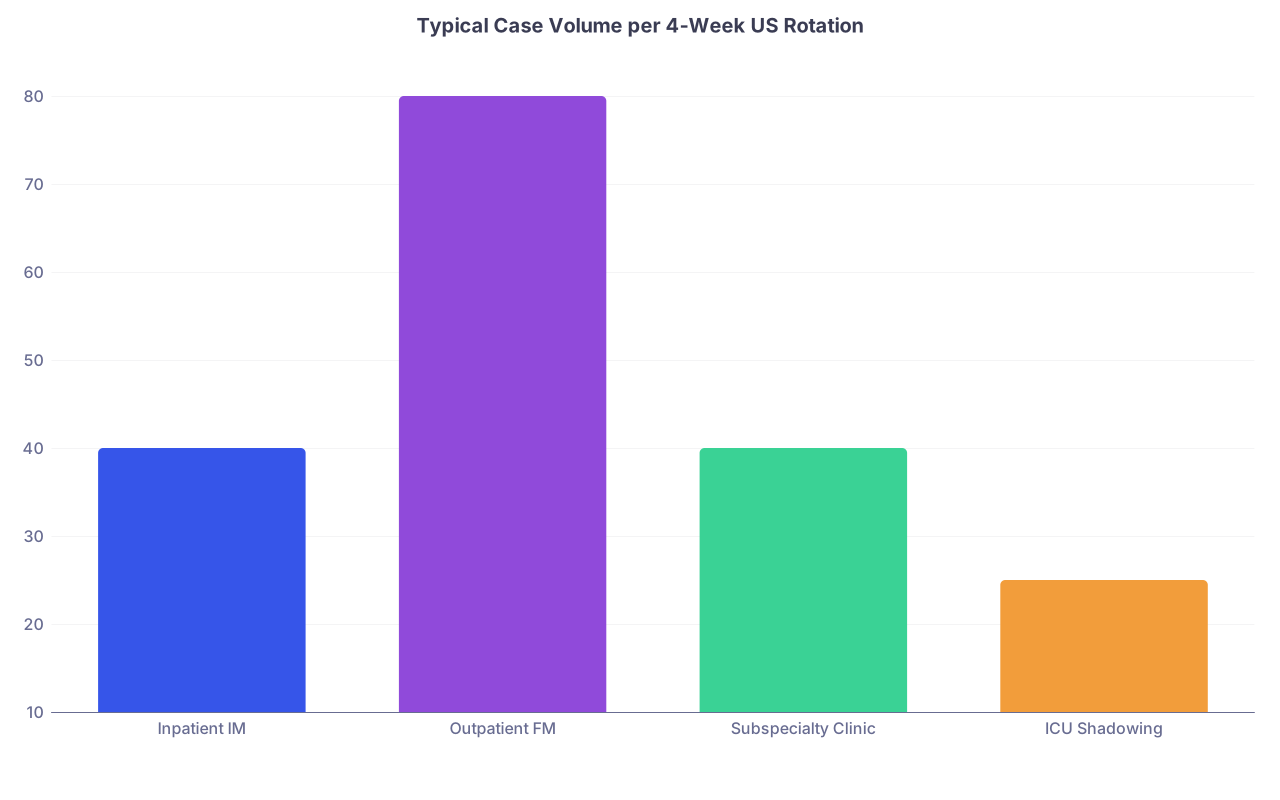
| Category | Value |
|---|---|
| Inpatient IM | 40 |
| Outpatient FM | 80 |
| Subspecialty Clinic | 40 |
| ICU Shadowing | 25 |
This corresponds to:
- Inpatient internal medicine:
- 40–60 unique patients followed at some point
- 1–5 interesting cases you can describe in detail
- Outpatient primary care:
- 80–120 visits observed across 4 weeks (5–10 per clinic half‑day)
- Subspecialty clinic (cardiology, GI, etc.):
- 30–60 distinct patient visits observed
Procedures:
- Thoracentesis, paracentesis, LP, central line in a general IM inpatient month:
- Observing 2–5 of each is believable
- Assisting with 1–3 is also believable in some settings, if policy allows
- In clinic (Pap smears, joint injections):
- 5–20 observed over a month is common, depending on specialty
If your log claims 200 admissions and 50 central lines in a single 4‑week observership, it looks invented. Your goal is not to impress with volume. It is to appear believable and consistent.
14. A Simple Example Template You Can Copy
Here is a quick mental model of how your documents should relate, without giving you a cluttered “template dump”.
Think of three levels:
- Spreadsheet (private):
- “St. Mary’s IM Inpatient March 2025” → 45 hours/week, 52 patients logged, 5 key procedures observed.
- Rotation Summary (for LOR writer and your own reference):
- One page describing setting, your day‑to‑day tasks, representative cases.
- ERAS Entry (public):
- 700 characters giving the polished summary with approximate numbers and concrete actions.
Your logs sit at level 1. Everything else is derived from them.
15. A Visual of How This Fits Into Your Match Timeline
You are not doing this in isolation; it fits into your broader residency prep.
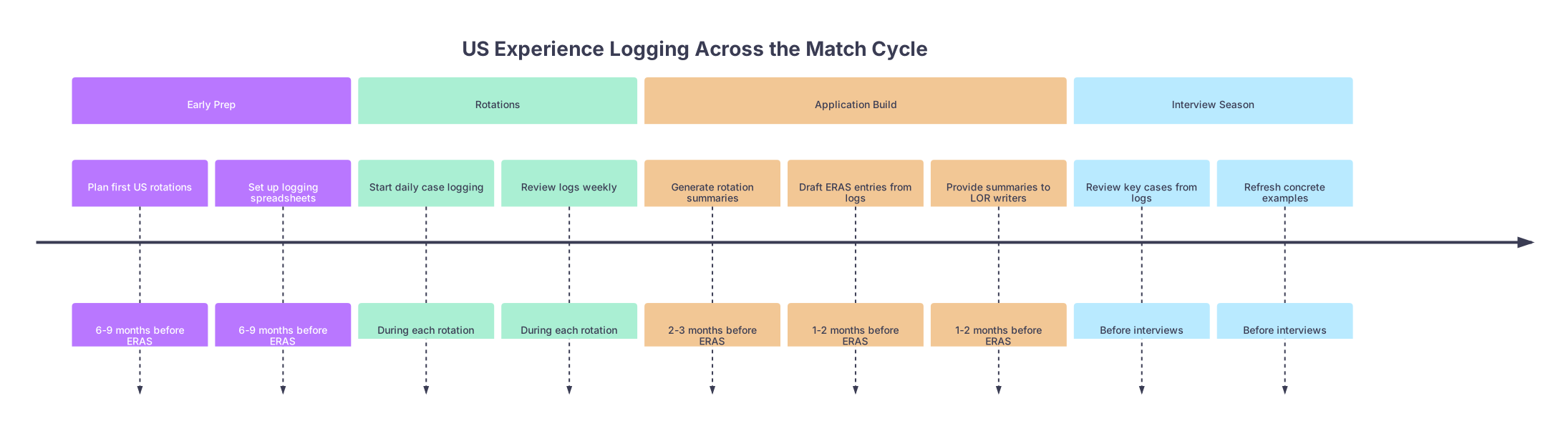
| Period | Event |
|---|---|
| Early Prep - Plan first US rotations | 6-9 months before ERAS |
| Early Prep - Set up logging spreadsheets | 6-9 months before ERAS |
| Rotations - Start daily case logging | During each rotation |
| Rotations - Review logs weekly | During each rotation |
| Application Build - Generate rotation summaries | 2-3 months before ERAS |
| Application Build - Draft ERAS entries from logs | 1-2 months before ERAS |
| Application Build - Provide summaries to LOR writers | 1-2 months before ERAS |
| Interview Season - Review key cases from logs | Before interviews |
| Interview Season - Refresh concrete examples | Before interviews |
You get the idea: logging is not some side hobby. It is infrastructure for your entire application.
16. Quick Reality Check: What If You Already Finished Rotations with No Logs?
You are not doomed, but stop making it worse.
For past rotations:
- Sit down with your calendar and any emails/clinic schedules you still have.
- Reconstruct:
- Start and end dates
- Average days per week and hours per day
- Types of clinics/wards you attended
- 5–10 memorable patients from each setting
- Create rotation‑level estimates:
- “Approximately 40–50 patient encounters observed.”
- “Observed 5–10 bedside procedures.”
Admit to yourself that these are estimates, not precise counts. Start precise logging from your very next experience. The worst mistake is to continue relying purely on memory.
17. Final Thoughts: Make Yourself Look Like a Future Resident, Not a Tourist
Residents in the US live by documentation: progress notes, sign‑out lists, duty hours, procedure logs. They are judged by how accurately and consistently they record reality.
When you, as an IMG, show up with:
- Clean rotation records
- Realistic, data‑backed summaries of your US experience
- Concrete patient stories with believable detail
- LORs that echo the same specifics
you stop looking like a visitor who “did some observerships” and start looking like a junior colleague who already thinks in the same structured way as a US trainee.
That is exactly the mental shift program directors want to see.
Get your logging system set up before you step into your next US hospital. Then use it ruthlessly. Once the logs are in place and your experience is documented, you will be ready for the next layer of strategy: building a coherent narrative across personal statement, ERAS entries, and interviews so that all of this experience actually converts into a Match.
But that is a whole separate operation—and it comes after you have your case and procedure logs under control.


