

The fastest way for an IMG to destroy an otherwise strong US rotation is not clinical incompetence. It is a professionalism incident documented in the chart or by the program.
Let me break this down specifically, because this is where many otherwise good candidates get blindsided. You are thinking about H&Ps, SOAP notes, and impressing attendings. The institution is thinking about liability, regulatory compliance, documentation standards, and whether they can safely vouch for you in a letter of recommendation. Those worlds collide in your documentation and your behavior around it.
If you treat documentation during US rotations like you did at home, you are taking a risk you do not fully understand.
Why Documentation Is a Professionalism Landmine for IMGs
US programs do not just evaluate “knowledge and work ethic.” They formally track:
- Professionalism incidents
- EMR access and misuse
- Late, incomplete, or inaccurate notes
- Boundary and confidentiality violations (HIPAA)
- Response to feedback about documentation
And yes, this gets reported in letters. I have read faculty emails that say: “Clinically solid, but required multiple reminders about documentation and confidentiality.” That one sentence drops you a tier on rank lists at several programs.
For IMGs, documentation is high-risk for three reasons:
- You are unfamiliar with US regulatory language (HIPAA, compliance, billing).
- You may come from systems where documentation is lighter, more narrative, or less scrutinized.
- You are under pressure to “prove value” and may over-document, copy-paste, or “pre-chart” in unsafe ways.
Programs know this. They watch your documentation behavior closely in early weeks. If they see red flags, they mentally move you into the “questionable professionalism” bucket, even if no one says it to your face.
The Types of Professionalism Incidents That Actually Get Documented
Let me be concrete. These are not theoretical.
| Incident Type | Typical Consequence |
|---|---|
| Accessing charts of non-assigned patients | Formal warning; EMR audit; note in file |
| Copy-paste from attending note without attribution | Labeled as potential dishonesty; impacts LOR |
| Entering orders without permission or cosign | Restriction of access; supervisor notified |
| Documenting procedures you did not perform | Serious integrity concern; rotation at risk |
| Sharing screenshots or PHI via messaging apps | Compliance report; removal from site |
Notice something: several of these have nothing to do with your medical knowledge. They are about trust and judgment.
Let me go through the big ones and how they intersect with your residency application.
1. EMR Access Misuse
Typical IMG mistake: You are curious about “interesting cases” on the ward, or you want to see what that subspecialty consultant wrote, so you open charts of patients not formally assigned to you. Or you look up your roommate who was in the ED yesterday. Or you search your own test results.
In most US hospitals, every EMR click is logged. Compliance teams run audits, especially on students, rotators, and anyone on a visa. A seemingly innocent “just looking” can generate a professionalism report.
Programs see this as:
- Boundary issue
- Judgment issue
- Potential legal/ethical risk
Residency implication: Any mention of “EMR misuse,” “inappropriate access,” or “HIPAA concern” in your file is toxic. It suggests you are a liability. It can completely override a good Step 2 score or research profile.
2. Dishonest or Misleading Documentation
This is the one that gets people labeled as “untrustworthy,” and that label sticks.
Common versions:
- Copying attending or resident notes and pasting as your own, without attribution
- Charting that you did a full exam you did not actually perform
- Recording ROS or physical findings you did not confirm yourself (“no murmurs,” “no edema,” “neuro grossly intact” when you never checked)
- Charting “patient counseled about X” when that counseling never happened
From the program’s point of view, this is not “sloppy.” It is falsification of the medical record. Once they doubt your honesty in the chart, they cannot safely recommend you to a residency program.
I have seen excellent IMGs—brilliant on rounds—lose strong letters because of precisely this. The attending’s email: “We did have some concerns about documentation accuracy that required coaching.”
That single line in a LOR is deadly.
3. Inappropriate Content or Tone in Notes
US documentation is not casual writing. It is a legal document, a billing document, and a communication tool. Your note is not your personal notebook.
Red flags that turn into professionalism issues:
- Jokes, sarcasm, or “venting” in notes (“difficult family,” “non-compliant and uncooperative”)
- Overly judgmental language about patient behavior
- Mentioning immigration status, financial situation, or social circumstances in a way that is irrelevant and biased
- Copying sensitive psychiatric or social details where they do not belong in the main problem list
No one will sit you down and say “your tone is unprofessional,” they will just decide you are not ready for residency here.
4. Timing and Reliability of Documentation
This is less dramatic but still matters. Programs track whether you:
- Consistently complete notes late
- Require constant reminders to finish documentation
- Abandon tasks, leaving incomplete or half-written notes for others to fix
Patterns like this get interpreted as poor professionalism and work habits. When an attending writes your letter, they remember who they could trust to finish what they started.
5. HIPAA and “Off-Chart” Professionalism Traps
This spills beyond the EMR, but residency programs lump it under professionalism and documentation culture:
- Taking photos of the computer screen
- Storing patient details on your personal device
- Discussing cases with identifiable details in public places
- Sharing cases on social media, even “de-identified,” in a way that could be linked back to a real person or institution
If compliance or risk management gets involved, the site may terminate your rotation. That will absolutely show up when programs call for informal background information.
How Programs Actually Use This Information When You Apply
You need to understand how professionalism on rotations translates into your residency application value.
When faculty write LORs for IMGs, they are quietly answering three questions:
- Can I trust this person with independent patient care in a US environment?
- Will they cause headaches for my colleagues, staff, and compliance office?
- If something goes wrong, will I regret that I endorsed them?
Professionalism and documentation incidents directly hit all three.
Programs will:
- Ask your attendings, off the record: “Any professionalism issues? Any concerns with EMR, notes, reliability?”
- Pay attention to subtle wording: “with supervision,” “after some coaching,” “ultimately improved,” “initial issues with documentation”
- Value a “solid but not flashy” IMG with spotless professionalism over a “super smart” IMG with even one major professionalism flag
Look at where documentation fits into their decision-making:
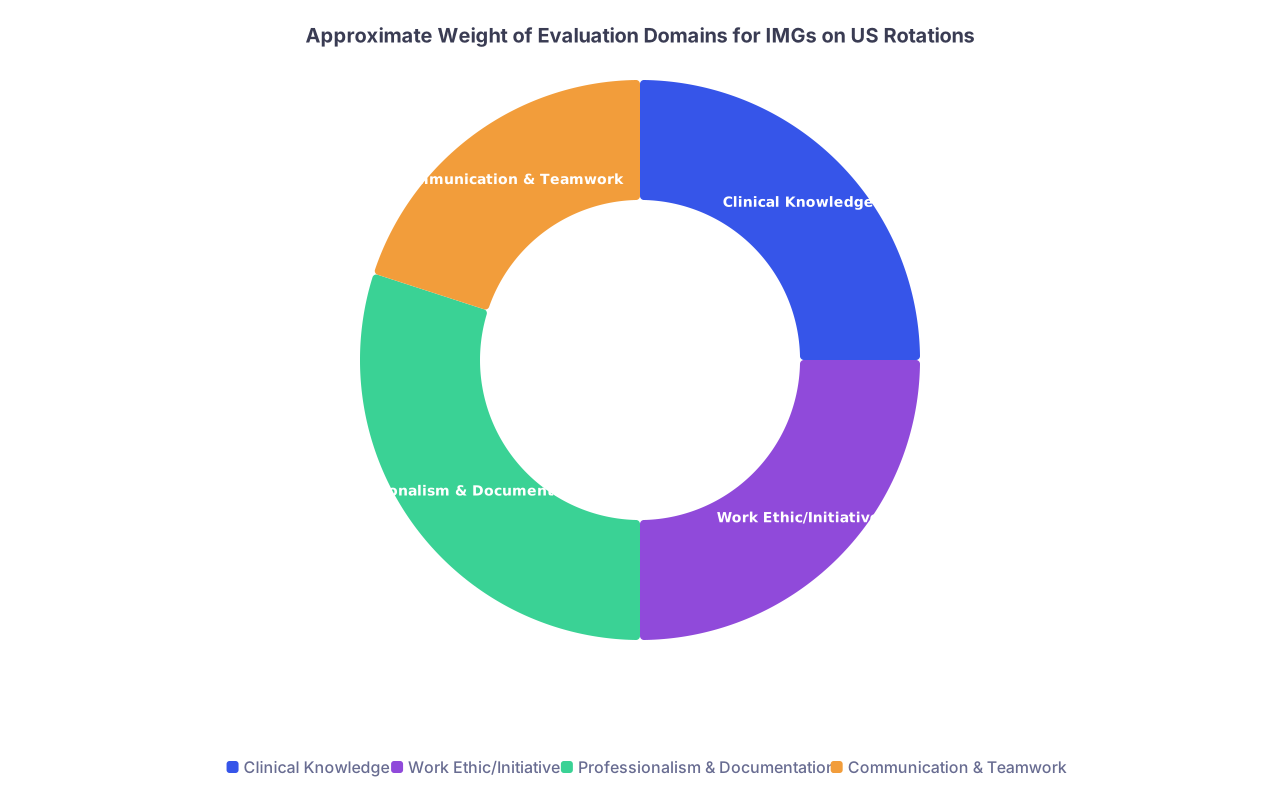
| Category | Value |
|---|---|
| Clinical Knowledge | 25 |
| Work Ethic/Initiative | 25 |
| Professionalism & Documentation | 30 |
| Communication & Teamwork | 20 |
Notice: professionalism and documentation combined are at least as important as your raw knowledge.
Specific Documentation Rules That Matter in US Rotations
Let me get very granular. These are the rules I want every IMG to follow from day one.
Rule 1: Never document what you did not personally do
If your note says:
- “Cardiac exam: RRR, no murmurs”
- “Lungs: clear to auscultation bilaterally”
- “Neuro: CN II–XII grossly intact”
you must have actually performed that exam, yourself, on that date.
If the resident or attending did the exam and you only observed, then your note must reflect that reality: “Cardiac exam per resident note: RRR, no murmurs. I personally heard no extra heart sounds.” Or, better, do your own exam.
This applies to everything:
- Counseling: Do not say “patient counseled about smoking cessation” unless you counseled them.
- Procedures: Do not write “arterial line placed” with your name unless you placed it (or clearly describe your role: “assisted with arterial line placement performed by Dr. X”).
- Decisions: Do not imply you made decisions you did not make.
This is not negotiable in US medicine. Falsification of the medical record is a career-killing label.
Rule 2: Make your level and role explicit
You must identify yourself clearly:
- In the EMR “author” field: “Visiting medical student,” “Observer,” or whatever matches your status.
- In the note body: e.g., “I am an international medical graduate completing a clinical elective on the internal medicine service.”
If the system does not automatically tag you as a student, your supervising team should ensure it is obvious from your signature or note type.
Why this matters: Residency programs want to know precisely what responsibility you had during the rotation. Attending letters become more credible when the documentation matches what they say about your level of involvement.
Rule 3: Do not pre-chart as if you saw the patient when you did not
Common mistake: You review labs, vitals, overnight events at 5:30 AM and start writing your full progress note, including “subjective: patient denies chest pain” when you have not yet seen the patient.
Later, you intend to update after pre-rounds, but you get pulled into something else, and the note goes unsigned or the wrong version gets saved. Now the chart says you documented a physical exam that did not happen.
The safer approach:
- You may pre-chart objective data—labs, imaging, vitals—and clearly mark them as “per EMR review.”
- Only document subjective and physical exam findings after direct patient contact.
- If you use templates, do not pre-fill “denies…” ROS lines before actually asking those questions.
Programs interpret pre-charted, inaccurate notes as dishonesty, not as “trying to be efficient.”
Rule 4: No copy-paste without verification and attribution
Copy-paste is ubiquitous in US documentation. It is also a litigation trap.
For IMGs:
- Do not blindly copy yesterday’s exam and ROS forward. Re-verify or shorten.
- When you borrow language from a consultant or attending note for clarity, you add attribution:
“As per cardiology note dated 1/5/26, echo showed EF 35% with global hypokinesis.” - For shared plans, distinguish: what is the attending’s plan vs what you are summarizing.
What gets you in trouble is misalignment:
- The attending writes one assessment; your note copies it but dates it inappropriately.
- You carry forward an outdated problem list with resolved issues.
- You leave in language that contradicts the rest of the chart.
When programs see this pattern, they doubt your attention to detail and your understanding of US documentation norms.
Rule 5: Respect institutional documentation hierarchy
Your note does not override the resident or attending. You are there to learn and to contribute, but within a structure.
Practical meaning:
- Do not document disagreements with the care plan in a confrontational way. If there is a concern, raise it verbally first.
- Do not create new orders or order sets within your notes unless explicitly allowed and cosigned.
- If your note layout or plan differs significantly, clarify that this is your understanding:
“My current understanding of the plan is…” rather than “Plan: discharge today” if that has not yet been decided by the team.
This is both a safety and professionalism issue: programs want to see that you understand your position in the team hierarchy.
Rotation Stage vs. Documentation Expectations
Expectations change depending on what phase of training you are in and what kind of US experience you are doing.
| Rotation Type | Direct Charting Usually Allowed? | Supervision Intensity |
|---|---|---|
| Pure observership (no hands-on) | No, view-only access | Very high |
| Student elective (4th-year level) | Yes, with cosign | High |
| Sub-internship / Acting Intern | Yes, more independent draft notes | Moderate-High |
| Research with clinical exposure | Often restricted or none | Variable |
| Unregulated “externship” | Varies; can be risky | Unclear, often poor oversight |
On your CV and in ERAS, reviewers will cross-reference what you claim (e.g., “acted as sub-intern, wrote daily notes, participated in management”) against the typical expectations and policies at that institution. If your style of documentation on-site was sloppy or out of bounds, attendings are less likely to confirm your level of responsibility when they are called or emailed.
Preventing Professionalism Incidents: Concrete Behaviors
Let me outline practical steps that protect you.
Before the Rotation Starts
You do three things:
Complete every required EMR/HIPAA/compliance module seriously. Do not just click through. Pay attention to:
- Policies on accessing your own record or staff records
- Rules for using mobile devices
- What constitutes inappropriate chart access
Ask for clarity upfront: “As a visiting IMG, what am I allowed to enter in the EMR? Are there specific restrictions for student notes or orders?”
Decide your own standard: “I will never chart something I did not personally do or directly confirm. I will never access charts for patients not under my team’s care without explicit permission.”
That personal rule alone would have saved a lot of IMGs I have seen get into trouble.
During the First Week
You test alignment with the team:
- When the resident says “feel free to pre-chart,” clarify:
“To confirm, do you prefer I only pre-chart objective data and then update subjective and PE after I see the patient?” - Ask how they want notes labeled: “Student note,” “preliminary,” etc.
- If you are not sure whether you can place orders (e.g., lab, imaging), ask once, clearly, and then stick to the program’s rule.
You also watch how residents and interns handle documentation boundaries. But be careful: some residents cut corners. You are being evaluated at a different standard. “But the resident does it” is not a defense.
Handling Mistakes Without Creating a Bigger Problem
Everyone makes documentation errors. The difference between “learning issue” and “professionalism incident” is how you respond.
Example: You realize you documented “clear lungs” on a progress note, but while pre-rounding, you had not actually auscultated the patient that day.
Correct response:
- Tell the resident: “I realized I documented clear lungs before actually listening; I would like to correct that. How should I amend the note?”
- Enter an addendum or correction as per policy.
- Do not silently ignore it.
Your attitude here is what gets reported upward: “He caught his own error, brought it up appropriately, and corrected it.” That kind of narrative reassures programs that you are safe to train.
Contrast that with:
- Defensiveness
- Making excuses
- Trying to modify the note quietly without telling anyone after it has been co-signed
That is when people start using the phrase “professionalism concern.”
How This Shows Up in Letters of Recommendation
You will not see most of the documentation about you that matters. It happens in emails and hallway conversations when program directors are comparing applicants.
But there are telltale patterns in written LORs.
Common positive phrases (these help you):
- “His documentation was consistently accurate and timely.”
- “She adapted quickly to our EMR and demonstrated strong professional judgment regarding HIPAA and confidentiality.”
- “I would trust him with the responsibilities of an intern in our system.”
Common concern phrases (these hurt you):
- “After some early feedback, she improved her documentation practices.”
- “Initially had some difficulty with US documentation style.”
- “Ultimately able to function safely with close supervision.”
Those words—“after feedback,” “difficulty,” “with close supervision”—are red flags, especially for IMGs.
On the PD side, when they are ranking, they see a pattern:
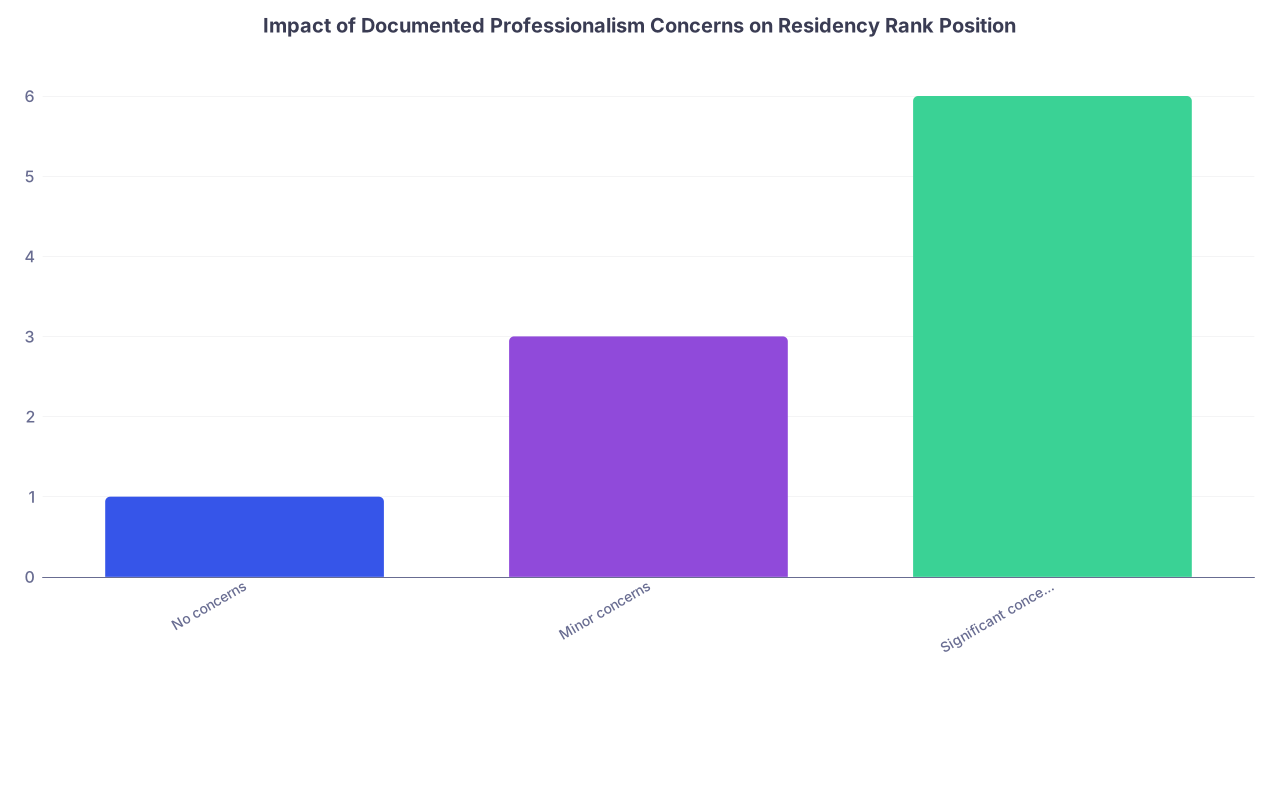
| Category | Value |
|---|---|
| No concerns | 1 |
| Minor concerns | 3 |
| Significant concerns | 6 |
Interpretation: candidates with no professionalism concerns typically rank near where their scores and interviews suggest (position ~1). Minor concerns push you down several spots. Significant concerns can drop you multiple tiers or remove you from the rank list entirely.
Social Media, Messaging Apps, and “Side Documentation”
Another underappreciated risk: informal documentation channels.
You or your co-rotators may:
- Create WhatsApp groups to discuss patients
- Take quick photos of lab results or wounds for “learning”
- Share “interesting cases” on Instagram or other platforms
This is where IMGs often underestimate US sensitivity. In many US institutions:
- Any transmission of identifiable patient information over non-approved platforms is a HIPAA issue.
- Even de-identified cases can be problematic if the institution or scenario is recognizable.
- A single screenshot, if seen by the wrong person, can trigger a compliance report.
If your name is attached, you might never hear “We’re reporting this,” but you will feel it when your LOR is cooler than expected or you are not invited back for further rotations.
Simple rule: if you would be embarrassed to show a screenshot or message thread to the program director in person, do not create it.
If You Already Had a Professionalism or Documentation Incident
Now the uncomfortable part. Some of you reading this have already had one of these issues on a prior rotation.
What can you salvage?
Get clarity on what is actually in your file. If the site has a student affairs office or visiting student coordinator, ask directly:
“Was there any formal professionalism report or notation related to my behavior or documentation during this rotation?”
It is better to know.If the incident was formally documented and might be discoverable, you prepare a concise, honest explanation for interviews:
- Own the mistake
- Describe how you corrected it
- Explain what systems or habits you set up so it will not recur
- Do not blame others
On future rotations, you need absolutely clean behavior. You are now under a microscope, whether people say it or not. Two incidents is a pattern; one can be framed as a lesson learned.
Choose letter writers strategically. Do not rely on an attending who seemed uneasy about your documentation; pick those who saw you after you improved and who can explicitly speak to your growth and reliability.
Building a “Professionalism-Positive” Reputation Through Documentation
Let’s flip the frame. Documentation is not just a way to screw up. It is also a way to stand out—in a good way—as an IMG.
You build that reputation when:
- Your notes are consistently on time, accurate, and succinct.
- You incorporate evidence and guidelines appropriately (with citations where relevant).
- You use structured, clear assessment and plan sections that make life easier for residents and attendings.
- You respond to feedback once, without requiring repeated reminders.
- You quietly fix small documentation issues and let the team know when something important changes.
Residents remember who made their jobs easier.
That memory turns into comments like:
- “We could rely on her notes, and her documentation was as good as our interns.”
- “He respected EMR rules and never created extra work or risk for the team.”
Program directors see those lines and put you in the “safe, high-yield IMG” category. That is exactly where you want to be.
To visualize the impact over multiple rotations:
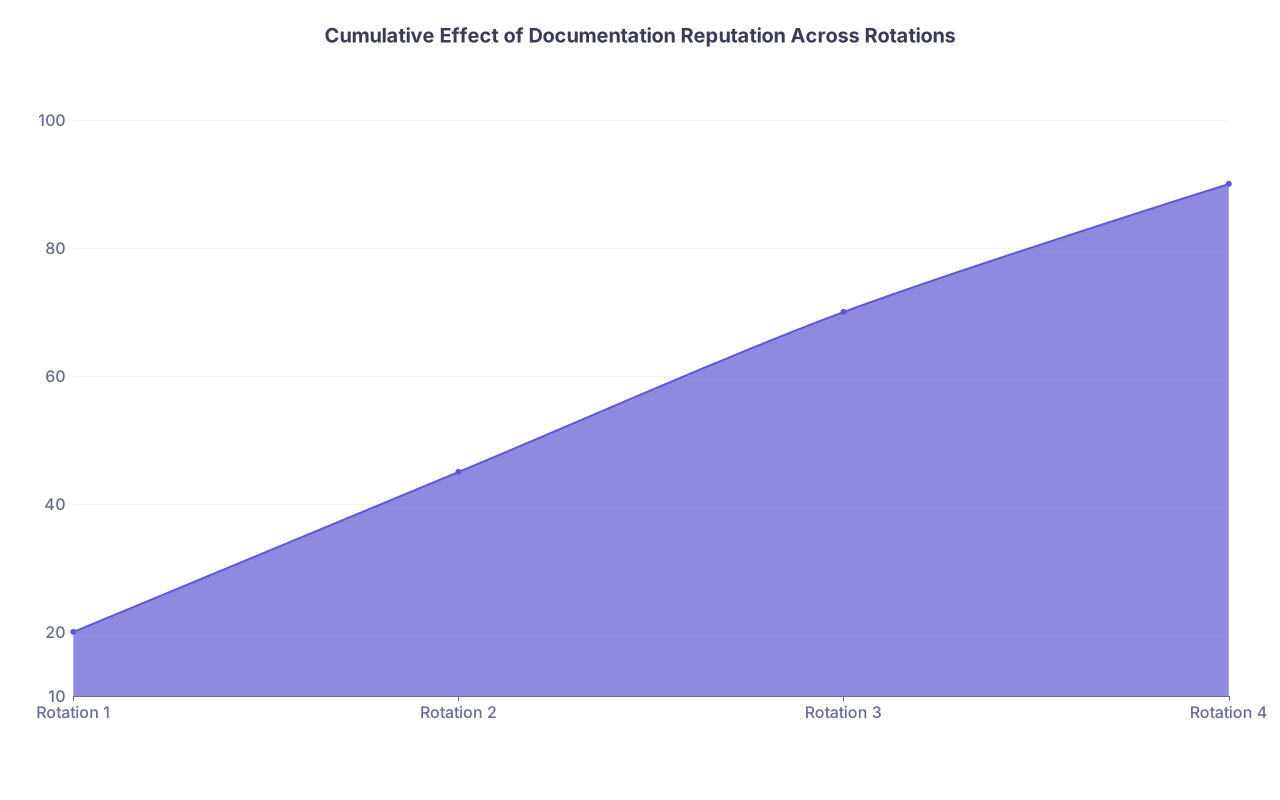
| Category | Value |
|---|---|
| Rotation 1 | 20 |
| Rotation 2 | 45 |
| Rotation 3 | 70 |
| Rotation 4 | 90 |
Think of that curve as your “trust index.” Each rotation either pushes it up or flattens/lowers it. Documentation professionalism is one of the few levers fully under your control.
Three key points and then I am done:
- US programs care as much about how you handle documentation and EMR behavior as they do about your medical knowledge. For IMGs, that is often the deciding factor between “strong candidate” and “too risky.”
- Never document something you did not personally do or confirm, never access charts outside your role, and never treat the EMR like a private notebook or group chat. Those three boundaries alone prevent most professionalism incidents.
- Clean, reliable, and honest documentation does more than keep you out of trouble. It builds a reputation that directly strengthens your letters, your credibility, and your position on rank lists.


