
It is mid-July. You are on your third US rotation. Different hospital. Different EMR. Different attending who calls you “the observer” instead of “doctor.”
You open your ERAS draft and realize: your experiences section reads like a random grocery list. One neurology observership. One internal medicine clerkship. A tele-rotation in family medicine. Two research projects that do not talk to each other. Nothing feels connected.
And you know exactly what the program director is going to think:
“Busy. But unfocused. What is this person actually about?”
This is where a themed clinical portfolio matters. Not just “I did several USCEs,” but “All of these rotations and projects are clearly moving in one direction, and the story fits the specialty I am applying to.”
Let me break this down specifically.
1. What a “Themed Clinical Portfolio” Actually Means
First, definition. A themed US clinical portfolio is not:
- Doing only one specialty.
- Forcing every experience to look identical.
- Deleting anything that does not fit the theme.
A themed portfolio means this instead:
- Your clinical rotations, projects, letters, and personal statement all clearly support a coherent professional identity.
- There is visible continuity over time: skills you started building in one setting get reinforced and developed in later ones.
- A program director can answer, in one sentence, “This is who this applicant is and why they fit our specialty.”
For IMGs, this is not optional. You are already fighting:
- Distance from medical school graduation.
- Skepticism about your home school’s clinical environment.
- The “tourist” perception: short USCEs without depth or progression.
A themed portfolio is how you signal: “I know where I am going and I am using US clinical experiences deliberately to become the kind of resident you want.”
2. Core Concept: Continuity Across Rotations
Continuity is the backbone. Not volume. Not brand names.
Continuity shows up in three dimensions:
Clinical Focus Continuity
A recognizable set of interests or patient populations appears across rotations.Skill Continuity
You are not restarting from scratch each time. You clearly build on previous competencies.Mentor/Network Continuity
At least one or two people can say, “I have watched this person grow across multiple settings or over time.”
Think like this: each new experience must answer one of two questions:
- “How does this deepen something I already started?”
- “How does this logically extend my theme or next step?”
If it does neither, it goes into the “maybe” pile.
3. Step One: Choose a Theme That Programs Will Actually Recognize
Do not overcomplicate the theme. Programs are not looking for “Cardio-metabolic translational researcher with a focus on adipokines.”
They need: “Future academic internist with interest in cardiometabolic risk in underserved populations.”
So you pick something broad, specialty-aligned, and believable.
Here is how to build a usable theme in three components:
- Specialty Anchor – IM, FM, Peds, Psych, Neuro, etc.
- Clinical or Population Focus – chronic diseases, geriatrics, immigrant health, women’s mental health, epilepsy, etc.
- Professional Direction – academic, community, hospitalist, primary care, research-oriented, QI-focused, etc.
You combine them into a short internal sentence:
- “Internal medicine – chronic disease management – academic-hospitalist track”
- “Psychiatry – severe mental illness – community and safety-net care”
- “Pediatrics – developmental disorders – academic clinician-educator”
This becomes your filter for:
- Which rotations to seek
- Which cases to highlight
- Which projects to accept
- How to frame “miscellaneous” experiences so they still fit
4. Mapping Your Theme to Specific Rotations (Before You Apply)
Most IMGs do this backwards. They grab whatever USCE they can find, then try to retro-fit a theme into it. That looks fake.
You are better off doing a basic map first, then adjusting as reality hits.
| Element | Example Plan (Internal Medicine Theme) |
|---|---|
| Core USCE 1 | Inpatient IM, community hospital |
| Core USCE 2 | Inpatient IM, university-affiliated |
| Outpatient 1 | IM continuity clinic or FM clinic |
| Sub-focus | Cardiology clinic or endocrine clinic |
| Bonus | QI or research project in IM |
You will not get this exact structure. That is fine. But you aim in this direction:
- At least 2 rotations squarely in your target specialty.
- At least 1 outpatient or continuity-type experience.
- At least 1 setting or rotation that matches your sub-interest (e.g., geriatrics, cardiology, endocrinology).
The point is not perfection. The point is pattern.
5. Building Continuity When Your Rotations Are Already Random
You might be thinking, “Too late. I already booked neurology, nephrology, and a random FM tele-rotation. How do I theme that?”
You can still salvage this. By re-framing.
Example: You are applying to Internal Medicine. Your actual experiences:
- Neurology observership
- Nephrology elective
- Family medicine tele-rotation
- Non-clinical COVID hotline job
You can pull a theme of chronic disease and continuity of care out of this:
- Neurology: stroke patients with hypertension, diabetes, atrial fibrillation.
- Nephrology: CKD, dialysis, diabetic nephropathy, hypertensive nephrosclerosis.
- FM tele: chronic disease management, medication adherence, lifestyle counseling.
- COVID hotline: longitudinal follow-up calls, risk counseling in vulnerable populations.
Now you structure your story around:
- Long-term disease management
- Multi-system complexity
- Continuity with patients over time
- Communication and coordination across specialties
Is it perfect? No. Is it coherent enough for a PD to nod and think “makes sense”? Yes.
6. Designing Continuity Within a Single Rotation
Most applicants see each rotation as a checklist: show up, be polite, hope for a good letter. Wasted opportunity.
You want to treat each rotation as a mini-arc of development that fits your larger theme.
On day 1–2, you should be asking yourself:
- Which patient population here fits my theme most strongly?
- Which skills can I work on that I can reference again later?
- Which attending or resident seems interested enough to follow my progress?
Then you act deliberately:
- Track 2–3 “continuity” patients whose stories you can follow through the stay.
- Volunteer for tasks that fit your theme (e.g., diabetic education, discharge planning, cognitive screening).
- Ask to see clinic patients matching your interest when possible.
You want to walk away able to say:
“In this rotation I specifically advanced my ability to [X], which I had started in [previous rotation]. For example, I went from just documenting diabetes to actually counseling on insulin titration and collaborating on discharge plans.”
That is continuity. And it is gold for your LOR writers and personal statement.
7. Inter-Rotation Continuity: Don’t “Reset” Yourself Every Month
A huge mistake: acting like a brand new, blank-slate observer at each site.
You should be explicitly importing your prior skills and experiences into the new setting, and making sure people see it.
How you do that in practice:
On Day 1 intros with attending or preceptor, say something like:
“I am an IMG from [country]. Over the past two months I have completed two US rotations in internal medicine, both inpatient. I gained a lot of experience in managing chronic conditions like diabetes and CKD in the hospital setting. I am particularly interested in how we maintain continuity of care after discharge, so I am hoping to focus on that aspect when possible in this rotation.”
You just did three things:
- You signaled progression: this is not your first exposure.
- You reminded them you have a theme (chronic conditions and continuity).
- You implicitly set them up to observe and comment on those specific skills in your evaluation or LOR.
Then during the rotation, you consciously:
- Use the same frameworks for presentations you developed before, and mention that.
- Share cases from prior rotations to show pattern recognition and growing sophistication.
- Ask for feedback framed as continuity: “Do you see improvement in my [X] compared to how I presented at the start?”
You are teaching attendings how to talk about you in a way that matches your theme.
8. Unifying Diverse Experiences: Clinical, Research, QI, Teaching
You probably have non-rotation experiences: research, QI, tutoring, assistant jobs. These can either look random, or they can lock in your theme.
The trick is to use one conceptual thread to connect them.
Pick a thread like:
- “Improving transitions of care for complex patients”
- “Understanding and addressing barriers to adherence”
- “Reducing diagnostic delay in X condition”
- “Enhancing communication with non-English-speaking patients”
Then you reframe each piece:
- Clinical rotations: cases that highlight that problem.
- Research: projects that measure or analyze it.
- QI: practical changes to improve it.
- Teaching/tutoring: educating others about it.
You are not lying. You are selecting, from your real experiences, what to highlight so the pattern is visible.
9. Translating Themed Rotations into ERAS Sections
Rotations alone do not convince anyone. The way you describe them does.
Experience Descriptions
Do not write:
“Observed inpatient IM activities. Presented patients. Attended rounds.”
That is generic noise.
You write:
- 1 line about setting and role.
- 2–3 lines about theme-consistent responsibilities and growth.
- 1 line about outcome or impact, even if small.
Example for an IM-themed rotation:
“Four-week inpatient internal medicine rotation at a community teaching hospital. Managed daily follow-up on 6–8 patients with complex chronic conditions including CHF, COPD, and diabetes under direct supervision. Focused on discharge readiness and transition planning, collaborating with case management to reduce readmission risk. Developed structured approaches to medication reconciliation and patient education which I later applied in subsequent outpatient rotations.”
See the continuity? It points forward.
Personal Statement
This is where continuity becomes explicit. You should be drawing a line:
- From early exposure →
- Through 2–4 key rotations/projects →
- To your intended residency and career direction.
Use rotations as pivot points, not as a list.
Example structure:
- Paragraph 1–2: One anchor clinical story that embodies your theme.
- Paragraph 3–4: “I built on this by…” + 2–3 rotations that show progression.
- Paragraph 5–6: How that shaped your intended role as a resident and beyond.
If your theme is “chronic disease and continuity,” you write your rotations as a sequence of increasingly sophisticated encounters with that problem, across inpatient-outpatient, specialist-primary care, etc.
10. LOR Strategy: Continuity in Your Advocates’ Voices
You do not just need letters. You need letters that talk to each other.
At minimum, aim for this:
- 2 letters from your target specialty (ideally from different sites).
- 1 letter that bridges or reinforces your sub-theme (e.g., clinic-based, sub-specialty, or research mentor).
Before they write, you give each letter writer:
- Your CV
- A very short summary (half page) of your theme and where their rotation fits into it
- 2–3 concrete cases or behaviors they observed that match that theme
You can literally write:
“My application focuses on my interest in chronic disease management and continuity of care in Internal Medicine. During my time on your service, I particularly valued:
– following Mr. R, a patient with decompensated heart failure, from admission to discharge planning;
– working with you on medication counseling for complex diabetic patients;
– practicing structured presentations of multi-morbidity cases.
If you feel it is appropriate, I would be grateful if you could comment on my ability to manage chronic, multi-system conditions and to communicate clearly with patients and the multidisciplinary team.”
You are not scripting them. You are aligning them. Big difference.
11. Handling “Off-Theme” Rotations Without Wasting Them
You will have experiences that do not fit the theme on first glance. Surgery. Radiology. Anesthesia. A short ICU stint.
You have three options:
Support Skill Layer
Use them to highlight universal yet theme-relevant skills:- ICU: managing instability in chronic disease patients.
- Radiology: understanding imaging in your disease focus.
- Anesthesia: perioperative risk in your target population.
Exploration That Clarifies Your Choice
“My experience in neurology confirmed that my interests were broader and more aligned with internal medicine, where I could manage multi-system disease over time.”Downplay or Omit From Spotlight
If it truly does not add to your story and you are short on space, list but do not feature it.
Do not try to twist a random ophthalmology observership into an IM cornerstone. Let some things stay minor.
12. Visualizing Your Themed Portfolio as a Timeline
Sometimes it helps to literally see your experiences as a timeline, and ask: does this look like a trajectory or a scatter plot?
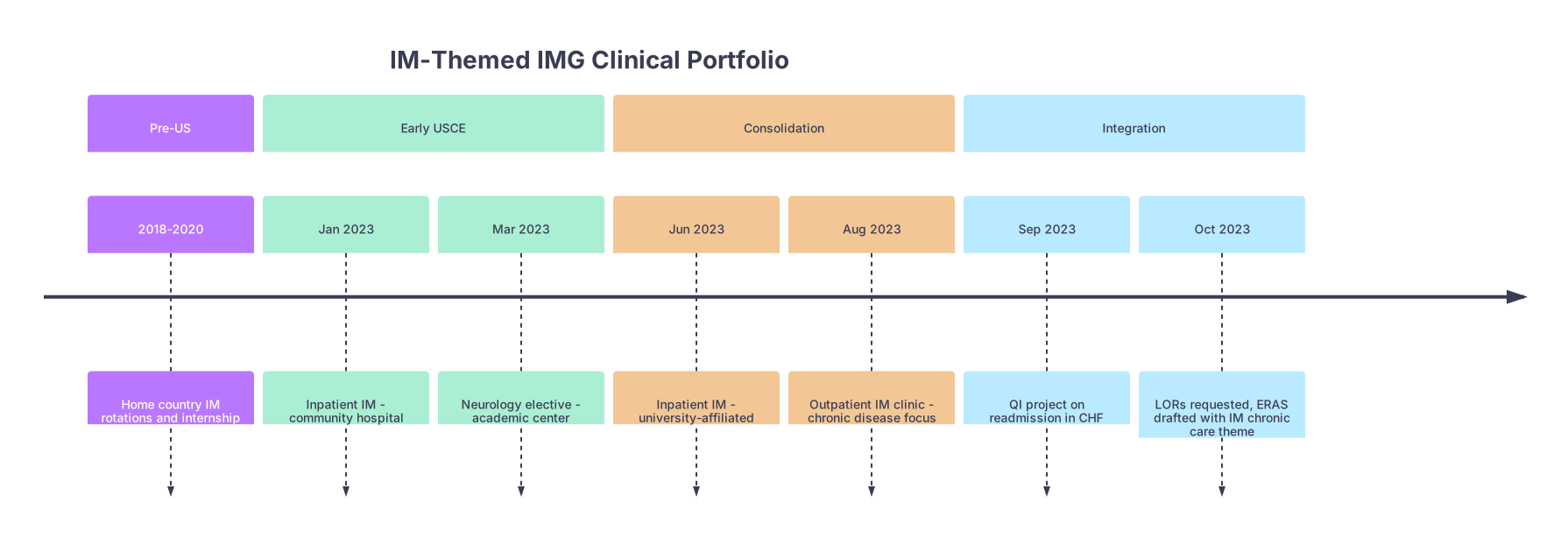
| Period | Event |
|---|---|
| Pre-US - 2018-2020 | Home country IM rotations and internship |
| Early USCE - Jan 2023 | Inpatient IM - community hospital |
| Early USCE - Mar 2023 | Neurology elective - academic center |
| Consolidation - Jun 2023 | Inpatient IM - university-affiliated |
| Consolidation - Aug 2023 | Outpatient IM clinic - chronic disease focus |
| Integration - Sep 2023 | QI project on readmission in CHF |
| Integration - Oct 2023 | LORs requested, ERAS drafted with IM chronic care theme |
Ask yourself:
- Does each step look like a random move, or does the next point acknowledge the previous one?
- Could a stranger look at this and guess your intended specialty and interest area without reading the labels?
If the answer is no, you have work to do in how you frame and sequence things.
13. Common Mistakes IMGs Make (And How to Fix Them)
Let me be blunt about the patterns I see every year.
Mistake 1: “Shopping Mall” Portfolios
One month of everything: IM, FM, Neuro, Psych, Cardio. No depth anywhere.
Fix:
Pick the specialty you are actually applying to and retroactively build your story around it. Downplay rotations that are clearly off-path. Emphasize 2–3 core rotations and align everything else as either supportive skills or early exploration.
Mistake 2: No Outpatient or Continuity Experience
All inpatient, all the time. Looks incomplete, especially for IM/FM/Peds/Psych.
Fix:
Even a short outpatient or tele-rotation can be repurposed as “continuity” experience. Emphasize follow-up, longitudinal contact, medication titration over weeks. Do not treat outpatient as “lesser”; treat it as final glue for your theme.
Mistake 3: LORs That Tell Different Stories
One letter: “Great future neurologist.”
Another: “Strong interest in psychiatry.”
Your ERAS: “I am applying to internal medicine.”
Fix:
You control this by clarifying to each writer what you are applying to and what aspect of you they should focus on. If a letter goes off-theme, you do not use it. Simple as that.
Mistake 4: Copy-Paste Experience Descriptions
Same verbs, same phrases, no progression.
Fix:
Force yourself to differentiate across time:
- First rotation: “exposed to,” “assisted with,” “learned basic…”
- Later rotation: “independently coordinated,” “led,” “refined,” “applied previous skills to…”
That signals growth and continuity.
14. Example: Two Themed Portfolios Side by Side
Let me show you what “random” vs “themed” looks like at the portfolio level.
| Aspect | Random Portfolio | Themed Portfolio (IM Chronic Care) |
|---|---|---|
| Rotations | IM, Neuro, Surg, FM, Psych | IM x2, IM clinic, Neuro (stroke), FM tele |
| ERAS Descriptions | Generic tasks, no link between rotations | Repeated focus on chronic, multi-morbidity |
| LOR Content | “Hard worker”, “keen”, different goals | All mention chronic disease and continuity |
| PS Narrative | List of rotations | Clear trajectory toward IM chronic care |
Same number of experiences. Same months in the US. But one reads like an itinerary. The other reads like a career path.
15. Practical Weekly Checklist During Any Rotation
To keep continuity real, not theoretical, use a simple weekly self-check:
- Which 2–3 patients this week best reflect my theme?
- Did I improve on one specific skill I have been tracking across rotations (e.g., presentations, diabetic education, discharge planning)?
- Did I mention my prior experience or future goals to my attending at least once this week, in a natural way?
- Did I document or save a few anonymized notes about cases or feedback that I can use in my PS or for talking points?
- Did I identify at least one person who could eventually write a letter that fits my theme?
You do that consistently for 3–4 rotations, you will have more than enough material for a coherent application.
16. Using Data to Guide Your Effort (Where Continuity Matters Most)
Not all elements of your portfolio are equal in impact. For IMGs, program directors weight a few things heavily.
, USCE Quality, Theme Coherence, Research, Volunteer Work](https://cdn.residencyadvisor.com/images/articles_svg/chart-perceived-importance-of-portfolio-elements-for-img-1664.svg "Perceived Importance of Portfolio Elements for IMGs (Approximate)")
| Category | Value |
|---|---|
| [US LORs](https://residencyadvisor.com/resources/clinical-experience-imgs/why-your-us-clinical-experience-letters-matter-more-than-you-think) | 90 |
| USCE Quality | 85 |
| Theme Coherence | 75 |
| Research | 60 |
| Volunteer Work | 50 |
You force-theme your volunteer work? No one cares.
You build continuity across your USCE and LORs? That moves the needle.
Focus your “theme energy” where it matters:
- Rotations → LORs → Personal Statement → Interview answers.
That is the spine. Everything else is helpful but not decisive.
17. Bringing It All Together on Interview Day
If your portfolio is actually themed, your interviews become much easier.
You are not inventing answers. You are just narrating the pattern already visible in your file.
Your answers should:
- Start with one or two key patients or rotations that crystallized your interest.
- Link to how you built on that in later experiences.
- End with what you want to do in residency at that specific program.
Example structure for “Tell me about your clinical experience in the US”:
“I structured my US experiences to deepen my ability to manage chronic, multi-morbid patients in Internal Medicine.
My first rotation at [Hospital A] exposed me to decompensated heart failure and COPD on the inpatient side, where I focused on understanding acute management. I then moved to [Hospital B], where I deliberately concentrated on discharge planning and follow-up, working closely with case management on readmission risks.
Finally, in my outpatient rotation at [Clinic C], I saw many of the same conditions in a more stable phase, which helped me appreciate adherence challenges and the importance of clear education. Across these experiences, I have become most interested in how we maintain continuity and prevent avoidable admissions, which is why your program’s strong ambulatory curriculum and QI emphasis are particularly appealing to me.”
That is a themed answer. And it feels natural because it is exactly how you curated your portfolio.
FAQ (Exactly 4 Questions)
1. I have only one true US clinical rotation and a few online or tele-rotations. Can I still build a theme?
Yes, but you need to lean harder on your home-country experiences and any long-term roles (e.g., residency, internship, clinic jobs). Use the single strong USCE as the “anchor” and frame tele-rotations and prior work as extensions of the same interest or skill set. Your theme becomes more longitudinal (across years) than geographic (across US hospitals).
2. Should I avoid taking any rotation outside my chosen specialty to preserve my theme?
No. That is unrealistic and sometimes harmful. A well-chosen off-specialty rotation can strengthen your profile if it touches your theme (e.g., neurology for an IM applicant interested in stroke, or OB for a psych applicant interested in perinatal mental health). Just avoid booking many unrelated, short rotations that you cannot reasonably connect to your story.
3. How many US rotations do I need for a convincing themed portfolio as an IMG?
For most core specialties, 2–3 substantial USCEs (4 weeks each) with at least 2 in your chosen specialty are enough to build a real theme, provided your home experiences and non-clinical work are aligned in how you present them. More can help, but quantity without continuity just looks like desperation, not strength.
4. What if a letter writer describes me in a way that conflicts with my theme or specialty choice?
If a letter clearly undermines your theme or suggests a different specialty, do not use it. Politely thank the writer and select stronger, more aligned letters. You are responsible for curating the letters that support your application narrative; including a conflicting one just to have an “extra US LOR” is a net negative.
Key points:
- A themed portfolio is not about having perfect, identical rotations; it is about visible continuity in interests, skills, and progression across your experiences.
- You create this continuity by planning ahead when possible, and by smartly framing and connecting whatever experiences you already have, especially in ERAS entries, LORs, and your personal statement.
- For IMGs, the strongest signal to programs is alignment between your USCE, your letters, and your stated specialty goals; that coherence is what turns scattered rotations into a compelling residency candidate profile.