
Last week I was on a late Zoom with a friend from med school in India. She had her Step scores ready, CV polished, dreams of matching in Internal Medicine… and then her B1/B2 visa appointment got pushed to next year. She just stared at the screen and said, “So that’s it? I’m done before I even start.”
If you’re reading this, I’m guessing you’re in the same mental spiral: visa issues, delayed appointments, 214(b) refusals, consulate closures, travel bans… and meanwhile program websites screaming “US clinical experience preferred” or “Hands-on USCE required.” It feels like a brick wall you can’t climb, doesn’t it?
Let me be honest: you’re not making this up. Visa problems can absolutely limit your US clinical experience options. But they don’t automatically kill your match chances. The danger isn’t just the visa; it’s you giving up because it feels impossible.
Let’s walk through this like two anxious people trying to find a way out.
How Bad Is It Really If I Have Little or No USCE?
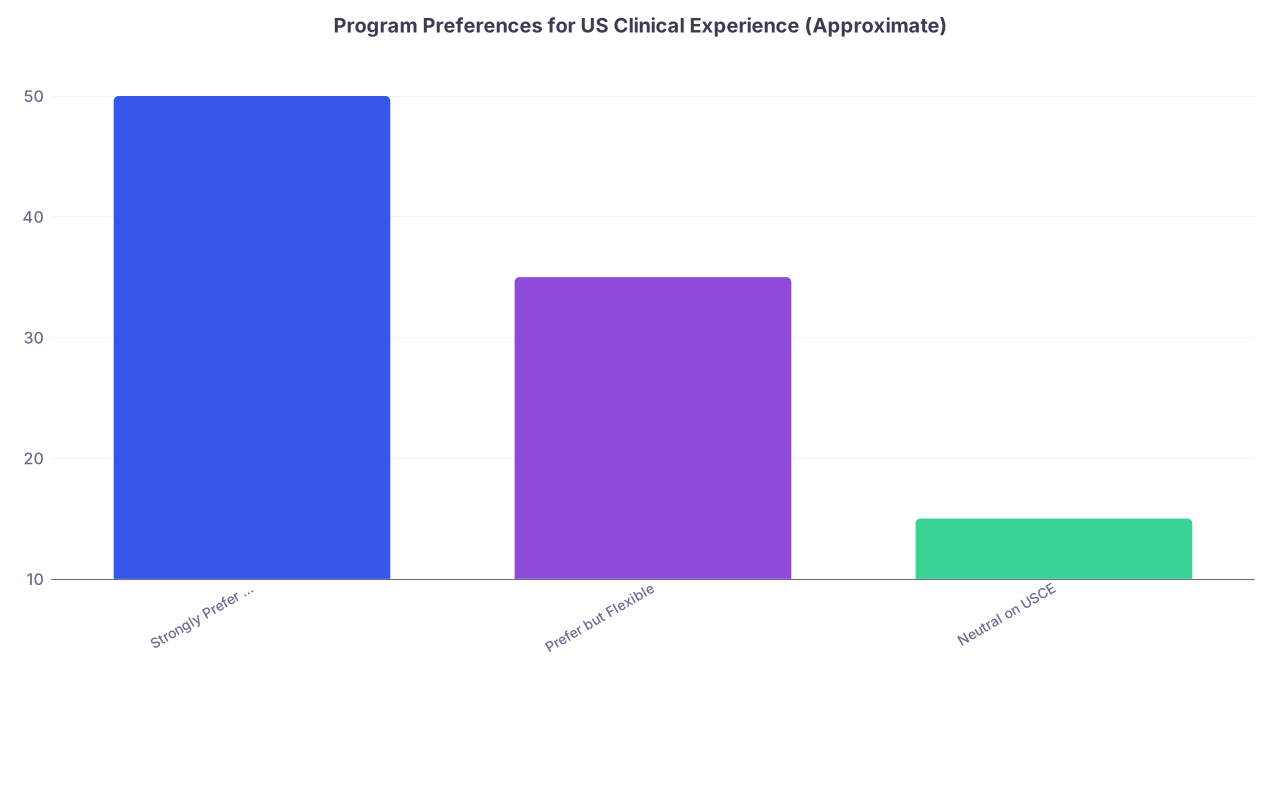
The fear in your head sounds like: “No USCE = automatic rejection.” That’s not quite true, but there are patterns.
| Category | Value |
|---|---|
| Strongly Prefer USCE | 50 |
| Prefer but Flexible | 35 |
| Neutral on USCE | 15 |
From what I’ve seen:
- Around half of community IM/FM/Peds programs say they strongly prefer USCE and actually mean it.
- A decent chunk say “preferred” but routinely interview people with home-country experience + good scores + strong LORs.
- A smaller set (often community programs in less popular locations) are genuinely flexible.
Where this hurts most:
- Competitive specialties (Derm, Ortho, ENT, etc.): effectively impossible without serious US exposure.
- Mid–high tier university IM programs: they want US LORs from academic physicians, and “USCE” isn’t just a box; it shapes your letters, your understanding of the system, your interview stories.
Where it hurts less:
- Community Internal Medicine, Family Medicine, Pediatrics, Psychiatry (especially in non-coastal states).
- Programs with histories of taking IMGs straight from home country.
The key thing: lack of USCE is a minus, not a permanent black mark. You can offset minuses. Strong Steps. Consistent clinical experience at home. Research. Clear explanation of circumstances.
The problem is when it becomes: no USCE + average scores + generic home-country letters + vague personal statement. Then yeah, the application starts to look weak.
Visa Issues That Block USCE (And What They Actually Mean)
You’re probably dealing with one of these:
- No visa yet (waiting for B1/B2 or ESTA not allowed)
- 214(b) refusal (classic “you don’t have enough ties to home country”)
- Prior overstay / immigration history making consulate nervous
- Country-specific restrictions or long processing times
- Programs only offering electives to US citizens/GC holders
This is where your brain says: “Programs will just think I’m lazy or didn’t plan.” But they won’t, if you show a pattern that makes sense.
What scares programs isn’t “no USCE”. It’s:
- No explanation
- Gaps with nothing clinical
- Random path with no consistent story
So you need to make the narrative obvious:
“I tried for USCE, visa was blocked, so I maximized what I could do from where I was.”
We’ll come back to how to actually say that.
What Can I Do Clinically If I Can’t Get to the US (Right Now)?
You can’t magically open the embassy. But you’re not completely powerless either.
1. Max Out Clinical Experience in Your Own Country
Not glamorous. But it matters way more than people think.
If you can’t get USCE, then your home-country experience needs to be:
- Longitudinal (months, not a 2-week “observer” shadowing your uncle).
- Relevant to your specialty choice.
- Recent (the closer to application cycle, the better).
Example:
Instead of one random month in Medicine and one in Surgery two years ago, do:
- 6–12 months of consistent Internal Medicine ward/OPD work
- Clearly documented roles: admissions, progress notes, discharge summaries, presenting cases, night calls
Then have your attendings write letters that describe things US programs care about:
- Your clinical reasoning (“She consistently made appropriate differential diagnoses…”)
- Your reliability (“Never missed a shift, handled high patient volume…”)
- Your communication (“Explained complex diagnoses to families in understandable terms…”)
A strong, concrete letter from a home-country attending who actually supervised you is worth more than a weak “observership” letter from some US guy you barely met.

2. Virtual / Remote US Clinical Exposure (Yes, It Helps Somewhat)
Is virtual USCE equal to real USCE? No. Let’s not lie to ourselves.
But can it:
- Show familiarity with US guidelines and documentation?
- Get you a US-based letter that comments on your thinking and communication?
- Give you something to talk about in interviews that isn’t “I did nothing”?
Yes.
Look for:
- Online telehealth shadowing with US physicians
- Structured virtual clerkships / electives from US schools or hospitals
- Case discussion groups or QI projects with US-based mentors
Is it perfect? No. But it’s still better than saying, “I just waited for the embassy to call.”
How Programs Actually See This (And What You Can Do About It)
Here’s the part that keeps me up at night: that programs will just silently filter out anything without USCE and I’ll never know. That might happen at some places. So you don’t waste energy on them.
You focus on the ones who’ve shown they’re willing to look past it.
| Program Signal | What It Usually Means |
|---|---|
| “Minimum 3 months hands-on USCE required” | Don’t waste the application if you truly have 0 |
| “USCE strongly preferred” | Maybe — depends on IMG history and your other strengths |
| “No US clinical experience required” | Actually read their past resident list |
| Many current IMGs from your region | More likely to understand your situation |
| PD/LOR bios mention international training | Often more sympathetic and flexible |
If your CV is: strong Steps, good clinical experience at home, maybe research, but no USCE, then you:
- Apply more heavily to community programs in non-major cities
- Target programs with visible IMG presence (check resident bios)
- Email programs where you have a genuine connection (same med school alumni, same country, past electives from your med school) and briefly explain the visa situation + what you’ve done instead
You don’t send a sob story. You send a coherent story.
How To Explain Limited USCE Without Sounding Weak
You’re scared programs will think “Excuse.” That’s why the wording matters.
Bad version:
“I couldn’t do US clinical experience because of visa issues, so I just studied for Step.”
Better version in your personal statement or ERAS experiences:
“Due to repeated delays and denials in obtaining a visitor visa, I was unable to complete in-person US clinical experiences before this application cycle. To maintain and advance my clinical skills, I worked full-time in Internal Medicine at [Hospital], where I managed [specific responsibilities]. I also enrolled in virtual case-based sessions with US-trained physicians to better understand guideline-based management and documentation expectations in the US system.”
See the difference? One is “this happened to me.” The other is “this happened, and here’s how I responded like someone you’d want as a resident.”
On interviews, if they ask about USCE:
Briefly acknowledge reality:
“I don’t have in-person USCE yet because my B1/B2 visa applications have been repeatedly delayed/denied.”Immediately show what you did instead:
“So I focused on X months of full-time clinical work in Internal Medicine at [Hospital], and I joined [virtual/remote] activities to learn US-style documentation and guidelines.”Show forward focus:
“If I’m fortunate enough to match, I know there will be a transition period, but I’m used to adapting quickly. In my current hospital, I had to learn a new EMR and protocol system in a few weeks, and I’m prepared to put in the same level of effort here.”
Don’t dwell on the visa drama. State it, then move back to what you control.
Should I Delay Applying Until I Get USCE?
Here’s the question that really messes with your head.
Some thoughts, and I’m going to be blunt:
You might consider waiting a cycle if:
- You have no clinical experience at all in the last 1–2 years
- Your Step scores are mediocre for your target specialty and no USCE
- Your visa chances realistically might improve (e.g., you’re starting another degree abroad, gaining stronger home ties, moving to a country with better consular access)
You should probably apply this cycle anyway if:
- You have solid, recent home-country clinical experience
- Your Steps are competitive for community IM/FM/Peds/Psych
- You can build some virtual US exposure / research / teaching before interviews
- Your financial situation can handle a broader application list (and maybe a second try next year if needed)
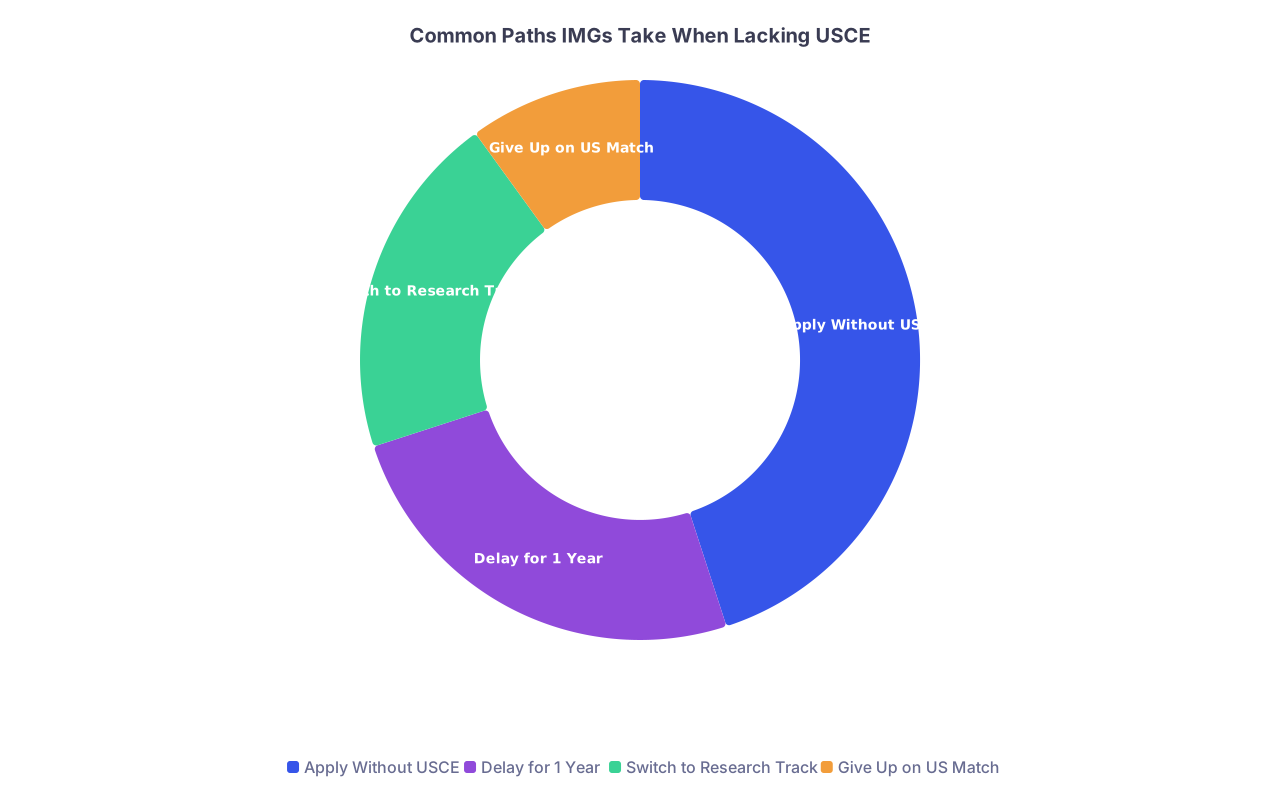
There isn’t a perfect answer. You’re trading money + time vs probability of a better profile later. What I hate seeing is people waste 2–3 years “waiting for USCE” and end up older, more distant from clinical work, and no closer to a visa.
Sometimes “good enough now” beats “perfect later that never comes.”
| Category | Value |
|---|---|
| Apply Without USCE | 45 |
| Delay for 1 Year | 25 |
| Switch to Research Track | 20 |
| Give Up on US Match | 10 |
If I Ever Do Get a Visa, How Do I Use It Strategically?
Say you finally get a visa slot or approval next year. Don’t just grab the first random observership you see.
You want maximum impact for minimal time and money.
Prioritize:
- Hands-on electives (if you’re still a student) over pure shadowing
- Programs that take IMGs and have open communication with their GME office
- Longer single rotations (e.g., 3 months at one place) rather than 3 random 4-week rotations, because relationships = better letters

| Step | Description |
|---|---|
| Step 1 | Visa Approved |
| Step 2 | Apply for Hands-on Electives |
| Step 3 | Target IMG-friendly Observerships |
| Step 4 | Max 2-3 High Yield Rotations |
| Step 5 | Choose Sites That Interview IMGs |
| Step 6 | Secure Strong LORs |
| Step 7 | Still Student? |
And you absolutely tell that story in your next application cycle:
“Once my visa was approved, I completed X and Y rotations at [US hospitals], where I learned [specific skills] and received mentorship from [US attendings].”
Again: show cause and effect, not chaos.
The Ugly Truth: Some Things Will Be Out of Your Control
This is the part I hate admitting. You can do everything “right” and still:
- Have your visa rejected
- Get ignored by programs that auto-filter for USCE
- End up unmatched despite being fully capable of thriving in residency
That doesn’t mean you were wrong to try.
Programs don’t see the nights you’re up refreshing the consulate page, or the disappointment on your parents’ faces, or how small you feel explaining another rejection to your friends. They just see an ERAS PDF.
Your job is to make that PDF tell the clearest, strongest possible story under the constraints you live with.
You’re not competing with a fantasy version of yourself who had unlimited US electives and a US passport. You’re competing with the reality of other IMGs who also have imperfections and obstacles.
Quick Mental Checklist: Am I Doing What I Can?
When the anxiety spikes and you feel like it’s all pointless, run through this:
- Am I actively involved in real clinical work right now (or as soon as possible)?
- Are my letters detailed, specific, and from people who actually know me?
- Have I pursued any kind of US-connected activity (virtual, research, case discussions)?
- Am I targeting the right tier of programs for my profile, not just famous names?
- Have I written a clear, honest explanation of my situation without sounding like a victim?
If the answer to most of those is yes, you’re not “behind.” You’re just on the hard version of this level.

FAQs
1. Will programs automatically reject me if I have zero US clinical experience?
No, not automatically. Some will, yes—especially those that clearly state “minimum 3 months hands-on USCE required” or historically rarely take IMGs. But a lot of community IM/FM/Peds/Psych programs will still consider you if you have strong scores, solid and recent clinical experience at home, good letters, and a coherent explanation for why you lack USCE. You’ll need to apply broadly and strategically, but “no USCE = zero chance” is simply not true.
2. Are virtual US clinical experiences and observerships worth the effort?
They won’t fully replace in-person USCE, and any program pretending otherwise is lying. But they do help you show effort, familiarity with US practice patterns, and can sometimes give you usable US-based LORs. If done with engaged mentors who actually interact with you, they’re definitely better than having nothing US-connected at all. Just don’t oversell them like you did a full sub-internship.
3. Should I mention my visa problems in my personal statement?
Yes, but briefly and strategically. One or two sentences explaining you were unable to complete in-person USCE due to repeated visa delays/denials is enough, followed immediately by what you did instead (clinical work at home, virtual US exposure, research). You’re giving context, not asking for sympathy. Don’t turn your personal statement into a visa essay.
4. If I don’t match this year without USCE, is it over for me?
No, but you can’t repeat the same cycle unchanged. If you go unmatched, you need a concrete plan: keep or increase real clinical work, strengthen letters, maybe add research or teaching, apply to a more realistic mix of programs, and reassess whether it’s possible to attempt USCE again (visa reapplication, different consulate, different passport country if you move). Plenty of IMGs match on second or third attempt after smart changes. It’s not over unless you decide you’re done.
Key points to hold onto:
You’re not the only one blocked by visas; programs have seen this before. Lack of USCE hurts, but it’s one variable in a bigger equation that you can still influence. And your job right now isn’t to be perfect—it’s to be the strongest, most consistent version of yourself within the limits you actually live with, not the life you wish you’d had.