
It’s mid-January. ERAS is long gone, interview season is winding down, and you’re sitting there doing the mental math you’ve done 200 times already:
USMLE scores: decent.
Letters: all from back home.
US clinical experience: absolutely none. Zero.
And the question that keeps hitting like a stomach punch:
“Did I just waste a whole year applying? Is matching without USCE actually a thing or is that just what people say to be nice?”
Let me be blunt: yes, people match every year with little or no US clinical experience.
Also blunt: for a lot of programs, especially as an IMG, having zero USCE is a huge handicap.
Both things are true. The trick is figuring out which world you’re actually competing in—and what to do now if you’re staring at an empty “Clinical Experience in the United States” section.
How Bad Is Zero US Clinical Experience Really?
Here’s the part that no one says clearly because everyone’s trying to be “encouraging”:
Some programs filter you out automatically if you don’t have US clinical experience. They don’t hate you personally. They just get 5,000+ applications and need something to slice the pile.
But there’s nuance.
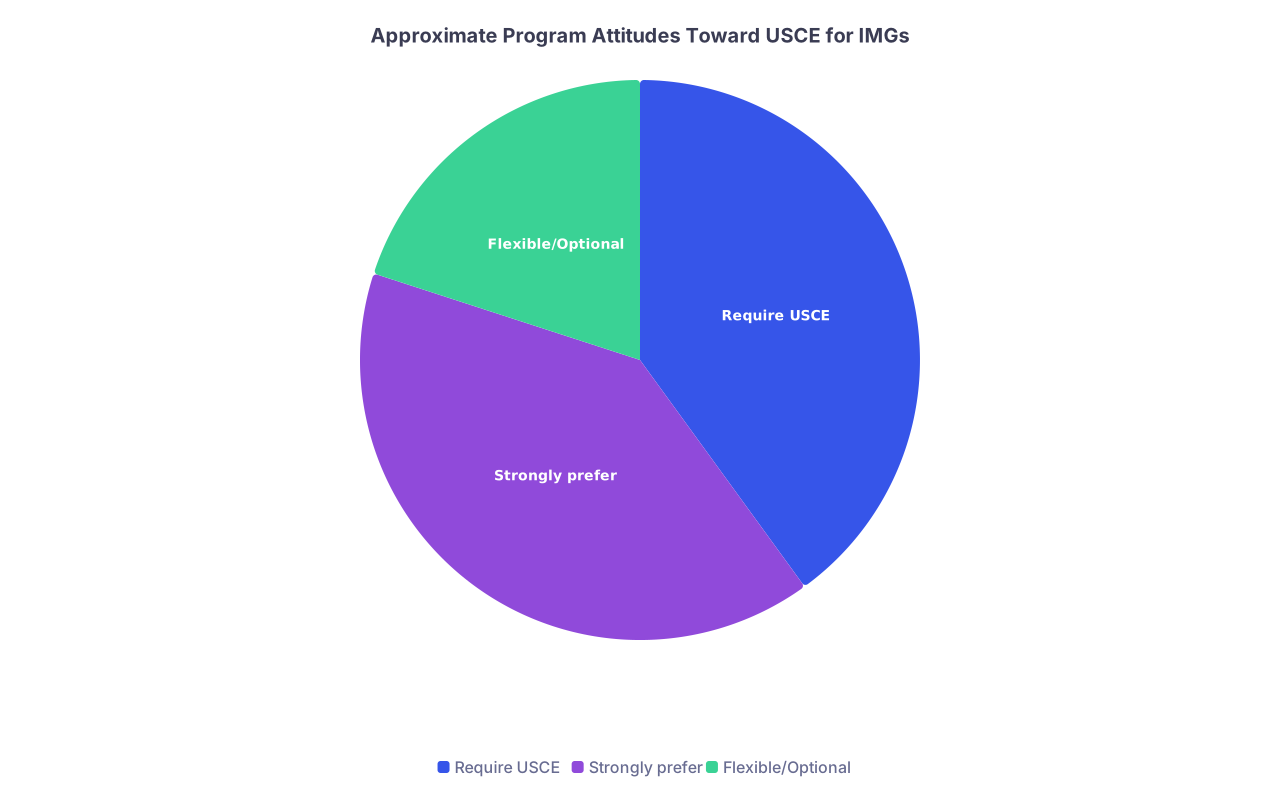
| Category | Value |
|---|---|
| Require USCE | 40 |
| Strongly prefer | 40 |
| Flexible/Optional | 20 |
Are those exact numbers? No. But this is what I’ve seen reading program websites, talking to faculty, and watching IMGs go through this year after year.
Here’s the rough reality:
You’re in a stronger spot with zero USCE if:
- You’re targeting community programs, especially IMG-friendly ones.
- Your Step scores are high for the specialty.
- You graduated recently (within 3–5 years).
- You have strong non-US clinical letters that actually say something specific about how you work.
You’re in a weaker spot with zero USCE if:
- You’re trying for super competitive specialties (derm, plastics, ortho… you know the list).
- You have multiple gaps in training, or an older YOG.
- Your application is already borderline (low scores, attempts, or weak research).
- You’re applying mainly to big-name academic places that spell out “USCE required.”
So is Match still possible? Yes.
Is it harder? Absolutely yes.
Is “no USCE = impossible” true? No. That’s the fear talking, not the data.
Why Do Programs Care So Much About USCE?
You’ve probably asked yourself, “Why do they care where I saw pneumonia? It’s the same lungs.”
Here’s what program directors really worry about (and I’ve heard these exact sentences in PD meetings):
- “Will this person understand how a US hospital actually runs, or will they be lost for 6 months?”
- “Can this person work in a multidisciplinary system—EPIC, consultants, nursing culture, patient expectations?”
- “Do I have any evaluator I trust who has seen this person in a US setting?”
- “Will they struggle with communication, documentation, or medico-legal issues here?”
USCE—especially hands-on (observerships are better than nothing, but everyone knows they’re limited)—is basically a proof-of-concept:
“I’ve functioned in your system and someone here says I don’t suck.”
It’s not about your intelligence. It’s about perceived risk.
Residency is already chaos. PDs don’t want to add “teach this person how US healthcare works from scratch” on top of that—unless they have some confidence you’ll adapt fast.
That’s where you’re behind with zero USCE. You’re asking them to take a leap of faith.
What Actually Moves the Needle If You Have No USCE?
You can’t time-travel and magically add two US clerkships to your 3rd year. So the question is: what can you do that programs actually respond to, especially if you’re in or approaching Match season?
Let’s break this up by timing.
If You’re Applying This Cycle (Right Now, With Zero USCE)
You’re not doing a full rebuild. You’re in survival mode and “salvage what we can” mode.
Here’s what matters more than obsessively refreshing your email:
- How IMG-friendly your list actually is
If you created your list by vibes (“this hospital looks nice”), you probably aimed too high or too random.
You want programs that:
- Consistently rank/match IMGs.
- Do not explicitly state “US clinical experience required” on their website.
- Are community-based or lower-profile university-affiliated.
| Program Type | USCE Expectation | IMG-Friendliness |
|---|---|---|
| Big-name university | Usually required | Low–moderate |
| Mid-tier university | Strongly preferred | Moderate |
| Community university-affiliated | Preferred | High |
| Pure community hospital | Flexible | Very high |
If you barely got any interviews, it might not be “I have no USCE therefore I’m trash.” Often it’s “I applied to the wrong places for my profile.”
- Your letters and personal statement actually doing the heavy lifting
With zero USCE, your non-US letters matter more. They can’t be generic fluff like “hardworking and punctual.” PDs see 500 of those.
They need to say things like:
- You functioned like an intern.
- You managed complex patients.
- You communicate well with patients and team.
- You were reliable, took ownership, and handled pressure.
And your personal statement? It can quietly acknowledge your lack of USCE without sounding like an apology letter.
Something like:
“I haven’t yet had the opportunity to work in a US clinical environment, but I’ve sought out roles with high responsibility in [country], including [brief, specific example], that mirror the autonomy and accountability expected of residents here.”
Not:
“I know my lack of USCE is a big weakness and I hope you’ll overlook it.”
That just screams insecurity and reminds them of the red flag.
- Post-interview communication and signals
If you did get interviews, zero USCE becomes less fatal. Once you’re in that Zoom room, they’re evaluating you as a person, not just as a CV.
Strong interviews + clear interest + normal human conversation can absolutely outweigh lack of USCE in many community programs.
If You’re Planning the Next Cycle (Or You Expect You Might Not Match)
This is where you actually have leverage. Painful leverage, but real.
You have two big decisions:
- Do you try to get any form of USCE—observership, externship, research with some clinical exposure?
- Do you adjust your specialty and program strategy?

| Step | Description |
|---|---|
| Step 1 | Unmatched |
| Step 2 | Plan for USCE or research |
| Step 3 | Strengthen home country practice |
| Step 4 | Choose more IMG friendly specialty |
| Step 5 | Reapply same specialty with changes |
| Step 6 | Can you get US visa or funding? |
| Step 7 | Need to switch specialty? |
1. Getting USCE when you currently have none
Reality check: it’s not easy. It’s expensive. It’s full of gatekeeping.
But here’s the harsh truth I’ve seen over and over:
The IMGs who move heaven and earth to get at least 2–3 months of any USCE usually do better on their next attempt than those who say, “I’ll just reapply with the same CV and hope for better luck.”
Types of USCE, from strongest to weakest:
Hands-on externship with documentation, notes, patient contact, and a letter.
Gold. Rare. Often expensive. But if you can get even 1 month, it changes how PDs read your file.Inpatient or outpatient observership with a strong, detailed letter.
You’re not writing notes, but if the attending knows you well and can speak to your clinical reasoning and work ethic, it still helps a lot.Research + some clinical exposure (rounds, patient conferences, tumor boards).
Not true “USCE,” but it lets you learn the system, get named letter writers, and show you can exist in that environment.
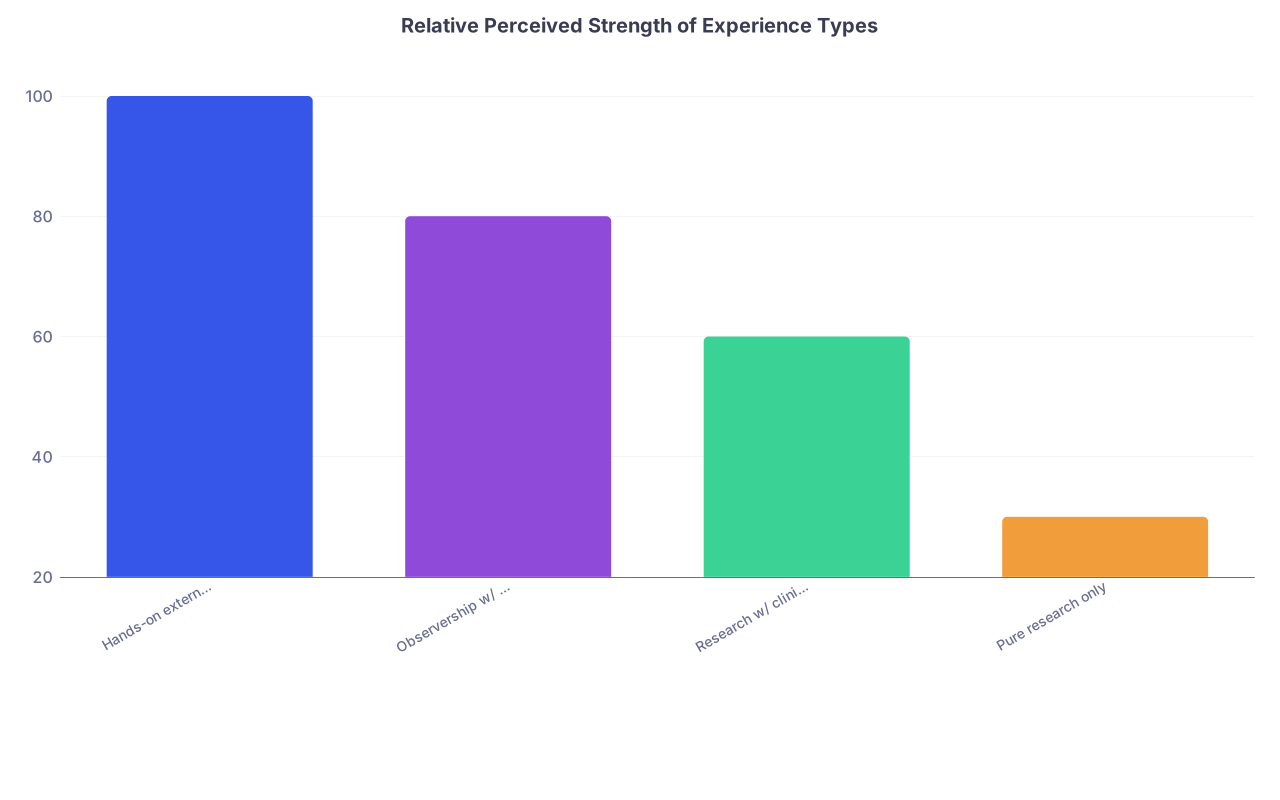
| Category | Value |
|---|---|
| Hands-on externship | 100 |
| Observership w/ strong letter | 80 |
| Research w/ clinical exposure | 60 |
| Pure research only | 30 |
If money, geography, or visa issues make formal USCE impossible, then your job is to:
- Get as much responsibility-heavy clinical work at home as possible.
- Get letters that describe that responsibility in detail.
- Lean hard into being clinically ready day one.
Not ideal. But not hopeless.
2. Specialty and program strategy
If you have zero USCE and no realistic way to get any, trying to match into a hyper-competitive field as an IMG is basically gambling your future on lottery odds.
I’ve seen people cling to neurosurgery or radiology with no USCE, old YOG, okay scores… and then sit through three unmatched cycles while their confidence erodes.
Sometimes the bravest thing you do is pivot.
Specialties and settings that are generally more forgiving about lack of USCE (assuming other parts of your app are solid):
- Internal medicine (especially community, non-university-heavy)
- Family medicine
- Pediatrics (community programs)
- Psychiatry in some regions
- Certain prelim programs
Notice I didn’t say “easy.” Just “less brutal.”
How Do You Compensate Inside the Application Itself?
Say you’re stuck with zero USCE this round, or you know you’ll only have 1–2 short observerships. How do you present yourself so programs don’t write you off immediately?
1. Make your non-US clinical work look like a residency-in-waiting
Don’t just list “Rotating internship – Internal Medicine.” Everyone has that.
Spell out responsibilities:
- Did you manage your own patient list?
- Did you write orders? Prescriptions?
- Did you cover nights? Codes? ICU?
- Did you teach juniors or students?
PDs care more about that than the fancy name of the hospital.
2. Build a coherent story instead of “random experiences”
Your CV shouldn’t look like:
1 month of cardiology here.
2 weeks of some research there.
3 random observerships you barely remember.
You want a clear theme:
“I am committed to this specialty, and here’s the consistent pattern of choices that prove it.”
That way, even if you lack USCE, your seriousness about the specialty is obvious.
3. Be preemptive, not defensive, about your lack of USCE
You don’t need to devote paragraphs to explaining why you don’t have it. But you can show awareness:
“In my home institution, I’ve taken on progressive responsibility equivalent to a junior resident, including managing a panel of [X] admitted patients under supervision, presenting in multidisciplinary rounds, and leading sign-out. While I haven’t yet completed US clinical rotations, I’ve proactively studied US practice patterns in [X ways] to minimize the learning curve once I begin residency.”
That signals:
- You know this is an issue.
- You’re not in denial.
- You’re already trying to close the gap.
The Emotional Side: The “Everyone Else Has USCE” Spiral
Let’s be honest. This part sucks.
You scroll through forums and see people posting:
“Matched IM with 3 US LORs, 4 months USCE, multiple observerships.”
“PGY1 IM. Step 1 245, Step 2 252, 6 months USCE at big-name places.”
And you’re sitting there thinking, “I had no shot. I never stood a chance.”
That mindset is poison. Not because it’s “negative,” but because it makes you passive. You start believing the outcome is predetermined.
Here’s the quiet truth most people don’t share publicly:
Every year there are IMGs who match with ugly-looking applications by Reddit standards. No USCE. Decent but not elite scores. Some gaps. Imperfect English.
But they do a few things very well:
- They apply smart, not just wide.
- They hustle for any US exposure they can get—emails, cold calls, smaller hospitals.
- They accept that they might need more than one cycle and use the in-between year strategically, not just drifting.
- They let go of ego about specialty and prestige.
You are not doomed because you’re starting behind. You’re doomed if you start behind and then freeze in place.
What I Would Do If I Were You (Zero USCE, IMG, Anxious Out of My Mind)
If you’re mid-cycle:
- Stop catastrophizing every silence as “because I have no USCE.” Maybe yes, maybe no. You don’t control it now.
- For any remaining interviews: overprepare. Practice answering, “Tell me about your clinical experience” in a way that shows you’ve had serious responsibility even if not in the US.
- Make a quiet Plan B in parallel: what will you do from March onward if you don’t match?
If you’re planning for next cycle:
- Have a brutally honest talk with yourself about specialty and program targets.
- Investigate any realistic route to 1–3 months of USCE or at least US-based research with clinical exposure.
- Decide now: are you willing to move, spend, and hustle for that, or is your path going to be “no USCE ever, but heavy responsibility at home + strong letters”? Either is valid. They just have different odds.
- Promise yourself you won’t submit the exact same application twice. Something must change: USCE, research, scores (if Step 3 is in play), letters, or specialty choice.
And while all this anxiety is screaming at you: remember this—
Program directors don’t sit in a room and say, “No USCE? Reject.”
They say, “Given our applicant pool this year, is this person too risky?”
Your job over the next months or year is to make yourself just a little less risky in their eyes.
Not perfect. Just less risky.