
Here's the myth: academic programs teach better risk management because they have bigger safety offices, more committees, more policies, and more lawyers floating around after something goes wrong.
Sounds respectable. It's also sloppy thinking.
Risk management in residency is not a PowerPoint about malpractice. It's not a laminated policy hidden somewhere on the intranet. It's a behavior system. Handoffs that don't drop the ball. Supervision that shows up before the patient crashes, not after. Escalation that's clear, early, and unembarrassed. Documentation that explains your reasoning instead of decorating the chart with nonsense. Disclosure culture that doesn't turn residents into ghosts the second harm happens.
That's the real game.
And program type? Academic versus community? Useful shorthand, maybe. Reliable proxy for who actually teaches these habits? Not really. I've seen "prestige" programs with gorgeous simulation centers and atrocious handoffs. I've seen community programs with modest resources but a ruthless culture of closed-loop communication, clean escalation, and ownership of follow-up. Guess which one teaches safer medicine.
This article is for applicants who want the truth, not brochure language. We're going to compare how academic and community programs actually train risk-management behavior, what data is worth trusting, and what questions you should ask before you rank a place.
This article is for educational purposes only, not legal, tax, or professional liability advice. Malpractice exposure, institutional policy, and training quality vary widely by hospital and state, so use this as a framework and verify details with qualified professionals and current residents.
What the Data Actually Measures: Outcomes, Not Buzzwords
Applicants love easy proxies. "Big academic center" becomes "must be safer." "Lots of lawsuits" becomes "must be dangerous." That's not how any of this works.
Malpractice claim volume is a dirty metric. It reflects patient complexity, local litigation culture, insurance structures, documentation style, referral patterns, and whether a hospital encourages aggressive reporting or buries everything under committee language. A tertiary center taking transfers of catastrophic disease will almost always look different from a smaller community site, even if the bedside decision-making is excellent. Claims are not a clean safety score. Never were.
What can you measure a little better? Mechanisms. Whether residents know when to call. Whether attendings actually answer. Whether there are structured handoffs instead of freestyle storytelling at 6:45 p.m. Whether near-misses get reported without residents being publicly flayed. Whether duty hours are violated in ways that create fatigue-related mistakes. Whether complication review is educational or theatrical. Whether anticoagulation errors, post-op deterioration, fever in neutropenia, and procedural consent problems are taught as recurring hazards with clear playbooks.
That's the bottom line: don't confuse branding with signal. If you want to know whether a residency teaches risk management, look for training mechanisms and outcome proxies that live at the bedside. Not just committee names.
Academic Programs: Where They Can Win, and Where They Often Don't
Academic programs do have real advantages. Let's not be lazy and deny the obvious.
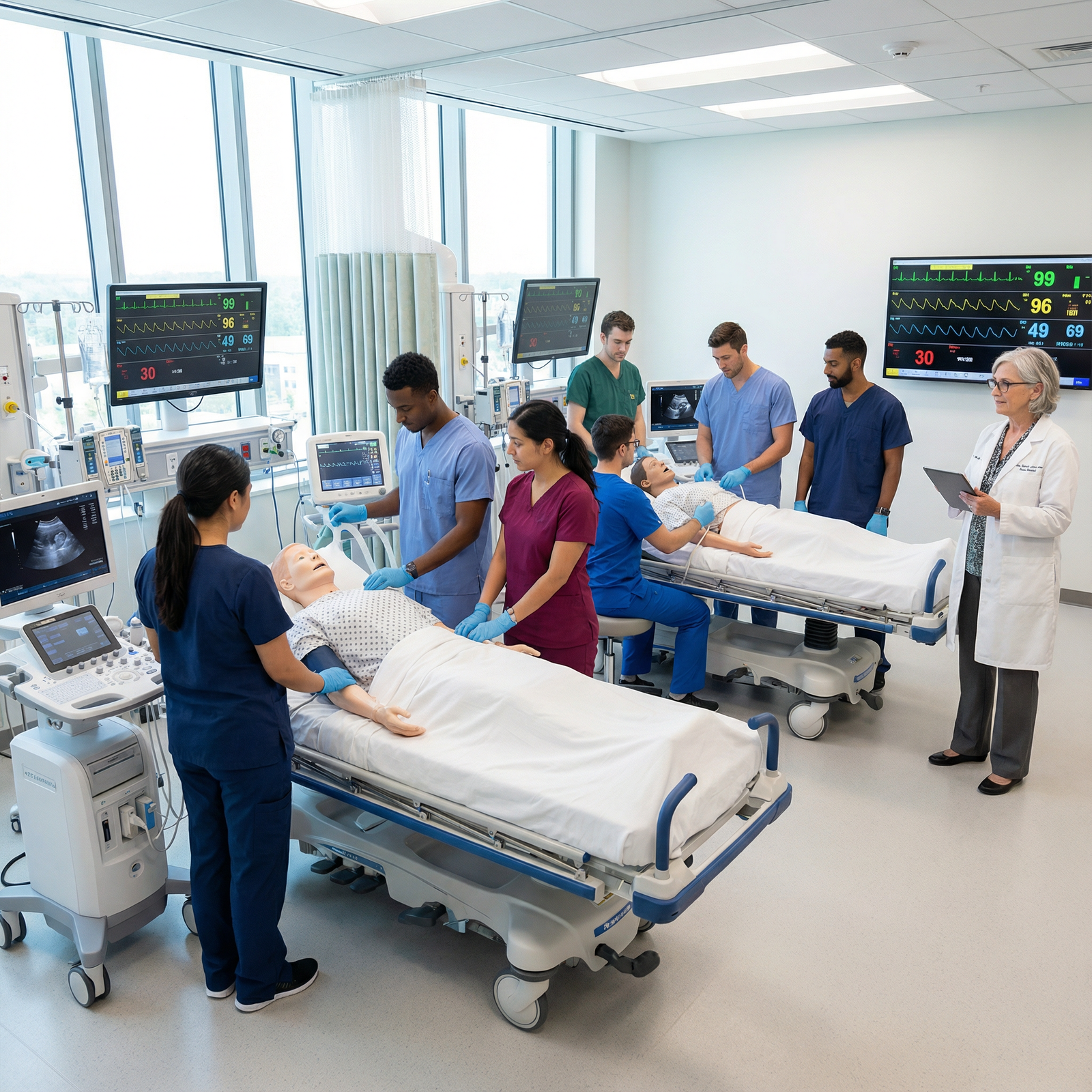
First, the best academic centers are better at formalizing learning. Simulation can be excellent when it's tied to actual failure modes: can't-intubate scenarios, postpartum hemorrhage, anticoagulation reversal, post-procedure decompensation, handoff collapse at shift change. Good M&M conferences can also be outstanding. Not the old-school blood sport where everyone pretends the intern's note caused sepsis. I mean structured review: timeline, contributing factors, supervision, communication failures, latent system errors, and what changes next week because of this case. That's useful.
Second, subspecialty depth can improve escalation. If your patient with neutropenic fever decompensates at 2 a.m., it matters whether there's operational access to ICU, ID, heme/onc, and an attending who knows the service and picks up the phone. In strong academic programs, that network creates safer rescue pathways.
But here's the part applicants miss: more oversight on paper does not equal better risk judgment in the resident.
I've seen the failure mode over and over. The resident learns that every hard problem belongs to a fellow, every gray zone belongs to a consultant, every unstable moment belongs to somebody "more specialized." The resident becomes good at transferring responsibility, not owning risk. Cognitive offloading. It feels safe. It looks polished. It can be terrible training.
If a resident never has to articulate, "Here's what worries me, here's what I think is happening, here's why I'm escalating now," then the program is not building a risk manager. It's building a messenger.
Another weak spot: difficult communication is often less consistent than applicants expect. Academic programs may be fantastic at complex physiology and still weak at frontline disclosure, family conflict, and authority ambiguity. Who tells the family there was a delayed diagnosis? Who explains a post-procedure bleed honestly without improvising legalese? Who coaches the resident after a near-miss? Not every elite place does this well. Some are weirdly performative, lots of safety language, very little bedside coaching.
So yes, academic programs can win. They often do in simulation, conference structure, and specialist backup. But when they fail, they fail in a very specific way: too much system sophistication, not enough resident ownership.
Community Programs: Where They Can Win, and Where They're Misjudged
Now the myth on the other side: community means less structure, less safety, less sophistication.
Wrong. Often smugly wrong.
Community programs can be excellent at the most neglected part of risk management: continuity. Not just avoiding an inpatient error, but closing the loop. Did the patient understand return precautions? Did someone own the callback? Did the abnormal imaging result get tracked? Did the discharge plan actually survive contact with real life? That's risk management too. And community settings often force residents to care about it because there isn't an army of layered teams buffering every loose end.
Autonomy is the other big advantage. Earlier independent decision-making, if paired with clear backup, builds ownership fast. Residents learn to think, commit, reassess, and call for help without dramatics. That matters. The safest doctors are not the ones who look calm because someone else is always catching them. They're the ones who recognize danger early and escalate cleanly.
Community programs are also routinely underestimated because their safety structures may be less centralized. Fewer branded institutes. Fewer glossy QI dashboards. Fewer grand-sounding committees. Fine. None of that tells you whether the senior resident says, "This blood pressure plus that lactate means we're calling now," or whether the attending responds, "Good catch, I'm coming."
That said, community programs do have vulnerabilities. Access to simulation can be thinner. Subspecialty support may be variable. Formal event reporting can be inconsistent. The difference is that strong community programs compensate with practical tools: standardized handoff sheets, procedure checklists, direct attending escalation, and brutally clear rules for when autonomy stops and supervision begins.
That's not inferior. That's operational.
The Real Comparison: Mechanisms That Teach Risk Management Behaviors
Here's what actually teaches risk management, regardless of logo on the badge.
Teach-back beats training hours. I don't care if a program gives residents six lectures on patient safety if nobody checks whether they can recognize impending airway failure, dose anticoagulation safely in renal dysfunction, or identify post-op bleeding before the hemoglobin comes back ugly. The real question is whether attendings coach in real time and then make residents explain the reasoning back.
Operational escalation is the core skill. Does the program teach explicit triggers? Fever in neutropenia. Hypotension after a procedure. New oxygen requirement. Altered mental status after sedation. High-risk potassium. Concerning fetal tracing. Whatever the specialty, residents should know: this is the threshold, this is the call, this is how you phrase it. "Call early, call clearly" is not a slogan. It's a safety device.
Reliability engineering matters too, even if nobody uses that phrase on interview day. Standardized handoffs. Procedure time-outs. Read-backs for critical orders. Medication reconciliation that isn't fake. Default habits under stress. That's what reduces preventable error.
Documentation is another place applicants get fooled. Risk management is not teaching residents to write defensive novels. That's bad medicine and bad charting. Good programs teach concise, defensible reasoning: why you thought the patient was stable or unstable, what differential you considered, what contingency plan you gave, what follow-up you arranged, when you escalated, and why. The "why" matters. I've seen residents at both academic and community sites get almost no coaching on this until something goes sideways. That's absurd.
Then there's communication and disclosure. If residents never practice saying, "Something unexpected happened, here's what we know, here's what we're doing next, and I'm sorry this occurred," they are not being trained for real risk. Full stop. Simulation helps. Role-play helps. Debriefs after real events help more.
And supervision should change with risk, not with bureaucracy. Graduated responsibility is good only when high-hazard moments are explicitly identified. Central line in a crashing patient? Different supervision than a routine line at noon. New intern cross-covering chest pain overnight? Different backup than a senior managing a stable boarder. Good programs don't just declare "graded autonomy." They define where the guardrails tighten.
That loop is the whole story. Recognize. Escalate. Supervise. Act. Document. Debrief. Repeat until it becomes automatic. Programs that do this well teach risk management. Programs that don't, don't. Academic or community is secondary.
What Applicants Should Ask: A Myth-Buster Checklist for Risk Management
Stop asking, "Is your program strong in risk management?" That question is useless. Every program will say yes. Every single one. They'll say it with a straight face while interns are getting vague sign-outs and guessing whether they're "allowed" to wake the attending.
Ask for behaviors.
Ask how handoffs are standardized. Ask whether residents use checklists for procedures. Ask for concrete escalation triggers in common dangerous scenarios. Ask what happens after a near-miss. Ask who coaches documentation. Ask residents whether they're ever discouraged from calling early. That last one is gold, because residents will usually tell the truth with their eyebrows even when their words are diplomatic.
If possible, watch rounds or handoffs. You'll learn more in 20 minutes there than in an hour of polished recruitment talk. Does the senior summarize contingency plans clearly? Does anyone clarify code status, anticoagulation, pending tests, and "if X happens, do Y"? Or is it all vibes and memory?
Ask for examples. Not slogans. "Tell me about a recent simulation on communication." "What does your M&M look like?" "When a patient deteriorates after a procedure, when do you call the attending?" "Have you ever been coached through disclosure to a patient or family?" These questions expose whether safety training is lived or marketed.
Green flags are boring in the best way: explicit call thresholds, residents who can name recent process changes from M&M, attendings who welcome early escalation, and documentation coaching that focuses on reasoning and contingency plans. Red flags are also boring, just uglier: vague supervision, performative M&M with no implementation, punitive chart culture, and residents who whisper that calling too early makes you look weak.
That's the stuff that matters.
Closing Reflection: The Best Risk Management Is Built, Not Bragged About
Applicants get seduced by brand. Big name, big building, big promises. Or the opposite: they assume a smaller community program must be less safe because it talks less like a hospital administrator. Both instincts can mislead you.
What you can trust is behavior. Watch how people hand off. Listen to how they escalate. Ask whether supervision tightens at dangerous moments. Find out whether mistakes become better systems or just better excuses. That's the real curriculum.
My view is simple: academic versus community is a weak predictor. Specific safety infrastructure, supervision culture, and resident ownership are far more predictive. The best programs don't brag about risk management. They operationalize it. Daily. Quietly. Relentlessly.
Use the checklist. Then verify it with resident stories, specific examples, and what you observe when nobody's delivering the sales pitch. That's how you separate a training environment that talks about safety from one that actually teaches it.