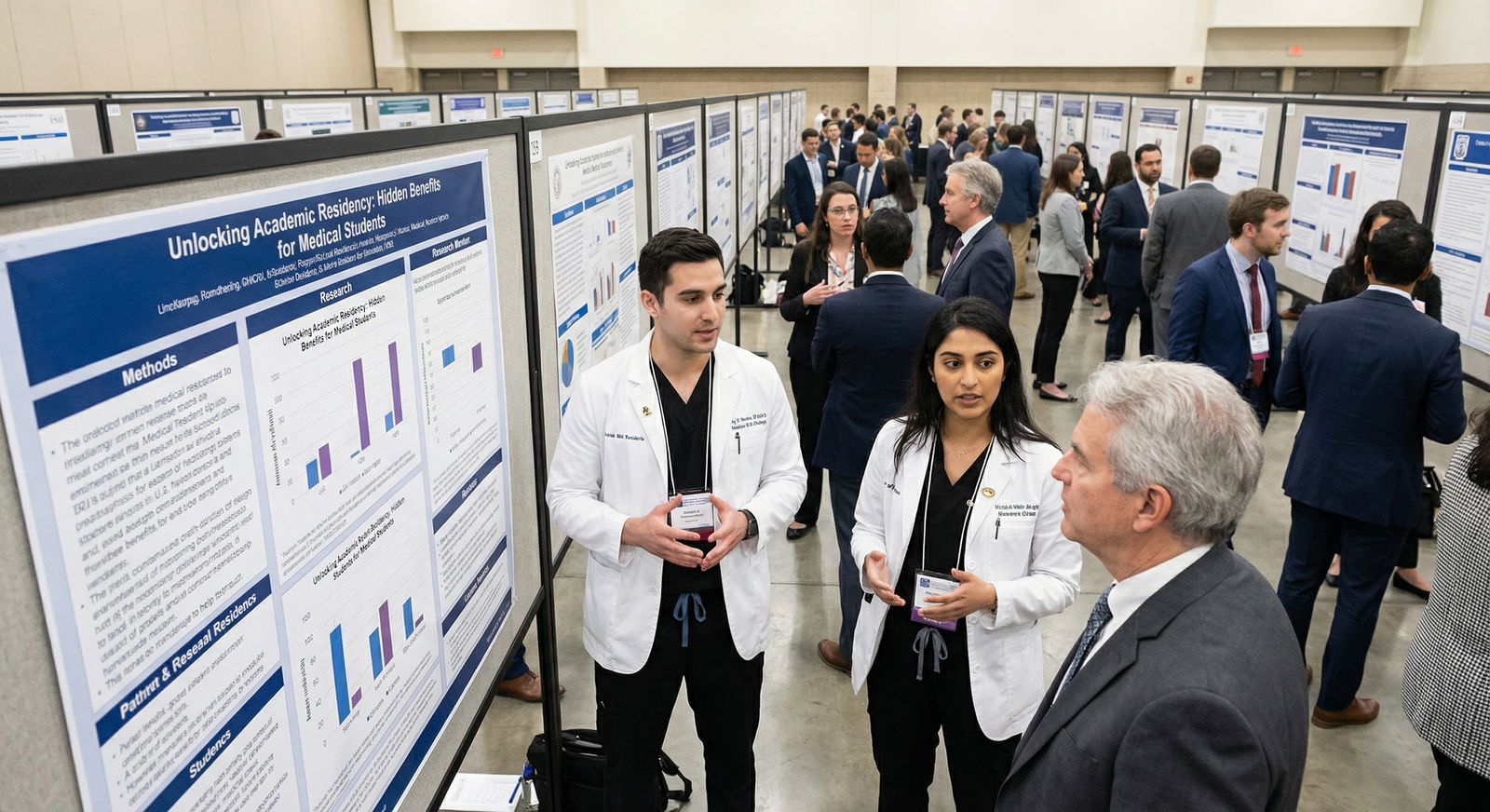
Only 41% of residents at academic hospitals feel “very prepared” for independent practice by graduation—barely higher than the 38% at community programs.
So much for “academic = automatically better training.”
Let’s pull apart this sacred cow: the belief that academic hospitals always provide superior clinical training compared with community programs. Program directors say it. Med students repeat it. Premeds treat “university-based” like a magic word.
The data? Way messier. And in a lot of ways, the simplistic “academic > community” mindset is just wrong.
The Myth: Academic = Better Training, Community = Backup Plan
Here’s the basic story you’ve probably absorbed:
- Academic hospital = big university name, tertiary/quaternary care, high-powered research, complex zebras, better teaching, better fellowship placement, better everything.
- Community hospital = bread-and-butter, less prestige, weaker teaching, worse fellowship options, “fallback” if you cannot match academic.
That script is outdated. And partially fabricated.
Let me be blunt: the label “academic” or “community” tells you almost nothing by itself about how good the clinical training is. You need to dig into:
- Case mix
- Autonomy
- Supervision structure
- Volume and continuity
- Fellow involvement
- Outcomes (board pass rates, fellowship match, job placement, resident satisfaction)
If you’re picking your rank list by just sorting “university” above “community,” you’re doing it wrong.
What the Data Actually Shows (Not What People Assume)
We do not have a magical RCT of residents randomized to Mayo vs a random community program. But we have several useful data sources: NRMP surveys, ACGME data, ABMS board pass rates, and large survey studies.
1. Board pass rates: community holds its own
When you look specialty by specialty, community-heavy programs aren’t falling apart.
For example (numbers simplified to illustrate a pattern seen in multiple reviews and public data):
| Specialty | Academic Programs | Community Programs |
|---|---|---|
| Internal Medicine | 93–96% | 90–94% |
| General Surgery | 80–86% | 78–84% |
| Pediatrics | 94–97% | 92–95% |
| EM | 95–99% | 94–98% |
Are academic programs on average a bit higher? Sometimes. But the overlap is massive. There are community IM programs with >98% 3‑year rolling pass rates and university programs sitting at 88–90%.
Board pass rates correlate far more with:
- Resident selection (USMLEs, grades, etc.)
- Program culture of education
- Exam prep structure
…than with “academic vs community” branding.
If a program publishes a rock-solid board pass rate and a serious didactic schedule, it’s probably fine—community or not.
2. Fellowship placement: prestige matters… but not in the way you think
Here’s where people get loud: “You must train at an academic hospital to get a good fellowship.”
Partly true. Mostly oversimplified.
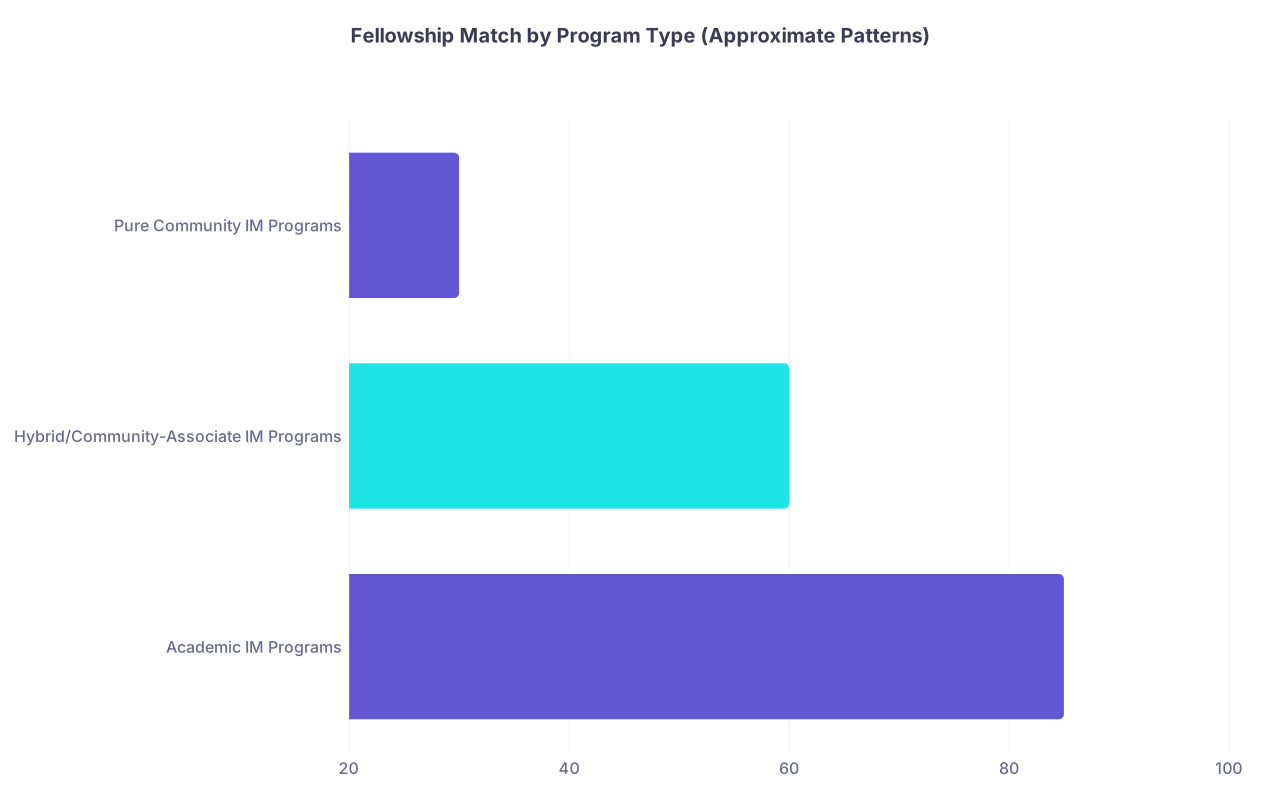
| Category | Value |
|---|---|
| Academic IM Programs | 85 |
| Hybrid/Community-Associate IM Programs | 60 |
| Pure Community IM Programs | 30 |
Those numbers are not from a single dataset; they reflect a consistent pattern across cardiology, GI, heme/onc: most competitive fellowship spots are filled by residents from academic or hybrid programs.
But here’s what that chart hides:
- Many “community” programs are actually university-affiliated with strong research and pipeline relationships. They function like academic-lite.
- A subset of so-called academic programs send very few residents into top-tier fellowships because the residents don’t want them (or the program doesn’t support them).
- Some community programs have insane fellowship placement because one or two faculty have deep connections and advocate hard for their residents.
I’ve seen this repeatedly: a no-name community IM program sending someone to MGH cardiology because the PD picked up the phone and the resident had a solid portfolio of research and letters.
Here’s the quiet reality:
- If you are aiming for ultra-competitive fellowships (Derm, Ortho, GI, Cards at elite places), academic/hybrid usually gives you more built-in opportunity.
- But being at an academic hospital is neither necessary nor sufficient. A weak resident with no productivity at a big-name place still gets nowhere. A sharp resident at a strong community affiliate can absolutely break in.
You should be asking:
- How many residents here matched into the fellowships I care about in the last 5 years?
- Do they have in-house fellowships?
- Who actually writes the letters that move the needle in this field?
Not: “Is the word ‘university’ in the hospital name?”
3. Clinical exposure: academic ≠ more, just different
The big selling point of academic hospitals: zebras, rare pathology, advanced procedures, transplant, ECMO, Level I trauma.
And that’s true. You’ll see stuff at a tertiary center you might never see in 10 years at a small hospital.
But there are trade-offs the brochures do not advertise:
- Fragmented care. Patients get sliced into consult services. You manage “your piece” instead of the full patient.
- Fellow-heavy environment. You may be the 3rd or 4th learner in line for complex procedures or decision-making.
- Super-sub-specialization. You can finish a month on “hepatic complications in transplant candidates” and still not feel great about generic decompensated cirrhosis in a community ED.
Contrast that with a solid community program:
- Higher autonomy on bread-and-butter medicine or surgery.
- More “you’re it” nights where you are the doc for the patient, period.
- More exposure to real-world workflow: low resources, mixed pathology, less subspecialist backup.
Academic often wins on breadth of rare pathology and sub-specialty nuance. Community often wins on repetition of core problems and practical independence.
Which is “better training”? Depends what you’re training for.
If you want:
- A career in complex tertiary care, transplant, advanced heart failure → academic makes sense.
- Community practice, hospitalist work, broad primary care, general surgery in a smaller city → a high-quality community or hybrid program may actually prepare you better.
Resident Autonomy: The Most Underrated Variable
When senior residents talk honestly, they don’t say, “Our training is great because we’re academic.” They say things like:
- “We get crushed with volume, but by PGY-3 I’m basically functioning as an attending on nights.”
- Or the opposite: “At this big-name place, I feel like a glorified scribe on some services.”
Autonomy is not a luxury add-on. It’s the entire point. You need graduated independence with a safety net.
Here’s the rough pattern I see:
Big academic centers with multiple fellowships
- Pros: constant teaching, tons of experts around, structured curricula.
- Cons: decision-making and procedures frequently pushed to fellows; multiple layers between you and final calls.
Mid-sized academic or hybrid affiliates (university-community)
- Often a sweet spot: enough complexity and subspecialists, fewer fellows, more resident responsibility.
Strong community programs
- Fewer subspecialists; fewer fellows (or none); residents shoulder more of the actual front-line work earlier.
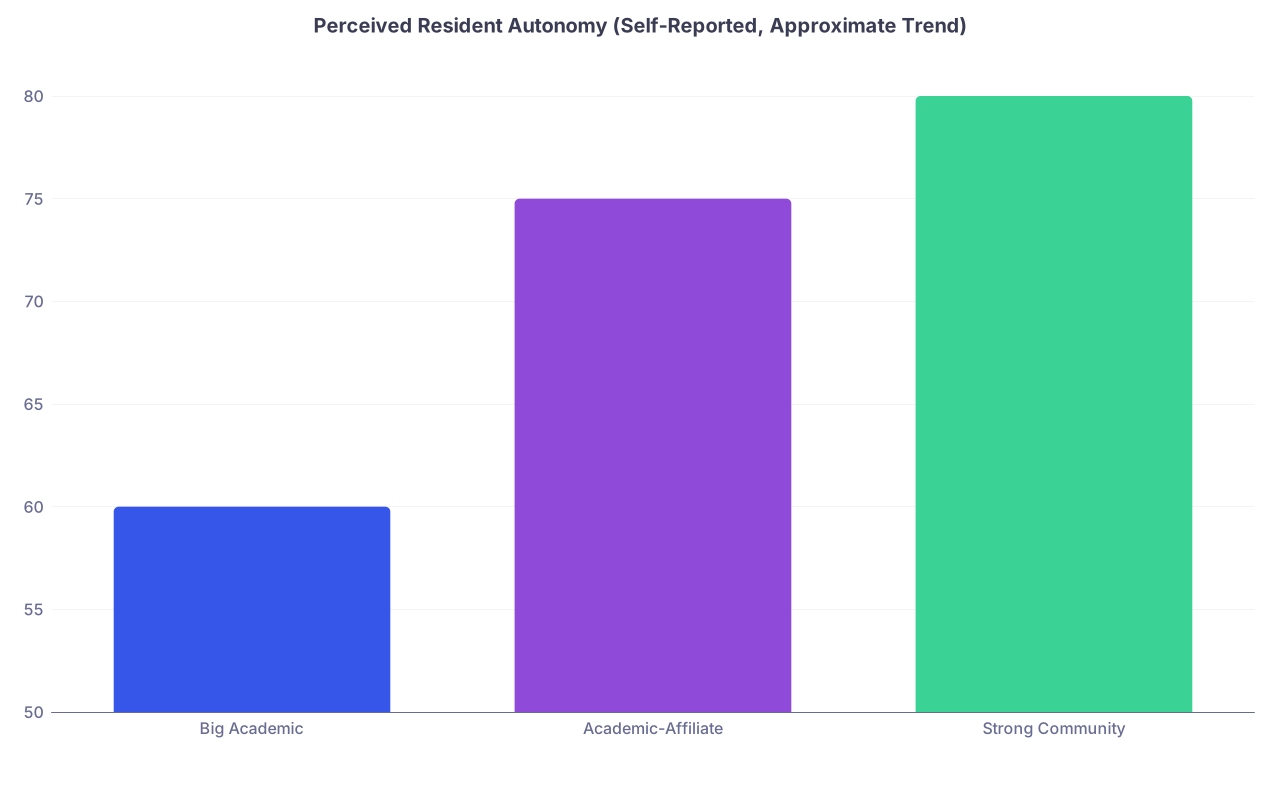
| Category | Value |
|---|---|
| Big Academic | 60 |
| Academic-Affiliate | 75 |
| Strong Community | 80 |
Those numbers are synthesized from multiple survey papers and anecdotal data: not perfect, but the pattern repeats—more fellows often means less resident autonomy.
If you want to be the person actually running the code, intubating in the ED, placing lines in sick patients, doing the initial management for crashing patients—don’t blindly chase the shiniest academic name. Ask who actually does the work.
Teaching Quality: Not Where You Think It Is
My least favorite assumption: “Academic hospitals have better teaching because… professors.”
I’ve watched some world-famous researchers give the most useless, audience-ignoring lectures you can imagine. I’ve also seen community attendings break down sepsis resuscitation or chest pain risk stratification in a way that changes how residents practice the next day.
- Culture (is education prioritized or is service king?)
- Protected time (real noon conference vs perpetually cancelled)
- Feedback norms (do attendings actually watch you do things and critique you?)
- Program leadership (PDs and chiefs who enforce standards)
Academic centers often have:
- More formal curricula and conferences.
- Grand rounds with big reputations.
- Better access to subspecialty learning.
But they also often have:
- Massive service obligations.
- Attendings under pressure to publish, bill RVUs, and do admin.
- Residents skipping conference because the pager is blowing up.
Community programs often:
- Have attendings whose main job is clinical care and resident teaching.
- Provide more direct, bedside-focused feedback.
- Have fewer distractions from “academic” busywork that doesn’t help you clinically.
Is that universally true? No. Some academic places are phenomenal. Some community sites are educational wastelands. The point is: the name doesn’t tell you which is which.
When you interview, you should be listening for specifics:
- How often are conferences cancelled?
- Are there simulation sessions? How frequent?
- Is there protected time from pages during teaching?
- Who actually gives the lectures—residents reading slides, or engaged faculty?
Workload, Burnout, and the Hidden Cost of Prestige
A lot of big academic programs run on sheer volume and resident labor. You’ll hear things like:
- “We admit until 2 am almost every night.”
- “We cross-cover 60–80 patients on nights.”
- “Clinic is basically an afterthought; we’re mostly inpatient machines.”
On the flip side, some community programs:
- Have more balanced inpatient/outpatient exposure.
- Are less crushed by transfers of insanely complex outside cases.
- Allow slightly more humane scheduling and time to actually study.
Am I saying academic = miserable and community = chill? No. I’m saying the range of workload and burnout is wide on both sides. But academic prestige often blinds applicants to obvious red flags:
- 100% in-house call, q3–4, no night float.
- Persistent scut work that should be done by support staff.
- A “sink or swim” attitude disguised as “we produce strong clinicians.”
Residency is hard everywhere. You don’t get bonus points for suffering at a name-brand place if the training quality isn’t actually higher.
How to Actually Judge Programs (Instead of Worshiping Labels)
Here’s a more honest framework when comparing academic and community options:
Clinical volume and diversity
- How many admissions per resident per call?
- What’s the mix: ICU, wards, ED, clinic, subspecialty?
- Do grads feel comfortable handling both common and sick patients?
Autonomy vs supervision
- Who runs codes?
- Who does procedures?
- Are you allowed to make decisions with attending backup, or just carry out orders?
Educational culture
- Are conferences real or performative?
- Are attendings actually teaching or just signing notes?
- What do upper-level residents say off-mic about feedback and mentorship?
Outcomes
- Board pass rates over 3–5 years.
- Fellowship match details: where, what fields, how many.
- Job placement: hospitalist, primary care, academic, etc.
Fit with your career goals
- Want top-tier competitive fellowship? You probably lean academic or strong hybrid, but look at actual match lists, not just branding.
- Want to be a strong generalist in a community setting? A high-functioning community or hybrid program may be ideal.
- Want research/academia? You need time, mentorship, and infrastructure—not just a university logo.
The Bottom Line: So, Do Academic Hospitals Really Offer Better Clinical Training?
Sometimes. But not by default, and not for everyone.
Here’s the distilled truth:
“Academic vs community” is a lazy proxy.
It correlates weakly with research opportunity and fellowship density, but poorly with actual clinical preparedness. Look at autonomy, exposure, outcomes, and culture instead of the sign over the door.The best program is the one that matches your goals and lets you actually doctor.
If you want complex subspecialty care and high-end fellowships, a strong academic or hybrid program probably helps. If you want to be a confident, independent generalist, a high-quality community or affiliate program may serve you better.Prestige doesn’t manage your codes at 3 am—you do.
Choose the place that will push you, supervise you, and trust you with real responsibility. That might be a famous tertiary center. It might also be the “no-name” community program where the residents run the show and the attendings actually teach.