
The loudest people on Reddit are wrong about surgical autonomy.
If you believe the forums, community programs are “knife-happy free-for-alls” where residents do everything, and academic programs are “malignant scut factories” where fellows steal your cases and you hold the camera for five years. That split story is comforting. It is also lazy, outdated, and often just false.
Let me walk through what actually drives autonomy and who really operates more — backed by what data we have, plus what people actually report when they are not trying to impress MS2s online.
The Core Myth: “Community = Autonomy, Academic = No Cases”
This is the script:
- Community programs: “You’ll be primary on cases early, tons of bread-and-butter, attendings hands-off, no fellows to compete with.”
- Academic programs: “You hold retractors, watch the fellow, and finally get to close skin as a PGY-5. Maybe.”
You see that exact phrasing over and over, usually from:
- A single resident with a sample size of one
- A student who rotated at one shiny academic center and one mediocre community hospital
- Or someone selling their program on interview day
Here’s the uncomfortable truth: both extremes exist on both sides. There are community programs where you mostly assist a private surgeon who moves too fast to let you do anything. There are academic programs where chiefs are essentially junior attendings and run entire cases.
The binary is wrong. The drivers of autonomy are not “community vs academic.” They’re:
- Case volume and case mix
- How attendings are paid and what their incentives are
- Presence and culture of fellows
- Program size and resident:case ratio
- Faculty culture around teaching and graded independence
- Your own competence and initiative
“Community vs academic” is just a sloppy proxy people use when they don’t know how to think about those variables.
What the Data Actually Shows (And What It Doesn’t)
There is no giant national database that tells you: “Residents at community programs do X more cases as primary surgeon than residents at academic programs.” That dataset doesn’t exist.
What we do have:
- ACGME case logs that show minimums and averages by specialty
- ABS/ABOG/etc board eligibility requirements
- Studies and surveys where residents self-report autonomy and case numbers
- Match data and reputation signals
Across general surgery, OB/GYN, ortho, etc., one thing is consistent: graduates of accredited programs — both community and academic — overwhelmingly meet or exceed required case minimums. The boards don’t care if your logo says “University of” or not. They care if you can safely do the operation.
What is less standardized is how you get there:
- Some places give you skin-to-skin autonomy on moderate-difficulty cases by PGY-3.
- Others have you as a second assist on the same case until you’re chief, then they turn you loose.
But that distribution pattern doesn’t neatly line up with “community vs academic.” In many published surveys, residents at some academic programs report more autonomy than residents at certain community programs — especially where private practice attendings dominate and prioritize speed over teaching.
To visualize what residents think about autonomy, not what’s actually written in marketing brochures:
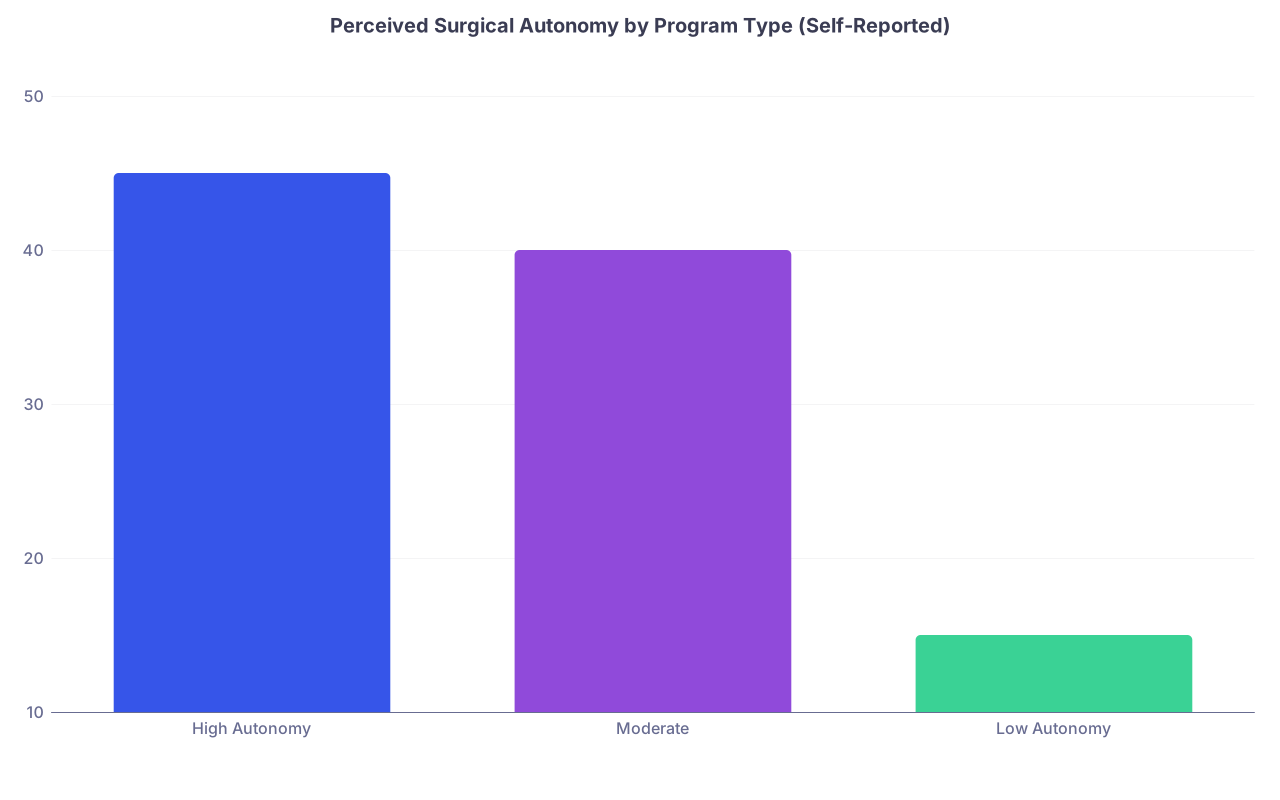
| Category | Value |
|---|---|
| High Autonomy | 45 |
| Moderate | 40 |
| Low Autonomy | 15 |
These are ballpark based on mixed survey data and anecdotal reporting: a lot of residents, at both program types, place themselves in the “moderate” bucket. The myth that “you either operate like an attending or you don’t operate at all” is just that — a myth.
What Actually Drives How Much You Operate
Forget labels for a second. Here are the levers that actually determine who is holding the knife.
1. Case Volume and Case Mix
If the OR list is thin, nobody is getting great numbers.
High-volume centers (community or academic) with multiple rooms running daily and steady ED/trauma flow inherently create more opportunities. Within that:
- Community-heavy elective practices (hernia, lap chole, scopes, OB deliveries) generate lots of bread-and-butter autonomy.
- Academic tertiary centers load you up on complex oncologic resections, transplant, congenital, or revision ortho. Fantastic exposure — but each case is longer, more complex, and less likely to be PGY-1 skin-to-skin.
Both have value. But complexity often delays autonomy, not because it’s academic, but because it’s complex.
2. Faculty Incentives and Payment Structure
This one almost never gets discussed by applicants, and it matters a lot.
In a pure community private practice model:
- Surgeons are paid by clinical productivity (RVUs).
- OR time is money.
- If letting you struggle through your first hand-sewn anastomosis adds 45 minutes to the case, some attendings will simply not tolerate that.
So you:
- Hold the camera
- Retract
- Close
- Maybe get to do the easy parts of straightforward cases
Plenty of excellent community attendings are incredible teachers and will eat the lost time. But you cannot ignore the financial pressure.
In many academic settings:
- Faculty have a salary with RVU plus academic/teaching components.
- Residents must meet ACGME/board minimums (and the program must protect that).
- The system expects teaching, not just throughput.
That doesn’t guarantee good teaching. But the economic pressure to “go faster, let the resident do less” is often stronger in community private groups than at academic salaried centers.
3. Fellows: Threat or Red Herring?
Myth: “Fellows steal all the cases at academic programs.”
Reality: It depends which cases and how the rotation is structured.
Patterns I’ve seen repeatedly:
Academic program with fellow on a subspecialty service (e.g., surgical oncology, colorectal, MFM, sports ortho):
- Fellows often run the complex tertiary cases with attendings.
- Residents get:
- Bread-and-butter on general services
- Non-tertiary cases
- Nights/weekends/trauma
No-fellow community program:
- Residents may do more advanced cases earlier.
- Or they may still watch the attending do the key parts because of RVU pressure or surgeon preference.
What matters is not “are there fellows?” but:
- How many of them?
- How many residents?
- How the service splits cases.
- Whether the culture is “resident first” or “fellow first.”
I’ve seen academic programs where chiefs get all attendings’ big cases and the fellows primarily function as consultants and clinic backstops. I’ve also seen community programs with “unofficial” fellows (post-grads hanging around doing cases) who quietly siphon off complex cases.
Label does not predict structure.
4. Resident:Case Ratio
Simple math that applicants routinely ignore: if you have 10 residents and 5 rooms running, you eat well. If you have 40 residents and 6 rooms, people are going hungry.
This can cut either way:
Huge academic programs:
- Tons of services, tons of rooms, but also tons of residents.
- If they’re not careful with scheduling, juniors can get buried in floor work and see fewer primary cases.
Small community programs:
- Fewer residents, fewer rooms, but ratio is favorable.
- Juniors get into the OR more just because there aren’t enough bodies.
Or the reverse if the community hospital has low volume.
You have to look at per-resident case volume, not just “my cousin at Big Name U said they’re always busy.”
5. Culture of Graded Autonomy
This is the invisible factor that applicants almost never interrogate properly.
Some programs, community and academic, have a very clear progression:
- PGY-1: exposure, assist, simple parts
- PGY-2–3: whole straightforward cases with backup
- PGY-4–5: senior runs room, attending assistant, complex cases with oversight
Others treat residents like semi-permanent assistants until the last year, then flip a switch.
The giveaway language:
- Good sign: “By PGY-3 our residents are routinely doing lap choles skin-to-skin,” “chiefs run two rooms,” “we use a graduated autonomy framework.”
- Bad sign: “We’re very hands-on, you’ll see a ton of advanced cases” — but no specifics on who does what, when.
On away rotations, I’ve literally heard residents whisper, “Yeah, that’s an ‘attending-first’ place. We mostly retract unless they’re feeling generous.”
That’s what you need to sniff out — not whether the hospital has a university logo.
Community vs Academic: Where the Autonomy Myths Come From
The myths didn’t appear out of nowhere. They’re rooted in some older truths that are partially eroded now.
Historically:
- Many academic flagships did have heavy fellow presence, slow adoption of graded autonomy, and highly complex case mixes. Residents logged solid numbers but felt less “independent” because they rarely ran a room alone.
- Many community programs did have high-volume bread-and-butter surgery with no fellows — lots of real-life cases, earlier autonomy, more “private practice-style” training.
What’s changed:
- ACGME oversight tightened
- Case logging became real and auditable
- Academic departments realized they need strong generalist graduates, not just future subspecialists
- Many community hospitals got bought by health systems who also care about metrics, patient satisfaction scores, and legal risk — all of which temper cowboy-style autonomy
So now autonomy is program-specific, not label-specific.
Here’s how it often shakes out in broad strokes today:
| Feature | Community-Heavy Program | Academic-Heavy Program |
|---|---|---|
| Bread-and-butter volume | High | Moderate to high |
| Complex tertiary cases | Lower | High |
| Fellows | Few/none (often) | Present on subspecialty services |
| Early junior autonomy | Can be high or low | Can be high or low |
| Senior chief independence | Often strong | Often strong |
Notice what’s missing? Any guarantee.
How To Actually Evaluate Autonomy When You’re Applying
You’re not powerless here. You can stop parroting “community = more operating” and start asking questions that matter.
1. Ask for Numbers — Real Ones
On interview day or at socials:
- “What’s the average total case number for graduating chiefs in the last few years?”
- “Can you give me a rough breakdown of cases by PGY year?”
- “On a typical day, how many cases are residents primary on vs assist-only?”
If they dodge, that’s an answer.
2. Ask About Fellows and Case Ownership
- “How do residents and fellows split cases on [service X]?”
- “When there are complex cases, who usually drives — fellow or chief resident?”
- “Do juniors still get to do bread-and-butter when fellows are around?”
Listen for systems, not vague assurances.
3. Ask Residents About When Autonomy Happens
- “What could you do completely yourself by the end of PGY-2? PGY-3?”
- “Do you feel your autonomy has increased in a stepwise way?”
- “Can you think of a recent case where you felt like the primary surgeon?”
You’ll hear it in their voice if they’re actually running cases.
4. Observe the OR If You Rotate
On an away rotation, keep a quiet mental tally:
- Who’s holding the knife?
- How long before the attending takes over?
- Does the attending narrate and hand tasks back, or just steamroll?
- What do residents say off-mic in the break room?
You will learn more in one honest week in the OR than from 50 Reddit threads.
One More Myth: “More Autonomy Always = Better Training”
People love equating sheer independence with quality.
That’s simplistic, and sometimes dangerous. There is such a thing as reckless autonomy:
- Being thrown into cases without proper foundation
- Bad habits that no one corrects because “they’re fast”
- Overconfidence that doesn’t match skill
Great programs (again, community or academic) know the balance:
- Enough independence that you can actually perform as an attending on day one
- Enough supervision that you do it safely and correctly
Where people get burned is chasing “maximum autonomy” with zero regard for structure. Five years later, they know they did “a lot of cases” but never got methodical feedback, never had to justify their intra-op decisions, never learned why an attending would do it differently.
Controlled, graded autonomy beats chaotic independence.
So… Who Operates More?
You want a binary answer. You’re not getting one.
In practice:
- Some community programs absolutely offer more hands-on bread-and-butter autonomy, earlier.
- Some academic programs offer huge volume, strong senior independence, and breadth you will never see in a small community hospital.
- Some programs of both types are terrible for autonomy — overstaffed, RVU-obsessed, or culturally “attending-first.”
The right question is not “community vs academic – who operates more?”
The right question is: “Which specific programs, given their volume, culture, resident:case ratio, and faculty incentives, will actually let me grow into a safe, independent surgeon?”
The label won’t tell you that. The questions you ask will.
Key takeaway #1: “Community = autonomy, academic = no cases” is a lazy myth. Autonomy is program-specific, not label-specific.
Key takeaway #2: Real drivers of who operates are volume, incentives, fellow structure, resident:case ratio, and culture of graded independence — not whether the hospital has a university name.
Key takeaway #3: Stop hunting for a logo type. Start interrogating programs with concrete questions about case numbers, who holds the knife by PGY year, and how residents actually experience autonomy day to day.