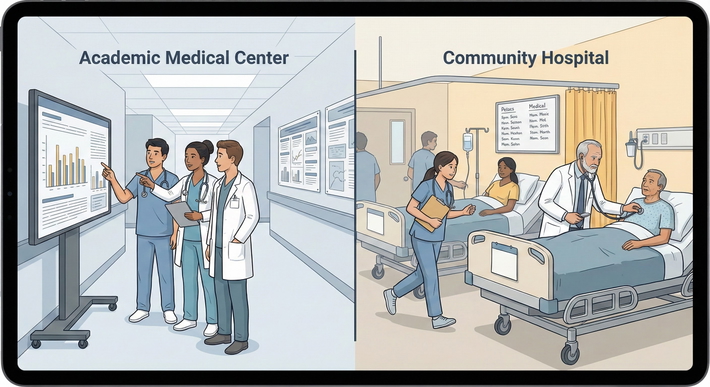
Picture this.
Resident A is in a community program. Tuesday afternoon clinic starts on time, the same diabetic patient shows up for the third visit in six months, there's a knee injection after lunch, and by 4 p.m. the resident has handled hypertension, prenatal counseling, rashes, back pain, and a last-minute COPD flare.
Resident B is in an academic program. Same half-day clinic on paper. Totally different feel. More precepting layers, more chart review, more complex referral patients, more teaching pauses, and more messages from specialists already involved in the case.
Both are doing "continuity clinic." But they are not having the same training experience. Not even close.
That's the mistake applicants make. They hear continuity clinic and assume the difference is minor. It isn't. Clinic is where your outpatient identity gets built. Your speed. Your confidence. Your relationship with long-term patients. Your tolerance for chaos. Your actual readiness for independent practice.
Here's the practical way to compare community versus academic continuity clinic using 7 lenses:
- Patient mix
- Supervision
- Procedures
- Continuity depth
- Schedule and pace
- Learning environment
- Career fit
This is not a prestige contest. That framing is lazy. The real question is simpler: which clinic structure will train you better for the doctor you want to become?
1) Patient population and case mix
This is the first thing I'd compare, because it changes everything downstream.
Community continuity clinics often give you broad, classic primary care. Lots of hypertension, diabetes, depression, URI visits, well-child checks, women's health, sports physicals, med refills, asthma follow-up, and the endless parade of musculoskeletal complaints. Bread-and-butter medicine. Repeated often. That repetition matters.
Academic clinics often skew toward higher complexity. More medically fragile patients. More referral-based care. More patients already plugged into cardiology, nephrology, GI, rheum, or transplant teams. You may see unusual disease earlier. Good for intellectual growth. But sometimes you're managing one slice of a patient while five other teams handle the rest.
The insurance and social mix can differ too:
- Community clinics may reflect the local town or region more directly
- Academic clinics often pull from a wider catchment area
- Safety-net academic sites can be extremely socially complex, with unstable housing, transportation barriers, and fragmented care
- Suburban community programs may give you a very practical outpatient mix that mirrors private practice or employed primary care
What does that mean for your training?
- If you want deep reps in preventive care and chronic disease management, community clinics often win.
- If you want exposure to rare disease, tertiary referrals, and medically complex coordination, academic clinics usually win.
- If you want both, you need to ask whether the program truly mixes them, or just claims it does.
I've seen applicants get seduced by "complexity" and miss the obvious problem: they graduate excellent at discussing obscure workups but slower than they should be at routine outpatient medicine. That's not a small flaw. That's a readiness issue.

2) Supervision style and teaching density
Supervision is where the philosophical difference shows up fast.
Academic clinics usually have:
- More formal precepting
- More direct attending observation
- More scheduled teaching
- More explicit feedback
- More discussion around guidelines, literature, and differential diagnosis
That can be fantastic. Especially early in residency. If you're the kind of learner who wants structure, coaching, and regular correction, academic clinic may feel safer and more rigorous.
Community clinics often move differently:
- Fewer layers
- Faster decision-making
- Less ceremony around teaching
- Quicker autonomy
- More "go see the patient, come back with the plan, let's tighten it up and move"
That's not worse teaching. It's just less padded. More practical. Sometimes more honest.
The tradeoff is real.
- Academic supervision can sharpen your thinking, but it may slow your independence.
- Community supervision can build confidence faster, but you may need to be more self-directed about reading and feedback.
The wrong setup for your personality will frustrate you. If you need heavy coaching and land in a clinic that expects early self-sufficiency, you'll feel lost. If you're decisive and want to run your own room, a highly layered academic clinic can start to feel like driving with the parking brake on.
Here's how to judge it on interview day:
- Ask who staffs clinic most often.
- Ask how often attendings directly observe visits.
- Ask what feedback looks like, real-time, written, quarterly, or basically nonexistent.
- Ask residents when they started feeling independently capable.
If the answer is vague, that's a red flag. Programs love saying "graduated autonomy." Fine. Show me what that actually means.
3) Procedure exposure and clinic workflow
If outpatient procedures matter to you, don't assume anything. Ask for logs. Real numbers. Not vibes.
Community clinics often do very well with routine procedures because the workflow is built for them. You may get frequent reps in:
- Joint injections
- Skin biopsies
- IUD placement or removal
- Nexplanon
- Toenail procedures
- Cryotherapy
- Laceration repair
- Incision and drainage
- Basic point-of-care ultrasound in some sites
That repetition is gold. Skill comes from volume, not from a glossy brochure.
Academic clinics can go either way. Some are excellent and have procedural tracks, specialty clinics, and access to advanced equipment. Others are so layered with referrals, scheduling complexity, and departmental boundaries that simple outpatient procedures somehow become a production. That's ridiculous, but it happens all the time.
Workflow matters just as much as the procedure menu.
Compare:
- MA and nursing support
- Point-of-care testing availability
- Room turnover speed
- Prior auth burden
- EHR complexity
- How much time residents spend hunting supplies versus actually doing medicine
A community clinic may feel more operationally efficient. An academic clinic may have more resources but also more friction. More people. More rules. More clicks.
I've seen residents in community settings become excellent proceduralists because they kept doing the same useful office procedures over and over. I've also seen academic residents get impressive niche exposure but miss routine reps. Depends what you want. But if your goal is broad outpatient competence, routine volume wins.
4) Continuity depth: how well you actually follow your patients
This is the most misunderstood part of continuity clinic.
Having a weekly clinic does not equal continuity.
Real continuity means:
- You see the same patient again
- You adjust a long-term plan
- You track whether the plan worked
- You manage disease over time, not just one encounter at a time
Community programs often have stronger continuity depth because patients live nearby, stay in the system, and identify the clinic as their primary care home. That creates stronger panel stability. You start recognizing names. You know who never takes their metformin. You know whose blood pressure spikes every winter. You know which parent always brings three siblings at once. That's real outpatient medicine.
Academic continuity can be weaker, especially if there are:
- High no-show rates
- Frequent resident schedule disruptions
- Multiple rotating attendings
- Heavy subspecialty handoffs
- Referral-based patients who don't truly anchor in the resident clinic
Now, some academic clinics do continuity very well. But plenty don't. The branding says "longitudinal clinic," while the resident sees fragmented follow-up and spends half the visit reconstructing what happened between consults.
That's not continuity. That's chart archaeology.
Here's how to test continuity quality fast:
- Ask average resident panel size
- Ask how often residents see their own patients again
- Ask no-show rates
- Ask whether inpatient rotations routinely break clinic flow
- Ask residents for one specific example of following a patient over a year
If they can't answer concretely, continuity probably isn't strong.
5) Scheduling, patient volume, and clinic pace
Clinic pace can make or break your training.
Community clinics often run with:
- Higher patient throughput
- More repetitive primary care problems
- Shorter visits
- A stronger expectation of efficiency
- Less protected discussion time
That can be exhausting. It can also make you very good, very fast.
Academic clinics often have:
- Longer visits
- More precepting time
- More documentation
- More teaching interruptions
- More inbox and coordination burden
- Slower operational tempo
That can be valuable for learning. It can also become bloated. Too many stops. Too many handoffs. Too much time spent discussing care instead of delivering it.
The right question isn't "which is easier?" Neither is easy. The question is: which pace helps you grow without frying you?
If you learn by repetition and momentum, community clinic may fit better. If you learn by processing, discussion, and deliberate review, academic clinic may fit better.
Be honest about your burnout risk too.
A packed clinic with minimal support will wear you down. So will an academic clinic where every patient generates ten messages, three forms, and a philosophical debate about statin thresholds. Burnout doesn't care whether the logo is fancy.
6) Learning environment, mentorship, and career development
This is where applicants often overcorrect.
Academic programs usually offer:
- More research infrastructure
- Easier access to QI mentors
- More teaching opportunities
- Better fellowship networking
- More formal scholarly tracks
If you want fellowship, academic medicine, or a future role involving research and teaching, that infrastructure matters. A lot.
Community programs often offer:
- Closer day-to-day mentorship
- Less competition for leadership roles
- Earlier ownership of clinic processes
- Stronger exposure to real-world outpatient practice
- Practical mentorship from people doing the exact kind of job you may want
That closeness is underrated. In smaller community settings, attendings may know you better, trust you earlier, and help you grow in concrete ways. Not abstractly. Actually. They'll show you how to run a panel, move a clinic day, handle difficult patient expectations, and make sane outpatient decisions.
Use this filter:
Choose academic if you strongly want:
- Fellowship
- Scholarly production
- Formal teaching roles
- Subspecialty-heavy networking
Choose community if you strongly want:
- Broad outpatient readiness
- Faster autonomy
- Practical clinic management skills
- A career in general practice or regional/community care
If you're unsure, don't default to prestige. That's how people end up in the wrong place for three years.
7) How to compare programs during interviews and site visits
Here's the fix. Stop asking fluffy questions and start collecting decision-grade data.
Your continuity clinic interview checklist
Ask every program these same questions:
- What is the resident panel size by PGY year?
- How many continuity clinic sessions do residents have per week or per block?
- What's the average number of patients per clinic session?
- How often do residents see their own patients again?
- What are the no-show rates?
- Who precepts clinic, and how often is supervision direct versus indirect?
- What outpatient procedures do residents actually log?
- How often do rotations disrupt continuity clinic?
- What support staff are consistently available?
- How satisfied are residents with outpatient training, really?
Then do one better.
If possible, observe a real clinic session
Watch for:
- Are residents rushed or just efficient?
- Do attendings teach in a useful way or derail workflow?
- Do residents know their patients?
- Is support staff engaged?
- Are rooms turning over smoothly?
- Does the clinic feel like a primary care home or a holding zone?
You can tell a lot in 20 minutes. More than from an hour of polished program sales talk.
Use a simple scoring system
Make a 1-5 score for each category:
- Patient mix
- Supervision
- Procedures
- Continuity depth
- Pace
- Mentorship
- Career alignment
Then weight them based on your goals.
Example:
- If you want fellowship, give mentorship/scholarship and complex case mix more weight.
- If you want outpatient practice readiness, weight continuity, procedures, and pace more heavily.
A simple way to do it:
- Score each category 1 to 5
- Multiply by importance:
- 3 = critical
- 2 = important
- 1 = nice to have
- Add total scores for each program
That's boring. Good. Boring systems beat emotional guesswork.
The bottom line
Community and academic continuity clinics are not interchangeable. The biggest differences are usually not prestige, not branding, not whether the hospital is famous. They're the daily realities: who your patients are, how much autonomy you get, how often you do procedures, whether you truly follow patients over time, and how the clinic day actually feels.
That's what shapes you.
So here's my advice: build your own comparison sheet before interviews, ask the same hard questions everywhere, and rank programs based on training fit, not reputation theater. If you do that, your rank list gets a lot clearer.