
Am I secretly blowing up my entire career by refusing to rank community programs?
Because that’s what it feels like, right? You’re staring at your rank list or ERAS program filter thinking: “If I only apply to academic programs, I’ll either end up exactly where I want… or not match at all and obliterate my career in one shot.”
Let me say this bluntly: completely cutting out community programs is usually a mistake. Not always. But usually. And the scarier part? Most people who make that mistake don’t realize it until February, when interview invites are dead, silent, and they start counting how many programs they actually have.
Let’s walk through this like two people panicking together but trying to be smart about it.
First: What you’re really afraid of
You’re not actually asking “Are community programs bad?”
You’re asking:
- “Will a community program screw me for fellowship?”
- “Will I look ‘less than’ compared to my peers from big-name places?”
- “Will I be stuck in some under-resourced hospital doing scut forever?”
- “Am I selling myself short if I have decent stats?”
And under all of that:
“What if I compromise on prestige and still end up unhappy and with fewer opportunities?”
That’s the nightmare. That you’ll sacrifice “pedigree” and then learn you traded it for nothing.
Here’s the problem: your brain is comparing real community programs it barely knows… to a fantasy version of academic programs you’ve built in your head from Instagram, match lists, and that one attending who flexes their Harvard fellowship every three minutes.
Most people don’t understand what “community” vs “academic” actually means in practice.
Quick reality check: What “community” vs “academic” actually gets you
Let’s stop talking in vibes and talk in structure.
| Feature | Community Program (Typical) | Academic Program (Typical) |
|---|---|---|
| Main Focus | Clinical service, patient care | Clinical + research + teaching |
| Fellows Around | Often fewer or none | Many, across multiple specialties |
| Research | Available but more self-directed | Built-in infrastructure, expectations |
| Prestige Signaling | Variable, often local/regional | Stronger national name recognition |
| Autonomy | Often earlier and heavier | Slower ramp-up, more layered hierarchy |
Is this table perfectly universal? No. But it’s a good default mental model.
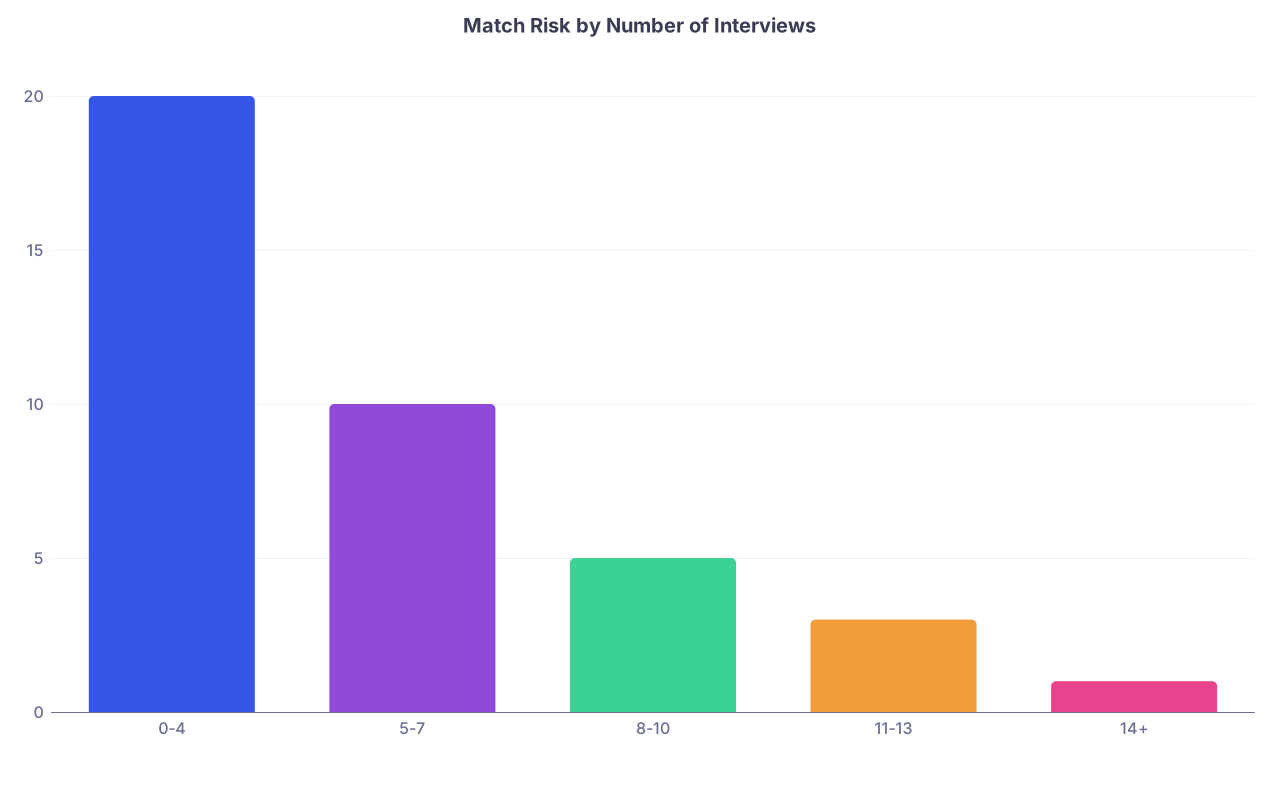
Now layer on the real risk that matters to you:
| Category | Value |
|---|---|
| 0-4 | 20 |
| 5-7 | 10 |
| 8-10 | 5 |
| 11-13 | 3 |
| 14+ | 1 |
Those numbers aren’t exact, but they mirror NRMP trends: below ~8–10 interviews in most core specialties, your match risk starts to feel very real.
Cutting out community programs often means you’re voluntarily cutting out 30–60% of potential interview opportunities.
That’s the part nobody says out loud when they brag about “only ranking academic programs.”
The three ways avoiding community programs actually backfires
I’ve watched this happen in real time to classmates and advisees.
1. You overestimate your competitiveness
This is the classic trap.
Your brain:
“I have a 245+ Step 2, strong letters, some research. I’m above average. I should be fine with just academics.”
Reality:
You’re competing against:
- People with similar numbers plus 5–10 pubs
- Home students from those institutions
- Couples matching
- Re-applicants
- People who rotated there and are “known quantities”
Programs are not ranking you in a vacuum. They’re comparing you to hundreds of other strong apps. If 90% of your list is mid/high-tier academic and you’re not in the top slice of applicants, you’re playing a high-stakes game with your entire future.
And those “safety” academic programs you’re counting on? Often not actually safe. Everyone else calls them safeties too.
2. You use a fantasy version of academics as your benchmark
You imagine:
- Constant teaching
- Name-brand attendings mentoring you
- Easy access to research
- Protected didactics that always happen
- Beautiful, modern facilities
I’ve seen residents at big academic hospitals:
- Doing pure scut for fellow-heavy services
- Fighting for cases because fellows take everything interesting
- Having conferences regularly canceled because “service needs”
- Getting ghosted by research mentors who are too busy chasing grants
Meanwhile, I’ve met residents at strong community programs:
- Doing complex cases because there are no fellows
- Publishing case reports and small QI projects that actually get done
- Getting direct attending mentorship because they’re not one of 60 residents + 30 fellows
Is this universal? No. But the point is: academic ≠ automatically better training. Community ≠ automatically “less than.”
The worst mistake is rejecting a program type you don’t understand based on prestige anxiety.
3. You underestimate how awful not matching actually feels
People hand-wave this away like: “Well, if I don’t match, I’ll just SOAP or reapply more broadly next year.”
Let me be ugly-honest:
- SOAP is brutal. You’re speed-dialing programs, crying between calls, watching your entire class post “Matched!” pictures while you refresh your email.
- Reapplying tanks your confidence. You now have to explain why you didn’t match. You’re now “the one who didn’t match” in everyone’s story.
- Some specialties basically shut the door after a failed attempt unless you do something significantly different.
Giving yourself a buffer of solid community programs is not “selling out.” It’s protecting your future self from a really dark timeline.
But what about fellowship and career prospects?
This is usually the big “but.”
“I want cards / GI / heme-onc / derm / whatever. Don’t I need an academic program to get there?”
Let me be direct:
- Coming from a top academic program is an advantage for competitive fellowships.
- Coming from a no-name, zero-research, zero-support community program can be a disadvantage.
- But there’s a huge middle ground of strong community-based and hybrid programs where people match great fellowships every year.
Program directors care about:
- Your letters (“Best resident I’ve worked with in 10 years” beats “solid trainee” every day)
- Your research output (yes, you’ll need some for competitive specialties)
- Your reputation in your local/regional network
- Your interview performance and story
If you’re driven and willing to hustle, you can absolutely do well from a community program, especially in fields like IM, peds, FM, psych, anesthesia. Even some surgical subs, depending on program.
The danger isn’t “community vs academic.”
The danger is “supportive, training-focused program vs chaotic, under-resourced mess.”
And both of those exist on both sides.
How to tell if you’re making this mistake vs being strategic
Avoiding community programs isn’t always wrong. Sometimes it’s rational. Here’s the real decision tree in your head:

| Step | Description |
|---|---|
| Step 1 | Start |
| Step 2 | Know true competitiveness? |
| Step 3 | Get honest advisor input |
| Step 4 | Project interview numbers |
| Step 5 | Can consider limited or no community |
| Step 6 | Include strong community and hybrid programs |
| Step 7 | Likely 10 plus interviews with academics only? |
If you’re:
- Mid-range on scores
- Average research
- No home program in your specialty
- Maybe an IMG / DO in a competitive region / specialty
…and you still refuse to list community or hybrid programs?
Yeah. That’s playing Russian roulette with multiple loaded chambers.
If you’re:
- Clearly top-tier on paper
- With strong mentorship and honest PD-level input saying you’re very competitive
- In a less competitive specialty
- Willing to live basically anywhere academic programs exist
Then you can get away with a more academic-heavy list. But even then, I still think having at least a couple well-vetted community programs is smart.
The dreaded “settling” feeling: will I hate myself if I match community?
This is the emotional part nobody admits.
There’s this shame story in your head:
“If I end up at a community program, everyone will know I wasn’t good enough.”
Reality:
- Most people outside medicine barely know the difference.
- Even within medicine, once you’re a PGY-2 actually functioning, people care about how good you are, not where your badge is from.
- Five years out, you’ll be boarded and practicing and patients literally don’t care where your residency logo came from.
What does matter day-to-day:
- Are you learning?
- Are there attendings who actually like teaching?
- Are you safe and supported?
- Are you getting cases and responsibility?
If you need prestige to be happy and validated, fine, own that about yourself. But don’t pretend this is about “training quality” when it’s actually about status anxiety.
Smart way to include community programs without feeling like you’re giving up
This doesn’t have to be all-or-nothing. You don’t need to swing from “zero community” to “sure, I’ll rank any random 3-resident shop in the middle of nowhere.”
Do this instead:
Identify hybrid programs: community-based but with a university affiliation, maybe rotating at an academic center, some fellows, some research. These are often the sweet spot.
Look for community programs with:
- Solid fellowship match lists (yes, stalk their websites and ask residents about recent matches)
- Real QI/research support (even if small scale)
- Residents who don’t look dead inside on interview day
Talk to actual residents:
- Ask: “What’s one thing that really surprised you about training here, good or bad?”
- Ask: “If you wanted cards/GI/critical care, what would that path look like coming from here?”
- Ask: “Do you feel supported with letters, mentorship, and applications?”
If they stare into the distance and say “You’ll figure it out,” that’s a red flag.
If they say, “We’ve had two cards fellows in the last three years; Dr. X really helps with that,” that’s real data.
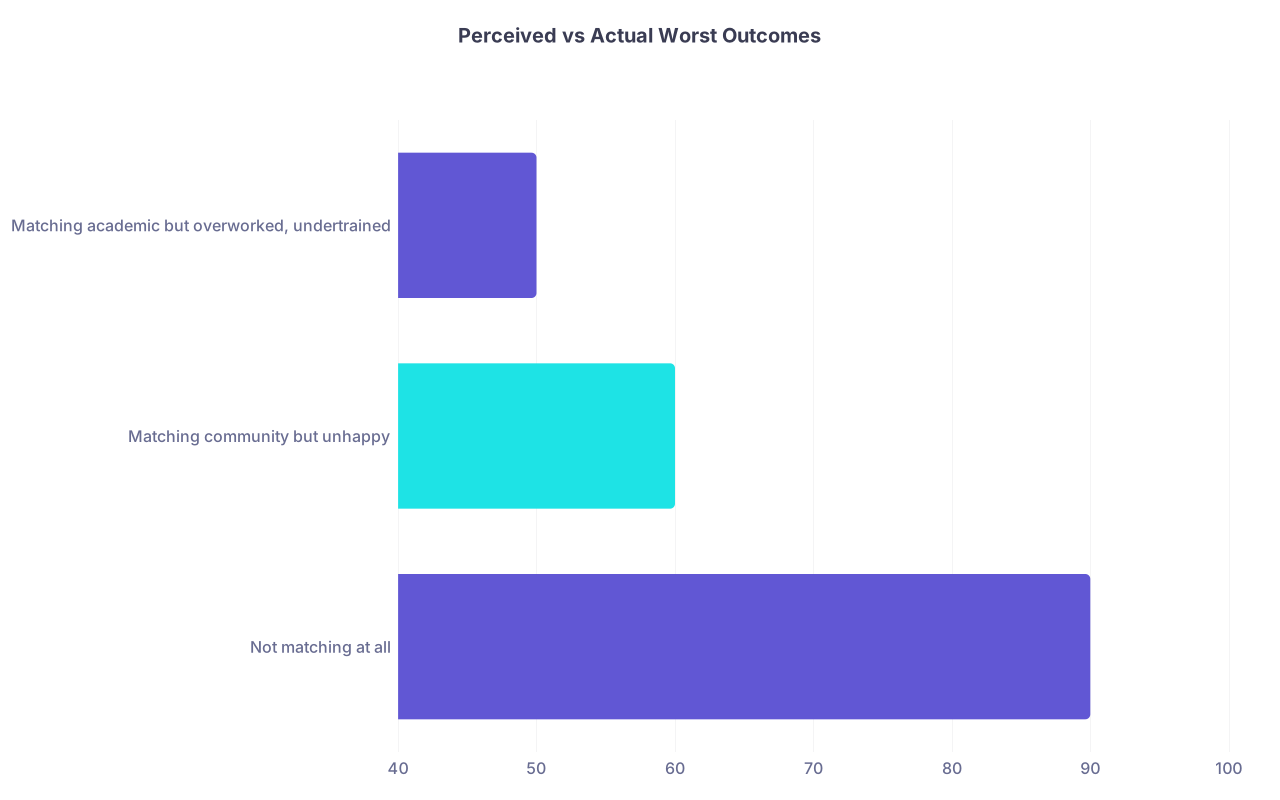
Quick comparison: your worst-case thinking vs actual worst-case
| Category | Value |
|---|---|
| Not matching at all | 90 |
| Matching community but unhappy | 60 |
| Matching academic but overworked, undertrained | 50 |
You’re probably telling yourself the worst thing that could happen is:
“I match a community program and regret it for life.”
Honestly? No.
The actual worst scenario is:
- You don’t match because your list was too narrow.
- You waste a year scrambling or reapplying.
- You lose momentum, confidence, and options.
Second worst:
- You match somewhere that looks shiny on paper but gives you terrible training and zero support.
Matching a solid community or hybrid program where you grow, get strong letters, and maybe even enjoy being treated like a human? That’s… not tragedy. That’s a decent outcome.
What you should do today to sanity-check your approach
Don’t just stew in your head about this. Do something concrete:
- Pull up your current list of programs (or at least your mental list).
- Put a star next to the ones you’d actually be ok spending 3–7 years at. Not “dream,” just “ok.”
- Count how many of those are:
- Academic
- Community
- Hybrid (community with strong academic ties)
If your entire “ok” column is 90–100% academic, and you’re not a slam-dunk applicant on paper, you’re taking a bigger risk than you think.
You don’t have to suddenly love the idea of community programs. You just have to respect the reality that they might be your safety net, and sometimes, your best fit.
FAQ (you’re probably thinking at least one of these)
1. If I go to a community program, am I basically closing the door on competitive fellowships?
Not automatically. People match competitive fellowships from certain community and hybrid programs every year. The key factors are: your performance, your letters, and whether the program actually supports fellowship-bound residents. Some tiny community programs with no track record and no research culture will make it harder. Some large, busy community or hybrid programs with strong local rep and good mentorship can launch you just fine. If you’re fellowship-driven, screen programs on fellowship match history, not just “academic” vs “community” labels.
2. Won’t people silently judge me for being from a community program?
Some will. Medicine has plenty of prestige-obsessed people. But once you’re in practice, almost everyone cares more about: are you competent, safe, reasonable to work with, and not a disaster on call. I’ve watched community-trained attendings outshine “big-name” grads all the time because they had more hands-on experience. Your insecurity will bother you way more than anyone else’s opinion, especially after PGY-1 when you’re just trying to survive.
3. My advisor said I’m “competitive.” Isn’t that enough to go all-academic?
“Competitive” is vague and overused. Competitive for what? Mid-tier university? Top-10? In your region only? You want specific, painful honesty: “If you only applied to academic programs of the type you listed, I’d be worried” vs “You will almost certainly get enough interviews even with an academic-heavy list.” If they hesitate, that’s your answer. Ask them directly: “Would you be nervous if I had zero community programs on my list?”
4. How many community/hybrid programs should I include so I’m not taking a huge gamble?
There’s no magic number, but think in terms of interviews, not raw program count. For most core specialties, aiming for at least 10–12 interviews is reasonable for a comfortable-ish match probability. If your academic invites alone probably won’t get you there, you need enough community/hybrid options on your list to realistically hit that number. That might mean 20–40% of your applications are community/hybrid, sometimes more if you’re not a top-of-the-pile applicant.
Open your program list right now. Put a bold mark next to every single community or hybrid program you’d actually be willing to train at. If that list is empty or tiny, and you’re not rock-solid on paper, you’ve got a decision to make today—not in March when it’s too late.