This article is for educational purposes only. It is not financial advice, not legal advice, and not tax advice. Figures vary by individual circumstances, so consult a qualified professional before acting.
The Candidate with a Mark: A Tale of Two Applications
Maya was a solid MS3. Good boards, decent grades, well-liked on rotations. Then came the professionalism lapse, a pattern of late admissions notes and one missed patient encounter she didn't hand off properly. Her school put her on a brief professionalism remediation plan. She completed it. Moved on. Did well on her sub-I. Got strong letters.
Now she's applying to internal medicine. Her list has ten community programs and six academic programs. Same ERAS application. Same MSPE. Same disciplinary footnote in her dean's letter.
Here's what keeps her up at night: the same story, landing on two completely different desks, being read through two completely different lenses. And she's right to worry. Because it will be.
I've watched applicants in this exact position crater at academic programs while thriving at community ones, and vice versa. The disciplinary history itself is only half the equation. The other half is who's reading it and what they're afraid of.
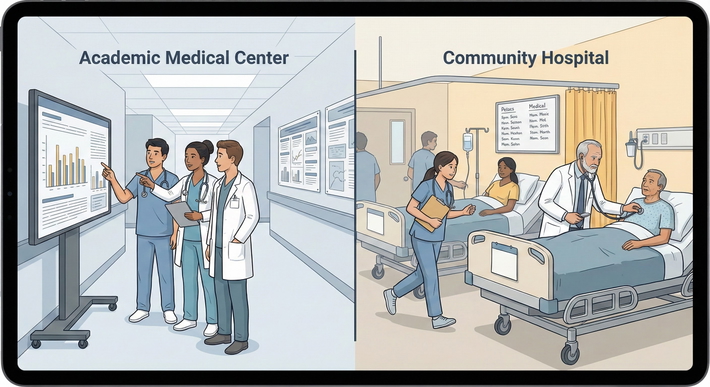
Program directors don't treat disciplinary history uniformly. They can't. Their incentives are different. Their institutional cultures are different. And nobody, not the PD, not the coordinator, not your dean, will sit you down and explain how the calculus shifts between a community hospital in Toledo and an academic medical center in Boston.
So let me.
How do you navigate this divide without guessing yourself into rejection?
The Unspoken Calculus: How PDs Really Weigh Disciplinary History
Let's get into what PDs actually care about, because it's not what they put in their brochures.
Community programs are running a service. They need residents who show up, work hard, connect with patients, and don't create headaches for the attending staff. A community PD looking at a professionalism lapse is asking one question: Will this person be a good doctor here, on Tuesday night, when the ICU is full and the ER is boarding twelve patients? If your infraction was minor, you owned it, and you've demonstrated growth, many community PDs will move past it. Some have seen worse. Some have done worse.
For more on how program directors compare these settings, see our article on what attendings whisper about community vs academic career paths (https://residencyadvisor.com/resources/community-vs-academic-residency/what-attendings-whisper-about-community-vs-academic-career-paths).
I'm not saying they don't care. I'm saying their threshold for "forgivable" is different because their operational needs are different. They need clinical bodies. They need team players. They need someone who won't bail at 3 AM. If your disciplinary history suggests you can still be that person, you're in the conversation.
Academic programs are running a brand. Their PDs are answerable to department chairs who are answerable to deans who are answerable to funding agencies, alumni, and US News rankings. A disciplinary infraction at an academic program isn't just about whether you'll be a good clinician, it's about whether you'll become a liability to the institution's reputation. Will this person apply for an NIH grant and have something surface in a background check? Will they represent the program well at a national meeting? Will faculty mentors feel comfortable putting their name next to yours on a publication?
Academic PDs also worry about resident morale. A cohort of high-achievers who've never had a disciplinary mark will eye a colleague with one, fairly or not, as someone who got in on a different standard. That's a culture problem the PD doesn't want to manage.
The type of infraction matters enormously. Academic dishonesty, cheating, plagiarism, falsifying data, is near-fatal at academic programs. It strikes at the core of what they do. At community programs, it's still serious, but I've seen PDs weigh it against clinical performance and give a second chance if the applicant is otherwise strong and transparent.
Behavioral and professionalism issues, the kind Maya has, get scrutinized everywhere, but community programs are more likely to view them as growth opportunities. Academic programs are more likely to view them as character indicators. That's a subtle but critical distinction.
Here's the unspoken rule I've heard from PDs over drinks at conferences: community programs evaluate "will this person be a good doctor here?" Academic programs ask "will this person become a liability to our brand?"
Neither is wrong. Both are real. And you need to speak to both.
The Art of Framing: Tailoring Your Explanation for Each Audience
If you're considering making this choice, understanding whether PDs judge community trainees harshly can help you prepare (https://residencyadvisor.com/resources/community-vs-academic-residency/the-applicants-fear-do-pds-judge-community-trainees-harsher-in-interviews).
Here's where most applicants screw up. They write one explanation, send it everywhere, and hope for the best. That's lazy, and it shows.
For community programs, your explanation should sound like this: "During my third year, I struggled with time management during a heavy inpatient rotation. I missed completing admission notes on time and failed to properly hand off a patient. My school placed me on a professionalism remediation plan. I completed it, but more importantly, I changed how I work. I adopted a structured note-completion system. I did a sub-I where I was first to round and last to leave, and my attending wrote that my professionalism was exemplary. I also volunteered at a free clinic downtown, where I learned that being on time and communicating clearly isn't just professional, it's how patients feel respected. That experience made me the clinician I am now."
What did that do? It showed concrete behavior change. It tied the lesson to patient care. It demonstrated humility without groveling. Community PDs eat that up. They want coachable. They want self-aware. They don't need a philosophical essay.
For academic programs, your explanation shifts: "In my third year, under the pressure of a demanding rotation schedule, I failed to meet documentation standards on several occasions. This was a one-time lapse in an otherwise strong academic record, but it was a serious one. I completed remediation, then went on to present two research posters, serve as a teaching assistant for the MS2 pathophysiology course, and earn a medical student teaching award. My research mentor, Dr. Chen, can speak to my integrity and work ethic during the eighteen months since the incident."
Different emphasis. Same event. This version highlights productivity, regained trust through academic channels, and a specific person willing to vouch for you. Academic PDs want evidence that the lapse was an aberration, not a pattern, and that the person in front of them now is operating at a high level.
In your personal statement: Do not lead with the disciplinary history. I've seen applicants try to make it the centerpiece of a redemption arc. Bad idea. It sets the tone before you've established your strengths. Instead, use ERAS's optional "Additional Information" section for a concise, factual, two-to-three sentence summary. Save the narrative depth for interviews, where you can read the room and adjust.
Letters of recommendation: This is your secret weapon. Choose a writer who worked with you after the incident and can speak to your growth. For community programs, that's a clinical preceptor who saw you perform well on a sub-I. For academic programs, it's a research mentor or course director who can vouch for your reliability and integrity over time. A strong letter that says "I'm aware of the prior incident and can attest that this student has been exemplary since" is worth more than any explanation you write yourself.
The Interview Room: What They Won't Say But Will Probe
The interview is where disciplinary history either kills you or becomes a non-issue. Here's how the two settings differ.
Community PDs tend to go direct. "I see something in your dean's letter about a professionalism issue in third year. Tell me about that." They want a straight answer. No hedging. No "it was a misunderstanding." Give them the facts, own your part, and explain what changed. Two minutes, max. Then stop talking.
What they're watching for: defensiveness, blame-shifting, or minimization. If you say "the attending had it out for me," you're done. If you say "I struggled with the documentation expectations and I've since built a system that works," you're showing them someone who takes feedback and adapts. That's exactly the resident they want.
Academic PDs are sneakier. They rarely ask about the infraction directly. Instead: "Tell me about a time you faced a significant challenge and how you handled it." Or "Describe a situation where you made a mistake and what you learned." They already know about the disciplinary history from your file, they want to see if you'll connect the dots yourself or if they have to drag it out of you.
Here's the move: integrate the lesson into your answer without being prompted. "During my third year, I had a professionalism lapse around documentation. I was placed on remediation, and it was a wake-up call. I restructured how I approach patient handoffs, completed additional training in communication, and went on to earn a teaching award the following year. The experience made me more attentive to the systems that prevent errors, which is actually what drew me to your program's patient safety curriculum."
You've answered their question. You've addressed the elephant in the room. You've tied it to their program. That's a three-for-one.
Both PDs watch for patterns. If you deflect blame or minimize, that's a bigger red flag than the original infraction. I've sat in ranking meetings where a PD said, "The infraction I could work with. The fact that they blamed their attending in the interview, I can't."
Own it. State what you learned. Explain the systems or behaviors you put in place to prevent recurrence. Then pivot forward.
Non-verbal cues matter, and they differ by setting. In academic interviews, maintain steady eye contact, speak in measured tones, and connect your answer to future academic goals. In community settings, a warmer, more collaborative tone works, you want to come across as coachable, team-oriented, and grounded. The academic PD wants to see a future colleague who can hold their own in a grand rounds presentation. The community PD wants to see a future colleague who'll be pleasant to work a 14-hour shift with.
The Hidden Metrics: Background Checks and Institutional Policies
Here's what applicants don't realize: the disciplinary history you disclose on ERAS is only one layer. There's a whole infrastructure of background checks and institutional policies that can make or break you, and they're not uniform.
All programs run criminal background checks. Most use a service like Certiphi. What shows up: criminal records, court records, sex offender registries. What does NOT show up on a standard criminal check: internal medical school disciplinary actions. Your professionalism probation, your failed professionalism exam, your remediation plan, unless your school reported it to the National Practitioner Data Bank (which they generally don't for medical student issues) or a program specifically requests it in a supplemental application, it stays internal.
But here's the catch: PDs call your dean's office. All the time. A quick call to the student affairs office can surface things that aren't on paper. So can the MSPE, which often includes coded language about professionalism concerns. Be honest on ERAS because the truth will come out, and a discrepancy between what you disclosed and what your dean reports is far more damaging than the infraction itself.
Community programs tend to be more flexible with minor misdemeanors. A DUI from college, a minor drug possession charge, these are painful but not always disqualifying if you're upfront and show evidence of rehabilitation. I've seen community PDs rank applicants with these histories when the applicant was transparent and the rest of the file was strong.
Academic programs often have zero-tolerance policies for substance-related infractions, driven by institutional GME offices rather than the PD's personal judgment. A PD might want to rank you, but the hospital's credentialing committee blocks it. This is especially true at academic medical centers that are part of large university systems with rigid HR policies.
Some academic institutions require state medical board clearance before granting privileges. If your disciplinary history involved anything reported to a state board, which is rare for medical students but possible if you had a prior license in another field, it can block you even if the program wants you. Community programs often rely on hospital credentialing committees that evaluate cases individually, which gives you more room to explain context.
Proactive strategy: Before ERAS opens, request a background check on yourself through a service like Certiphi or a similar consumer screening provider. Know exactly what will appear. If there are surprises, an old charge you forgot about, a record that should have been expunged, deal with it before programs find it. Prepare a one-page factual explanation you can bring to interviews if asked. Walking in knowing what's on your record and having a clean, honest narrative ready projects control. Walking in hoping nothing surfaces projects naïveté.
Your Action Plan: Turning a Blemish into a Strength
Here's your step-by-step playbook.
Step 1: Gather everything. Pull the full documentation of the disciplinary event, the original incident report, the sanction, any remediation requirements, and proof of completion. You need to know exactly what your dean's office has on file because that's what programs will see.
Step 2: Draft two explanations. One for community programs, emphasizing clinical growth and patient impact. One for academic programs, emphasizing renewed professionalism, research continuity, and high-level performance since the incident. Same event, different framing.
Step 3: Run it by your dean or a trusted advisor. Ask them directly: does this sound constructive or defensive? If they hesitate, it's defensive. Rewrite it. Your explanation should sound like a person who learned something, not a person who's still processing it.
Step 4: Run your own background check before ERAS. Know what's out there. If something unexpected appears, consult a residency advisor about addressing it preemptively, either in your ERAS additional information section or in a prepared statement for interviews.
Step 5: Practice your two-minute answer. In a mirror, out loud, until it sounds natural. Structure: here's what happened → here's what I learned → here's what I changed → here's the evidence it worked. Then immediately pivot to a question about the program. Don't let the disciplinary history be the last thing you talk about in an interview.
Step 6: Send a thank-you note that reinforces growth. Not a groveling apology. Something like: "I appreciated the chance to discuss how my third-year experience shaped my approach to teamwork and patient communication. It made me even more excited about your program's emphasis on..." You're reinforcing the narrative without being heavy-handed.
A disciplinary history isn't a death sentence. It's a filter. The applicants who get filtered out are the ones who pretend it didn't happen, minimize it, or blame others. The ones who get through are the ones who own it, frame it appropriately for their audience, and demonstrate, with evidence, that they're better for it.
You're not the same applicant you were when it happened. Now make sure your application reflects that.