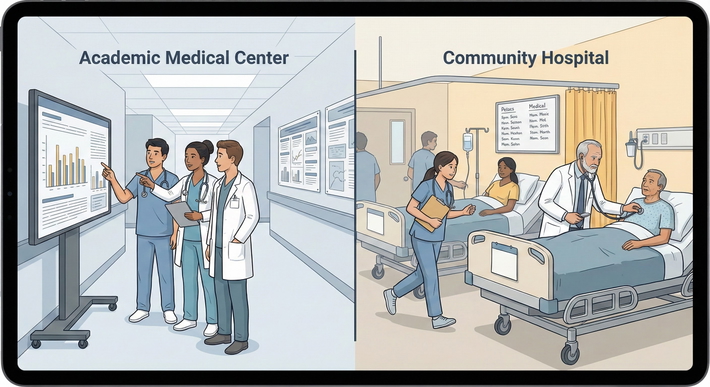
You are picking a training identity, not just a hospital. Community vs academic is not a prestige ranking. It's a completely different job for 3-7 years. Get this wrong and you'll be miserable, even at a "top" program.
At this point you should stop asking which is better and start asking which daily grind actually fits you.
Phase 1: Mapping the Terrain, Defining the Spectrum
At this point, you must establish a baseline definition. Stop using the labels loosely. People throw around "academic" when they mean university-owned. That's not the point.
An academic program = university-affiliated, tertiary/quaternary center. The mission is research, teaching, and seeing the stuff that gets transferred in because nowhere else can handle it. You have fellows for everything. You have protected research time that you will be forced to use. Your attendings have CVs longer than your personal statement.
A community program = freestanding or affiliated with a community hospital system. The mission is service delivery. High volume. Bread and butter. Efficiency. Your attendings are often private practice docs or hospital-employed clinicians who operate, round, and go home. They teach because they like it, not because it's in their promotion packet.
It's a spectrum, not a binary. University-affiliated community programs exist. I've seen them. They have the community hospital logo on your badge but you do 6 months at the university. Know where on the spectrum your list sits.
At this point you should make a spreadsheet and classify every program you're considering by 3 criteria:
- Who owns the hospital? University vs health system
- Who are the faculty? Full-time academics with labs vs clinical faculty
- Where do graduates go? Fellowships and faculty jobs vs private practice jobs in the region
That tells you everything.
Phase 2: Curriculum & Clinical Exposure, The Daily Grind
This is where the difference hits you at 6 AM.
Step 1: Analyze the didactic schedule. Academic programs love conference. Grand rounds, M&M, journal club, research conference, sub-subspecialty lecture you will never use. Expect 10-15 hours a week of protected didactic time. Often 1-2 half-days completely off clinical duties. Community programs? 3-5 hours. Morning report, noon lecture, done. Efficient. Clinical.
At this point you should ask: do you learn by sitting in lectures or by seeing 30 more patients?
Step 2: Evaluate patient volume and pathology. Counterintuitive truth: community programs often make you a stronger generalist faster. Higher census. Less competition with fellows for procedures. You will see 20 cases of CHF exacerbation, cellulitis, COPD before your academic friend sees one rare vasculitis that gets presented at grand rounds for a year.
Academic centers have the zebras. The LVADs, the transplant patients, the weird genetic syndromes. Incredible if you want that. But you might go a whole month without putting in a central line because the ICU fellow took it.
Step 3: Assess autonomy. This is the big one. Community programs typically grant you real responsibility by late PGY-1. You're running the floor team. You're first-assisting on OR cases start to finish. Academic programs have layers. Resident, fellow, attending. More supervision. More hand-holding. Safer on paper. Slower to independence.
I have seen community PGY-2s run codes better than academic PGY-3s. Not because they're smarter. Because they've done it 40 times.
At this point you should email current residents and ask: "When was the last time you felt you did something beyond your comfort level with backup nearby?" The answer tells you your autonomy.
Phase 3: Mentorship & Career Trajectory, Where are you going?
Your residency chooses your next 20 years. Seriously.
Step 1: Identify your career goal. If you want GI fellowship, Cardiology fellowship, or a job as academic faculty at a university, the academic network is non-negotiable. Fellowship directors call people they know. Academic PDs know them. Community PDs, less so. The match data is brutal on this. 80-90% fellowship match rates from top academic IM programs vs 40-60% from pure community programs.
If you want to be a killer hospitalist, primary care doc, general surgeon in private practice? Community training is not just fine, it's better. Tailored to that life.
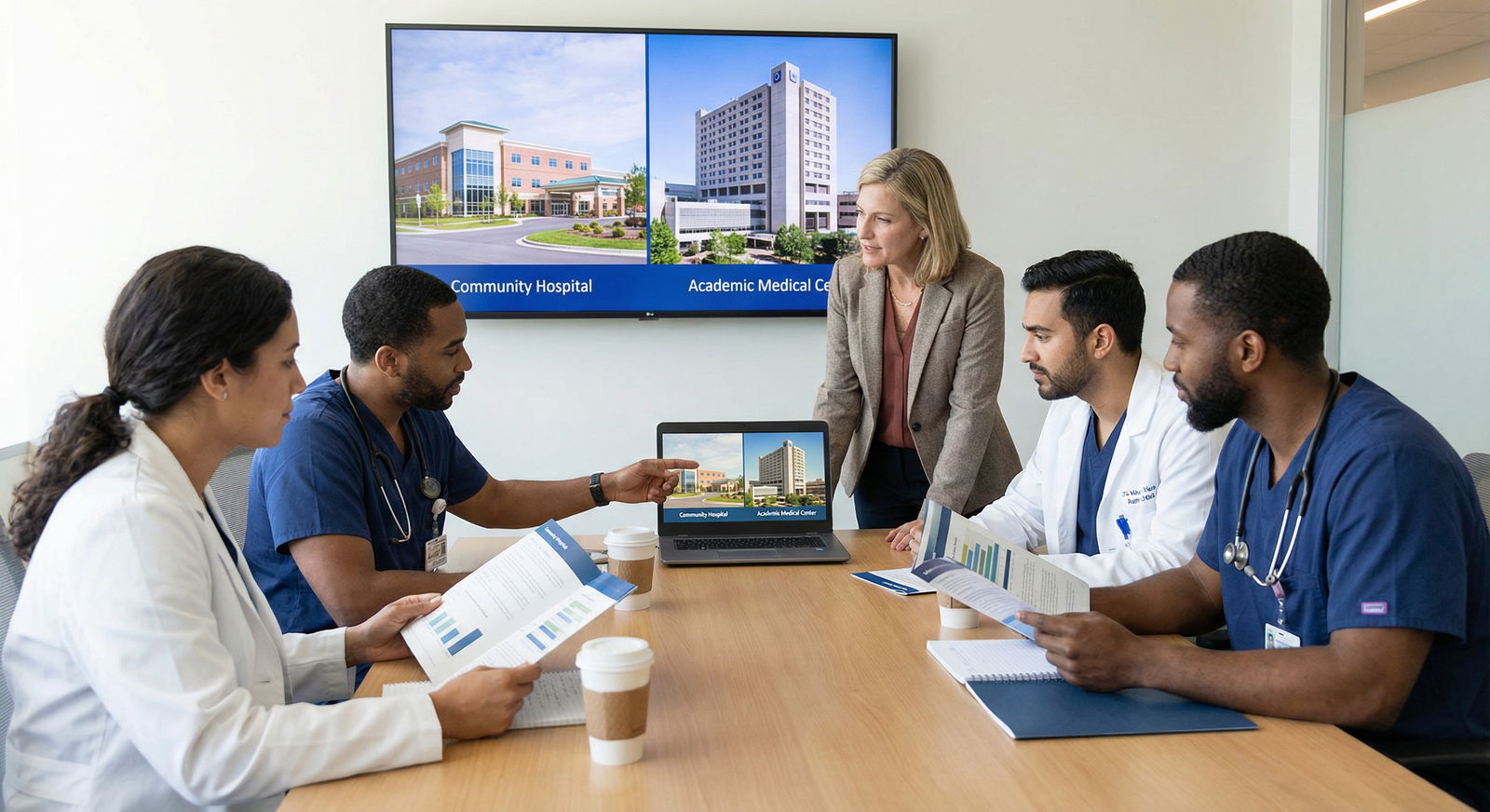
Step 2: Assess the mentorship style. Academic mentors: senior faculty with protected research time. They meet you monthly. They edit your abstract for 6 weeks. They have R01s. They will help you publish.
Community mentors: practicing clinicians balancing full-time work. Mentorship happens between cases. In the hallway. Over text at 9 PM after clinic. More practical, less formal. Less research polish, more "here's how you actually handle this insurance denial."
At this point you should ask each program: "Can you name 3 faculty who have mentored residents into my desired career in the last 2 years?" If they hesitate, that's your answer.
Step 3: Consider the exit strategy. Community programs have pipelines. Local groups love hiring their own residents. You know the EMR, the surgeons, the referral patterns. You often have a job offer by PGY-2.
Academic programs feed into fellowship and then maybe chief year. The pipeline is longer, more prestigious, less geographically stable. You will move again.
Phase 4: Lifestyle & Work-Life Integration, The Cost of Training
Don't lie to yourself. Lifestyle matters.
Step 1: Review call schedules. Academic programs often have heavier call by volume because they are referral centers. Sick patients never stop. Every community hospital sends them to you at 2 AM. But they also often have night float systems, fellow coverage, and moonlighting limits.
Community programs often have more humane call, q4, q5, home call as senior. Smaller teams, but fewer 28-hour disasters.
Step 2: Factor in research expectations. Academic programs require research. Not optional. You need abstracts, posters, manuscripts. That's evenings and weekends after clinical work if you didn't get protected months. It's a second job. Some love it. Others burn out pretending to love it.
Community programs require QI projects. A poster maybe. Your weekends are yours.
At this point you should be honest: when you get home at 7 PM after a 12-hour shift, do you want to work on a manuscript or see your family?
Step 3: Evaluate moonlighting. Community programs are far more likely to offer moonlighting privileges early, PGY-2 onward, urgent care, hospitalist shifts. Real money. Real autonomy. Academic programs often restrict moonlighting until PGY-3 or ban it during research years.
Phase 5: The Final Decision Matrix, Choosing Your Path
Stop collecting opinions from everyone. You need a system.
Step 1: Create a weighted scorecard. At this point you should list your non-negotiables. Rank these 1-5 for YOU: Research opportunities, Fellowship match, Autonomy / volume, Location / family, Lifestyle / moonlighting, Teaching quality.
Be ruthless. If lifestyle > research, weight it. No one else sees this.
Step 2: Visit. And actually talk to residents. Not the curated tour residents. The ones in the workroom at 6 PM. Ask them: "If you could re-rank, would you come here again?" Watch their eyes. Ask what they complain about. Every program complains. You want to know WHAT they complain about. Fellows stealing procedures vs low pathology variety, very different problems.
Step 3: Trust your gut on culture. The right program feels like your people. Academic programs can feel hierarchical, intellectual, sometimes impersonal. Community programs can feel family-like, intense, sometimes chaotic. Neither is wrong.
Summary Takeaways
- Academic programs prioritize research, teaching, and tertiary care. Perfect pathway to fellowship and faculty roles, but expect more layers, more lecture time, and more pressure to publish on your off-hours.
- Community programs prioritize high-volume, generalist, early-autonomy training. Excellent preparation for private practice and hospitalist medicine. Faster to independence, often better lifestyle, fewer built-in research pipelines.
- At this point in your selection process, you must align program choice with your specific endgame. Don't pick academic because it sounds better. Don't pick community because it sounds easier. Pick the training culture that builds the doctor you want to be in 10 years.