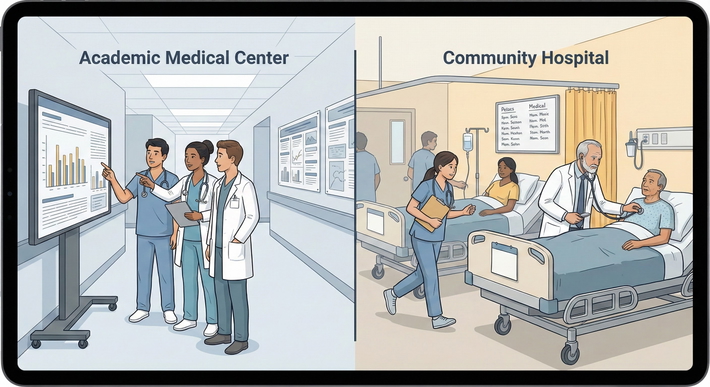
1. The Late-Night Spiral: Is My Background My Fate?
Do I look like a risk the moment I walk through that interview door?
That's the question I've been chewing on at 2 AM for the past three weeks. Not "Did I prepare enough?" Not "Did I answer that question well?" But the one that haunts: Will they see my community background and quietly write me off before I've said a single word?
Here's the thing nobody admits out loud. There's a creeping paranoia that community trainees are viewed as second-tier candidates. That academic PDs see us as research-light, paper-poor, and clinically soft. The imposter syndrome hits different when your pedigree isn't shiny. You start wondering if your dean's letter is shorter than everyone else's. If your Step score is just barely enough. If your CV looks thin next to the guy who published four case reports before medical school even ended.
Then your brain does what it does best at midnight. It builds the worst-case narrative. The PD has 800 applications. They're tired. They see "community medical school" or "non-research heavy clinical rotation" and they put you in the "maybe" pile. Your application never gets the real read. It's filtered out. Lazy sorting. Done.
But here's the pivot. The one I have to remind myself of when I'm catastrophizing. PDs aren't hunting for perfect paper trails. They're desperate for capable clinicians who won't quit on them in year two. The whole system is starved for people who can actually function on day one. Research pedigree is a luxury. Work ethic is the requirement. And work ethic isn't something you inherit from a fancy school name.
2. Decoding the Bias Myth: Academic vs. Community Judgment
Let me name the specific anxieties because they're eating me alive.
Anxiety one: An academic PD sees "community" and thinks unprepared. Anxiety two: A community PD sees a community applicant and thinks safe, but not ambitious. Either way, I'm stuck. Either I'm too dumb or I'm too safe. Both feel fatal.
Let's talk about the "Academic Snobbery" theory. The one where elite university programs secretly rank applicants by their medical school's US News ranking and laugh at the rest of us. Does it exist? Probably, in some programs, with some attendings. Is it the dominant filter? No. Once you survive the initial numerical screen, most PDs genuinely care about clinical readiness and work ethic. They want to know you won't freeze during a code. They want to know you can take feedback without crying. Those things don't come from your school's prestige.
Now the "Community Safety" anxiety. Applying to community programs feels like admitting defeat. Like you're too weak to survive the academic grinder. Here's the truth I've learned from talking to actual residents: applying community is smart strategy. PDs at community programs know exactly who they are. They want people who want their environment. They're not grading your ambition. They're grading your fit. If you say "I want to be at a place where I get hands-on early and learn through volume," they believe you. They don't see desperation. They see alignment.
The shared pain point nobody talks about. Both academic and community programs struggle with the same core issues: resident retention, clinical competence, burnout management. They're not judging you from opposite ends of a moral spectrum. They're both asking, "Will this person thrive here and not quit?" That's it. That's the question. Your school's name doesn't change the answer.
3. Interview Room Panic: Interpreting Every Micro-Movement
This is where I lose it completely. The interview itself.
You've made it to the Zoom room. Congratulations. Now you're going to spend the next 30 minutes convinced the PD hates you. Here's the cycle:
PD pauses for two seconds. You think: They're thinking of how to politely end this early. Reality: They're gathering their thoughts between questions, or their kid just walked in the other room.
PD checks their watch. You think: I'm taking too long. They're bored. I've failed. Reality: They have back-to-back interviews scheduled. They check their watch on every single candidate.
PD asks you a tough clinical scenario and you hesitate. You think: I don't know this. I'm going unmatched. Reality: They don't care if you know the answer. They care if you can think through it. The process matters more than the result.
I've watched friends spiral after interviews because they "didn't vibe" with the PD. But here's what I've also seen: those same friends matched there. Interview vibes are a terrible predictor of rank list placement. PDs are evaluating hundreds of people. They don't have the emotional bandwidth to hate you personally. They're tired. They're behind on charts. They want someone competent and likable. That's the bar.
Community interviews specifically might feel less polished. No fancy hospital tour video. No catered dinner with the chair. What you get instead is candor. Direct questions. "Tell me about a patient you couldn't help." "How do you handle being wrong?" These aren't academic flex questions. They're gut-check questions. They want to see how you operate under pressure. For a community-trained applicant, this is actually your edge. You've been doing more with less for years. You know how to improvise. You know how to work a resource-limited environment. That's gold to a community PD.
The fit factor is everything. PDs aren't picking the smartest person in the room. They're picking the person who won't make their lives harder for the next three to seven years. Being labeled a "hard worker" from a community background isn't a red flag. It's a green one. You're someone who knows how to show up.
4. Strategic Reassurance: Turning Doubt into Confidence
Okay. Less spiral. More strategy.
You got an interview. Stop. Breathe. Realize that the screening battle is over. You cleared it. Whatever stats or background made the cut, you're in. The remaining question is whether you're a good fit, and that's a story you can actually shape.
Here's how to actually leverage the community advantage without sounding like you're overcompensating:
- Frame your resilience as operational experience. Don't say "I had to work harder because my school lacked resources." Say "I learned to deliver high-quality care in a high-volume, resource-conscious environment, and that's exactly what your program trains for."
- Email PDs strategically, not desperately. Share a specific growth story after your interview. "After our conversation about [topic], I reflected on my rotation where I [specific moment]. It reinforced my interest in [their program's specific strength]." That's not needy. That's alignment.
- Don't apologize for your CV. If they didn't want to interview you, they wouldn't have. Silence on the research section isn't weakness. It's focus. You chose clinical depth over paper padding. Own it.
- Differentiate through hustle, not pedigree. Your edge is that you've had to be scrappy. Volunteer experiences. Side gigs during school. Real-world problem-solving. Lead with that.
The "what if" loop is the killer. What if they think I'm not academic enough? What if they realize I don't know enough? What if they have someone better? You cannot think your way out of this loop. You have to accept that rejection is part of the numbers game. Some programs interview 80 people for 8 spots. You can be excellent and still not match there. That's not a verdict on your potential. That's statistics.
Prompt: Split composition: Left side shows focused student reviewing patient charts with determination and coffee cup, Right side shows welcoming resident team collaborating in bright sunlit common room, dotted gold line connecting them representing successful match, uplifting tone, diverse group, cinematic split-screen style with soft transition between panels, warm morning light, hopeful atmosphere.
5. The Bottom Line: You Belong Where You Thrive
Programs exist to train doctors. They are not selecting finished products. They are making investments. The minute you internalize this, the spiral loses half its power.
You are not a liability. You are a bet. PDs are betting that you'll show up, learn fast, take care of patients, and stick around. Your school's name doesn't determine whether that bet pays off. Your work ethic does. Your character does. Your willingness to grow does.
Hundreds of successful residents started exactly where you are. Average scores. Community backgrounds. CVs that don't scream "prestige." They're now attending physicians. They're program leaders. They're proof that the system, despite its flaws, sometimes picks the right people regardless of pedigree.
Here's the call to peace: let the PDs worry about their rank list. You focus on two things only. Preparation and authenticity. Know your story. Tell it well. Don't perform. Don't apologize. Don't try to be someone you're not. The programs that are right for you will see that. The ones that aren't were never going to be your home anyway.
Your background isn't a deficit. It's a different kind of strength. You learned medicine in the trenches. You know how to be resourceful. You know how to build relationships with patients who don't have access to specialists. You know how to thrive when the resources are thin and the cases are thick. That perspective is rare. That perspective is valuable. And once you walk through that interview door, it's going to come through whether you're nervous or not.
Breathe. Prepare. Show up. Trust that the right program will see what you bring to the table, not what your transcript doesn't.
Prompt: Close up of hands holding smartphone displaying positive notification message, soft morning light streaming through window, blurred background of smiling friends and family in living room, expression of overwhelming relief and hope captured in the slight smile, symbolizing end of uncertainty, shallow depth of field, golden hour lighting, intimate candid photography style.
Key Takeaways
- PDs prioritize clinical readiness, professionalism, and fit far above residency pedigree. Your background is rarely a disqualifier. The screening has already happened by the time you hit the interview room.
- Anxiety-driven interpretations of PD behavior are almost always projections. Most interview hurdles are structural or situational, not personal rejections. They don't hate you. They're tired.
- Community trainees possess grit and clinical hustle that are highly valued traits. Frame these as assets that solve PD problems, not weaknesses to hide. Your edge is your scrappiness. Use it.