

This article is for educational purposes only. It is not financial advice, not legal advice, and not tax advice. Figures vary by individual circumstances, so consult a qualified professional before acting.
Lead: The myth that virtual vs in-person interviews will break a couples match
Couples match success is not about whether you interviewed on Zoom or in a hospital conference room. It's about planning, communication, and rank-list strategy. Period.
The myth I hear every season: "We're doomed because I'm mostly virtual and my partner is flying everywhere in-person. Programs will think we're not equally committed." That's false. And it's anxiety-inducing in exactly the wrong way, it makes you focus on format instead of the stuff that actually sinks couples.
Here's the promise: you can fix this. Virtual vs. in-person doesn't change how the couples match algorithm works. It changes logistics, perception, and fatigue. Those are manageable problems.
What actually changes between formats? Virtual = less travel, more calendar Tetris, higher risk of Zoom blur where every program feels the same. In-person = stronger relationship-building, much higher cost, more physical exhaustion, tighter windows. Neither automatically gives you or your partner an advantage. The algorithm still just tries to match you as a pair based on your joint rank list. Your job is to stay coordinated enough to build that list smartly.
Reality check: what interview format actually affects in a couples match
Let's be blunt. Programs evaluate you individually. Dr. A does not get a penalty because her partner Dr. B had to fly to Chicago. The NRMP doesn't have a checkbox for "interviewed virtually, therefore less committable as a couple."
Interview format affects three things. Not your match eligibility.
1. Scheduling burden. Virtual interviews look easier. They often are. You can do two in a day if you're careful, no TSA line. But they stack up fast and create overlapping invites you'll be tempted to say yes to because "it's just Zoom."
2. Travel fatigue. In-person interviews build rapport. You remember the residents' lounge, the weird elevator, the attending who actually talked to you. You also remember the 5:30 AM flight to Detroit after a late checkout in Houston. Fatigue makes you irritable. Irritable makes you fight with the one person you need to be aligned with.
3. Perceived experience. Yes, an in-person day feels more real. I've seen students come home saying, "I felt that program," after an in-person, and then rate a virtual program lower even though the training was objectively better for them. That's the distortion you have to guard against.
Common fears I hear: "My partner got more face time, so programs will like them more." No. "I'm traveling more, so I'm missing chances to debrief." That's a coordination problem, not a couples match problem. "One of us looks less serious because we're on camera." Programs know applicants don't control format. Most programs offered virtual to save themselves time too.
Fix the logistics. The match mechanics take care of themselves.
Where couples actually get into trouble: the predictable failure points
Couples don't fail because of Zoom. They fail because they stop acting like a team.
Here are the exact failure points I've watched derail strong applicants year after year:
Overlapping interview days with zero calendar visibility. Partner A accepts a virtual at 10 AM CT, Partner B books a flight landing at 9:45 AM CT in the same city cluster. Neither told the other until the night before. Now you're resentful and scrambling.
Uneven travel schedules that breed resentment. One partner is home making dinner and doing Anki, the other is on their third hotel in four days. If you don't name that dynamic early, it becomes "you don't understand how hard this is."
Format competition. "You got 16 in-persons and I got 6, so you're more competitive." I've literally heard couples argue about this in the hallway. Number of in-persons is not a proxy for competitiveness. It's a proxy for specialty culture and geography.
Last-minute invites and geographic clustering with no plan. You get a "We had a cancellation, can you interview Thursday?" email. Great opportunity. Also chaos if you don't have a pre-decided rule for when to say yes. The couples who struggle are the ones deciding everything in the moment.
Rank-list drift. This is the silent killer. You start ranking as individuals. "I liked this place, even though it's nowhere near anything you ranked." You stop asking, "What works for us as a pair?" and start justifying your solo preferences. The interview format just gives you a convenient excuse: "Well, I was actually there, so I know it's good."
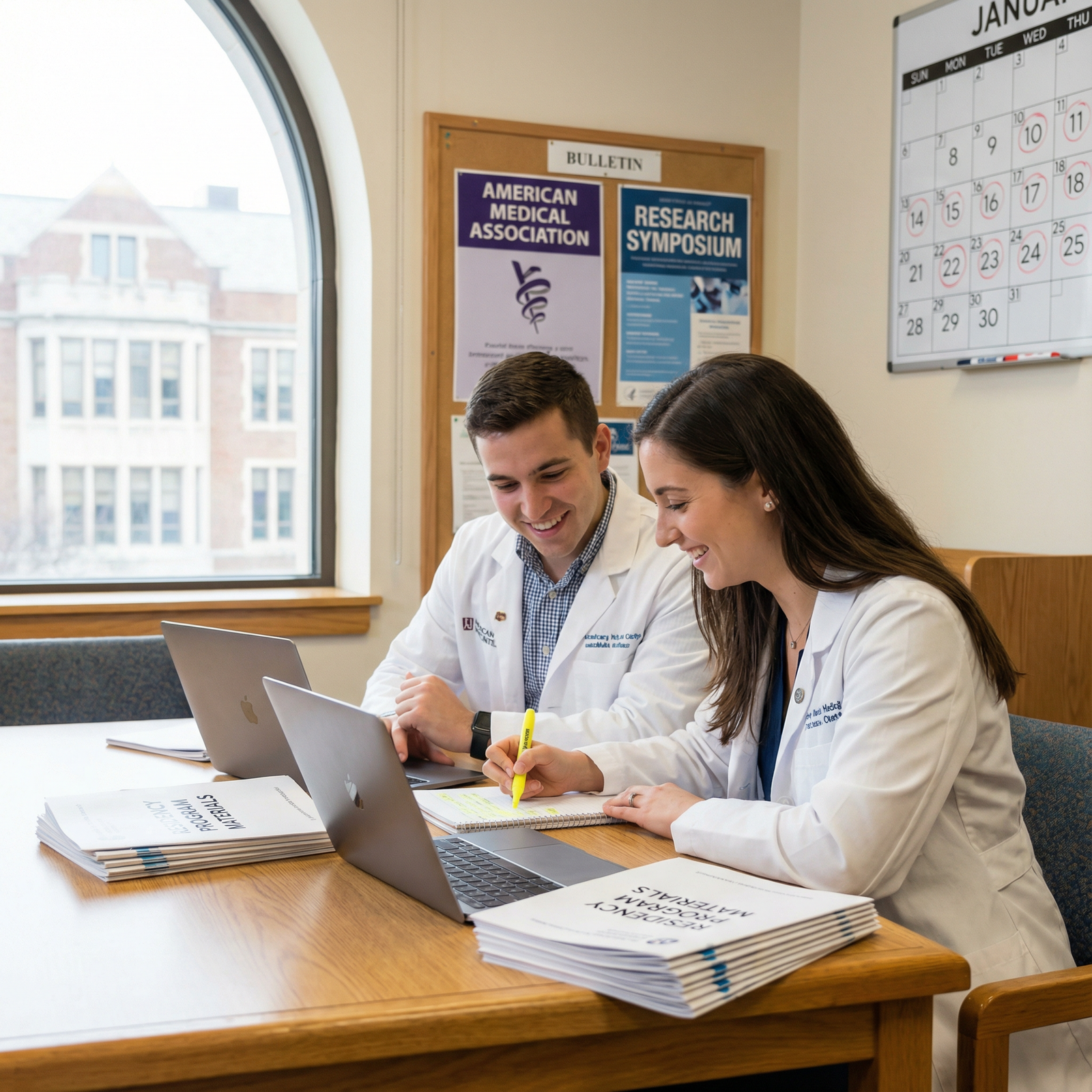
None of this is fatal. But it is predictable. So you can build a system to prevent it.
Step-by-step fixes: how to keep the couples match on track across both interview formats
You need a protocol. Not vibes. A protocol.
1. Build ONE shared master schedule. Today. Use Google Calendar or Notion, whatever you both will actually check. Put in:
- Every interview date + format (V vs IP) + time zone
- Travel days blocked as "UNAVAILABLE - IN TRANSIT"
- Decision deadlines and communication deadlines -Buffer days: at least one full day off after every 3 in-person interviews
If it's not on the shared calendar, it doesn't exist. No "Oh I forgot to tell you."
2. Run a weekly 15-minute alignment check. Same time every week. Sunday at 8 PM works for most. Agenda:
- New invites / waitlists?
- Cancellations or conflicts?
- Money / points / energy check?
- Any upcoming "must-be-together" dates (anniversaries, family stuff)? Keep it short. Put a timer on. Save the deep rank talk for later.
3. Create a pre-set conflict rule. Decide now before you're tired. Example rule I give couples:
- If two interviews overlap perfectly, the higher-priority program for the pair's geography wins. The other asks for alternate date once.
- If an alternate date isn't available and it's not a top-10 for either, you decline without guilt.
- If it's a top-5 for one partner, the other partner supports the attendance, period. No scorekeeping.
Write it down. Literally. When emotions are high, you follow the written rule.
4. Keep partner communication separate from program communication. Don't explain your couples logistics to interviewers unless they ask directly and it's relevant. "My partner is also interviewing in the area" is fine. A five-minute saga about your flight delays and shared calendar is not. It reads as disorganized.
5. Protect energy like it's a board exam. For in-person blocks: meal prep, pack snacks, pick one hotel chain, get TSA PreCheck if you can, and never red-eye into an interview day. If you can afford it, pay the $40 for the direct flight. For virtual blocks: same camera, same light, same quiet corner, water, and hard stops between interviews. Don't do an interview from your car.
6. Use the same evaluation rubric for both partners. After each interview, score 1-5 on: Training quality, Culture / people, Location for both, Partner job / family feasibility, Gut feeling. Do it within 24 hours. Same sheet, shared folder. This stops "but I was there in person so I know better" from contaminating your list. Data beats memory.
This system isn't sexy. It works.
How to rank as a couple without letting interview format distort the list
Rank what you want. Not what was easiest to attend. I'll say it again because people mess this up: do not downgrade a program because the interview was virtual.
Here's how to fix rank-list distortion:
Separate convenience from preference. Ask: "If both interviews had been in-person with perfect travel, which would we pick?" If you keep ranking the in-person programs higher just because you remember the lunch spread, you're lying to yourselves.
Do a joint ranking conversation in two parts. Part 1: each partner makes their own solo list with scores. Part 2: you merge into a couples list. Use language like "For us, geographically, this pairing works because..." not "My program was better."
Build backup scenarios on purpose. What if one partner matches higher on their list and the other is in a near-match or research year? What if you get lots of invites in Boston but nothing in Atlanta? Map two or three geographic backup clusters, not just dream pairings. It's less romantic. It's far more practical.
Honesty matters more than format-matching. If you loved a virtual interview and your partner thinks you're rationalizing, say it. Show your rubric scores. If your partner hated an in-person day that you thought looked great on paper for both of you, believe them. The best couples lists I've seen were built with brutal honesty at 10 PM with cold coffee, not with polite agreement.
Warning: Don't abandon a strong program choice just because the interview was short, virtual, or low-production. Some of the best programs have terrible virtual days. Some of the most mediocre programs have amazing in-person recruitment days with fancy tours. Don't be fooled.
Bottom line: virtual and in-person interviews are manageable, not match-breaking
This isn't about Zoom vs. hospital badge. It's about whether you act like a team under stress.
Virtual and in-person won't break your couples match. Poor coordination will. Fixable problems: calendars, travel pacing, decision rules. Unfixable if ignored: resentment, drift, bad ranking.
Here's your action list this week:
- Create the shared master calendar and add every confirmed date plus travel blocks.
- Agree on your written conflict rule and buffer-day policy.
- Set the recurring 15-minute Sunday check-in.
- Start the joint scoring rubric now, even if you only have 2 interviews done.
- Stop comparing formats. Compare fit.
Do those five things and you'll spend a lot less energy fighting about format and a lot more on the thing that actually gets you matched: a coherent, honest, team-built rank list.


