

The most dangerous words in the Couples Match are: “Don’t worry, we’ll take care of you.”
If you remember nothing else, remember this: in the NRMP Couples Match, only the rank list matters. Not the warm phone call. Not the reassuring email. Not “we love you both.” If it’s not in the algorithm as a rank, it does not exist.
This is one of the quietest but cruelest ways couples get burned. I’ve watched strong pairs unravel emotionally on Match Day because they trusted “verbal promises” from programs instead of hard data and written policy.
Let’s walk through the traps so you do not become the cautionary story people whisper about next year.
The Core Mistake: Treating Program Words Like Contracts
Here’s the error in one line: believing program directors, coordinators, or residents when they imply or state you’re “safe” as a couple—without having actual proof in the rank list or institutional policy.
Common flavors of this mistake:
- “The PD said we were in their top tier and they love couples.”
- “The APD told us they’d make sure we’re together if possible.”
- “The chief resident said they’ve never split up a couple.”
- “They said, ‘If you rank us highly, you’ll be fine.’”
None of that is binding. None of it is checked by NRMP. None of it is visible in the algorithm.
The NRMP algorithm does not know:
- that you both cried in that exit interview
- that the PD hugged you and said, “We’ll make this work”
- that a resident texted you, “You’re basically in”
The algorithm knows two things:
- Your certified couples rank list
- Their certified program rank lists
That’s it. Full stop.
The mistake is assuming:
Verbal reassurance → means → high rank position → means → safe as a couple
Real translation:
Verbal reassurance → means → nothing guaranteed → sometimes not even close to your assumptions
Why Programs Say Comforting Things (That May Not Be True)
Let me be blunt: programs are not necessarily lying. But they’re also not always being precise, and they’re not the ones who will suffer if their optimism blows up your match.
Why they give verbal “comfort”:
They genuinely like you
Faculty are human. They enjoy you, they picture you as a resident, they want you to feel good. So they talk like:
“You’d be such a great fit here.”
“We’d love to have both of you.”
That’s social warmth, not a contract.They hate conflict and awkwardness
Almost no one on the program side wants to say, “You’re not competitive enough here,” or “We probably won’t rank your partner high.” So they smooth it over with vague reassurances.They don’t control everything they sound like they control
- Rank lists often involve multiple faculty
- GME oversight can change positions or slots
- Hospital admin can cut funding late
That PD promising you something in December may be overruled in February.
They use soft language intentionally
Notice the verbs:- “We’ll try to…”
- “We do our best to…”
- “We generally keep couples together…”
That’s not the same as:
“We will rank you both in positions that ensure your match if you rank us first.”
They benefit from you ranking them highly
You’re both good applicants. They want you on their list. Reassuring you makes it more likely you’ll put them near the top. The risk to them if you don’t match there? Minimal. The risk to you? Massive.
The Specific Couples Match Pitfalls Around Verbal Promises
Couples Match adds complexity and pressure. That’s where bad verbal promises become landmines.
Pitfall 1: Over-ranking a combined program based on a “we’ll take care of you” comment
You hear something like:
- “We love both of you.”
- “We really support couples.”
- “If you rank us #1, it’s very likely you’ll be here.”
So you:
- Push that city to the top of your couples list
- Move safer combinations (e.g., A+community program, B+solid backup) further down
- Build your whole geographic life plan around that “promise”
What actually happens:
- One of you is ranked high
- The other is ranked mid-to-low
- A few strong individual applicants slip between you on their list
- The algorithm can’t align your pair with their list
- Result: you match far down your list, or worse, one of you doesn’t match
Programs don’t sit there the day before Rank Day and say, “Let’s double-check that we didn’t mislead any couples.” They certify their list. The damage to you was done weeks earlier when you trusted casual reassurances instead of scenario planning.
Pitfall 2: Believing “we never split couples” means they won’t split you
I’ve seen this exact sentence multiple times:
“Our program really doesn’t split up couples.”
Reality check:
- That might mean they try not to.
- It might mean they usually match both people at the same hospital but different programs, which may or may not be what you meant.
- It might refer to historical patterns, not a guarantee.
And sometimes, it’s just not true.
Programs have no power over:
- Where the partner matches at a different institution
- What other programs do with your application
- The final output of the algorithm
They can decide who they rank and in what order. That’s it. Everything after that is out of their hands.
Pitfall 3: Trusting residents’ “inside info” as if they see the rank list
Residents love to say things like:
- “The PD absolutely loved you.”
- “Honestly, you two are their top couple.”
- “I’d be shocked if you didn’t end up here.”
Here’s the uncomfortable truth: most residents have zero actual access to the rank list. At many places they:
- Don’t sit in the ranking meetings
- Get impressions through gossip or tone
- Want to be encouraging, not realistic
They can advocate for you. They cannot promise you a rank position. If you treat their words as rank-list facts, you’re setting yourself up for an ugly surprise.
The Only Things You Can Trust in the Couples Match
Now, let’s turn protective. You’re not powerless. You just can’t afford fantasy.
Here’s what you can lean on:
| Reliable Input | Unreliable Input |
|---|---|
| Certified NRMP rank lists | Verbal promises |
| Historical match data | “Top tier” compliments |
| Program policies in writing | Resident gossip |
| Your own priority rankings | Vibes from interview day |
You make better decisions when you understand this.
1. The certified rank list is the only real commitment
Until both sides hit “certify” in NRMP, nothing is real.
- Programs are free to like you and still rank you lower than you think.
- You’re free to like them and still rank them realistically rather than “all in.”
Treat anything said before that as non-binding opinion.
2. NRMP Match rules override “informal agreements”
NRMP has strict rules against:
- Guarantees of a match
- Commitments outside the match
- Quid pro quo (“If you rank us #1, we’ll rank you high”)
If someone is giving you a “promise,” they’re already in a grey zone. And if they’re willing to break NRMP rules casually, why on earth would you assume they’ll be honest with you about risk?
Practical Ways to Avoid Getting Burned
You want tactics, not slogans. Good.
Strategy 1: Translate all soft language into realistic assumptions
When you hear:
- “We really liked you both” → Translate to: We might rank you somewhere, no idea where.
- “You’d be a great fit here” → We’re not actively discarding you.
- “We support couples” → We don’t hate couples. We still rank individually.
Unless they say, in writing (and most won’t, for good reason):
“We plan to rank you both highly, and we historically almost always match couples we rank highly”
…assume nothing.
Strategy 2: Ask better, sharper questions
You can’t ask, “Where will you rank me?” But you can ask:
- “Have you previously matched couples where one partner was in a more competitive specialty than the other?”
- “Do you rank couples any differently than individual applicants?”
- “Are there structural limitations (funding, positions) that might make it difficult to take both of us in the same year?”
Watch for hedging:
- “It depends on the year.”
- “We’ll see how things shake out.”
- “We’d love to, but can’t make promises.”
Those are red flags. Not because they’re dishonest, but because they’re honest about uncertainty. Treat them seriously.
Strategy 3: Model worst-case scenarios on your rank list
Most couples build rank lists assuming “things will probably be okay.” That’s not how you protect yourselves.
You should:
- Build your ideal list first.
- Then build your safe list.
- Then merge them into a combined list that assumes at least one program overestimated you or misled you.
Ask yourselves:
- “If the ‘friendly’ program doesn’t take us, are we okay with where we fall next?”
- “Did we leave a huge cliff between our top 3 options and everything after?”
- “Are we ranking a fragile dream scenario over several realistic, stable ones?”
If you both secretly know, “If we don’t get X city together, at least we could live with Y + Z as individual programs,” that needs to be reflected up in your list.

| Step | Description |
|---|---|
| Step 1 | List true priorities |
| Step 2 | Identify realistic programs |
| Step 3 | Ignore verbal promises |
| Step 4 | Build best-case rank list |
| Step 5 | Stress-test worst-case outcomes |
| Step 6 | Adjust pairs to avoid big cliffs |
| Step 7 | Certify couples rank list |
Common Real-World Scenarios Where Couples Get Hurt
Let me walk you through a few patterns I’ve actually seen.
Scenario 1: The “They loved us” urban academic disaster
- Couple: FM + IM, decent stats, strong fit vibes at big-name city program
- PD: “We really want both of you here. Rank us first.”
- Residents: “You’re exactly who they look for.”
They:
- Put that city combo at the very top
- Push more realistic mid-tier city/community combos way down
Match Day:
- IM partner matches at that institution
- FM partner falls way down list to a different city
- They’re separated by 2 flights and a time zone
Why? FM program at that institution ranked them, but not high enough. A few superstar solo FM applicants bumped them down just enough that the couples combo never materialized.
The verbal promises? Gone. No appeal. No “but you said…” department.
Scenario 2: The “We never split couples” misunderstanding
- Couple: Peds + Psych, dual interview at combo hospital system
- Program leadership: “We’ve never split a couple we rank highly.”
- They interpret that as: “If they like us, they won’t split us.”
Reality:
- They were ranked high in Psych
- Middle of the pack in Peds
- Strong solo Peds applicants pushed the couple’s Peds partner just far enough down
Psych side matched their partner. Peds side did not. Result: one matches there, one unmatched. The system technically “didn’t split a highly ranked couple”—because one of them, on paper, wasn’t “highly” ranked.
Words sounded good. Algorithm didn’t care.
How to Keep Your Sanity When You Can’t Trust Verbal Signals
You can’t control programs. You can control how addicted you get to their reassurance.
1. Treat compliments as emotional support, not information
A PD saying, “We’d be lucky to have you both,” feels great. Let it feel good. Then mentally file it under “emotional noise” when building your rank list.
2. Don’t build your relationship plan on undocumented promises
I’ve seen couples:
- Sign leases early near a “verbal promise” program
- Tell families, “We’re basically going to X city”
- Turn down other interview offers assuming this one is “locked”
Do not do this. Until the NRMP email hits your inbox, any “promise” is a story, not a fact.
3. Have an honest, non-romantic conversation with your partner
This is usually missing.
Sit down and ask, out loud:
- “If the program that ‘loves us’ doesn’t actually rank us high enough, where do we want to land?”
- “Are we okay sacrificing geography or prestige a bit to increase the odds of being together?”
- “Are we both willing to treat those reassuring emails as noise instead of guidance?”
If you can’t have that conversation, the Match will have it for you. And it is not kind.
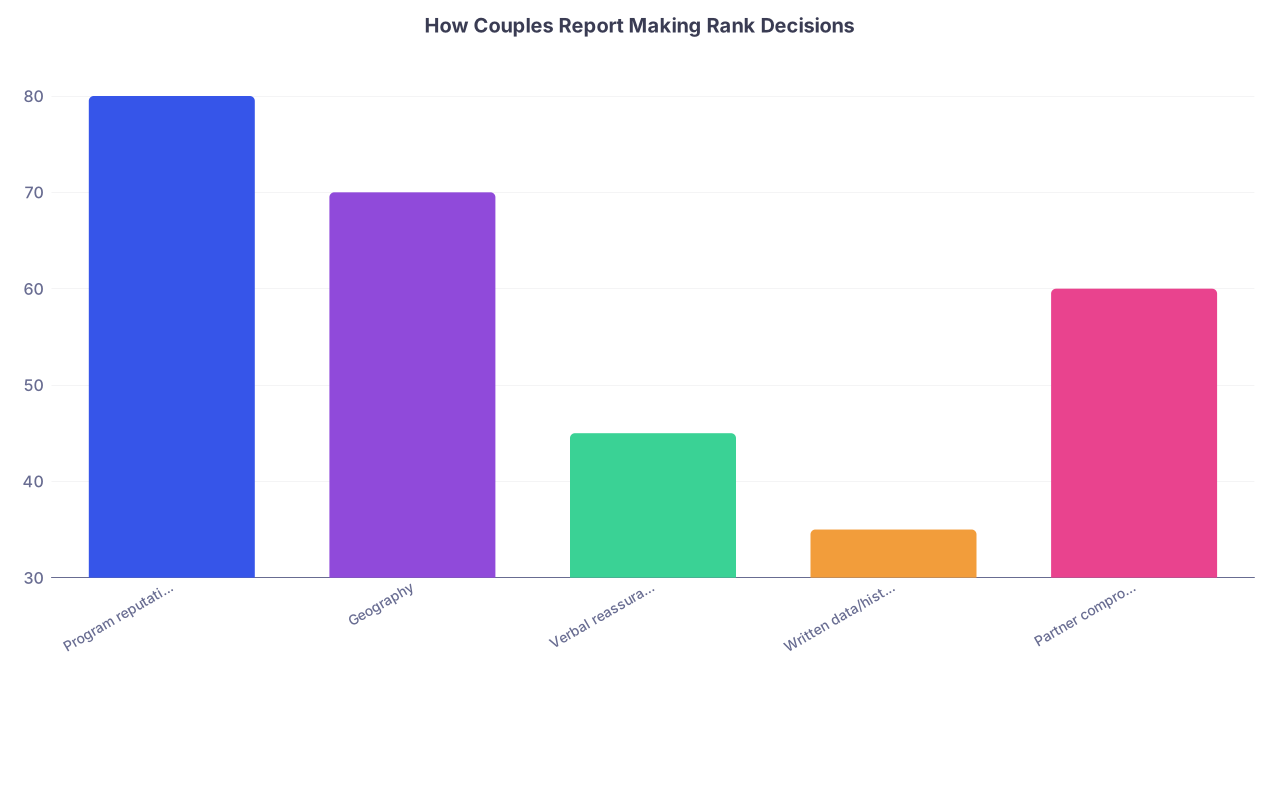
| Category | Value |
|---|---|
| Program reputation | 80 |
| Geography | 70 |
| Verbal reassurances | 45 |
| Written data/history | 35 |
| Partner compromise | 60 |
(Hypothetical numbers, but the pattern tracks what I’ve seen: verbal reassurances are over-weighted; written data/history are underused.)
Concrete Rules to Protect Yourself
Here are the lines I’d tape to your laptop while you’re editing your rank list:
- If it’s not on paper or in the NRMP system, it doesn’t exist.
- Never put a fragile dream scenario above multiple solid, tolerable options.
- Assume at least one program that “loves you” ranked you lower than you think.
- Do not let a single program’s verbal promise warp your entire list.
- The goal is not to win validation from a PD. The goal is to land in a life you both can actually live.
FAQ (Exactly 5 Questions)
1. A PD told us, “If you rank us first, I’m confident you’ll match here as a couple.” Can we trust that?
No. That’s an NRMP red flag statement, and it still isn’t binding. Programs are not allowed to guarantee matches. Even if that PD intends to rank you highly, other applicants, institutional changes, or multi-person rank committees can change the final list. Use that comment as one data point about their enthusiasm, not as a promise when building your couples rank list.
2. Is it ever appropriate to ask a program directly how they handle couples?
Yes, and you should. But ask about process, not your specific rank. Good questions: “Do you have a formal policy for ranking couples?” “Have you historically matched many couples?” “Are there constraints (funding, position caps) that limit how many couples you can take?” Their answers guide your risk assessment. Just do not mistake any “we like you both” language for a guarantee.
3. Our residents said we’re ‘definitely at the top of the list.’ Should we move that combo higher?
Do not adjust your list based solely on that. Residents rarely see the final rank list. They may sense enthusiasm but not know exact positions or how you compare against other applicants. If that program is already a top-choice for both of you based on training, geography, and lifestyle, fine—rank it highly. But the resident gossip is not enough reason to move it above multiple safer, acceptable combinations.
4. What if we don’t trust any program and end up ranking too conservatively?
You won’t “break” the algorithm by being rational. Ranking conservatively in Couples Match doesn’t mean only low-tier programs—it means spreading your risk so you don’t bet everything on one or two fragile scenarios. List your true preferences in order, but imagine that at least one “dream” program misjudged you. Make sure your list beneath those dreams is still a life you can live with, together or in reasonable proximity.
5. Can we email a program to clarify if they really meant they’d rank us highly as a couple?
You can email to clarify general couples policies, but do not expect (or ask for) a specific ranking confirmation. Something like, “We’re applying as a couple and want to better understand how your program historically handles couples in the ranking process,” is fine. If they respond with more vague support (“We love couples! We’ll do our best!”), your interpretation should still be: nice sentiment, zero guarantee. Build your list accordingly.
Key points you should walk away with:
- In the Couples Match, only the certified rank lists matter—verbal promises are noise.
- Programs can like you and still rank you too low to match as a couple; assume at least one will.
- Protect yourselves by stress-testing worst-case scenarios and refusing to build your future on “Don’t worry, we’ll take care of you.”


