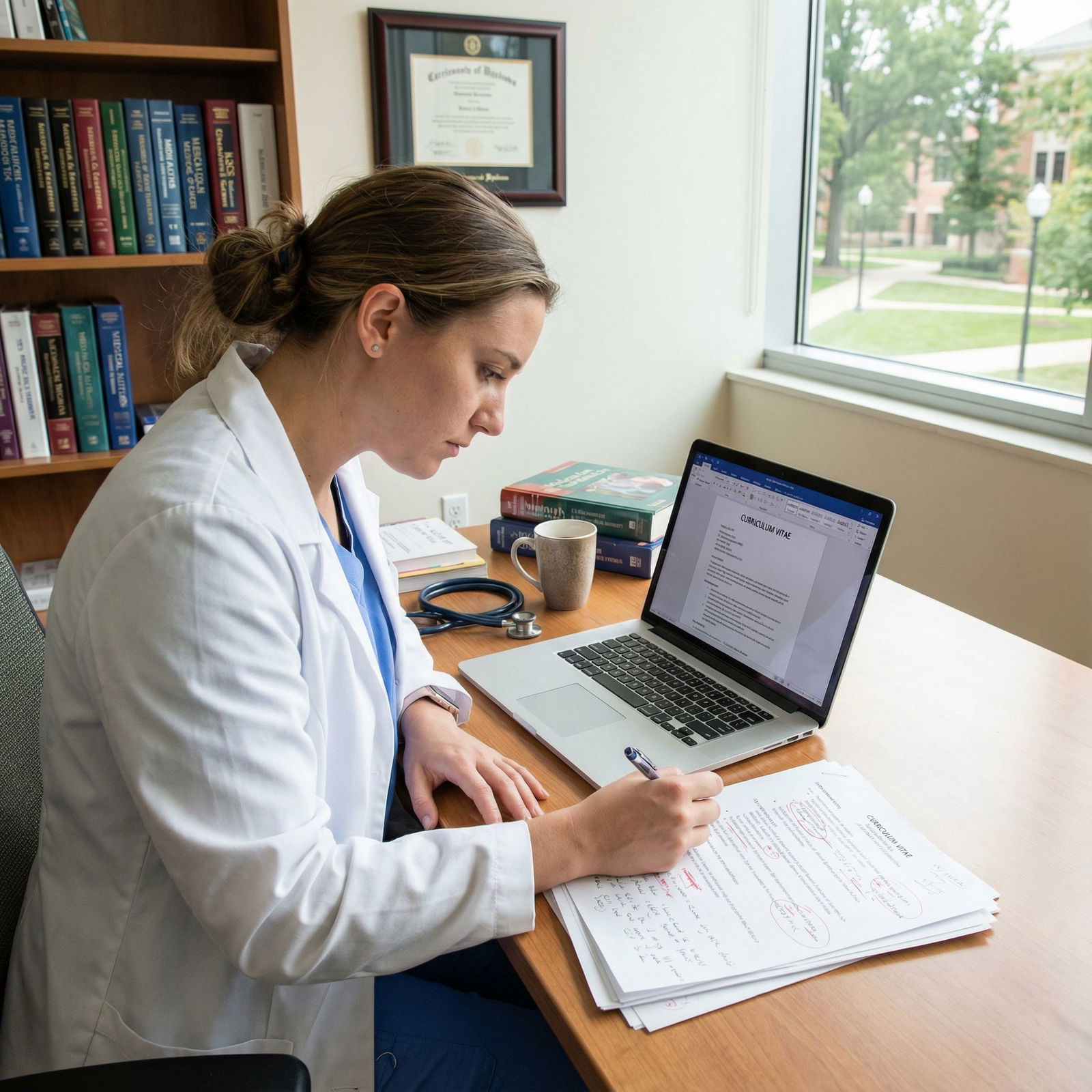
If you're asking that at 11:47 pm with 14 tabs open and your ERAS draft staring back at you, hi. You're me. I've been there. The transfer happened, for whatever reason, and now you're convinced every Program Director is going to see it and think you're flaky, unstable, or you couldn't hack it somewhere else.
Take a breath. Let's talk about what actually happens on the other side of that screen.
So You Changed Paths? The Panic Attack Begins...
First, that panic? Valid. Totally normal. When you transfer mid-med-school, whether it was second year, after step 1, for family, for research, for finances, because the first school was just... wrong, it feels huge. It feels like you're walking into interviews with a giant asterisk on your forehead.
Here's the truth I wish someone had screamed at me sooner: PDs do NOT care as much as you think.
Seriously. They see transfers all the time. Military moves. Spouses matching elsewhere. Students chasing a specific research lab. Schools closing programs. Visa issues. Carribean-to-US transitions. It's common. Not catastrophic.
They're not sitting there thinking, "Oh, this person moved. Reject." They're thinking, "Okay, why'd they move?" That why matters more than the move itself.
A transfer isn't a red flag. It's a plot twist. And PDs read plot twists every day.
What they actually worry about is continuity. Did you still get your core clerkships? Do you have solid clinical grades from somewhere? Did you disappear for 8 months with no explanation? Consistency beats location. Every single time. If your surgery, medicine, peds rotations are all accounted for and your performance is steady, the address on the transcript is just logistics.
How PDs Actually Read Your CV: Decoding the 'Scattered' Myth
Let's kill the biggest lie you're telling yourself: that "scattered" means you changed schools.
Nope.
I watched a PD, Dr. K, at a midwest IM program, flip through 30 CVs in maybe 10 minutes during an advising session I begged my way into. You know what she did? 10-20 seconds per CV. Eyes zipped to: name, med school, grad year, any gaps, specialty focus, publications. Transfer? She barely blinked. She said, "Oh, transferred. Makes sense." And moved on.
You want to know what made her pause and frown? That was "scattered."
Scattered isn't two school names. Scattered is:
- A 6-month gap in 2023 with zero explanation
- Electives in derm, then ortho, then psych, then rads, with no thread
- No research, then three random case reports with different specialties in the last month before ERAS
- A personal statement that says you love primary care but all your LORs are from surgery
That looks scattered. That looks confused. A single, clean transfer line? That's just admin.
And honestly? A bland, generic CV that could belong to anyone is way riskier than a transfer. PDs will forget a bland CV in 5 seconds. They will not forget someone who has a clear reason and a clear direction, even if they moved.
They prefer honesty over perfection. Every time. If you pretend the transfer didn't happen or you try to bury it in tiny font, THAT looks weird. If you're upfront, the noise disappears.
Framing the Transfer: Turning Anxiety into Strategic Narrative
Okay, so how do you actually write it without spiraling? How do you make it bulletproof?
1. Make your education line dumb-proof. Don't do that thing where you list both schools with overlapping dates and people have to do math. Keep it simple:
Education: Doctor of Medicine (MD), [Current School Name], Expected May 2026
Then underneath, if you want: Previous medical education: [Old School Name], 2022-2024. Done. Clean. No confusion.
2. Don't trauma-dump in your personal statement. I wanted to write three paragraphs about why my old school was toxic and how I cried in the parking lot. Bad idea. Just bad.
Use neutral, forward-facing language. I'm talking:
- "Sought an environment with stronger [X clinical exposure / research alignment / community health focus]"
- "Transferred to align training with long-term goal in [specialty] and to be closer to family support system"
- "Transitioned to [Current School] to pursue [specific opportunity]"
You're not lying. You're framing. Complaining about your old school makes PDs worried you'll complain about theirs. Growth mindset > grievance.
3. Turn the bug into a feature. For real. You now have exposure to TWO systems. Two EMRs. Two patient populations. Two teaching styles. That is adaptability. That is breadth. Most applicants have one lens. You have two.
If you can say, "Training at both a tertiary academic center and a community-based hospital gave me perspective on resource use...", that's gold. That's not scattered. That's seasoned.
Here's how PDs actually weigh risks in my experience, not what Reddit says:
See that tiny bar for transfer? That's what you're losing sleep over. The big bars? Those are the things that actually sink applications. Focus your anxiety there.
Filling the Gaps: Proactive Steps to Stabilize Your CV
The worst part after transferring is that weird imposter feeling. Do I belong here? Who will write my letters? Will my MSPE say something shady?
Let's fix what you can control, right now.
Your MSPE / Dean's Letter: Email your student affairs dean this week. Ask, literally, "How will my transfer be documented in my MSPE?" Most schools just state dates and that you are in good standing. Make sure there's no vague language like "disciplinary" or "academic difficulty" if that wasn't the case. Clarity kills rumors before they start.
** Letters of Recommendation:** This is where people spiral. "But my best mentor is at my OLD school!" Great. Keep them. You absolutely can have an LoR from your old institution. In fact, it's powerful if that letter says you were excellent there too. Aim for 2 from your current school, 1 from your old school if the relationship is strong. And get a letter from someone who saw you AFTER the transfer who can speak to your adaptability. "Thrived immediately despite transition" is a sentence PDs love.
** Research:** Don't start over just to start over. If you have a project from your old school, keep it going. Email that PI. Say, "I'm still committed, can we finish this manuscript remotely?" That shows persistence, the opposite of scattered. A line that says "Continued collaboration despite institutional transition" hits different.
** Mentors:** Tell them. Don't let them guess. A quick, "Just wanted to give you a heads up, I transferred to X for family reasons last year. I'm fully committed to [specialty] and excited to be here," shuts down any assumptions. People want to help when they know the story.
The Mental Game: Silencing the Imposter Syndrome
You know the feeling. Everyone in your new cohort has friend groups from first year. They have inside jokes about anatomy lab. You walked in late to the party.
And you're sitting there thinking, "I'm the transfer kid. I'm different. They're going to figure out I don't belong."
I felt that every day for three months. Turns out, so does everyone else for different reasons. The guy with the PhD feels old. The person who took a research year feels behind. The IMG feels like they have to work twice as hard.
Residency applications are holistic. One line about school stability does not outweigh your shelf scores, your Step 2, your clinical evaluations. It just doesn't. Math is math.
What helped me was obsessing over what I could control. I couldn't change where I started. I could control my elective in October. I could control my interview prep. I could control sending thank you notes.
And listen, I've met residents at top programs who transferred. A surgery resident at a big academic center told me she did two years in the Caribbean then transferred to a US MD. Matched general surgery. An EM resident I worked with left his first school because his mom got sick. Matched his #1.
Your brain is lying to you when it says you're the exception who won't make it. You're not.
Final Thoughts: You Are More Than Your Transcripts
So, did you transfer schools? Yes. Will your CV look scattered? Only if you let it.
A transfer is a logistical fact. Not a character judgment. Not proof you give up when things get hard. PDs know life happens. Med school is long. People move.
What overwrites everything? Clarity. Consistency everywhere else. A genuine narrative that makes sense. When you give them a clean timeline, solid clinical performance, and a reason that sounds like an adult making a smart choice, they stop worrying.
Breathe. Trust the process a little. And then go review your CV one more time, not for content, but for clarity. Make it so obvious a tired PD at midnight can get it in 10 seconds.
You've got this. Even if it doesn't feel like it right now.