
Hook: What Program Directors Actually Mean by "Industry Research"
Let me tell you what really happens when your application hits a screening meeting.
Nobody is sitting there delivering a TED Talk about the philosophical value of industry collaboration. A faculty reviewer is flipping through your CV in 15 to 60 seconds and trying to answer one blunt question: is this real scholarly work, or is this padded corporate-adjacent activity dressed up as research?
That's the truth.
And "industry research" is one of the easiest things to misread on a residency CV. I've watched reviewers pause on a line, squint, and say, "Was this an actual study, or did they work for a company?" That moment matters more than applicants realize. If your wording is sloppy, your strongest experience can become a credibility problem.
Here's the first distinction you need to get right: industry-sponsored research, industry employment, and consultant work are not the same thing. A multicenter device outcomes study funded by a company is one category. Being hired as a research assistant or analyst by that company is another. Sitting on an advisory panel or helping build educational slides is something else entirely. Put them all under "Research" and you create confusion fast.
Industry research can absolutely help you. In competitive specialties, especially procedural fields, oncology, cardiology, ortho, neurosurgery, radiology, and anything driven by trials or outcomes, it often signals exposure to real clinical evidence generation. But there's a catch. Faculty are alert to ghostwriting, inflated authorship, vague "contributions," and applicants who use sponsor names to make ordinary work sound elite.
Your job is simple: make your role legible instantly. Show what you did, what came out of it, and why the authorship is believable. No ethics buzzwords. No defensive overexplaining. Just clean, credible structure.
First Truth: Residency CVs Are About Transferable Signals, Not Job Titles
Here's the insider secret students miss: residency committees are not hiring you for your title. They are scanning for transferable academic signals.
They want proof you can function in scholarly medicine. Can you help define a question? Can you execute study tasks without wrecking the workflow? Can you work with data, interpret findings, present results, and survive the grind of a project that takes months instead of posting about it after two afternoons? That's what they care about.
So your CV has to answer three hidden questions fast.
What did you contribute? What was the output? Can we trust the rigor and authorship?
If any one of those is fuzzy, the whole line weakens.
This is why I push a role-forward strategy. Too many applicants lead with the company or the job label: "Clinical Research Intern, X Biotech." Bad move. That reads like employment first and scholarship second. On a residency CV, your research section is not the place to showcase branding. It's the place to showcase intellectual and methodological contribution.
A better structure leads with the study product or scholarly output, then your role, then the setting or sponsor as context. For example: a poster presentation on a multicenter registry, where you performed data cleaning and drafted the methods section, reads as research. "Intern at DeviceCo" reads like summer employment unless the output is unmistakable.
That doesn't mean job titles should disappear. If you were formally employed in an industry role, list it. Just put it in the right section, usually under research experience or work experience depending on the nature of the role. But don't confuse your employer with your scholarly contribution. Those are different signals.
I've seen this go wrong in interviews. An applicant thought they were showcasing sophistication by dropping a recognizable company name. Instead, an attending asked, "What exactly did you publish from that?" Silence. That's how a fancy line turns into dead air.
Your CV should make the answer obvious before anyone has to ask.
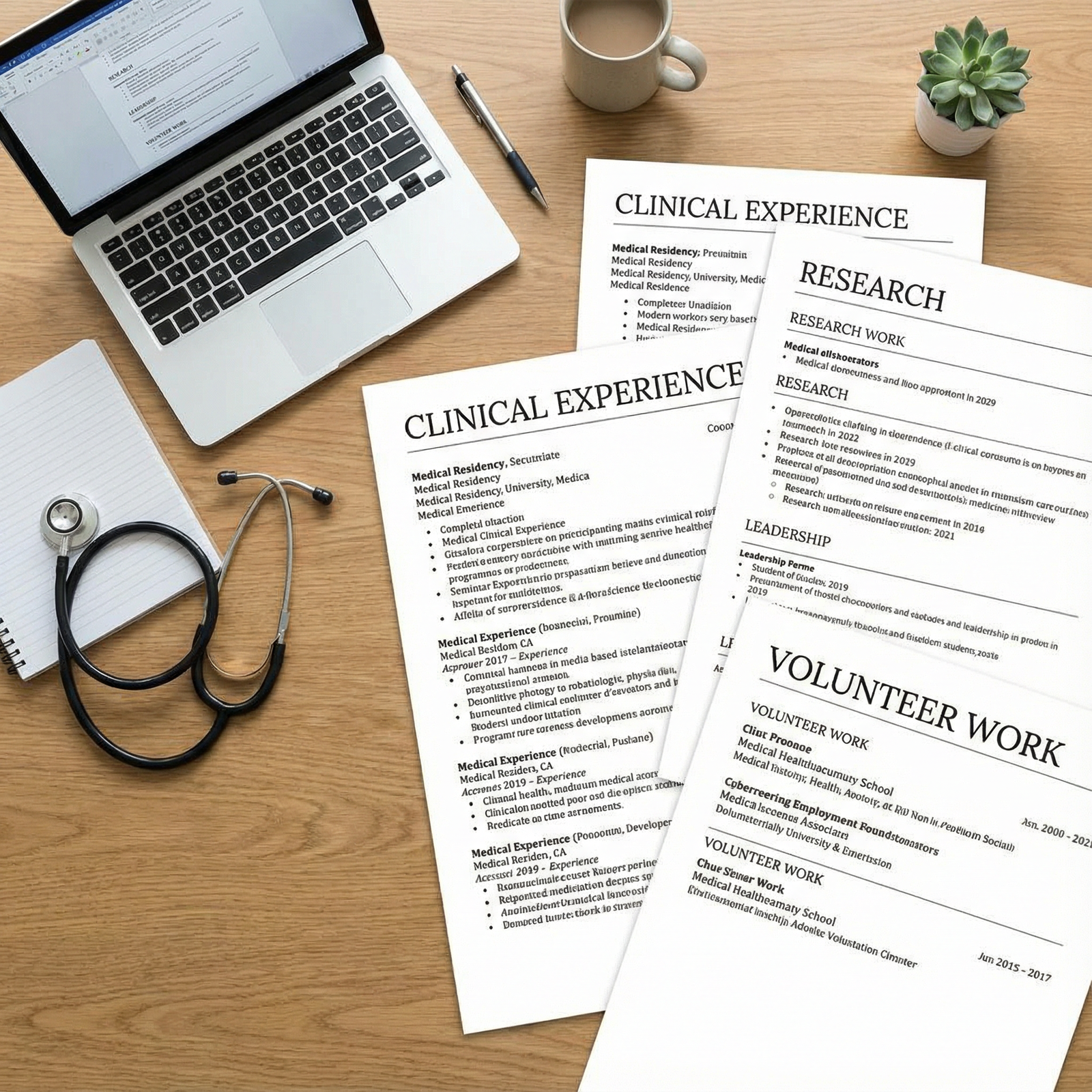
Map the Category: How to Classify Industry Research Correctly
If you don't classify the work correctly, everything downstream gets messy. So here's the taxonomy I wish more applicants used.
A. Industry-sponsored clinical study. This is the cleanest fit for a research section. Think prospective trials, retrospective analyses, device studies, therapeutic studies, or multicenter outcomes work funded by a company. If there's an abstract, poster, manuscript, registry listing, or protocol, good. List it as research.
B. Industry-sponsored registry or real-world data project. Also legitimate research. These often involve observational cohorts, claims analyses, registry outcomes, quality datasets, post-procedural surveillance, or comparative effectiveness work. Faculty understand this category well, especially in procedural specialties.
C. Post-market surveillance or pharmacovigilance. This can count, but only if there's a scholarly product or a clearly methodological contribution. If your role was signal review, adverse event coding, or safety dataset support without any presentation, abstract, methods paper, or public output, it may fit better under work experience than under research.
D. Industry collaboration with an academic investigator. Usually strong. This is where credibility often improves because the project is anchored by a PI, department, or university center. If you worked with Dr. Smith's lab on a sponsor-supported study and contributed to manuscript drafting or analysis, that's much easier for committees to interpret.
E. Literature research or market research. This is where people get themselves into trouble. Competitive landscape summaries, internal evidence decks, sales-adjacent analytics, educational slide development, and market research are usually not residency research. Calling them research makes you look like you don't know the difference between scholarship and business support. Harsh, but true.
And there are things that simply do not belong under research unless they produced a genuine scholarly output: advisory boards, consulting, educational programming, speaker support, commercial training materials. Those may be valid experiences. They just go elsewhere, leadership, service, education, or work experience.
Employment needs its own distinction too. "Research Scientist, MedTech Company" is a role. "Co-author on publication from industry collaboration" is an output. Both can appear on your CV. They should not be merged into one vague line that leaves the reader guessing whether you had authorship, employment, or both.
A compliance point, because this is where applicants get careless: don't imply authorship you don't have, don't include confidential trial details, and don't freelance language if your institution or PI has approved wording for public description. You do not win points for sounding secretive and important. You win points for sounding accurate.
The Listing Template: The Line Structure That Makes You Look Legit (Fast)
Now the part that actually fixes the problem.
Use an outcome-first, role-second format. Not because it's pretty. Because it works under speed-reading conditions.
The basic structure is:
Study or product + publication/presentation status + your role + setting/sponsor + year
That order matters. It tells the reviewer, immediately, that this was scholarship with a tangible output.
A few templates:
Manuscript Patel R, Chen L, You A, et al. Outcomes after minimally invasive valve repair in high-risk patients. J Thorac Cardiovasc Surg. Under review. Contributed to data curation, regression modeling, and manuscript drafting; multicenter study with industry sponsorship, 2025.
Conference abstract "Thirty-day readmissions after peripheral intervention in a prospective registry." Abstract accepted, Society for Vascular Surgery Annual Meeting, 2025. Co-author; performed chart abstraction, baseline table generation, and methods editing. Sponsor-supported multicenter registry.
Poster Poster presentation: Real-world safety outcomes of biologic therapy in refractory IBD. Digestive Disease Week, 2024. Second author; assisted with IRB amendment, data cleaning, and figure preparation in academic-industry collaboration.
Clinical trial registry-linked work Sub-investigator team member, phase II multicenter oncology trial (ClinicalTrials.gov identifier available on request), 2024. Supported screening logs, adverse event documentation, and protocol deviation tracking; contributed to abstract development for interim safety analysis.
Protocol or methods paper Methods publication: Design of a multicenter observational registry for post-market device surveillance. Co-author, 2024. Contributed to protocol refinement, case report form review, and manuscript editing.
Under review Use that phrase only if it is literally under review at a named journal. Not "preparing," not "planned submission," not "manuscript in progress unless the stars align."
Authorship position matters. If you are first author, say it clearly through standard citation order or a parenthetical if needed. If you are middle author, own it. Middle authorship is still real. What looks bad is trying to blur your role so the reader assumes more than you did.
You can add a one-line capability marker when it's truthful and supports your case. Good examples: study design support, REDCap database management, IRB workflow coordination, Kaplan-Meier analysis support, R or STATA data cleaning, figure generation, manuscript drafting. But don't toss in software names like seasoning. If you can't defend that skill in an interview, leave it out.
And keep it tight. One to two bullets per project. No paragraph blocks. No autobiography. Use consistent tense and abbreviations. If one item says "accepted" and another says "in press," make sure you know the difference. Faculty notice these things more than applicants think.
Authorship & Credibility: The Behind-the-Scenes Rules You Must Follow
Here's what actually bothers program directors. Not industry.
Unclear authorship. Fuzzy methodology. Inflated language.
That's what gets people side-eyed.
Ghostwriting suspicion is real. If a CV is heavy on glossy sponsor-linked titles but light on specific contribution, experienced faculty notice immediately. Same if you describe your work with passive mush like "participated in data review" or "involved in manuscript support." That sounds like you were near the project, not inside it.
What passes the smell test? Concrete, ordinary, believable work.
Data abstraction. Screening and enrollment logs. IRB submission or amendment support. Protocol development. Data cleaning. Descriptive statistics or model support. Figure or table generation. Drafting the methods or discussion section. Coordinating multicenter data harmonization.
That language feels real because it is real.
Another credibility marker: if there's a trial number, public abstract, poster title, or publication, use it when appropriate. Not to show off. To anchor the work in something verifiable. Reviewers are much more comfortable with "co-author on accepted AHA abstract from sponsor-supported heart failure registry" than with "conducted groundbreaking cardiovascular research with major company." The second one sounds like nonsense because it usually is.
Sometimes you genuinely can't list every detail. Confidentiality happens. Fine. Then describe your role at the right altitude: "Contributed to data curation and statistical analysis support for a multicenter observational study; findings later presented at [meeting]" is perfectly acceptable. Specific enough to be believable, restrained enough to respect boundaries.
And let's kill a few bad phrases right now. Don't call yourself "primary investigator" unless you truly were. Most students and residents were not. Don't claim ownership over outcomes you can't document. Don't make the company name the most prominent part of the line, because that shifts the emphasis away from the scholarship and toward the sponsor. Wrong signal.
I've seen applicants tank credibility by overplaying trivial roles. A reviewer asked one student about their "lead investigator" title on an industry project. It turned out they mainly handled follow-up calls and spreadsheet cleanup. Useful work? Yes. Lead investigator? Absolutely not. That kind of inflation sticks in faculty memory, and not in a good way.
Where the Sponsor Goes: Company Names, Conflicts, and the "Right Amount" of Detail
Here's the committee psychology nobody says out loud: a sponsor name is not automatically a red flag, but it can become a distraction.
If the company name is the first thing the reader sees in every bullet, your CV starts to feel commercial. That's not what you want. Your contribution should be the headline. The sponsor is context.
Best placement? Usually in parentheses after the study type or at the end of the line. Something like: "Multicenter observational study of post-market device outcomes (industry-sponsored), co-author, 2024." Or: "Poster presentation on registry-based stroke thrombectomy outcomes; data analysis support in collaboration with University X and industry sponsor, 2025."
Notice what happened there. The scholarship stays in front. The sponsor is present, but it doesn't dominate.
If your work was tied to a specific platform, registry, or data network, anchor it to the academic PI or institution whenever you can. "Under Dr. Lee, Division of Cardiology, sponsor-supported registry analysis" lands much better than "Research project with CardioNova Analytics Platform." Faculty trust people more than platforms.
As for conflicts of interest, don't turn your CV into a disclosure statement unless something is already public or institutionally required. You are not writing a journal manuscript. You are presenting your experience accurately. There's a difference between ethical transparency and awkward self-advertising. Don't sound like you're pitching the company. Nobody is impressed.
Publication Status Language: Accepted vs Under Review vs "Submitted"
This section is where applicants get weirdly creative. Stop that.
Use status language you can prove. Accepted, in press, under review, submitted. Those terms mean specific things. They are not vibes.
Accepted means the journal or meeting accepted it. In press means accepted and moving toward publication. Under review means currently being reviewed by a journal. Submitted means sent in, not yet under review or decision unknown.
Do not write "forthcoming," "anticipated," "preparing for submission," or my personal least favorite, "publication pending." That means nothing. It reads like wishful thinking.
From an applicant-value standpoint, accepted and in press carry real weight because they show completion and momentum. Under review is still useful; it signals active work. Submitted is the weakest public status, but it is still acceptable if true and used sparingly. What kills you is stacking half your CV with speculative promises.
Wording examples:
Accepted abstract: Abstract accepted for presentation, American College of Cardiology Scientific Session, 2025.
Under review manuscript: Manuscript under review at Journal of Clinical Oncology, 2025.
Submitted manuscript: Manuscript submitted to Spine Journal, 2025.
Group these consistently. Publications in one section. Abstracts and posters in another if you have enough of them. Research experience separate from publications. Current year first, then prior years. Clean chronology. Clean labels. Sloppy status language makes faculty wonder what else is sloppy.
Add Impact Without Inflating: Outcomes, Methods, and What to Quantify
Here's a mentor move that makes bullets stronger without making them dishonest: quantify only what you actually know.
Good things to quantify include sample size, study design, data source, number of centers, your deliverable, or the type of analysis you supported. "Retrospective cohort of 1,240 patients" is useful if verified. "Generated baseline characteristics table and assisted subgroup analysis" is useful. "Contributed to multicenter chart abstraction across 4 sites" is useful.
What's useless? Fake precision. Guessed sample sizes. Invented endpoints. Quoting p-values you didn't verify. Throwing in "machine learning" because somebody once mentioned a random forest model on a Zoom call.
If you participated in analysis planning but didn't run the statistics, say that. "Assisted in analysis plan development and result interpretation with PI" is honest and respectable. If you contributed to discussion writing after findings were reviewed, say that. It signals intellectual engagement without pretending you built the whole paper yourself.
And if you were not the analyst, you can still sound rigorous. High-quality research depends on process. Data quality checks, abstraction protocol adherence, source verification, reproducibility workflow, and regulatory coordination all count when described correctly. A lot of faculty know exactly how much real work lives in those tasks. The trick is naming them clearly instead of hiding behind vague verbs like "helped."
A Practical Checklist: Your Industry Research Bullet Audit (10 Questions)
Before you send your CV, audit every industry-linked bullet with brutal honesty.
Can a reviewer tell your role in 10 seconds? Is there a public output or clearly named project type? Is the publication status accurate right now, not last month? Is the sponsor detail proportionate, not screaming for attention? Is authorship exactly consistent with reality? Is the method described at an appropriately high level? Have you avoided confidential or proprietary details? Does the wording sound ethical without sounding performative? Does each bullet follow one clean logic line? Does it match the rest of your residency CV formatting?
That's the checklist.
And here's the fastest test I know: hand the CV to a neutral faculty member and ask, "What was my role on this project?" If they can't answer in 10 seconds, the bullet is bad. Revise it until they can.
Most fixes are simple. Add the study design. Reorder the line so output comes first. Replace "assisted" with what you actually did. Remove vague fluff. Standardize dates, citation style, and meeting names. These are not cosmetic details. They are trust signals.
FAQ: Quick Cuts for the Most Common Industry Research CV Problems
Can I list unpublished industry work? Yes, if it's real work and you label it honestly under research experience. Don't pretend it's a publication.
What if the only public trace is a trial registry entry? That's fine. List the study appropriately and describe your role without overstating authorship.
What if I worked for a company but produced no abstract or paper? List it as work or research experience, not as a publication. Be clear that it was employment-based research support.
What about multi-author abstracts where I'm buried in the middle? Still list them if they're legitimate. Middle authorship is normal. Just don't inflate it.
Should I mention IRB or ethics approval? Only if it clarifies your role, like IRB submission support or protocol amendment work. Don't use "ethical compliance" as decoration.
Remember this rule and your CV gets better immediately: lead with the scholarly output, state your real role, and keep the sponsor in the background. That's how you turn industry research from confusing to convincing.