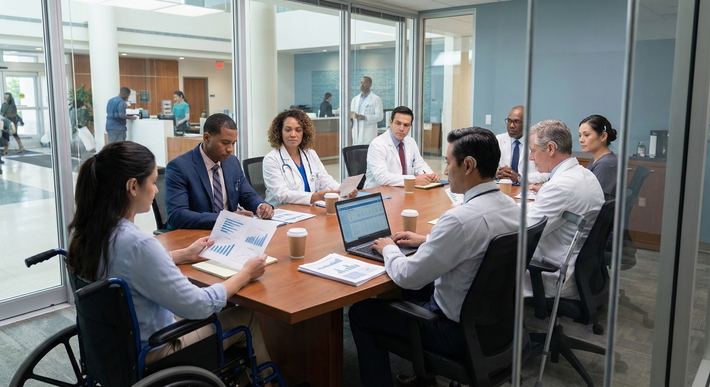
You're staring at the screen. The cursor blinks in the USMLE accommodation request portal. You've known about your ADHD since undergrad, maybe since high school. You've been medicated, in therapy, managing it for years. Now you need extra testing time because the eight-hour marathon of Step 1 is going to fry your executive function halfway through block three.
But then you hear the stories. A classmate with a spinal cord injury got their accommodation approved in three weeks. You submitted your ADHD paperwork four months ago and just got a letter asking for "additional documentation of functional impairment in a testing environment."
Before starting your application, it is essential to understand the unspoken rules of step exam accommodations to avoid common administrative pitfalls.
Same institution. Same application portal. Wildly different outcomes.
This isn't your imagination. And it isn't because the NBME hates you personally. The data shows a real, measurable disparity, and understanding why it exists is the first step toward beating the system instead of being beaten by it.
This article is for educational purposes only. It is not financial advice, not legal advice, and not tax advice. Figures vary by individual circumstances, so consult a qualified professional before acting.
For specific insights into documentation standards, review disability documentation what neuropsych reports must include for boards before submitting your paperwork.
The Reality Check: Why We Need to Look at the USMLE Accommodation Numbers
I've watched dozens of medical students hit this wall. The pattern is so consistent it's almost boring: physical disability accommodations sail through with minimal friction, while mental health and neurodevelopmental conditions get scrutinized, delayed, and denied at rates that would be embarrassing if anyone with power cared.
Here's what we know from publicly available NBME transparency reports and the documentation that emerged from recent legal settlements and regulatory complaints: the approval rates split dramatically along diagnostic lines. Physical and sensory impairments, mobility limitations, visual impairments, hearing loss, get approved at rates exceeding 80% on first application. Psychiatric and neurodevelopmental conditions? Not even close.
The NBME publishes aggregate accommodation data in their annual transparency reports, but they don't break it down by disability category in those documents. The categorical breakdowns come from a combination of Freedom of Information Act requests, data submitted in litigation, and analysis by disability rights organizations that have forced partial disclosures through legal channels. What emerged from the 2022 investigation by a coalition of disability advocacy groups, and from subsequent DOJ involvement, is damning.
The historical perception among medical students, that you're taken more seriously for a broken leg than for a broken prefrontal cortex, isn't paranoia. It's borne out by the numbers. And if you're sitting there with a mental health condition or learning disability wondering whether to even bother applying, the answer is yes, but you'd better understand what you're walking into.
The elephant doesn't just sit in the room. It takes up the whole damn house.
Mental Health vs. Physical Disability: What the Approval Data Actually Shows
Let's break down what the numbers actually say.
Sensory impairments, vision and hearing, lead the pack at roughly 85% initial approval. Physical disabilities requiring mobility accommodations follow close behind at 82%. These include conditions like spinal cord injuries, amputations, and neuromuscular disorders where the functional limitation is visible, measurable, and impossible to dispute.
Then there's a cliff.
ADHD and learning disabilities drop to approximately 58% initial approval. Mood and anxiety disorders plummet to 45%. That means more than half of applicants with depression or anxiety-related accommodation requests get a denial letter on the first round. Let that sink in. You can have documented, medicated, therapy-managed major depressive disorder that's been impairing your function for years, and the NBME's default response is "prove it harder."
The variance isn't subtle. It's a 40-point spread between the top and bottom categories.
Why does this happen? The NBME adjudication process applies different evidentiary standards in practice, even when the written policy claims parity. Physical disabilities come with structural medical evidence, an imaging report, a mobility assessment, a prosthetic specification. These are objective, measurable, and difficult to challenge. The NBME reviewer looks at an X-ray of a fractured spine and thinks "obvious limitation." They look at a neuropsychological report documenting processing speed deficits and think "but how bad is it really during a test?"
Mental health applications face what I call the "prove your suffering" standard. The NBME requests additional documentation at roughly double the rate for psychiatric conditions compared to physical ones. They want to see functional impairment in environments analogous to the testing condition. They want longitudinal history proving this isn't a new diagnosis manufactured to game the exam. They want updated testing, often within the last three to five years, performed by specific types of professionals using specific instruments.
And here's the kicker: they want all of this even when the treating physician has already documented the diagnosis, the treatment history, and the functional impact. The clinical observation of a board-certified psychiatrist apparently carries less weight than an MRI report from a radiologist who's never met the patient.
This is the gap. Not in policy, policy says all disabilities are evaluated equivalently. In practice. In the unwritten standards that reviewers apply when they sit down with your file and decide whether your brain counts as disabled enough.
Why the Gap Exists: Navigating the NBME's Evidentiary Burden
The gap exists because of documentation standards, not malice, not deliberate discrimination (usually), but a system that equates "measurable on a machine" with "real."
A physical disability file is straightforward. You've got a structural medical report. Spinal injury? Here's the MRI. Amputation? Here's the surgical record and prosthetic specification. Visual impairment? Here's the ophthalmologic exam with exact acuity measurements. The NBME reviewer can look at these documents and immediately map the impairment to a specific testing limitation. Can't hold a pen? Obviously needs a scribe. Can't see the screen? Obviously needs magnification.
Mental health and cognitive conditions require a different beast entirely: the comprehensive neuropsychological evaluation. This isn't a doctor's note saying "patient has ADHD." It's a 15-to-30-page document that includes developmental history, educational history, behavioral observations across multiple testing sessions, scores from standardized instruments with age-appropriate norms, and, critically, a functional analysis of how the identified deficits translate to real-world limitations.
And that's where most applications fall apart.
Common pitfall #1: Outdated testing. You got evaluated at age 14. You're now 26. The NBME doesn't care what your adolescent brain looked like. They want current adult norms. I've seen applicants submit evaluations that were eight years old and get denied without the NBME even bothering to request updates. They just said no.
Common pitfall #2: Missing longitudinal history. The NBME wants evidence that this condition has been impairing you over time, not just appeared conveniently before boards. No IEP? No 504 plan? No prior accommodations in undergrad? They'll question whether the diagnosis is legitimate or whether you're just anxious about the exam.
Common pitfall #3: No clear nexus between diagnosis and specific exam barrier. This is the one that sinks the most applications. Your doctor wrote "patient has generalized anxiety disorder, recommend extra time." That's not enough. The NBME wants to know exactly which cognitive functions are impaired, processing speed, working memory, sustained attention, and exactly how that maps to the USMLE testing format. "Anxiety makes testing harder" is not a functional analysis. "Generalized anxiety disorder causes sustained attention deficits measurable on the CPT-3, which impairs the examinee's ability to maintain focus across extended blocks, necessitating extended time and breaks" is a functional analysis.
Here's what most applicants don't understand: the NBME evaluates functional impairment, not diagnosis. They don't care that you have ADHD. They care that your ADHD causes specific, measurable deficits in functions required to take their exam. The gap between mental health and physical disability approval rates exists largely because physical disability documentation inherently demonstrates functional limitation, while mental health documentation often stops at diagnosis and expects the reviewer to make the leap.
Reviewers won't make that leap for you. You have to build the bridge and hand them the map.
If You Are in This Situation: Your Step-by-Step Action Plan to Bridge the Gap
If you're reading this with a mental health or neurodevelopmental diagnosis and a USMLE date on the horizon, here's exactly what you do.
Step 1: Get the Right Evaluation, Before You Submit Anything
Your accommodation is only as strong as your documentation. If you haven't had a comprehensive neuropsychological evaluation within the last three years, get one. Not a screening. Not a brief clinical assessment. A full battery.
Find a licensed psychologist who specializes in adult assessments. Ask specifically whether their testing instruments use adult norms, not pediatric norms extrapolated upward. The WAIS-IV, not the WISC-V. The CPT-3, not the CPT-II. Adult normative data matters because the NBME will reject pediatric-normed scores on the grounds that they don't accurately represent adult cognitive profiles.
Tell the evaluator upfront that this is for high-stakes testing accommodations and that you need a functional analysis, not just a diagnostic report. Give them the NBME's documentation guidelines (available on their website) so they know exactly what's expected. A good evaluator will know this already, but plenty don't, and a report that doesn't address the NBME's specific criteria is a report that's going to get you denied.
Step 2: Build the Longitudinal Paper Trail
If you had accommodations in high school or undergrad, gather every document. IEPs, 504 plans, accommodation letters from your disability services office, pharmacy records showing you've been on medication for years. The NBME wants proof that this isn't a new problem. Give them the timeline.
If you didn't have prior accommodations, and many legitimate cases didn't, especially for students who masked their symptoms through sheer effort, you need a detailed clinical narrative explaining why. "I managed without accommodations because I had supportive teachers who gave me extra time informally, but the USMLE doesn't allow informal accommodations" is a valid explanation. "I never needed accommodations before" sounds like the condition isn't impairing.
Step 3: Frame Everything as Functional Impairment
Every piece of documentation should answer one question: what specifically can't you do during the exam?
Not "I have ADHD." Not "I'm anxious." The answer is: "My processing speed, as measured by the WAIS-IV Processing Speed Index, falls in the 12th percentile, which impairs my ability to complete examination blocks within the standard time constraints, resulting in incomplete responses and elevated error rates in the final 30% of each block."
That's a claim the NBME can evaluate. That's a claim that maps to a specific accommodation (extended time). That's a claim that survives review.
Step 4: If You Get Denied, And You Might, Appeal Immediately
An initial denial for a mental health accommodation is not a final verdict. It's the opening move. The data shows that applicants who appeal with supplemental documentation succeed at substantially higher rates than initial approval rates suggest.
When the denial comes, and read it carefully, it will specify what's missing. It'll say something like "insufficient evidence of functional impairment in a testing environment" or "documentation does not demonstrate that the condition substantially limits a major life activity."
That's your to-do list. Get your evaluator to write a targeted addendum addressing exactly what the NBME said was missing. Don't resubmit the whole package with a new cover letter. Submit a focused supplement that closes the specific gap the NBME identified.
File the appeal within the deadline. Don't wait. The appeal window matters, and missing it means starting over, which costs time you don't have.
Step 5: Consider Legal Support if the Appeal Fails
If you've submitted robust documentation, been denied twice, and you believe the denial is unreasonable, this is where disability rights attorneys enter the picture. The DOJ's involvement in recent cases suggests regulatory interest in NBME practices around mental health accommodations. You don't have to sue, often a letter from an attorney is enough to prompt reconsideration. But know that this option exists and that you're not the first person to need it.
Key Takeaways
- The disparity is real and measurable. Physical and sensory disabilities clear the NBME accommodation hurdle at 80%+ initial approval rates. Mental health and cognitive conditions sit at 45-58%. This isn't your imagination, it's the data.
- The gap is about documentation, not diagnosis. The NBME demands recent, adult-normed neuropsychological testing and explicit functional analysis for mental health conditions. Physical disability documentation inherently provides this. Mental health documentation often doesn't.
- Initial denial is not the end. Applicants who respond to denials with targeted, gap-closing supplemental documentation successfully overturn decisions on appeal at meaningful rates. The system is beatable if you understand its standards.
Frequently Asked Questions
How long does the USMLE accommodation review process take?
Plan for 8-12 weeks from submission to initial decision, longer if the NBME requests additional documentation. Start the process at least six months before your intended test date. I've seen applicants who started three months out get forced to delay their exam because the appeal process ate their remaining time.
What if my neuropsychological evaluation is five years old?
Get a new one. The NBME typically rejects testing older than three years for adult accommodations, and anything using pediatric norms is a nonstarter regardless of age. If you were tested as a minor, you need an adult-normed reevaluation.
Can my psychiatrist write the accommodation letter instead of a psychologist?
A psychiatrist can document a diagnosis and treatment history, but the NBME strongly prefers (and often requires) neuropsychological testing data from a licensed psychologist for cognitive and neurodevelopmental conditions. A psychiatrist's letter alone will almost never suffice for ADHD, learning disabilities, or cognitive processing deficits.
Does getting accommodations show up on my USMLE score report?
No. Your USMLE transcript doesn't indicate whether you received accommodations. The NBME doesn't disclose accommodation status to residency programs. What it does show is your score, and if you needed accommodations and didn't get them, that score may not reflect your actual capability.