
Most neuropsychological reports written for “accommodations” fail board standards—and they fail quietly.
Let me be blunt: what passes for documentation in college or med school almost never satisfies NBME, USMLE, COMLEX, specialty boards, or state licensing boards. I have seen residents with excellent clinical records and genuine disabilities get flat-out denied because the neuropsych report was vague, outdated, or used the wrong language.
If you want accommodations on high‑stakes exams, the neuropsychological report is not a generic clinical write‑up. It is a legal and technical document that must check very specific boxes.
I will walk you through exactly what needs to be in that report—section by section—so that when you hand it to NBME, USMLE, COMLEX, ABIM, ABEM, ABP, or any other board, it reads like it was written by someone who actually understands board requirements.
1. Start With the Reality: Boards Do Not Trust Vague Reports
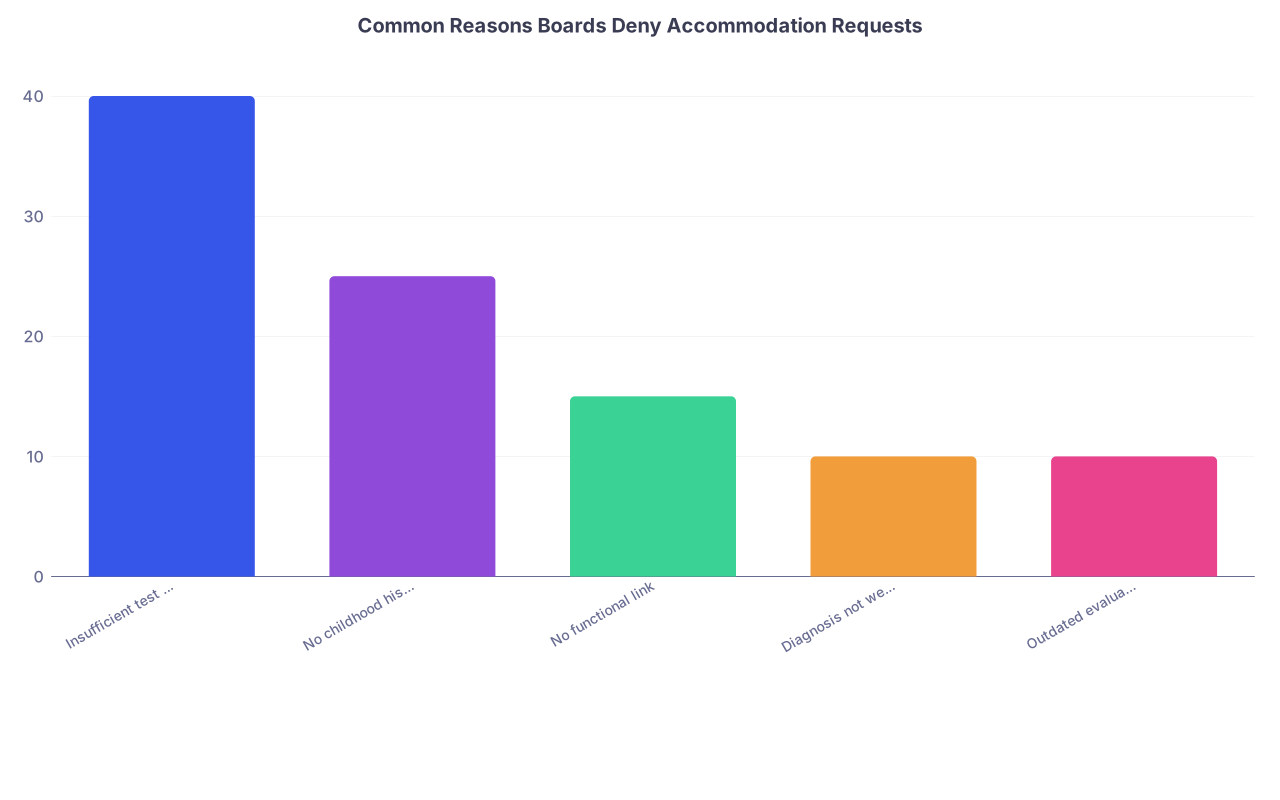
| Category | Value |
|---|---|
| Insufficient test data | 40 |
| No childhood history | 25 |
| No functional link | 15 |
| Diagnosis not well supported | 10 |
| Outdated evaluation | 10 |
Boards are not trying to play “gotcha,” but they are deeply skeptical. Why?
Because they see, over and over:
- A “diagnosis” based mostly on self‑report.
- No objective evidence of functional impairment relative to peers.
- No attempt to rule out alternative explanations (anxiety, burnout, sleep deprivation, language issues).
- Cut-and-paste letters that could apply to any applicant.
They are looking for three things, very specifically:
- A clear, DSM‑based diagnosis, supported by data.
- Objective evidence of substantial functional limitation in tasks relevant to the exam (reading, processing speed, working memory, sustained attention, written output).
- A logical, well-argued connection between the measured deficits and the specific accommodations requested.
If any one of those three is weak, the request is vulnerable.
2. The Non‑Negotiables: Core Elements Every Neuropsych Report Must Include
Let me break down the skeleton of a report that boards will take seriously. If your neuropsychologist cannot or will not include these, you need a different evaluator.
A. Precise Identifying Information
This sounds trivial. Boards deny for sloppier reasons.
The report should clearly list:
- Full legal name (as used with the board).
- Date of birth.
- Date(s) of evaluation and testing.
- Credentials of the examiner: degree, licensure, specialty (clinical psychology vs clinical neuropsychology).
- Location of testing (clinic, university center, hospital).
Boards have actually kicked back documents because the letterhead did not align with licensing information or because the person signing the report was not appropriately licensed in that jurisdiction.
B. Clear Reason for Referral – Tied to a Specific Exam
You need a concrete, exam‑linked referral question. Not a generic “assessment of ADHD.”
Something like:
- “Evaluation of attention and reading speed to determine the presence of ADHD and to inform the need for extended time and separate room accommodations on the USMLE Step 2 CK examination.”
- “Neuropsychological evaluation to assess learning disability in reading and written expression and to determine appropriate accommodations for the ABIM certification exam (computer-based).”
Boards want to see the test context up front: which exam, which format (paper vs computer, timed vs untimed segments, reading vs performance).
3. Developmental, Educational, and Medical History: Not Optional

This is where many reports fall apart. Boards are obsessed with “onset” and “course.”
A. Developmental / Childhood History
For ADHD and learning disorders, boards absolutely expect some evidence that symptoms existed before adulthood. That might include:
- Early developmental delays or normal development.
- Onset and trajectory of academic struggles (e.g., difficulty learning to read, poor spelling).
- Behavior reports: distractibility, hyperactivity, poor organization as a child.
They know not every adult has childhood records. But if there are no childhood records, the report must explicitly address that and describe collateral sources (parent interview, old report cards, anecdotal history).
B. Educational History
This must go beyond “did well in high school.”
You want:
- Type of schools attended (public vs private; any specialized programs).
- Grades, class rank, standardized test performance (SAT, ACT, MCAT, GRE, prior board scores).
- History of special education, resource support, IEP, or 504 Plans.
- Previous documented diagnoses (if any) and earlier evaluations.
Boards are very sensitive to the pattern: high achievement with no prior difficulties, followed by sudden “learning disability” in residency. That does not automatically invalidate a claim, but the report must make sense of it.
C. Accommodation History (Very Important)
You must spell out:
- What accommodations (if any) were provided in:
- K‑12
- College
- Medical school
- Prior board exams (MCAT, USMLE/COMLEX Step 1, NBME subject exams, etc.)
- How those accommodations were used, and perceived impact.
- Written documentation if available (prior letters, IEPs, disability office letters).
Boards like consistency. If you are asking for 50% extra time for Step 2 but never requested or used accommodations for Step 1, they will want a clear, data‑based explanation.
D. Medical and Psychiatric History
This is not a formality. NBME/USMLE/COMLEX want to know:
- Neurological history: head injury, seizures, CNS infections, chemo, toxic exposures.
- Sleep disorders, chronic pain, significant medical conditions that could affect cognition.
- Psychiatric history: depression, anxiety, PTSD, bipolar, substance use.
And, crucially, whether these have been:
- Adequately treated.
- Currently stable versus active and impairing.
The evaluator should differentiate what is likely due to a primary neurodevelopmental condition versus what looks like stress, burnout, depression, or sleep deprivation.
4. Behavioral Observations and Effort/Validity Testing
If this section is weak or missing, boards start doubting everything.
A. Behavioral Observations
At minimum:
- Appearance, affect, engagement.
- Apparent effort and frustration tolerance.
- Signs of anxiety, perfectionism, or under‑motivation.
- Any behaviors that might artificially lower or inflate scores (rushing, frequent breaks, visible fatigue).
Boards are looking for evidence that the evaluator actually watched you work and is not just reciting test scores.
B. Performance Validity and Symptom Validity
This is where a sophisticated neuropsychologist earns their fee.
The report should document:
- Which performance validity tests (PVTs) were administered (e.g., TOMM, WMT, embedded measures in major tests).
- The results of those measures.
- Whether performance across the battery was considered valid.
For psychological/symptom reporting, symptom validity measures (e.g., over‑reporting scales on MMPI‑2‑RF, PAI) should be acknowledged.
Boards are increasingly attuned to response bias. A line like “No measures of effort or validity were administered” in a high‑stakes accommodation evaluation is a red flag.
5. The Test Battery: Not Just “IQ and Achievement”
| Domain | Typical Tests (Examples) |
|---|---|
| Intellectual Ability | WAIS-IV, WISC-V |
| Academic Achievement | WIAT-4, WJ-IV, KTEA-3 |
| Attention/Working Mem | WAIS-IV WM, CPT-3, Digit Span |
| Processing Speed | WAIS-IV PS, TMT-A, Coding |
| Executive Function | D-KEFS, WCST, Trails B, Stroop |
| Learning & Memory | CVLT-3, RAVLT, WMS-IV subtests |
This part must be detailed and transparent. Boards want:
- Names of all tests given.
- Dates of administration.
- Scoring metrics: raw scores, standard scores, percentiles (at least standard scores and percentiles).
- Normative reference: age‑corrected norms appropriate for adults (especially for residents/fellows).
A. Intellectual Functioning
Most boards expect a current, individually administered IQ test:
- WAIS‑IV (or WAIS‑V when available).
- If older than ~3–5 years, some boards may treat it as stale, especially if the functional picture has changed.
The report should discuss:
- Full Scale IQ.
- Index scores (Verbal Comprehension, Perceptual Reasoning, Working Memory, Processing Speed).
- Any significant scatter across indices.
Internal inconsistency—average IQ but markedly low processing speed—often matters more than the overall IQ.
B. Academic Achievement Testing
For learning disorders or speed‑related requests, subject‑specific data are required:
- Word reading accuracy, reading fluency, and reading comprehension.
- Spelling and written expression (possibly timed and untimed).
- Math if relevant.
Timely, adult‑normed achievement testing is especially critical if you are asking for extended time.
C. Attention, Processing Speed, and Executive Function
For ADHD or similar conditions, the board is looking for multiple converging indicators, not one weak score.
Common tools:
- WAIS‑IV Working Memory and Processing Speed Index.
- Trail Making Test (A/B).
- CPT (Continuous Performance Test: CPT‑3, IVA‑2, etc.).
- D‑KEFS subtests (Color‑Word Interference, Verbal Fluency, etc.).
- Stroop‑style interference tasks.
The report should describe both accuracy and speed, and reference normative expectations for similarly educated adults where available.
D. Learning and Memory, Language, Visual‑Spatial
These are not always central for accommodations, but:
- If you have a history of head trauma, CNS disease, or suspected cognitive disorder, they become critical.
- If a “memory problem” is claimed as the primary reason for accommodations, then detailed verbal and visual memory testing with clear deficits is expected.
6. Data Presentation: How the Numbers Must Be Framed
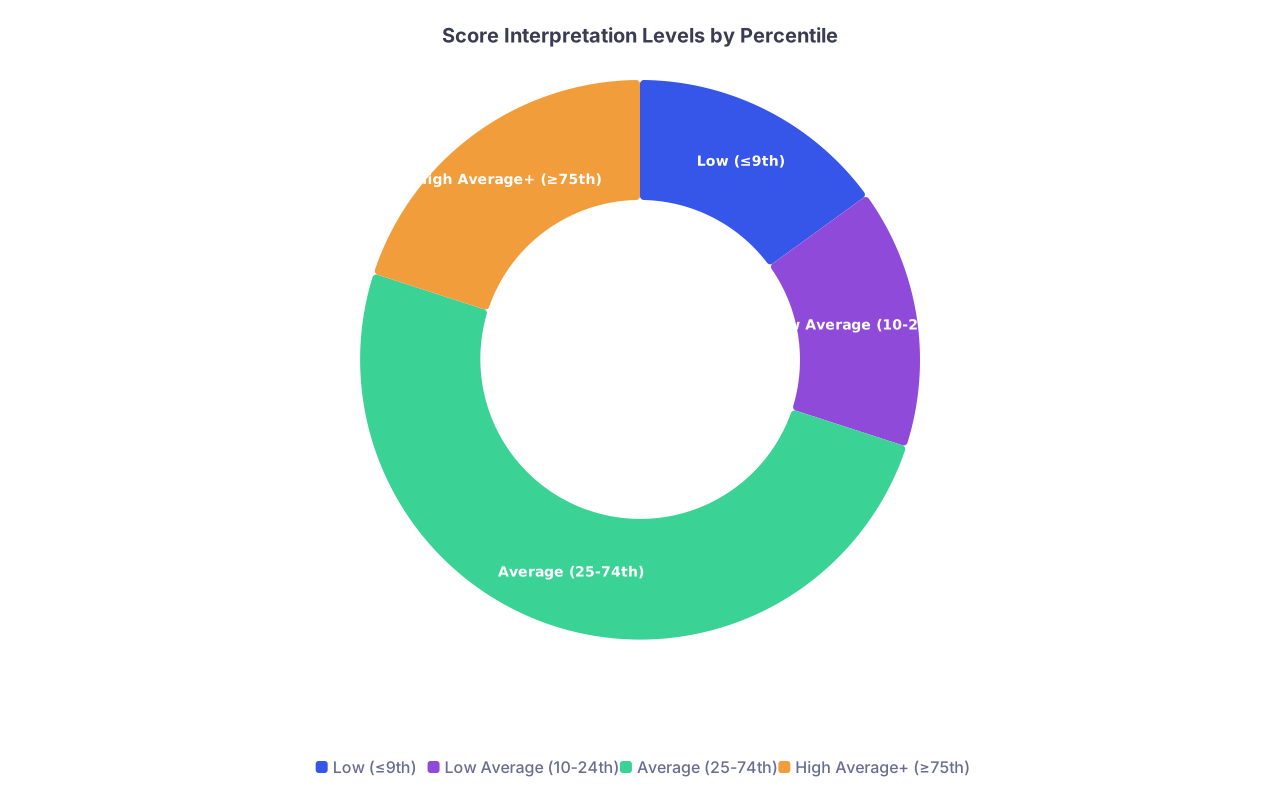
| Category | Value |
|---|---|
| Low (≤9th) | 15 |
| Low Average (10-24th) | 15 |
| Average (25-74th) | 50 |
| High Average+ (≥75th) | 20 |
Boards are not impressed by dumping a score table with no interpretation. They care about:
- Comparison to normative peers (age‑based at minimum; educational level if appropriate).
- Pattern of strengths and weaknesses.
- Magnitude of deviation: is it mild, moderate, or severe?
Your evaluator should:
- Convert scores into clear descriptors with percentiles.
- Explicitly flag scores that are clearly below expected levels for someone of your intellectual ability and educational attainment.
For high‑achieving medical trainees, the key is often relative impairment. A “low average” score (16th percentile) for an individual with otherwise superior abilities may indicate a meaningful functional bottleneck.
The report must say this explicitly, not make the board infer it.
7. Diagnostic Formulation: DSM Language or You Lose

Boards need a clear, explicit, DSM‑based diagnosis. Vague labels like “attentional issues” or “slow processing” are useless.
The diagnostic section should include:
- Full diagnosis (e.g., ADHD, Combined Presentation, moderate; Specific Learning Disorder with impairment in reading, moderate, with impairment in reading fluency).
- DSM‑5 (or ICD) criteria referenced and addressed.
- Consideration of differential diagnoses (e.g., depression, anxiety, sleep, stress).
- Relationship, if any, to medical conditions (e.g., mild neurocognitive disorder due to TBI).
Crucially: the evaluator must link test data and history directly to DSM criteria. Boards read that section line by line.
If there is no diagnosis—for example, “Subclinical attentional difficulties without clear evidence of ADHD”—the evaluator needs to be very careful about recommending accommodations, because boards will treat that as a mismatch.
8. The Critical Bridge: Functional Impact on Board Examinations
This is the section most neuropsychologists underwrite, and it is where approvals are won or lost.
The evaluator must explicitly answer: How do the documented impairments limit this individual’s ability to take the requested exam under standard conditions?
You want:
- Concrete examples: “On timed reading tasks, the examinee performs at the 5th percentile relative to age‑matched peers, requiring significantly more time to accurately process written information. This is likely to manifest as inability to complete all items on a densely text‑based exam such as USMLE Step 2 CK under standard time limits, even with adequate content knowledge.”
- Clear linkage to specific exam demands:
- For Step/Level exams: reading large volumes of vignettes quickly, sustained attention over multiple blocks, rapid switching between question types.
- For oral boards: working memory, verbal fluency, multi‑step problem solving under pressure.
If your request is for extra breaks due to a medical condition, the report should describe:
- Endurance limitations.
- Typical frequency and duration of breaks needed to manage symptoms.
- Effects of symptom exacerbation on cognitive performance.
9. The Ask: Specific, Justified Accommodation Recommendations

| Step | Description |
|---|---|
| Step 1 | Test Data |
| Step 2 | Identified Deficits |
| Step 3 | Functional Limitations |
| Step 4 | Exam Demands |
| Step 5 | Specific Accommodation Request |
This is where many letters read like advocacy, not clinical reasoning. Boards can smell that.
A strong recommendations section does three things:
- Lists each accommodation requested.
- Gives a brief, data‑based justification tying it to measured deficits and exam demands.
- States duration or context (for this exam vs for all future high‑stakes exams).
Examples:
- “50% extended time on all timed, multiple‑choice sections of USMLE Step 2 CK, due to documented significant deficits in reading fluency (4th percentile) and processing speed (7th percentile), which are expected to interfere with completion of the exam under standard time limits, despite otherwise intact comprehension and reasoning abilities.”
- “Use of a separate, reduced‑distraction room for all testing sessions, given demonstrated vulnerability to distractibility and need for external structure that was observed throughout testing, consistent with ADHD, Combined Presentation.”
- “Permission to take 10‑minute breaks every hour throughout testing, related to multiple sclerosis‑related fatigue and need to manage pain and prevent cognitive decline over the course of the multi‑hour exam.”
What boards do not like:
- Vague “may benefit from extra time” with no quantified connection.
- Laundry lists of accommodations with no prioritization or clear rationale.
- Requests that obviously exceed the level of documented impairment.
If you ask for more than the data can justify, boards may deny everything instead of scaling back.
10. Currency and Consistency: Timing Matters More Than You Think
Boards care about when the evaluation was done and whether it fits the current picture.
General patterns:
- For neurodevelopmental conditions (ADHD, learning disorders), boards often accept evaluations up to 3–5 years old, but newer is always safer, especially if there has been academic or functional change.
- For acquired conditions (TBI, stroke, MS, chemotherapy, psychiatric disorders), they usually want recent evaluation—often within 1–2 years or sooner if the condition is evolving.
The report should clearly state:
- “This evaluation was completed in [month/year], approximately X months before the requested exam date.”
- If appropriate: “Symptoms and functional limitations are chronic and stable, and previous difficulties have been consistent across academic settings.”
Also, internal consistency is non‑negotiable:
- History, test data, self‑report, and recommendations all need to tell the same story.
- If no functional impairment is seen on objective measures, the report must explain why accommodations are still justified (and that is a high bar).
11. Who Can Write the Report: Credentials Boards Actually Respect

Technically, different boards have different policies, but there is a pattern.
Most high‑stakes boards expect:
- A licensed psychologist or neuropsychologist with:
- Doctoral degree (PhD or PsyD).
- Specific training in psychological and neuropsychological assessment.
- Sometimes they want explicit neuropsychology expertise if there is a complex neurological history.
What they usually do not accept as the primary evaluation for learning/ADHD:
- A brief note from a psychiatrist with no objective testing.
- A one‑page letter from a primary care physician.
- A student health disability form with minimal narrative.
Those can support the application but cannot substitute for a comprehensive, data‑rich report.
12. Future Direction: Boards Are Getting Stricter, Not Looser
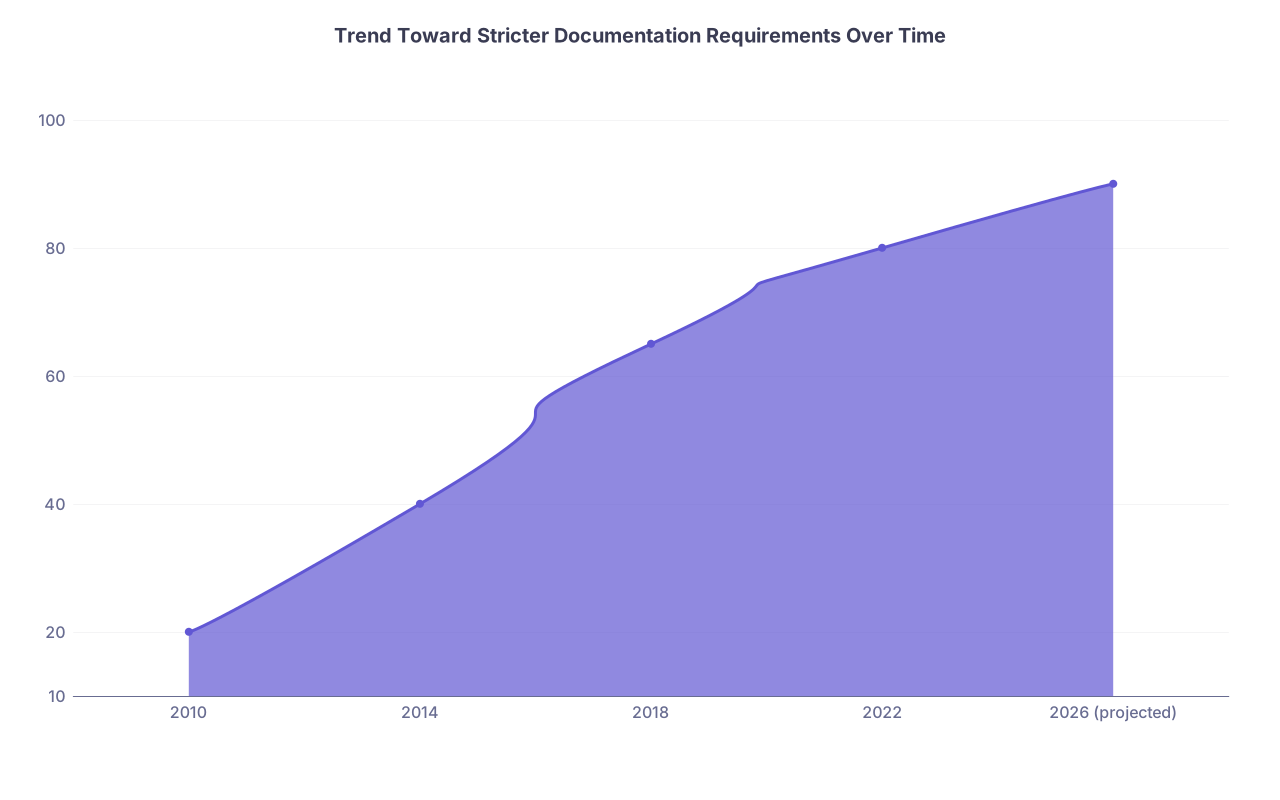
| Category | Value |
|---|---|
| 2010 | 20 |
| 2014 | 40 |
| 2018 | 65 |
| 2022 | 80 |
| 2026 (projected) | 90 |
You are operating in a very different environment than medical trainees 15 years ago.
Boards have:
- More experience distinguishing strong from weak documentation.
- More formalized policies about ADHD, learning disorders, and psychiatric conditions.
- More internal and external legal pressure to be consistent and data‑driven.
Two implications:
- Cookie‑cutter reports will increasingly fail. If your document reads like a generic “accommodation letter” that could apply to any graduate student, expect trouble.
- High‑quality, comprehensive reports will stand out. When the evaluator clearly understands board standards and speaks their language, reviewers are more likely to trust the conclusions.
If you are a trainee, that means you should:
- Plan evaluations well before your exam application deadlines.
- Choose evaluators with specific experience in high‑stakes testing accommodations.
- Ask, directly and politely, whether they are familiar with NBME/USMLE/COMLEX/ABIM documentation standards.
If you are a clinician writing these reports, you need to treat them as medico‑legal documents, not just clinical notes.
FAQs (Exactly 6)
1. How long should a neuropsychological report for board accommodations be?
There is no magic page count, but anything under ~8–10 pages for a full evaluation is usually too thin. Most strong reports I have seen for high‑stakes boards are in the 12–25 page range, depending on complexity. The key is not length for its own sake but adequate detail: full testing list, scores with interpretation, developmental and academic history, DSM‑based diagnosis, and a solid functional analysis tied to specific accommodations.
2. Can I use my college ADHD evaluation for residency board exams?
Sometimes, but it is risky. If your college evaluation was comprehensive, used adult norms, clearly documented ADHD with test data, and you have had stable symptoms, some boards may accept it if it is not too old (often <5 years). However, many boards prefer or require updated evaluation, particularly if your academic demands or functional level have changed (e.g., now in residency). An old, student‑health‑center‑only note with no standardized testing is almost never adequate.
3. Do I really need performance validity tests if I’m not “faking”?
Yes. These tests are not about assuming you are dishonest. They are part of modern, defensible neuropsych practice, especially in high‑stakes contexts. Boards know that performance and symptom validity measures are standard. Their absence signals either outdated practice or an evaluator who does not do much high‑stakes work. Including valid effort data protects you; it shows that your results are trustworthy.
4. If my test scores are mostly “average,” can I still qualify for accommodations?
Possibly, but only if the pattern shows a clear, meaningful relative weakness that functionally impairs you in exam‑relevant tasks. For example, a high‑IQ individual with uniformly high‑average scores except for very low reading fluency or processing speed may still meet criteria for a learning disorder or ADHD‑related impairment. The evaluator must explicitly discuss the discrepancy between your expected level of functioning (given abilities and environment) and your actual performance. If everything is cleanly average with no clear bottlenecks, it is very hard to justify accommodations.
5. How far in advance of my exam should I get evaluated?
Realistically, 6–12 months before your exam window is ideal. That gives you time to: (a) schedule a thorough evaluation (not a rushed, two‑hour screen), (b) receive the full report, (c) submit documentation to the board, and (d) respond to any requests for additional information or appeal if needed. Last‑minute, emergency evaluations often look rushed, skip critical components, and end up producing weak documentation.
6. What are the biggest “deal‑breakers” boards see in neuropsych reports?
The usual killers: no DSM diagnosis; diagnosis based almost entirely on self‑report; no standardized test data or minimal, outdated testing; missing developmental/educational history; no evidence of childhood onset for ADHD/LD; absence of performance validity measures; vague or over‑broad accommodation requests without data‑based justification; and obvious internal inconsistencies (e.g., “severe reading disorder” with a history of stellar timed test performance and no earlier documentation). Any one of these can sink an otherwise legitimate request.
Key takeaways: High‑stakes boards expect neuropsych reports that are comprehensive, DSM‑anchored, and explicitly tied to exam‑relevant functional limitations. Objective data, developmental and educational history, and effort/validity measures are not optional; they form the backbone of credible documentation. And finally, every recommended accommodation must follow logically from the test data and the specific demands of the exam you plan to take.