
The usual advice about ADHD in residency—“get extra time” and “just be more organized”—is lazy and clinically inadequate.
If you are a resident with ADHD, your problem is not time. Your problem is managing cognitive bandwidth in an environment built around interruptions, competing priorities, and endless partial tasks.
Let me break this down specifically.
Residency is an ADHD stress test: constant context switching, paging chaos, EMR friction, fragmented teaching, and a hierarchy that quietly rewards the people who “just remember” everything. Extra time on exams does almost nothing for you at 3 a.m. on night float with 17 active patients and 6 unchecked results.
You need a task management system engineered for ADHD in residency conditions. Not generic productivity nonsense. A system that:
- Offloads memory to external tools in real time
- Survives interruptions and rapid context switching
- Integrates with the EMR and your team’s workflow
- Works when you are tired, overstimulated, and running on pager adrenaline
That is what we will build.
The Actual Problem: ADHD Meets Residency Reality
ADHD in residency is not primarily about intelligence or knowledge. It is about:
- Working memory overload
- Task initiation under fatigue
- Priority sorting when everything “feels” equally urgent or equally boring
- Sticking with boring, multi-step tasks that do not give immediate feedback (discharge summaries, med rec, notes)
- Not losing threads when you are interrupted every 4 minutes
On paper, the job looks linear: pre-round, round, do notes, place orders, follow up results, call consults, discharge.
In reality, your day looks like this:
- Start a note
- Get paged about a new admit
- Walk to ED, get interrupted in the hall by a nurse about a different patient
- Return to workstation, can’t remember what note you were in, EMR has timed out
- While logging back in, attending asks about labs from 2 hours ago that you never actually checked
- You “quickly” check those labs, discover a critical result, start addressing that
- The original note is now 4 cognitive layers deep in your brain and essentially gone
If you have ADHD, that stack of open loops becomes dangerous. Not because you do not care. Because your brain’s unassisted tracking system is lousy under load.
So we build around that.
Principle 1: Externalize Everything, In Real Time
You cannot rely on “I’ll remember that.” You will not. Not reliably. And residency is not built for unreliable.
You need a single, always-open, brain-external inbox for tasks. Not 7. One.
The Non‑Negotiable Core: A Single Task Inbox
I recommend you pick one of these and commit:
- Paper index card or folded sheet in your pocket (“The Card”)
- Small pocket notebook
- Simple, fast digital list: Apple Notes, Google Keep, or a minimalist tasks app (Todoist, Things, Microsoft To Do)
- EMR-integrated note (if your institution allows personal notepads in Epic/Cerner)
Your criteria are more important than the tool:
- Frictionless: You can add a task in 3–5 seconds while someone is still talking to you.
- Ubiquitous: It is physically on you for 90–100% of your shift.
- Legible: You can understand it when your brain is cooked at 3 a.m.
The rule:
If it is not in the EMR as a formal order or in your inbox list, it does not exist.
I mean that literally. A nurse request, an attending comment, an idea for a QI project – if you care about it, you put it in the inbox. Right now. Not “in a minute.” You do this like a reflex.
How to Write Tasks ADHD‑Style
Your task wording matters. Vague = unexecuted.
Bad: “F/U labs”
Better: “JM 712 – BMP & CBC after 14:00”
Bad: “Call cards”
Better: “Call Cards – Mr. Lee 834 – new Afib RVR, HR 140, ask about rate control and CHA₂DS₂-VASc”
You want:
- Patient initials or bed number
- What exactly you are doing
- Any key data you will need (time, value, question)
Your future-self should not have to reconstruct the task from scratch when you are tired.
Principle 2: Build an Interrupt‑Proof Workflow
ADHD and interruptions are a toxic combo. The solution is not “avoid interruptions” (impossible) but to design a restart protocol.
The 3‑Column Minimal Board
You do not need a beautiful Kanban app. You need a structure your brain can latch onto quickly.
Use either a physical index card or a very simple digital layout with three sections:
- NOW
- NEXT
- LATER
At any given time, you should have:
- 1–3 items in NOW
- 3–7 items in NEXT
- Everything else in LATER
This instantly solves one ADHD nightmare: the undifferentiated blob of 27 “urgent” tasks.
How it works during a shift
- Everything incoming goes into Inbox (a scratchpad section or back of the card).
- Every 30–60 minutes, or after rounds, you “promote” tasks from Inbox to NOW/NEXT/LATER.
- When you start a task, you move it explicitly to NOW.
- When you are interrupted, you do this before walking away:
- Write exactly where you left off as a micro-task.
- Move it to NOW (if truly urgent) or NEXT.
Example:
You’re working on a discharge:
- Task in NOW: “Discharge – Ms. R 612 – reconcile meds & print AVS”
Pager goes off: new admit in ED.
You do this:
- Write: “Ms. R 612 – meds reconciled, still need AVS + scripts signed”
- Keep it in NOW.
- Draw a simple star next to it to indicate “mid-task when interrupted”.
When you get back, your brain does not need to reload the entire discharge workflow. You have a re-entry handle.
Principle 3: Time Blocking that Works in a Hospital (Not a Tech Startup)
The classic advice about “time blocking” ignores pages, codes, and attending preferences. But a loose, shift-compatible version works well for ADHD brains.
Think in 90–120 minute blocks, tied to the real structure of your day:
- Pre‑rounding
- Rounds
- “Post‑round block 1”
- “Post‑round block 2”
- Late afternoon wrap‑up
- Night float blocks (e.g., 20:00–22:00, 22:00–00:00, 00:00–03:00, 03:00–06:00)
In each block, you assign a “theme” plus 1–3 high‑yield tasks. Not 12.
Example for a medicine day team:
Post‑round Block 1 (10:30–12:00):
- Theme: Orders + pages + urgent follow‑ups
- NOW: Finish all orders from rounds, address active nurse pages, call 1–2 priority consults
Post‑round Block 2 (13:00–15:00):
- Theme: Notes for sickest patients + discharges
- NOW: 2 most complex notes, 1 discharge fully completed
Late wrap‑up (16:00–18:00):
- Theme: Results + sign‑out prep
- NOW: Check new labs/images on all patients, update sign‑out list with overnight plans
You are no longer “doing all the things all the time.” Your brain gets context.
For ADHD, that context is gold. It reduces the decision fatigue of “what now?” every 3 minutes.
Principle 4: Micro‑Tasks and Activation Energy
The hardest moment for many residents with ADHD is not doing the work. It is starting the work. Especially boring work.
The trick is to break everything into what I call restartable micro‑steps.
Bad task: “Write note”
Good sequence:
- “Mr. H 502 – open yesterday’s note, copy forward template only”
- “Mr. H 502 – update overnight events & vitals”
- “Mr. H 502 – update A/P for CHF, DM, CKD only”
- “Mr. H 502 – finish other problems & sign note”
Yes, this looks excessive. No, it is not. The point is simple:
Each micro‑task should be doable in 2–7 minutes and be easy to restart after an interruption.
You will notice something else: when you name a tiny starting step (“open yesterday’s note”), it often bypasses that mental wall of “ugh, whole note.” ADHD brains respond better to trivial activation steps than to abstract “be productive.”
Same with discharges:
Instead of “Discharge Mrs. L”:
- “Mrs. L 534 – confirm discharge destination & ride with RN”
- “Mrs. L 534 – reconcile meds & schedule follow‑up in clinic”
- “Mrs. L 534 – write discharge summary”
- “Mrs. L 534 – print AVS + go over meds with patient”
Now each time you return to your list, you do not see a towering, vague monster called “discharge.” You see the next 5‑minute chunk.
Principle 5: Use the EMR as a Cognitive Prosthetic, Not an Enemy
Most residents treat the EMR as a burden. If you have ADHD, the EMR can become your external memory if you set it up intentionally.
Templates and SmartPhrases
You should not be “remembering” your differential, work‑up, or management details for common problems every single time. Build them.
Examples:
.sbpneumonia– includes bullets for CURB‑65, cultures, narrow/widen antibiotics, follow‑up imaging plans, discharge criteria.sbDKA– includes stepwise insulin, fluids, electrolyte checks, transition to SQ regimen, patient education points
Why this matters for ADHD:
- You reduce decision fatigue on common cases.
- You prevent the “I know I am forgetting something” loop that keeps you paralyzed.
- You can execute complex steps more reliably when you are cognitively taxed.
EMR Task Views
Most modern EMRs have some version of:
- “My Patients” lists
- Results to review
- Orders placed but not completed
- Flags or sticky notes
Configure them once like a serious tool, not a random feed:
- Create a default “My Team Patients” list that appears on login.
- Turn on notifications/queues for critical results and uncrossmatched orders.
- If allowed, keep a “Personal tasks” or “Scratchpad” note open where you paste things you must not lose (pager numbers, half‑finished thoughts).
Use the EMR and your external list together. EMR is for system‑tracked items (orders, results, notes). The external list is for everything the EMR does not track: “ask attending about holding ACEi,” “double-check code status,” “follow up on neurology recs from yesterday.”
Visualization: How Your Time Actually Goes
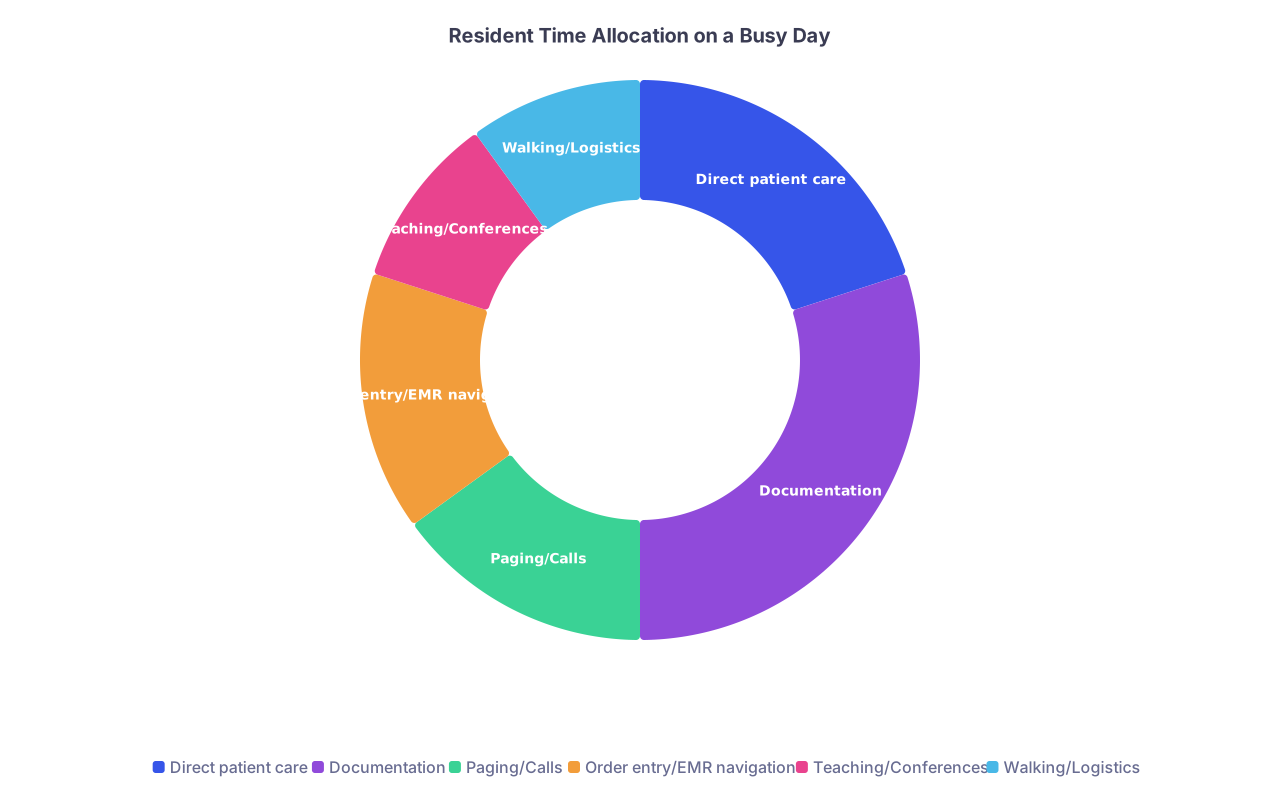
| Category | Value |
|---|---|
| Direct patient care | 20 |
| Documentation | 30 |
| Paging/Calls | 15 |
| Order entry/EMR navigation | 15 |
| Teaching/Conferences | 10 |
| Walking/Logistics | 10 |
If you have ADHD, documentation and EMR navigation tend to expand even further unless you get deliberate. Your task system’s real job is to shrink the overhead of context switching and restarting so that the 30% does not become 50%.
Principle 6: Shift‑End Rituals That Protect Tomorrow‑You
Most residents with ADHD underestimate how much chaos they generate for themselves 12 hours later.
You need a 5–10 minute closure ritual at the end of every shift. Not negotiable. You can do this at your workstation or in the resident room before you leave.
The basic steps:
- Open your task inbox and NOW/NEXT/LATER board.
- Cross off what truly got done. Do not trust your memory.
- For every unfinished item:
- Decide: Will I do this tomorrow? Is it someone else’s job now?
- If cross‑cover or night float will need it, put it explicitly in sign‑out.
- Create a Tomorrow Start List of 3 items. Only 3.
- Example: “1) Ms. T – check morning labs before rounds. 2) Call GI about Mr. Y. 3) Finish Mr. H’s note first block.”
- Put that list somewhere you will see as soon as you log in:
- Top of your note template
- Sticky note on your ID badge
- First item in your digital tasks app labeled “TOMORROW – START HERE”
This is the antidote to the ADHD “spin and scroll” you feel at 6:30 a.m. when you log in and your brain cannot choose what to touch first.
Accommodations Beyond Exams: What You Can Actually Ask For
Extra time on in‑training exams is fine. But your day‑to‑day disability accommodations can be more practical and powerful.
Let me be blunt: many GME offices and PDs have no clue what meaningful ADHD accommodations look like in residency. You will often have to propose concrete options.
Here are examples that are reasonable, defensible, and actually helpful:
| Accommodation Type | Specific Example |
|---|---|
| Structural scheduling | Avoid back-to-back 24h calls when possible |
| Communication format | Complex plans also sent via secure message |
| Workspace adjustments | Quiet workstation during key documentation |
| Teaching expectations | Written follow-up points after feedback |
| Admin tasks | Protected time block for paperwork/EMR work |
Now let’s translate those into real situations.
1. Communication and Task Clarity
Ask for:
- Attendings to summarize multi‑step plans in writing when feasible (e.g., quick message or EMR comment).
- Clear prioritization during rounds: “Top 3 things for each patient this morning.”
Phrase it professionally:
“Because of an attention disorder, I do best when complex, multi‑step plans are captured in writing. Would you be comfortable adding a quick summary in the EMR or by message when we make big plan changes? It helps me ensure accuracy and follow‑through.”
You are not asking for less work. You are asking for reliability in executing the work.
2. Protected Focus Windows
You cannot avoid pages. But you can sometimes negotiate micro‑protected focus for critical tasks.
Examples:
- A 30–45 minute block after rounds where another team member temporarily triages non‑urgent pages so you can finish 1–2 complex notes or discharges.
- During designated “documentation hour” later in the afternoon, your chief helps redirect non‑critical interruptions.
Is this always feasible? No. Is it sometimes feasible, especially on larger teams or in academic centers? Yes.
3. Reasonable Scheduling Adjustments
Some ADHD residents decompensate on certain rotations more than others:
- Chronic sleep deprivation (night float with chaotic day‑night switching)
- Rotations with extreme paging chaos and little structure (e.g., some consult services)
You can sometimes request:
- More predictable call patterns rather than last‑minute switches.
- Avoiding stacking the three most chaotic rotations back‑to‑back.
- Limiting the number of consecutive night shifts beyond the program minimum.
This is where documentation from your treating clinician helps. The request is not “I want an easy schedule.” It is: “I have a documented disability that is significantly impacted by chaotic sleep and extreme unpredictability; these modest adjustments help maintain safe performance levels.”
Principle 7: Collaboration Instead of Quiet Suffering
ADHD gets dangerous in residency when it is hidden and unmanaged. I have watched high‑potential residents spiral into “unreliable” reputations because they tried to white‑knuckle it alone.
You do not have to tell everyone. But you should seriously consider looping in:
- A trusted senior resident or chief
- Your program director (once you have some documentation and a clear ask)
- A therapist or psychiatrist who understands both ADHD and residency
Why? Because systems change when more than one person is looking at the pattern.
Specific Ways to Use Your Team
- Ask a senior: “Watch how I handle sign‑out for two days and tell me where you see dropped threads.” Then fix exactly those.
- During rounds, explicitly say: “If I miss something we talked about, please let me know early—I am using a task system but still dialing it in.” You frame yourself as proactive, not flaky.
- For big projects (QI, research, presentations), always co‑own with someone who has strong follow‑through skills. Not because you cannot do it, but because residency chaos plus ADHD plus solo long‑term projects is a recipe for shame and half‑finished work.
A Concrete Daily System: Putting It All Together
Let me sketch a realistic day for you using everything above. Assume you are an internal medicine PGY‑1 on wards.
Morning
- 06:30 – Log into EMR. Look at Tomorrow Start List from yesterday.
- Transfer these to NOW on your card. Example:
- NOW: “Check AM labs on Ms. T & Mr. H”; “Review overnight events for Ms. R (CHF)”; “Call GI about Mr. Y after rounds.”
- While pre‑rounding, every new task you hear goes into Inbox quickly. Do not categorize yet. Just capture.
Rounds
As attending runs the list, you:
- Capture each patient’s 1–3 top priorities into Inbox.
- Star anything time‑sensitive (e.g., “CT chest before 13:00”).
- Ask clarifying questions when a plan is vague. Your question is not “Why?” but “What exactly needs to be done and by when?”
Post‑Round Block 1 (10:30–12:00)
Quickly sort Inbox into NOW/NEXT/LATER.
NOW: orders, critical labs, time‑sensitive consults.
NEXT: notes for sickest patients, discharges that must go early.
LATER: teaching reading, low‑priority consults, stable chronic issues.
Work through NOW. Each time you are interrupted:
- Write where you left off as a micro‑task.
- Mark it clearly and keep it in NOW.
Midday Reset (12:30–13:00)
Before or after noon conference:
- Cross off completed tasks.
- Promote a few from NEXT to NOW for Block 2 (notes + discharges).
- Move anything truly not happening today into either sign‑out or tomorrow’s mental parking lot.
Afternoon Block (13:00–16:30)
- Block 2: Focus on notes and discharges, using micro‑tasks.
- Keep the NOW list short. If it grows past 3–4 tasks, you are lying to yourself. Re‑prioritize.
Late Wrap‑Up (16:30–18:00)
Check new results.
Update sign‑out with:
- Overnight concerns
- Pending labs / imaging and what to do with results
- New consult recs that came in late
End‑of‑shift ritual:
- Clean up the list.
- Create Tomorrow Start List (3 items).
- Move that to somewhere you will see first thing.
Visual: Minimal Workflow for ADHD Task Management in Residency

| Step | Description |
|---|---|
| Step 1 | Start Shift |
| Step 2 | Review Tomorrow Start List |
| Step 3 | Pre round - capture tasks to Inbox |
| Step 4 | Rounds - add top 3 tasks per patient to Inbox |
| Step 5 | Post round sort - NOW NEXT LATER |
| Step 6 | Work on NOW tasks |
| Step 7 | Write micro step note |
| Step 8 | Finish NOW task |
| Step 9 | Quick review and re sort |
| Step 10 | End of day ritual |
| Step 11 | Create Tomorrow Start List |
| Step 12 | Sign out and leave |
| Step 13 | Interrupted? |
| Step 14 | Block end or 60 min? |
This is all you are doing: capture → sort → execute → restart cleanly → close out.
What About the Emotional Side?
Let us not pretend this is just a systems problem.
Residents with ADHD are often carrying:
- Shame from med school (“lazy,” “disorganized,” “wasted potential”)
- Fear of being labeled incompetent
- Anxiety about missing something and hurting a patient
- Exhaustion from masking and overcompensating
Building a task system will not fix all of that. But it will give you evidence. Concrete, daily proof that you can run a complex service without drowning.
And that matters when you are sitting in a semi‑annual evaluation hearing an attending say, “You are very caring with patients, but sometimes we worry about follow‑through.”
If you can say, “Here is the system I use. Here is how I have improved sign‑out completeness, note timeliness, and follow‑up on labs,” you change the narrative from “flaky” to “deliberate and adaptive.”
The Future: Residency Culture Has to Catch Up
One last point. The hidden reality is that ADHD, autism, anxiety, and depression are common in residency. Programs are only beginning to accept that cognitive diversity exists and that “just be more organized” is not an intervention.
The future of disability accommodations in residency must include:
- Designed workflows that assume interruption and cognitive overload rather than romanticizing “perfect memory”
- Team norms that treat checklists, task boards, and written plans as standard, not “crutches”
- GME offices that understand cognitive accommodations beyond “extra time on the in‑service exam”
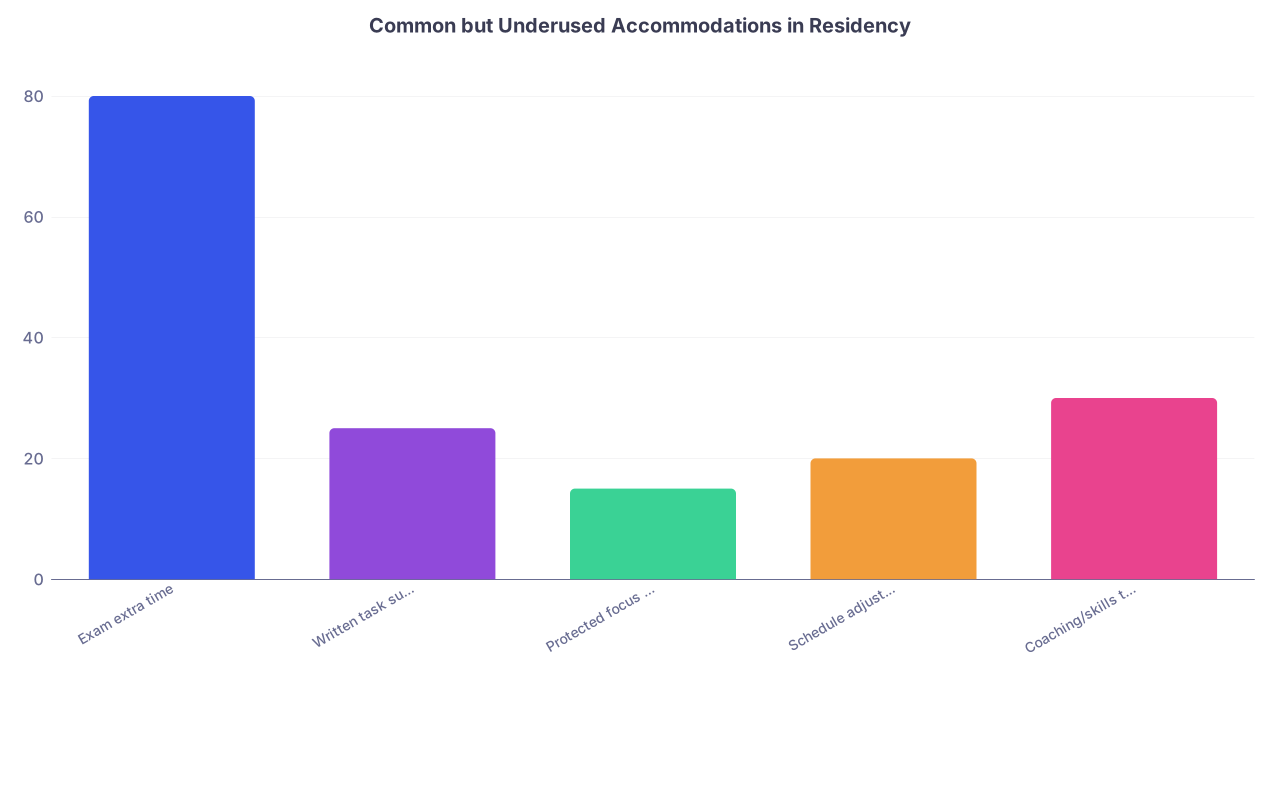
| Category | Value |
|---|---|
| Exam extra time | 80 |
| Written task summaries | 25 |
| Protected focus blocks | 15 |
| Schedule adjustments | 20 |
| Coaching/skills training | 30 |
Right now, extra exam time is common. Real world, workflow‑based accommodations are not. That is backwards.
You, unfortunately, are practicing ahead of the system. But the system will move faster if residents like you survive and succeed—and then redesign it from the inside.
Key Takeaways
- ADHD in residency is not a time problem; it is a task and bandwidth problem in an interruption‑heavy environment. Extra time on exams does almost nothing for your daily work.
- You need a concrete system: one reliable task inbox, a simple NOW/NEXT/LATER board, micro‑tasks, brief time‑themed blocks, and a 5–10 minute end‑of‑shift ritual.
- Real accommodations go beyond testing—ask for clearer written plans, modest scheduling tweaks, protected micro‑focus windows, and use the EMR and your team as deliberate cognitive supports, not ad‑hoc backups.