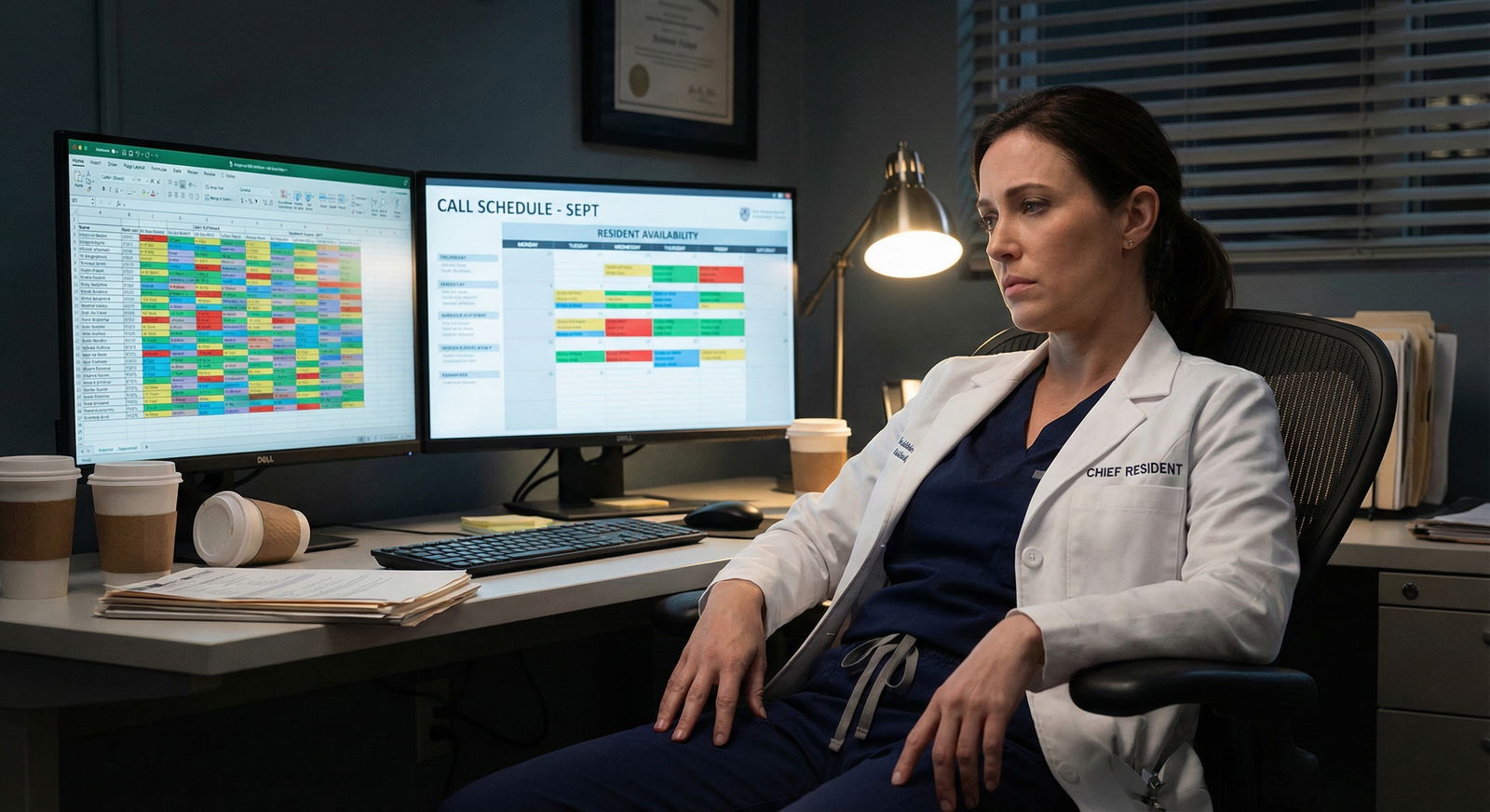
It is 2:17 a.m. on a Tuesday. You are three weeks into an inpatient night float month.
The telemetry alarm just went off again, your blood sugar is crashing because you have not eaten since 7 p.m., and your migraine aura is starting.
And you are thinking one thing very clearly:
“I physically cannot sustain this for an entire residency. But nights are ‘essential,’ right? So does that mean I am just supposed to break myself to prove I belong?”
Let me be blunt: a lot of programs are winging disability accommodations for night float. Badly. They reinvent the wheel, hide behind “patient safety” when what they mean is “schedule convenience,” and tell you that ACGME or the hospital “does not allow” things that are absolutely allowed.
There are, however, models that actually work. I have seen them implemented in large academic centers, safety‑net hospitals, and small community programs. When they work, they are usually:
- Specific
- Written
- Load‑balanced rather than “dumped on the co‑resident who is nice”
- Built into the schedule template, not taped on at the last minute
Let me break this down specifically.
1. The Core Problem: Why Night Float Breaks People
Before you talk accommodations, you need to be very clear about what is disabling about night float for you. Vague language (“nights are hard”) will get you nowhere. Concrete language (“I have a seizure disorder triggered by sleep deprivation and circadian disruption; my neurologist recommends no rotating day–night schedule and consistent sleep–wake times”) changes the conversation.
Common reasons night float is not just “unpleasant” but actually disabling:
- Epilepsy or other seizure disorders triggered by sleep disruption
- Bipolar disorder or major depression destabilized by circadian rhythm disruption
- Severe generalized anxiety or PTSD worsened by isolation + constant pages + high acuity
- Migraine disorders aggravated by overnight work, fluorescent lighting, skipped meals
- Type 1 diabetes where erratic schedule causes dangerous glycemic swings
- Autoimmune conditions (e.g., MS, SLE) where fatigue and sleep deprivation worsen flares
- ADHD or autism where extreme sensory/temporal disruption leads to functional breakdown
- Pregnancy with complications, or conditions like POTS, cardiac disease, etc.
If you are thinking, “That is me, but no one else seems to need this,” you are wrong. You are just early in the honesty curve.
2. Legal and Structural Reality Check: What Is Actually “Essential”?
People love to throw around “essential functions” like it is a trump card. It is not.
Under the ADA (and most state equivalents), the key questions are:
- What are the essential functions of the position?
- Can the resident perform these functions with or without reasonable accommodation?
- Does the requested accommodation pose an undue hardship on the institution or compromise patient safety in a concrete, demonstrable way?
Notice what is not in that list: “we have always done it this way” and “the chiefs say the schedule will be annoying.”
Many institutions define residency “essential functions” broadly:
- Provide inpatient and outpatient care
- Participate in night and weekend coverage appropriate to training level
- Participate in emergencies and cross‑coverage
That wording gives you room to argue how nights are structured, not “I will never work past sunset again.” You rarely win by asking for zero nights, forever, with no trade‑offs. You win by:
- Accepting the core function (providing 24/7 inpatient care)
- Proposing how you can safely and equitably contribute to that function
That is where these models come in.
3. Six Night Float Accommodation Models That Actually Work
We will go model by model. I will give you:
- The structure
- Who it tends to work for
- Pitfalls and how to fix them
- How to phrase it in a formal request
Model 1: Compressed Night Blocks with Extended Recovery
Structure:
Instead of multiple short night runs scattered through the year, you do:
- 1–2 larger night blocks (e.g., 3–4 weeks continuous)
- Strictly enforced post‑night recovery time (e.g., 5–7 consecutive days completely off, or a lighter research/clinic block afterward)
- Avoidance of rapid flip‑flops between days and nights
This keeps your circadian rhythm shifted once, instead of constantly yanking it back and forth.
Who this helps:
- Migraine disorders
- Moderate mood disorders where transition is the trigger
- Type 1 diabetes where frequent schedule changes wreck control
- People with milder sleep‑sensitive conditions who can tolerate one big disruption but not constant micro‑disruptions
Pitfalls:
- Programs tend to “pay” for this by stuffing those compressed blocks with extra high‑intensity nights. That defeats the point.
- Post‑night recovery days get eroded for “urgent” meetings, make‑up clinics, or “just Zoom in, it’s not that hard.” No. Recovery is part of the accommodation.
How to phrase it:
“Because my condition destabilizes with frequent circadian transitions, my physician recommends limiting the number of distinct night transitions per year and ensuring consolidated recovery. I am requesting that my annual night coverage be structured as one or two contiguous night blocks, followed by protected recovery time, rather than multiple scattered shorter runs.”
Model 2: Early‑Evening “Swing” Shifts Instead of Overnight
This is one of the most practical and underused.
Structure:
- You work defined “swing” shifts: e.g., 4 p.m.–11 p.m. or 3 p.m.–11 p.m.
- Cover admissions, cross‑cover calls, and ED evaluations during that high‑volume window.
- Hand off to a true night float resident who works 11 p.m.–7 a.m.
- Across the year, you do more swing shifts and fewer (or zero) full overnights.
You are still materially contributing to nocturnal coverage and patient care. You are just not awake at 3 a.m., which for many conditions is when the wheels come off.
Who this helps:
- Bipolar disorder, recurrent depression, or anxiety where severe decompensation occurs with complete overnight inversion
- Seizure disorders with strong circadian triggers
- Pregnancy (especially later trimesters or high‑risk)
- Autoimmune / chronic fatigue / POTS where 24‑hour wakefulness is unsafe
Pitfalls:
- Co‑residents may initially feel you “do not do nights.” That resentment fades if the swing shifts are clearly defined as hard work (which they are) and scheduling is transparent.
- Attendings/hospital may need minor coverage redesign: e.g., admissions cut‑off time, who cross‑covers what. This is logistics, not theology.
How to phrase it:
“Because of [condition], my physician has advised against full overnight duty, particularly between midnight and 6 a.m., due to documented risks of decompensation. I am requesting that my night responsibilities be fulfilled primarily through evening ‘swing’ shifts (for example, 3 p.m.–11 p.m.), during which I would handle admissions and cross‑coverage, with hand‑off to an overnight resident.”
Model 3: Night Float Credit via ICU / High‑Acuity Daytime Blocks
This one is more “deal‑making” and often used when the program director is sympathetic but worried about fairness.
Structure:
- You do more total weeks of high‑acuity daytime inpatient service (ICU, stepdown, high‑volume admitting services).
- In exchange, you do fewer or no traditional night float blocks.
- From a workload perspective, you are not “getting out of work.” You are just trading nights for days.
Think of it as “redistributing pain in a way that is safe for you.”
Who this helps:
- Residents with absolute contraindication to overnight work (documented seizures, severe decompensation with sleep loss)
- Residents whose conditions are stable on day shifts but collapse with circadian inversion
Pitfalls:
- Programs sometimes overcorrect and give you a martyr schedule: tons of ICU, no lighter rotations. That is not an accommodation; that is a punishment.
- Needs alignment with board / specialty requirements so you still meet exposure requirements without extra nights.
How to phrase it:
“Due to [condition], my treating specialist recommends avoiding circadian inversion and prolonged wakefulness. I can safely fulfill the intensity and educational goals of residency through increased daytime coverage of high‑acuity services (e.g., additional ICU or inpatient ward time) in lieu of night float, provided that this is structured within ACGME and board expectations.”
Model 4: Reduced Frequency + Structured Self‑Protection on Nights
Sometimes you cannot eliminate nights or even fully substitute them. But you can absolutely reshape them.
Structure:
- You take fewer night float blocks than your peers (for example, 2 instead of 4), with your total hours offset by increased day shifts or non‑clinical obligations.
- Within each night block, you get built‑in protections:
- Guaranteed 20–30 minute uninterrupted eating time
- Explicit “no new admissions” cut‑off 1 hour before sign‑out for you
- Defined backup for complex procedures overnight
- No mandated pre‑ or post‑shift meetings outside work‑hour rules
This is very doable in programs that already have some flexibility in night coverage (multiple residents, NP/PA help, etc.).
Who this helps:
- Many chronic illnesses that are more about “total burden” than an absolute prohibition
- Residents with ADHD, anxiety, or autism where reducing chaos and decision load is the difference between functional and overloaded
- Residents early in treatment where some nights are feasible but heavy exposure is not yet safe
Pitfalls:
- Vague “we will try to make sure you get a break” language. That turns into nothing under pressure. Needs to be written: “Resident X will have no new admissions from 6:30–7:30 a.m.”
- Needs coverage design so that co‑residents are not just inheriting unlimited extra burden. For example, you pick up extra short calls on days to compensate.
How to phrase it:
“I can safely perform some night float, but my physician recommends limiting frequency and ensuring predictable access to food, rest, and reduced last‑hour decision load. I am requesting a modified night assignment pattern with fewer total night blocks, offset by increased daytime service, and the following structured protections during those blocks: [specifics].”
Model 5: Team‑Based Night Coverage with Role Differentiation
This is closer to a structural redesign and works best at larger programs.
Structure:
Night coverage is reframed from “one person does everything” to a small team where:
- One resident (you) focuses on:
- Admissions
- Documentation
- Communication with ED, consultants, families
- Cross‑cover on lower‑acuity issues
- Another resident focuses on:
- Rapid responses / codes
- Physically demanding tasks
- “Run around the hospital” tasks
- A nocturnist or in‑house attending supervises.
Your accommodation is not “no nights.” It is “no high‑intensity activation without backup” or “no prolonged standing/rapid floor‑to‑floor travel” or “no more than X new patients per shift.”
Who this helps:
- Residents with mobility limitations, POTS, or cardiopulmonary disease
- Residents with PTSD triggered by codes/trauma situations
- Residents with neurologic conditions where extreme physical exertion is dangerous
Pitfalls:
- Needs clear task delineation so you do not get sucked into all the codes because “you were closer.”
- Program must acknowledge that you are still carrying meaningful cognitive load; the accommodation is physical or sensory, not about workload laziness.
How to phrase it:
“Because of [condition], I need to avoid [specific task/trigger] but can safely perform the cognitive and communication functions of night coverage. I am requesting a team‑based night coverage structure where I focus on admissions, documentation, and cross‑cover calls, while another team member responds as primary to rapid responses, codes, and physically demanding tasks.”
Model 6: Full Exemption from Nights With Structured Trade‑Offs
This is the heavy‑lift option. It is sometimes the correct one. But it needs to be very cleanly argued.
Structure:
- You do no overnight in‑house call/night float.
- You still:
- Participate in evening admissions, late stays, and possibly home call (if safe)
- Take on non‑night burdens: extra continuity clinic, QI projects, committee work, teaching, or daytime admissions
- Program adjusts schedules so your “burden” is different, not zero.
This exists. I have seen it granted for residents with severe epilepsy, for pregnant residents with critical complications, and for a resident with a catastrophic sleep disorder with documented near‑miss safety events on nights.
Who this helps:
- Severe, well‑documented conditions with clear medical opinion that any overnight work is unsafe
- Residents who have already had serious adverse events linked to nights (e.g., seizure at work, psychiatric hospitalization immediately post‑night block)
Pitfalls:
- Program leadership fear: “If we do this once, everyone will ask.” The answer is: No, they will not, because most residents do not want the trade‑offs. But leadership needs to see enforceable criteria.
- Must be vetted and ideally supported by GME/HR/Legal. This is not something you “handshake” with a chief.
How to phrase it:
“My treating specialist has documented that overnight in‑house work poses a significant and unacceptable risk of [specific harm] to myself and potentially to patients. I am requesting exemption from overnight in‑house call and night float. I am willing to assume additional daytime service, evening admissions, and other responsibilities to ensure I meet educational requirements and equitably contribute to the program’s workload.”
4. How Programs Can Actually Implement This Without Collapsing
Most of the resistance I have seen is not malicious. It is poor systems thinking. Chiefs stare at an Excel call grid and panic.
You can help them by making the solution legible.

| Step | Description |
|---|---|
| Step 1 | Resident identifies need |
| Step 2 | Discuss with treating clinician |
| Step 3 | Request meeting with PD and GME |
| Step 4 | Define essential functions |
| Step 5 | Propose specific model |
| Step 6 | Schedule redesign by chiefs |
| Step 7 | Written accommodation plan |
| Step 8 | Monitor impact and adjust |
Key elements that make accommodations sustainable:
Scheduling transparency
The worst approach is “secret” deals. That breeds resentment and rumors. Better:- Everyone sees the schedule shape (X does swings instead of nights)
- They may not see the medical details, but the pattern is not hidden.
Load balancing
You are not getting out of work; you are swapping work. Programs should decide:- If you do fewer nights, where do you compensate?
- If co‑residents take an extra night or two, what do they get in return? Days off? Less clinic?
Built‑in check‑points
Written accommodation letters should have review points:- “We will review after 6 months to ensure this is workable for you and the service.”
That reassures leadership this is not “forever no matter what,” but also protects you from unilateral rollbacks.
- “We will review after 6 months to ensure this is workable for you and the service.”
Using advanced practice providers and nocturnists
Many hospitals already have NP/PA night coverage or nocturnists. Integrate them into the model:- They can absorb some high‑intensity tasks
- They provide backup for you when a night goes sideways
Data tracking
Show that things are not imploding. Simple metrics:- Admission numbers per resident per night
- Code response times
- Housestaff duty hour compliance
Often the data prove what I already know: restructuring nights for one resident does not crash the system.
5. Practical Templates and Comparisons
Programs love tables and examples. So do lawyers.
| Model | Nights Done? | Typical Trade-Offs |
|---|---|---|
| Compressed night blocks | Yes, standard | Extra recovery days |
| Swing shifts instead of overnights | Partial nights | More evenings, fewer weekends |
| ICU/daytime high-acuity substitute | None or fewer | Extra ICU / ward weeks |
| Reduced frequency + protections | Fewer | More daytime service |
| Team-based with role differentiation | Yes, modified | Colleague handles codes/rapid |
| Full exemption | None | Extra clinic, QI, teaching load |
And just so this does not stay abstract, here is one pattern I have personally seen work in an internal medicine program of ~30 residents.
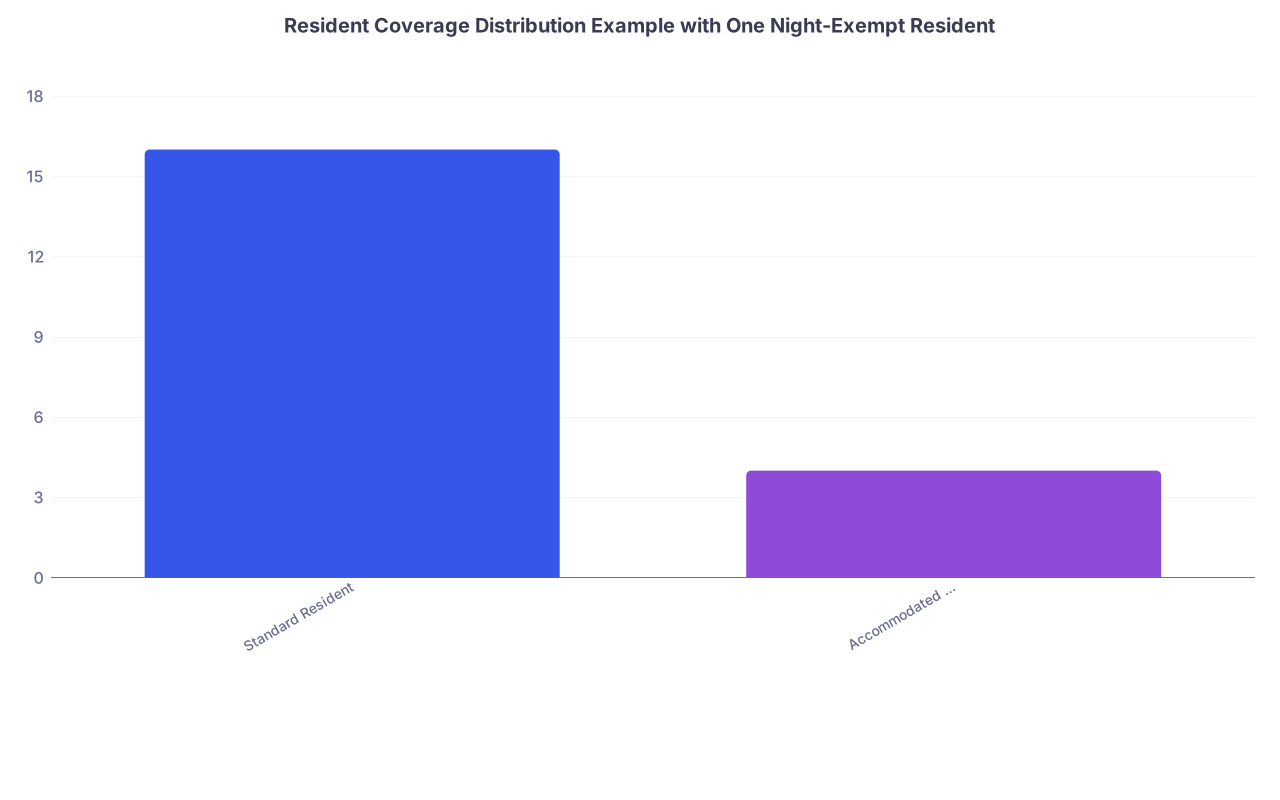
| Category | Value |
|---|---|
| Standard Resident | 16 |
| Accommodated Resident | 4 |
In that system:
- Standard resident: 16 total night shifts/year
- Accommodated resident: 4 evening “swing” shifts + 0 overnights
- The difference (12 shifts) was redistributed as:
- 4 shifts absorbed by nocturnist expansion
- 8 shifts distributed as 1 extra night each among 8 residents, with each of those residents getting 1 less clinic half‑day per month as compensation
Nobody loved it. Nobody died. It worked.
6. How to Actually Request This Without Getting Steamrolled
You cannot just show up to a PD’s office and say, “Nights are hard, I need help.” That gets you sympathy, not structure.
Step 1: Get a clean supporting letter
Ask your treating clinician for something specific. You want:
- Diagnosis (or at least category if you want partial privacy: “neurologic condition,” “mood disorder”)
- Specific restrictions:
- “Avoid overnight work between midnight and 6 a.m.”
- “Avoid rotating between day and night more than twice per year.”
- “Must have opportunity for regular meals and brief rest during overnight shifts.”
- Whether restriction is time‑limited or enduring
Vague statements like “resident would benefit from reduced stress” are useless.
Step 2: Draft your own proposed model
Do not make them invent it. You propose. Something like:
- “To operationalize these restrictions, I propose converting my night float requirements into [Model X]…”
- Include specifics: number of weeks, types of shifts, what you are willing to take on instead.
Step 3: Meet with PD + GME/HR as needed
Be calm and extremely concrete. No complaining about how much residency sucks. Everyone knows that. You are there to talk risk and solutions.
Language you can use:
- “I want to meet the same educational goals as my peers.”
- “I am not asking to work less overall, but to work differently so I can remain safe and effective.”
- “Here is how I see the essential functions being met under this model.”

| Step | Description |
|---|---|
| Step 1 | Present medical letter |
| Step 2 | Explain functional limits |
| Step 3 | Propose specific schedule model |
| Step 4 | Discuss service coverage impact |
| Step 5 | Revise details collaboratively |
| Step 6 | Formalize in accommodation letter |
Step 4: Get it in writing
You want a written accommodation letter or email that includes:
- The core elements of your night modification
- Any trade‑offs (extra clinics, extra ICU weeks, etc.)
- The timeframe and review plan
Verbal agreements during a stressful meeting have a half‑life of about two chief cycles.
7. Addressing the “Fairness” and “Culture” Pushback
You will hear versions of:
- “Everyone is tired on nights.”
- “If we let you do this, what do we say to others?”
- “It will look like you are not pulling your weight.”
Let me be direct: these are emotional arguments dressed up as policy concerns.
Your response should stay factual and calm.
On “everyone is tired”:
“I understand everyone is tired. In my case, my physician has documented objective safety and health risks tied specifically to circadian disruption. The accommodation is to allow me to perform at a safe baseline, not to avoid normal discomfort.”
On “slippery slope”:
“The ADA and institutional policy already require individualized assessment. Other residents who have a documented disability and similar risk profile can and should ask for accommodations too. That is not a bug; that is the legal standard.”
On “pulling your weight”:
“I am fully committed to carrying an equitable workload. My proposal includes [extra clinics/ICU/QI] to offset any reduction in night shifts. The total effort is comparable; the structure is different to maintain safety.”
You do not need to win hearts and minds; you need a functional agreement that meets policy and keeps you intact.
8. Future Directions: Better Night Systems for Everyone
A last point. The “future of medicine” piece here is not just about disability; it is about admitting that our night systems are archaic.
Some directions that are already starting to appear:
- Resident–nocturnist hybrid models where residents do swing/early‑night, nocturnists carry deep‑night load.
- Predictable, block‑based schedules that cut down on constant day‑night flip‑flopping.
- Formal “fit testing” for night work the way we fit test for N95s. If someone repeatedly destabilizes on nights, that should trigger a formal review, not just “toughen up.”
- Tech‑assisted handoffs and cross‑cover tools that reduce the cognitive overload of 3 a.m. cross‑cover.
At some point, we will stop pretending that a 27‑hour continuous duty or 6 nights of code coverage in a row is a marker of dedication instead of a safety hazard. We are not there yet. But the accommodations you fight for now often become, a few years later, “optional flexibility” for everyone.
With that, let us look ahead. Once you have a written, working accommodation for nights, the next steps are about long‑term strategy: choosing electives that fit your energy profile, planning for boards without crashing on ICU, and eventually negotiating attending jobs that respect the same boundaries. That is the next phase of this story. But for now, getting nights under control is the piece that keeps you in the game.
FAQ (Exactly 4 Questions)
1. Can a residency program legally say that night float is an essential function and refuse any modification?
They can say that some form of 24‑hour inpatient care participation is essential. That does not automatically make traditional night float an untouchable sacred cow. Under the ADA, they have to consider whether you can perform the essential functions with a reasonable accommodation. That might mean swing shifts, extra ICU days instead of nights, or team‑based nights. A flat refusal with no individualized assessment is usually not compliant. The exception is when they can show concrete, program‑wide undue hardship or genuine patient safety risk that cannot be mitigated.
2. Will asking for night accommodations hurt my fellowship chances or reputation?
It can, if handled clumsily and informally. If it is formalized through GME/HR with a clear accommodations letter, most program directors are surprisingly pragmatic when they write letters: they focus on your clinical ability, not your schedule structure. You can also control what you disclose to fellowship programs. Many residents go through training with modified nights and still match into competitive fellowships, because they performed well on service, on exams, and in research. Quiet suffering rarely impresses anyone; high‑quality, sustainable performance does.
3. What if my PD is sympathetic but the chiefs say the schedule cannot handle it?
That is where you get specific. Do not accept “cannot” as a complete sentence. Ask:
“What would need to change for this to be possible?”
Then propose concrete options: expanding swing shifts, adding one nocturnist shift, redistributing a few nights to residents with compensated days off. Chiefs are schedule optimizers, not policy makers; if PD and GME endorse your accommodation, the chiefs’ job is to operationalize, not veto. Sometimes you will need GME or HR to remind everyone that legal obligations do not evaporate because the Excel sheet looks messy.
4. Do I need to disclose my exact diagnosis to get a night float accommodation?
No. You need to document functional limitations, not necessarily the full diagnostic label, though some clinicians choose to include it. A letter that says “Because of a neurologic condition, this resident must avoid overnight in‑house work due to risk of seizure” is usually enough. You can also ask HR or disability services how much detail is required in your institution. The PD does not need your entire mental health history; they need clear, medically supported boundaries they can build a schedule around.