Most applicants get disability wrong in interviews—and programs remember it.
If you are a disabled applicant, you cannot afford sloppy answers, vague stories, or trying to “wing it.” Residency interviews amplify every insecurity you have about your health, stamina, or accommodations. Program directors have long memories. And they absolutely talk about what you say behind closed doors.
This is not about selling an inspirational story. It is about not sabotaging yourself.
Let me walk you through the most common mistakes I have seen applicants make when talking about disability during residency interviews—and how to avoid them without oversharing, overpromising, or undermining your own rights.
Mistake #1: Turning Your Disability Into A Confessional
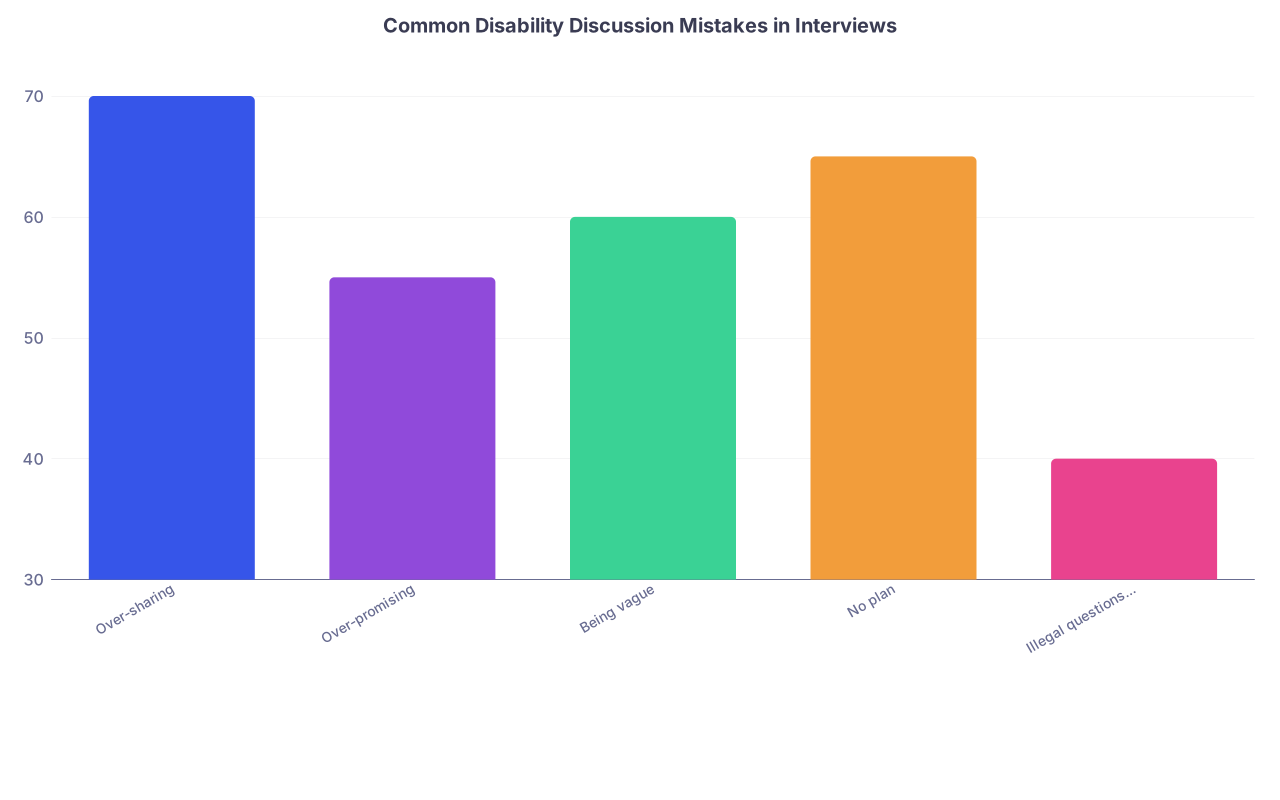
| Category | Value |
|---|---|
| Over-sharing | 70 |
| Over-promising | 55 |
| Being vague | 60 |
| No plan | 65 |
| Illegal questions mishandled | 40 |
The interview is not group therapy. It is not a late-night call with your best friend. The first big mistake: framing your disability as a long, emotional confession.
You have probably seen it:
- The applicant launches into a ten‑minute monologue about their medical journey.
- The story jumps from diagnosis, to family trauma, to past discrimination.
- Somewhere in there, they forget to explain what they can do now—and what a typical day looks like when things are going well.
Programs are not evaluating whether your story is moving. They are evaluating one thing: “Can this person safely and reliably perform the essential functions of this residency with or without reasonable accommodations?”
When you overshare, several bad things happen:
You invite irrelevant judgment.
Once you start describing every medication change, every hospitalization, every flare, you give people mental images they will not forget. They should not use that against you, but humans are human. They worry.You bury the practical facts.
PDs need to know how your disability interfaces with work. Not the details of your last MRI, but whether you can take overnight calls, manage a census, perform procedures, or handle clinic volume—with whatever legal accommodations you are entitled to.You sound like the disability is running the show.
When the only clear throughline is “this has been really hard,” you risk sounding fragile, overwhelmed, or barely hanging on. That may be accurate at your worst moments. It should not be your primary professional narrative.
How to avoid this mistake:
Think “professional summary,” not “memoir.”
When you mention your disability (if you choose to), keep it scoped:
- Name it briefly or describe its functional impact: “I have a chronic autoimmune condition that affects my energy and joint pain.”
- State your current level of control: “It has been well‑controlled for the past three years with a stable treatment regimen.”
- Anchor to function and reliability: “With specific scheduling accommodations, I have consistently met all clinical responsibilities during clerkships and sub‑I.”
Two to three sentences. Clear, factual, unemotional. Then pivot to what you have done, not everything you have been through.
Mistake #2: Pretending You Have No Limitations
The opposite error is just as dangerous: playing superhero.
A lot of disabled applicants get spooked by the idea of being “screened out,” so they swing to the other extreme: “I have no limitations at all. I can do anything anyone else can do. I do not need any accommodations. Ever.”
This sounds strong. It is not. It is reckless.
Here is what goes wrong when you do this:
You undermine your credibility.
If your disability is obvious (visible mobility aid, speech difference, tremor) and you insist you have zero limitations, people quietly stop believing you. They start waiting for the inconsistencies to pop up.You box yourself out of future accommodations.
Programs may remember: “They told us they did not need anything.” When you later request reasonable changes, some PDs will feel blindsided or misled, even if that feeling is unfair.You increase the risk of unsafe situations.
If you have real triggers, physical limits, or predictable fatigue patterns, refusing to acknowledge them in any form sets you up for failure. The system will not protect you from a problem you insist does not exist.
Balanced alternative:
You do not need to hand them a list of every limitation you have ever had. But you should not build your entire interview persona on denial.
A better frame sounds like this:
“I have a chronic neurologic condition that can affect my balance. With the adaptations I already use—like a forearm crutch for long distances and planning my schedule to avoid back‑to‑back late nights—I have completed all clerkships, including surgery and inpatient rotations, without any missed days or restrictions.”
This does three things:
- Acknowledges reality without dramatics.
- Demonstrates you understand your own needs.
- Shows that what you are doing works.
The worst thing you can do is insist you are invincible and then later prove you are not.
Mistake #3: Disclosing At The Wrong Time, For The Wrong Reason

| Step | Description |
|---|---|
| Step 1 | Disability |
| Step 2 | Plan concise script if asked about logistics |
| Step 3 | Disclose to GME or coordinator before interview |
| Step 4 | Consider strategic disclosure with plan |
| Step 5 | May choose not to disclose during season |
| Step 6 | Visible or obvious at interview |
| Step 7 | Needs interview day accommodations |
| Step 8 | Affects essential functions of residency |
Another pattern I see all the time: terrible timing.
Some applicants disclose disability:
- In the first five minutes of a meet‑and‑greet.
- In a personal statement where it is neither explained nor connected to anything.
- To the wrong person (for example, a random faculty interviewer instead of GME or HR) in excessive medical detail.
Others wait until after Match to mention serious functional limits that clearly affect core duties.
Both extremes can hurt you.
What you must remember:
You are not legally required to disclose a disability during residency applications or interviews. Ever. You are, however, responsible for being truthful about your ability to perform essential job functions.
So you have to think strategically, not fearfully.
When disclosure during interviews usually makes sense
- Your disability is visible and would raise obvious logistical questions (mobility aid, hearing device, aphasia, etc.).
- You will need clear, defined accommodations that materially change scheduling, call, or procedural volume.
- You have past academic anomalies (LOA, extended curriculum, Step delays) related to your disability that programs will ask about.
In those situations, silence can backfire because it creates confusion, speculation, and the perception that you are avoiding the issue.
When disclosure can reasonably wait
- Your disability is not visible.
- It is well‑controlled.
- You do not need any non‑standard accommodations beyond what most residents already use (occasional medical appointments, etc.).
- Your record does not contain glaring anomalies that demand explanation.
In that situation, you might choose to disclose only after you have matched, to the appropriate institutional entities, not in front of a ranking committee.
The wrong way to time it:
Blurt it out early as an apology.
“Before we start, I just want to explain that I have X and I know it might be a problem…” This frames you as a liability before they know you as a physician.Hide critical information that directly impacts safety.
If you literally cannot perform overnight call due to predictable seizures or cannot handle any procedural work due to an essential tremor, and you apply to surgery or ICU‑heavy programs without mentioning any of this until day 1, you are creating a crisis no one can fix cleanly.
Think sequence, not secrecy. You get to decide what to share, but you do not get to pretend constraints do not exist.
Mistake #4: Showing Up Without A Plan

The fastest way to make programs nervous is to talk about disability in abstract, anxious terms with no concrete plan.
This is the script I see way too often:
“I have some limitations, and I will need accommodations, but I am not sure exactly what. I am still figuring it out.”
That is a red flag. Not because you need accommodations. But because you sound like you have not done your homework on yourself.
Programs are not expecting perfection. They are expecting insight and preparation.
What a bad, plan‑less answer looks like:
Interviewer: “You mentioned in your application that you took a leave related to a medical condition. How are you doing now, and is there anything we should know about how that might affect residency?”
Applicant: “Yeah, it was a lot. I am better now, I think. I probably will need some help, but I do not know exactly. Residency is hard for everyone, so we will see.”
Unstructured. Unreassuring. Full of uncertainty.
A competent, plan‑based answer:
Interviewer: “You mentioned in your application that you took a leave related to a medical condition. How are you doing now, and is there anything we should know about how that might affect residency?”
Applicant: “I took a 6‑month leave two years ago after a new diagnosis of bipolar II. Since then, I have been stable on medication and in consistent care, and I have completed all required clerkships and two sub‑internships without issues or missed time.
If I match here, my main needs are predictable time off for routine appointments and avoiding repeated stretches of more than 24 consecutive hours awake, which I have already been able to manage during sub‑I by pre‑scheduling follow‑up days. I work closely with my treating psychiatrist to make sure my schedule and sleep are aligned with safe practice.”
Notice the difference:
- Same condition.
- Very different signal about reliability and self‑management.
Programs are afraid of preventable crises. Your job is to show you know your own risk points and already have systems to manage them.
Do not walk in empty‑handed.
Mistake #5: Treating Illegal Questions Like Normal Questions
You will probably get at least one question that is legally or ethically off‑base. Some are subtle:
- “Do you think you will have the stamina to keep up with our ICU rotations?”
- “Are you going to be okay with the call schedule, given… everything?”
- “Do you see your health affecting your ability to take overnight call?”
Others are blatant:
- “So what exactly is wrong with you?”
- “Are you on any medications that might interfere with your work?”
- “Are you planning to have surgery or other treatment during residency?”
You cannot control what they ask. You can control how you respond.
Wrong move #1: Directly answering every illegal question.
If you respond with full medical details, you may feel like you are being “transparent,” but you are handing them information they are not entitled to use. And you cannot unring that bell.
Wrong move #2: Confrontational call‑outs mid‑interview.
Telling an interviewer “That question is illegal” might feel satisfying, but it is usually strategically unwise in real time. It derails the encounter and makes the rest of the conversation tense.
Better approach: answer at the level of function, not diagnosis.
For example:
Interviewer: “So what exactly is wrong with you?”
You: “I prefer not to get into specific diagnoses, but I am happy to talk about how I function at work. Over the past two years I have been able to complete full‑time clinical rotations, including nights and weekends, without restrictions or missed time, and I expect to be able to meet the demands of your program with the same supports I have in place now.”
You have:
- Refused to give details they do not need.
- Re‑centered the conversation on what actually matters: function and reliability.
- Kept the tone professional, not combative.
If the questions are egregious, you document them afterward, and you decide whether you want to rank that program or report it. But you do not need to set yourself on fire in the middle of the interview to make a point.
Mistake #6: Tying Your Entire Value To “Resilience”
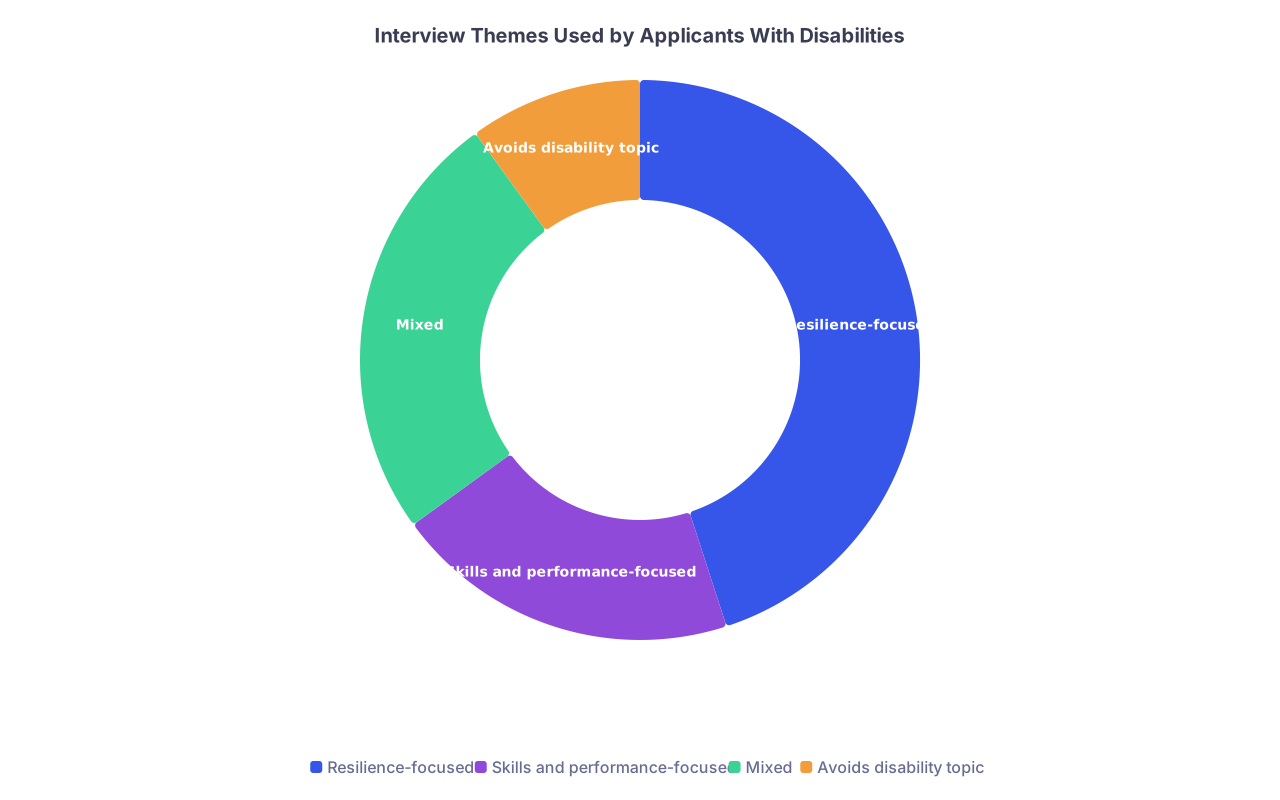
| Category | Value |
|---|---|
| Resilience-focused | 45 |
| Skills and performance-focused | 20 |
| Mixed | 25 |
| Avoids disability topic | 10 |
You have probably been told to “turn your disability into a strength” or “highlight your resilience.” That advice is overused and often lazy.
One of the most common traps: the applicant whose every answer can be boiled down to “I am resilient.”
“Tell me about a time you worked in a team.”
Answer: “I showed resilience despite my chronic illness…”“Why this specialty?”
Answer: “My disability taught me resilience, which I will bring to this field…”“What are your strengths?”
Answer: “Resilience.”
Programs get bored. And suspicious. Because if the only concrete skill you can name is resilience, what are you actually going to do on the wards?
Your disability story is not your whole CV. It also is not your entire personality.
Better: link disability to specific, observable competencies.
For example:
Situational awareness: “Managing low‑vision has made me meticulous about redundancy checks—during procedures I am obsessive about verbal read‑backs and team confirmation.”
Communication: “Because some days my speech can be less clear, I learned early to over‑communicate in sign‑outs and written notes. Attendings have commented that my written plans are especially thorough.”
System thinking: “Coordinating my own care made me very aware of system gaps. On my medicine clerkship, I built a quick discharge checklist with social work that cut down on missed equipment orders.”
See the difference? Concrete. Measurable. Less “look how brave I am,” more “here is how I will make your team safer and more effective.”
Use your disability to explain how you practice medicine. Not as a free ticket to “I’m resilient, trust me.”
Mistake #7: Choosing Programs Without Looking For Red Flags
| Signal Type | Positive Sign | Red Flag |
|---|---|---|
| Website info | Clear disability and accommodations policy | No mention of disability anywhere |
| Interview day | Coordinator asks about logistical needs early | Awkward silence when you arrive with visible disability |
| Resident comments | Residents can name colleagues with accommodations | Residents say "I don't think anyone here has issues like that" |
| Leadership language | Talks about "support" and "access" | Talks about "toughing it out" and "everyone here just pushes through" |
| GME structure | Active relationship with disability services | PD admits they are "not sure how that works here" |
You are not the only one being evaluated. If you are disabled, the culture of the program will matter far more than any “Top 10” ranking nonsense.
A common mistake: applicants ignore or rationalize obvious red flags because the program is prestigious or the specialty is competitive.
I have heard things like:
- “The PD said, ‘We expect residents not to get sick,’ but I think they were just joking.”
- “They told me no one has ever asked for accommodations before. I guess that means everyone is fine.”
- “The program coordinator seemed confused when I asked about accessible call rooms, but maybe they just haven’t been asked that before.”
That last sentence—“maybe they just haven’t been asked that before”—is usually a sign to walk away, not lean in.
If you mention disability or accommodations in a reasonable, professional way and get back:
- Visible discomfort.
- Quick subject changes.
- “We will have to look into that, no one has asked before” with no follow‑up questions.
…that program may not be ready for you. Or safe for you.
Watch for how they talk about wellness and leave, too.
If faculty joke about “we don’t have time to be sick” or brag that “our residents never miss a shift,” believe them. That culture will not magically bend around your needs.
You do not need perfection. You do need a place that has at least thought about disability. If they have never done this before, you will be their experiment. Decide whether you want that job.
Mistake #8: Using Vague, Minimizing Language That Undercuts You

The words you choose matter. A lot.
I routinely hear applicants sabotage themselves with language that makes them sound unsure, apologetic, or guilty for existing.
Phrases to avoid:
- “I struggle with…”
- “I am kind of dealing with…”
- “I have some issues but I do not want to be a burden…”
- “I hope it will not be too much trouble if…”
- “I will try my best to keep up…”
This kind of hedging tells programs you are expecting to fail. Or that you believe you are a problem they are being asked to tolerate.
You are not a burden for having a disability. You do not need to apologize for requesting legal accommodations.
But you do need to talk like a colleague, not a supplicant.
Clear, non‑apologetic language:
- “I have a chronic condition that intermittently affects my mobility.”
- “To perform my duties safely, I use digital dictation and a modified schedule for procedural days.”
- “These accommodations have been in place for the past two years of clinical training, during which I have met or exceeded all expectations.”
Notice: no “sorry.” No “I hope this is okay.” Just facts.
Practice these sentences out loud. Your tone should match your words: calm, matter‑of‑fact, confident in your right to exist in medicine without begging for permission.
FAQ: Talking About Disability In Residency Interviews
1. Do I have to disclose my disability during residency applications or interviews?
No. You are not legally required to disclose a disability at any point in the application or interview process. What you are obligated to do is answer truthfully about your ability to perform essential duties. If your disability impacts those duties or you will need significant accommodations, strategic disclosure (to the right people, at the right time) is often smarter than silence—but it is not legally mandated.
2. Should I mention my disability in my personal statement?
Only if it serves a clear purpose. Good reasons: explaining a non‑linear academic path (LOA, extended curriculum), directly connecting to your interest in a specialty, or illustrating how it shapes concrete skills you bring to clinical work. Bad reasons: fishing for sympathy, filling space, or vague “I am resilient” narratives with no specific link to your training or practice.
3. How do I answer “Are you healthy enough for residency?” without oversharing?
Shift from diagnosis to function. For example: “My condition has been stable for three years with treatment. During that time, I have completed full‑time clinical rotations, including nights and weekends, without restrictions or missed time. I have the capacity to meet the demands of your program with the same supports I already use now.” They do not need medication names, lab values, or past crises.
4. Who should I talk to about specific accommodations: PD, coordinator, or GME?
For detailed accommodation discussions, GME or the institution’s disability services office is usually the right starting point, not a random faculty interviewer. During interviews, you can keep it high‑level (“I use X types of supports and have reliably met all requirements”). Once you match or are strongly considering a program, you can request a more formal, confidential conversation with the appropriate institutional office about concrete accommodations.
5. What if an interviewer asks an inappropriate or illegal question about my disability?
You are allowed to decline diagnosis‑specific questions and redirect to functional capacity. A response like, “I prefer not to discuss specific diagnoses, but I can tell you that I have been able to meet all clinical requirements reliably and safely, and I am confident in my ability to handle your program’s workload with the supports I already use,” is usually enough. Afterward, document what was asked, and seriously reconsider whether you want to rank that program. Programs that ignore basic boundaries during interviews rarely improve once you are on payroll.
If you remember nothing else, remember this:
Do not treat your interview as therapy; treat it as a professional conversation about function and reliability. Do not erase your needs to seem “strong”; show you understand them and have a plan. And never ignore program red flags; your health and career will both pay the price if you do.