
You know this student. Maybe you are this student. They watch every single lecture. They take meticulous notes. They've got 100 hours of Pathoma under their belt and can quote every line from Sketchy's microbiology videos. Then they sit down for a practice block, read a clinical vignette, and their brain goes blank. The answer isn't on a screen anymore. There's no friendly narrator walking them through the logic. Just text, a patient, and a decision they have to make alone.
Here's what happened: they confused recognition with recall. They mistook familiarity for mastery. And they're not alone, this is the single most common trap in modern medical education.
The Illusion of Competence: Why Lectures Are Not Enough
Lectures feel productive. You sit there, you absorb, you nod along. The instructor says something brilliant and you think, "Yes, I understand this." But here's the harsh truth: understanding someone else's reasoning is not the same as generating your own. It never has been.
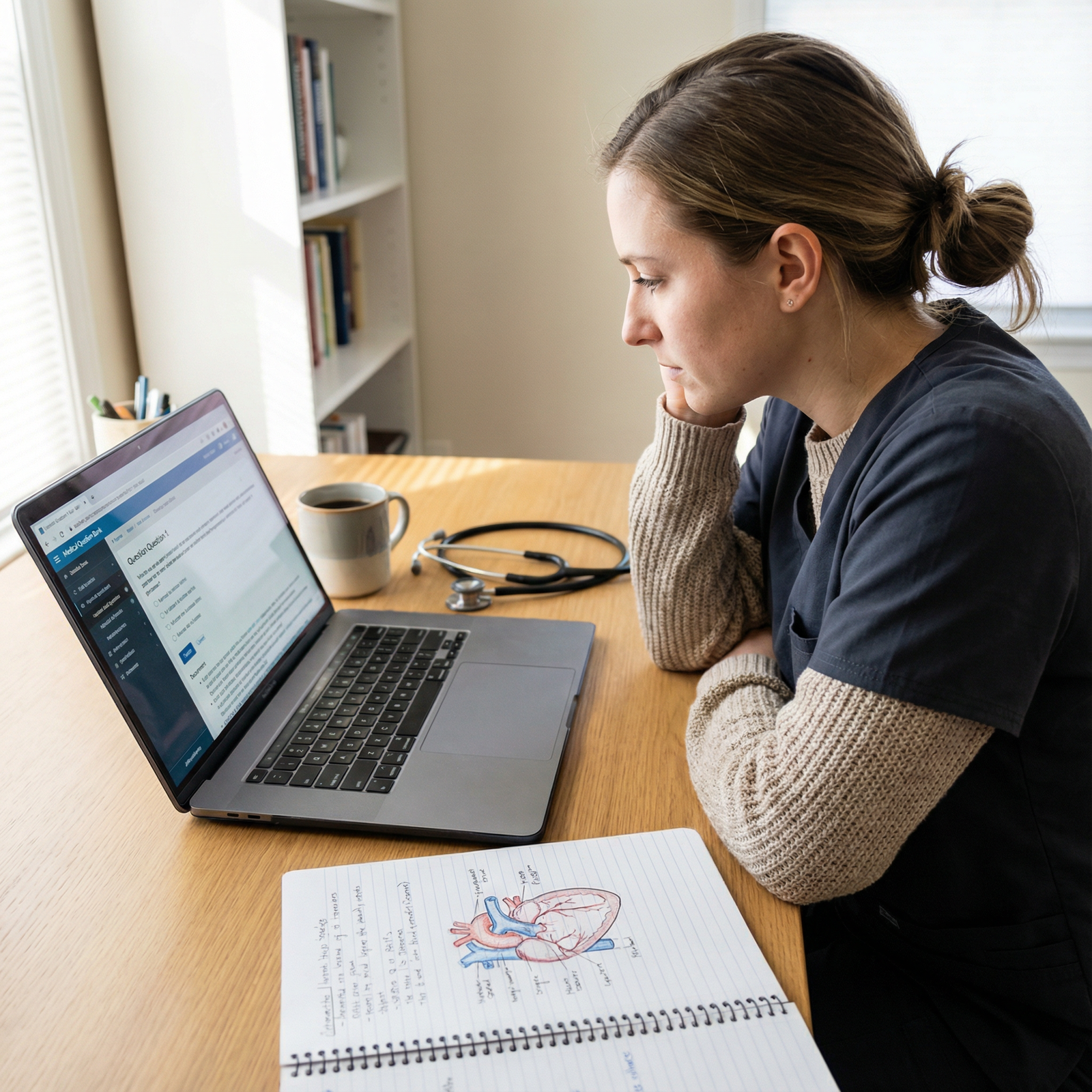
When you watch a video, your brain is in recognition mode. The instructor presents a concept, and your brain goes, "Ah yes, I've seen this before. Makes sense." That's recognition. It's passive. It feels like learning, but it's closer to confirming what you already vaguely know. The problem? Clinical vignettes don't test recognition. They test recall, the ability to retrieve information from scratch, apply it to a novel scenario, and make a decision under pressure.
I've watched this play out dozens of times. A student comes to me crushed because they scored a 45% on their first practice block after weeks of diligent video watching. They feel betrayed. "I studied so hard," they say. And they did, in the sense that they spent hours in a chair with educational content playing. But they didn't study the way the exam tests. They trained for a marathon by watching running videos.
The cognitive science here isn't complicated. Passive engagement, watching, listening, even re-reading, produces weak neural pathways. The information enters working memory, briefly activates prior knowledge, and then fades. Without retrieval practice, without the cognitive struggle of pulling information out of your brain and applying it to a new context, the material never consolidates into long-term memory in a usable form. You build a museum of facts you can admire but can't deploy.
Videos give you context. They give you a framework. They give you the false confidence that you're learning. But they don't give you the one thing that matters on exam day: the ability to reason through a clinical scenario you've never seen before, in text, without a narrator holding your hand.
That's the gap. And it's time to bridge it.
The Workflow Shift: From Passive to Active Reasoning
Here's where the rubber meets the road. You need a system, a concrete, repeatable workflow that transforms how you engage with material. No more pressing play and hoping for the best.
The Stop-and-Predict Method
Need a more precise way to manage your library? Check out how to audit and clean up your digital board prep annotations for better efficiency.
This is your new default. Here's how it works:
Read the last sentence first. Before you read anything else in the vignette, read the actual question being asked. "What is the most likely diagnosis?" "Which of the following is the mechanism of action?" "What is the next best step in management?" This frames everything that follows. You're not reading a story, you're hunting for evidence.
Predict before you proceed. Before reading the answer choices, pause. Force yourself to articulate what you think the answer is. Even if you're wrong. Especially if you're wrong. The act of generating an answer, even an incorrect one, strengthens retrieval pathways. Say it out loud if you have to. Write it in the margin. But don't cheat by looking at the options first.
Read the vignette with intent. Now go back and read the full stem. But read it like a detective, not a student. Every detail is either a clue or a distractor. "62-year-old male", that's a clue. "History of hypertension", clue. "Recently started on a new medication", big clue. You're building a case, not memorizing a paragraph.
If you are starting to feel the pressure of burnout, consider a short-form resource strategy to maintain momentum.
- Commit to an answer before reading all options. If your prediction matches an option, select it. If not, use the clinical reasoning you've built from the stem to narrow down. But never, ever let the answer choices do your thinking for you before you've done the work yourself.
Building Mental Models from Text
This is the hard part. Videos give you visual anchors, animations, diagrams, color-coded pathways. Text doesn't. You have to build those models in your head, from scratch, every time.
Here's how: when you read a vignette, mentally translate the text into a patient you can see. "45-year-old woman with fatigue, weight gain, constipation, and cold intolerance." Don't just register the words, picture the patient. Tired. Moving slowly. Wearing an extra sweater in July. That's hypothyroidism, not because a video told you, but because you built the clinical picture yourself.
The more you do this, the faster it gets. The first hundred vignettes feel like wading through mud. By vignette five hundred, you're reading the first three words of a stem and your brain is already generating a differential. That's not recognition, that's pattern recognition built through active recall. It's the difference between a tourist with a map and a local who's lived there for years.
Prioritizing USMLE-Style Resource Integration
Stop treating your resources as separate silos. Here's the integration framework I recommend:
- Start with a question bank. Not a video. Not a textbook. A question bank. This is your primary learning tool now.
- Use textbooks as targeted references. When you get a question wrong (or right but for the wrong reason), go to the relevant textbook section. Read that section, not the whole chapter. You're filling a specific gap, not starting a new course.
- Use videos as surgical strikes. Only when you've exhausted the text explanation and still don't understand the concept. Find the specific timestamp, watch the relevant 3-5 minutes, and close the tab. No bingeing. No "let me just watch one more."
This inverts the traditional hierarchy. Most students do videos first, then questions, then maybe textbooks if they have time. Flip it. Questions first, textbooks second, videos last and only when necessary. You'll be shocked at how much faster you learn.
Mastering the Vignette: Dissecting Clinical Language
Clinical vignettes are written in a specific dialect of medical English. It's not the language of textbooks. It's not the language of lectures. It's a compressed, code-laden format where every word carries weight and the exam writers are testing whether you can decode it in real time.
Buzzwords vs. Clinical Context Clues
Here's the truth that most prep resources won't tell you: pure buzzwords are dying. The USMLE has been moving away from them for years. "Blue rubber bleb nevus syndrome" as a one-liner? That's Step 1 circa 2012. Modern vignettes are longer, messier, and more realistic. They give you a patient with multiple comorbidities and ask you to prioritize.
But that doesn't mean buzzwords are useless. They're starting points. "Reed-Sternberg cells" still means Hodgkin lymphoma. "Heinz bodies" still means G6PD deficiency. The difference is that now you need to contextualize them. The question won't say "A patient has Reed-Sternberg cells, what's the diagnosis?" It'll say "A 34-year-old man presents with painless cervical lymphadenopathy, B symptoms, and a biopsy reveals binucleated giant cells with owl-eye inclusions." You need to get from the description to the buzzword to the diagnosis, and then potentially to the management or prognosis.
The Role of Laboratory Values
Labs are not just numbers to memorize. They're diagnostic tools that confirm or refute your clinical reasoning. Here's the framework:
- Formulate a differential based on the clinical presentation first. Before you look at the labs.
- Use labs to narrow the differential. If you're thinking sepsis vs. adrenal insufficiency and the potassium is high with hyponatremia, that's your answer, adrenal insufficiency. The labs aren't random; they're there to reward students who reason rather than guess.
- Don't overinterpret isolated values. A single mildly elevated AST in an otherwise healthy patient isn't driving the bus. Focus on the values that change your management.
Read the Last Sentence First, Always
This isn't a suggestion. It's a rule. I've watched students waste 90 seconds reading a dense paragraph about a patient's social history and family background, only to reach the end and discover the question is asking about a drug's mechanism of action. The social history was window dressing. Read the question first. Then read the stem with purpose.
Data-Driven Strategies for High-Stakes Exam Success
Track your performance ruthlessly. Not just overall percentage, that's a vanity metric. Track these instead:
- Accuracy by subject area. Where are you consistently weak? That's where you spend your textbook time.
- Accuracy by question type. Are you worse on "mechanism of action" questions than "next best step in management" questions? That tells you whether your problem is basic science knowledge or clinical reasoning.
- Time per question. If you're taking 90 seconds on a question you get right but 45 seconds on a question you get wrong, you're rushing when you're unsure. Slow down. The clock is important, but a wrong fast answer is still wrong.
Action Plan: Moving Forward
Here's your three-step plan to sunset your video dependence and build real clinical reasoning:
Step 1: The 80/20 Ratio Shift
Starting today, allocate 80% of your study time to question-based practice and 20% to passive review. That means if you study 10 hours, 8 hours are spent doing questions, reviewing explanations, and building mental models from text. Two hours, max, for videos, and only as targeted references.
Step 2: Weekly Question Bank Milestones
Set a concrete throughput goal. For dedicated study periods, that's 150-200 questions per day minimum. During coursework, aim for 40-50 per day on the current subject. Track your weekly total and hold yourself accountable. If you hit 70% correct on a topic across 100 questions, you can move on. If you're below 60%, you stay until you improve.
Step 3: The Post-Mortem Review
Every incorrect answer gets a review. Here's the structure:
- Why was the correct answer correct? Not just "it's the right diagnosis", what specific clues in the stem pointed to it?
- Why was my chosen answer wrong? What trap did I fall into? Was it a knowledge gap or a reasoning error?
- What will I do differently next time? This is the key question. "I'll read more carefully" is useless. "I will always check for contraindications before selecting a first-line medication in elderly patients" is actionable.
Do this for every wrong answer. It's slow. It's painful. It works.
Key Takeaways
- Video lectures provide context, but clinical reasoning is built exclusively through question-based application. Stop treating videos as your primary learning tool.
- The transition to text-based study is uncomfortable by design. Discomfort is a marker of active learning. If it feels easy, you're not learning.
- Always prioritize the "why" behind the correct answer over the "what" of the diagnosis. The reasoning is the skill. The diagnosis is just the output.