
You're Not the Only One Worried: When Shelf Looks "High" but Q-Bank Looks "Low"
This is exactly the kind of thing that makes people spiral at 11:47 p.m.
You look at a solid Shelf score, then open your Q-bank and see a percentage that feels... embarrassingly lower. And your brain does what anxious brains do: What if the Shelf was a fluke? What if I'm memorizing and not actually ready? What if boards expose me? What if I've been fooling myself the whole time?
I get it. That fear is real. Not dramatic. Not irrational. Real.
This mismatch, better Shelf performance, shakier Q-bank performance, is common, and it happens for reasons that are far less sinister than your panic is suggesting. These two tools are not measuring the exact same thing, not in the same way, and definitely not with the same day-to-day volatility. One can say, "You can perform under exam conditions." The other can say, "Your weak spots are still leaking." Both can be true at once.
And here's the part applicants need to hear clearly: program directors don't obsess over one isolated metric the way stressed students do. They care about trends. They care about whether you respond intelligently to weak data. They care about whether your prep behavior makes you more reliable on exam day. Not whether one ugly Q-bank stretch means doom.
Why PDs Don't Panic: Shelf vs Q-Bank Measure Different Skills
Shelf exams are blunt but useful. They tend to reflect broad content coverage, clinical reasoning, and your ability to hold it together under timed pressure on a real test day. That matters. A good Shelf score usually means you can integrate information, recognize patterns, and perform when stakes are high.
Q-banks are different. They're messier. More diagnostic. More annoying, honestly.
A Q-bank is supposed to expose weakness. That's the point. If you're using it correctly, it should find the places where your thinking breaks: when the stem is weird, when two answers look plausible, when your pacing gets sloppy, when you know the disease but miss the management step. A falling Q-bank percentage isn't automatically a sign that you're getting worse. Sometimes it means you've moved from easy, familiar questions into harder sets. Sometimes it means you're finally seeing your real blind spots instead of coasting on recognition.
I've seen this with students who scored well on medicine Shelf exams but got rattled when mixed Q-bank blocks started dragging down their average. Why? Because mixed blocks punish inconsistency. Because repeated random exposure is different from one polished exam day. Because recognizing a concept after a week on the wards isn't the same as generating the answer inside a long, ugly stem at question 34 of a timed block.
And review quality matters more than people want to admit. If you miss a question and just skim the explanation, you're not learning. You're sightseeing. If you actually classify why you missed it, content gap, stem misread, timing panic, bad elimination, you turn a bad block into useful data. That's what good prep looks like.
Worst-Case Thinking vs Board-Reality: What PDs Actually Want You to Do Next
Here's the reframe you probably need, even if your brain hates it: a falling Q-bank score is information, not a prophecy.
Boards are not determined by one discouraging week. They're shaped by cumulative readiness, stamina, and whether your study process is fixing the right problems. PDs know that. They've watched too many students catastrophize over noisy data to confuse a dip with disaster.
What they want you to do next is not panic harder. That's useless. They want targeted remediation. Better question review. Honest diagnosis.
Start by asking the uncomfortable questions: Are you missing because you truly don't know the content? Are you running out of time and rushing the last third of the block? Are you changing right answers to wrong ones? Are you reviewing explanations so passively that the same mistake keeps showing up in different outfits?
That's the real work.
If accuracy is dropping, remediate content. If timing is the problem, start doing timed blocks and practice moving on. If review isn't sticking, your review method is weak and needs structure. If your practice is inconsistent, three huge days followed by two avoidance days, you don't have a knowledge problem first. You have a process problem.
That's actually good news. Process problems are fixable fast.
A Practical "Before Boards" Playbook: Adjust the Process, Not the Panic
If boards are coming and your confidence is wobbling, don't redesign your whole life. That's a classic panic move. Keep the timeline short and brutal in the best way: two to four weeks of focused repair.
Week one is about stabilizing your baseline. No random heroic nonsense. You need predictable volume, predictable review, predictable sleep. Then, once your pattern is steady, you intensify remediation based on what the questions are actually telling you.
The daily template I like is simple because complicated study plans are fake productivity.
First: timed question sets. This builds endurance, pacing, and tolerance for uncertainty. Not every block has to be massive, but it does need to be real. Sit down, time it, and finish it without babying yourself. If fatigue is part of the problem, you need to train fatigue. There's no clever workaround.
Second: detailed review. This is where improvement happens. Not while clicking answers. During review. For every miss, decide the cause:
- content gap
- careless error
- stem misunderstanding
- second-guessing
- timing/rushing
That categorization matters because "I got it wrong" is too vague to fix. If it was a content gap, write one or two micro-notes only, tiny, high-yield corrections, not a novel. If it was a careless miss, identify the trigger. Did you ignore "next best step"? Did you miss a contraindication? Did you anchor on one buzzword and stop thinking? Be specific. Specific errors are fixable. Vague guilt is not.
Third: focused redo. This is the part people skip, and it's one of the dumbest mistakes in board prep. If a concept beat you once, you need to face it again. Build a redo list of missed concepts and recurring patterns. Then revisit them in short bursts. Not because repetition is glamorous. Because memory is rude and fragile, and if you don't re-encounter the concept, your brain will absolutely pretend it learned it when it didn't.
A sample week should look boring. Good. Boring works.
Monday through Friday, something like 35% timed questions, 45% review, 20% redo is reasonable. Weekends can tilt a little more toward review and mixed recall. The exact percentages don't need to be holy scripture. The point is that review takes the biggest share. That's where students separate "busy" from "actually improving."
And about switching resources: don't resource-hop just because you're scared. That's another panic reflex. Change resources only if your current one has weak explanations, poor alignment with your exam needs, or a format that prevents useful remediation. Otherwise, double down and use it better. A new question bank won't save you from sloppy review.
Tracking the Right Metrics: Trends, Weak Domains, and Confidence Calibration
Single scores are emotional. Trends are useful.
If you keep staring at one bad percentage, you'll make terrible decisions. Track three things instead: your percent correct over time, your average time per question, and your performance by topic or subdomain. Those metrics tell the truth more reliably than one discouraging block after a bad night of sleep and two cups of coffee.
Also separate "I missed it" from "I learned it." Those are not the same event. A miss only becomes useful if you improve on redo. That's why redo accuracy matters so much. If your first-pass score is stubborn but your redo performance is rising, you are learning. Maybe not as fast as your anxiety demands. But you are learning.
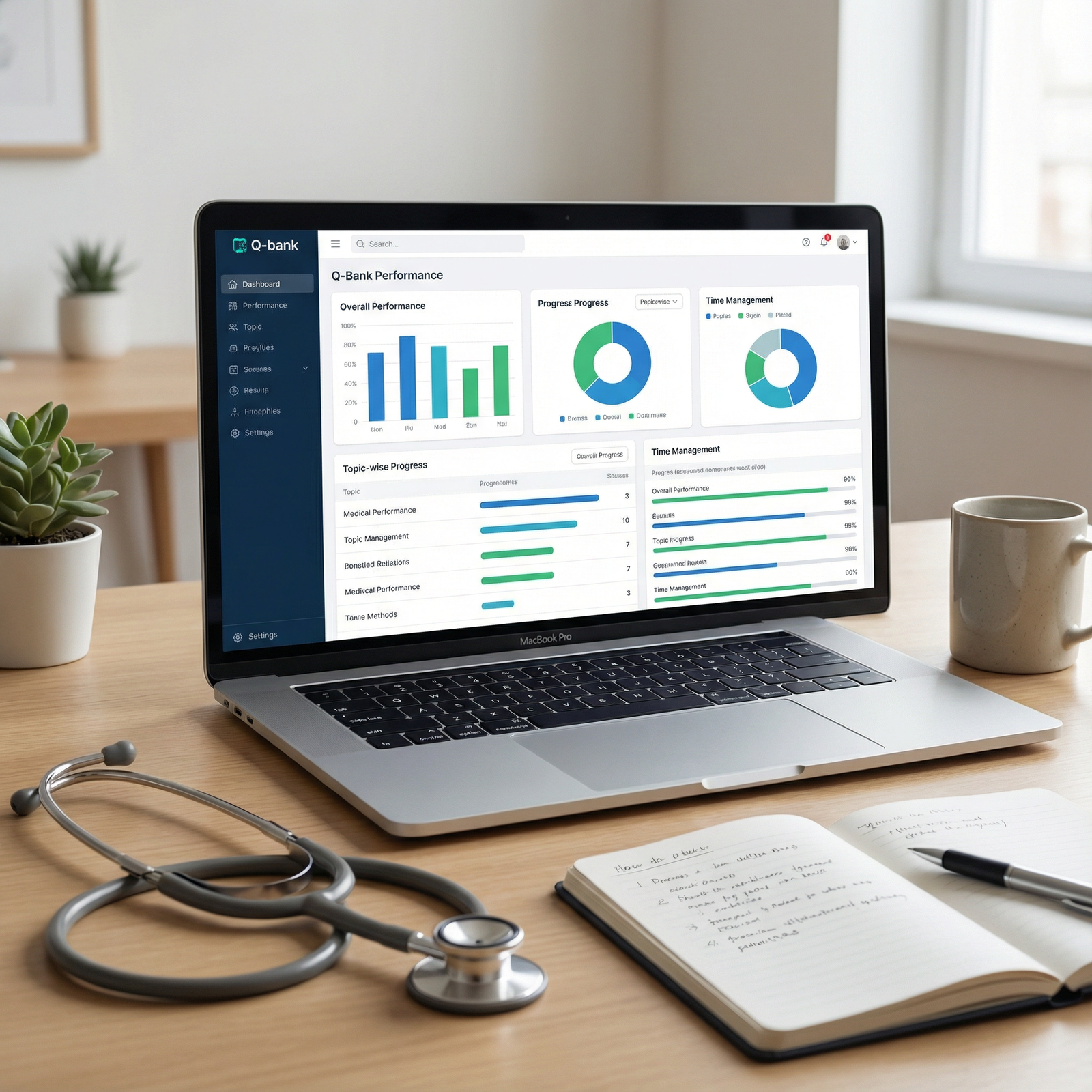
Confidence calibration matters too. Some students are underconfident globally but overconfident in a few dangerous domains. They'll say, "I know renal," then miss acid-base questions three times in a row. Or they'll feel fine in OB because they recognize the vocabulary, but management questions expose the gap immediately.
So build checkpoints. Mini-blocks on weak areas. Spaced recap two or three days later. Quick self-testing before you allow yourself to declare a topic "done." Because feeling familiar with material is not the same thing as being able to answer with precision under time pressure. That illusion wrecks people.
Boards-Ready Strategy: Timed Conditions, High-Yield Review, and Sleep-Proofing
By the final stretch, your job is not to consume more and more material like a frightened raccoon digging through study trash. Your job is to get test-ready.
That means timed conditions. Real ones. Practice sitting with uncertainty and moving anyway. Learn to eliminate aggressively when you don't know the answer cold. Usually one answer is obviously wrong, another is trendy nonsense, and two are in a knife fight. Your task is not to feel certain. Your task is to choose well under pressure.
You also need high-yield review that lowers cognitive load instead of inflating it. Do not spend your last days rereading everything equally. That's lazy disguised as thoroughness. Prioritize repeat weak areas, recurring error patterns, and themes boards love to test. If endocrine management keeps slipping, hit it again. If murmurs blur together when you're tired, build a one-page comparison sheet and test it. If you miss ethics questions because you answer too fast, slow down and read the actual question being asked.
And yes, sleep. Annoying but nonnegotiable.
Sleep deprivation creates fake knowledge gaps. It makes you misread stems, forget the last line, and choose impulsively. Then you assume you're underprepared when part of the problem is just fatigue. Last-minute cramming is especially seductive for anxious students because it feels morally serious. But a tired brain commits cheap errors, and boards punish cheap errors hard.
In the final days, protect stamina. Practice at the time of day you'll test if possible. Eat predictably. Don't experiment with bizarre productivity rituals from the internet. Don't suddenly add six new resources because panic told you more is better. It isn't.
And for anxiety itself: set limits on spiraling. After a practice block, take five minutes. Breathe. Stand up. Walk. Write down what the block actually showed you before your brain turns it into a character indictment. You are not your worst set. You are the pattern you build after it.
Checklist: What to Do in the Next 48 Hours (So You Can Stop Waiting for Doom)
If you're reading this in full panic mode, here's your triage.
Tonight, identify your top three causes of underperformance. Not fifteen. Three. Maybe it's timing, GI content gaps, and lazy review. Fine. Then assign one fix to each. Timing gets one timed block tomorrow. GI gets one focused remediation session. Lazy review gets a structured error log.
Create your redo list tonight. Not in your head. On paper or in one document. Group misses by cause and topic. You want something you can actually revisit, not a vague sense that "I should probably go over cardio again."
Tomorrow, run a timed set. Then review it using the same categories: content gap, careless, misunderstanding, second-guessing, timing. Keep the method consistent so your data means something.
Finally, decide what "good enough improvement" looks like over the next 7 to 14 days. Maybe it's a modest rise in percent correct, better pacing, and stronger redo accuracy in your weakest domain. That counts. Improvement doesn't have to look dramatic to be real.

Encouragement: Shelf High and Q-Bank Low Doesn't Mean You're Behind, It Means You Have a Map
This discrepancy does not mean you're secretly failing. It means your prep is giving you useful information before boards instead of after. That's a gift, even if it feels rude.
The students who do best aren't the ones who never get scary feedback. They're the ones who respond to it cleanly. They tighten the process. They review better. They redo misses. They track trends instead of worshipping single scores like they're divine judgment.
So no, don't ignore a falling Q-bank. But don't turn it into mythology either. Use it. Let it show you where the leaks are. Then fix them.
That's what PDs want to see. Not panic. Not perfection.
Responsiveness. Consistency. Trendlines.
You're probably less doomed than you think.