You just left the room. Heart still hammering, smile frozen in place as you walk past the coordinator's desk and mumble something about how nice it was to meet everyone. The door clicks shut behind you.
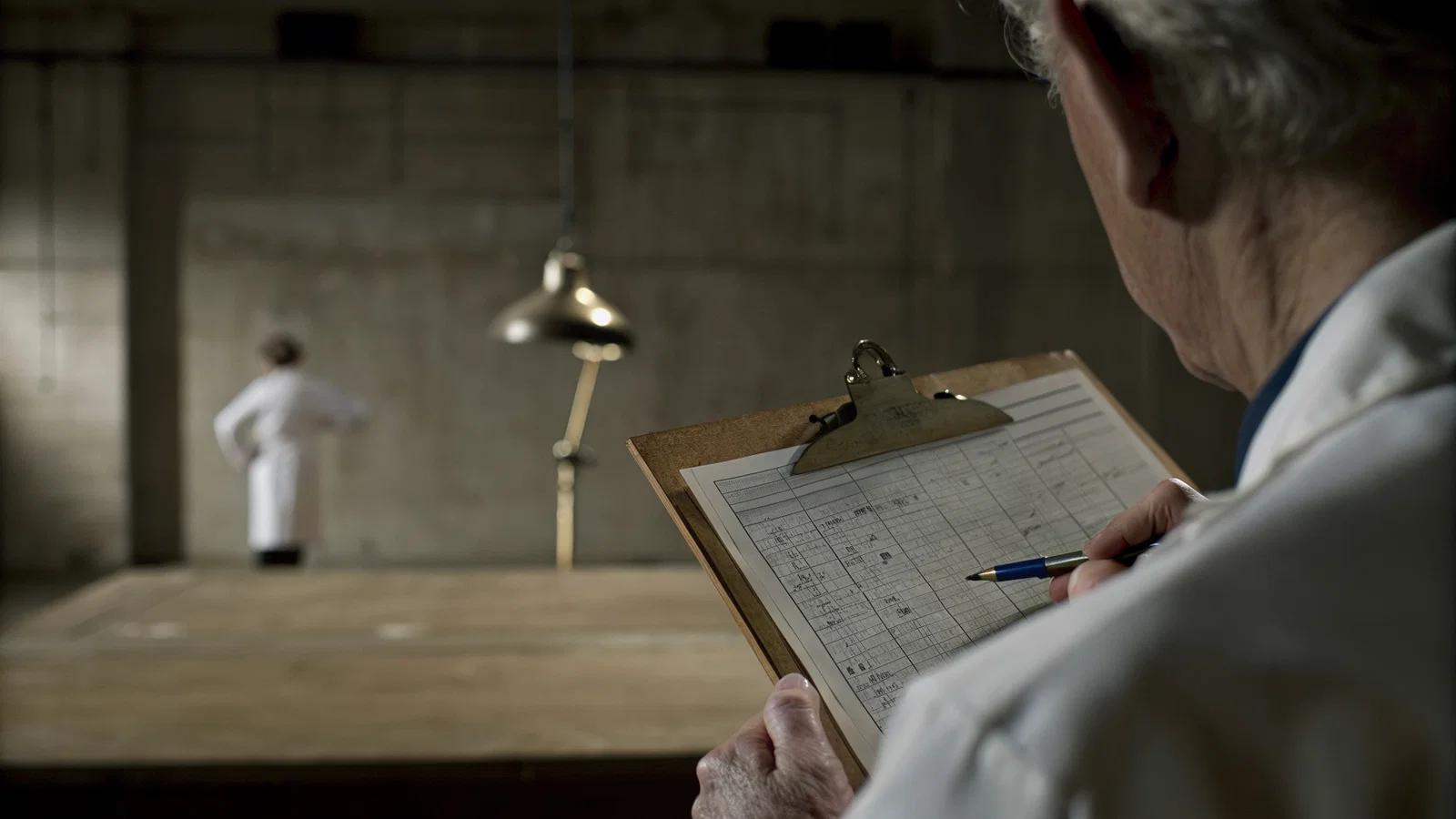
Here's what you don't know: within sixty seconds, the two faculty members sitting across from you are already filling out a standardized evaluation form. By the time you reach the parking garage, your "interpersonal fit" score is locked. Before you start your car, they've moved on to the next candidate. By dinner, the program director has averaged your scores with four other interviewers and dropped you into a tentative rank list tier.
This isn't speculation. I've sat on both sides of this table. Let me pull back the curtain on exactly what happens between the moment you leave and the rank list meeting in February.
Inside the Interview Room: The Post-Interview Debrief
The second you stand up and shake hands, the evaluator's brain is already shifting from "interview mode" to "scoring mode." Most programs use a structured form, usually a 1-5 Likert scale across four to six competency domains. Some programs are now using the AAMC Standardized Video Interview-style framework adapted for subspecialties. Others still rely on a hybrid: a numeric score plus a free-text box where interviewers write the comments that actually get quoted during rank meetings.
Here's the uncomfortable truth: that free-text box matters more than the score.
Faculty are fatigued. They've interviewed 25 applicants in three days. The applicant who gets remembered during the December ranking meeting is the one whose free-text comment contains a specific, vivid detail, "she explained a complex DKA case with genuine clinical reasoning," or "he asked an unusually thoughtful question about our fellow clinic structure." Vague praise like "seems nice" gets forgotten. Vague criticism like "something felt off" becomes a death sentence.
And yes, cognitive bias is rampant. Halo effects from your medical school prestige. Horns effects if you remind the interviewer of that one nightmare fellow from 2018. The "similar-to-me" bias is the biggest one, faculty rank candidates higher who share their interests, their communication style, even their hobby of ultramarathon running.
But the rubric exists specifically to blunt some of that bias. That's why every serious fellowship program has standardized forms now.

The 4 Core Domains on Every Secret Rubric
Every fellowship program has their own form, but they all measure essentially the same four domains. Here's what each one really captures.
1. Clinical Competence and Trainability (≈30%)
This isn't asking if you're already a fully-trained subspecialist. It's asking: Can this person learn what we need to teach them? Interviewers want to see baseline clinical reasoning, usually tested through a clinical vignette or case discussion, combined with intellectual humility. The candidate who confidently admits "I don't know, but here's how I'd approach finding out" outscores the candidate who bullshits through a question about pulmonary hypertension management.
2. Interpersonal Dynamics and Fit (≈35%)
This is the heaviest weight on most rubrics. Faculty aren't hiring a test-taker. They're hiring a colleague they'll spend three years with in a workroom, on consults, and at 3 AM in the ICU. They want to know: Will you make this place better or worse? Are you the person they want to grab coffee with after a bad code?
The killer here is that this score isn't just from your interview answers. It's built from how you treated the program coordinator when you thought nobody was watching. How you handled the awkward moment when the resident running your tour disagreed with your assessment of a patient. Whether you looked at the medical student or talked over them.
3. Academic Productivity and Grit (≈20%)
The checkbox for "has research" is a threshold metric, not a scoring one. Once you're in the interview room, nobody cares that you have three publications. They care whether you can articulate a coherent research narrative, and whether you have the resilience to push through a fellowship project that's stalling out at month eight.
Programs are reading between the lines: Did you do research because you genuinely wanted to, or because you needed to check a box? The applicant who can describe a rejected manuscript and what they learned from the revision process outperforms the applicant with a CV padded with fourth-author case reports.
4. Professionalism and Self-Awareness (≈15%)
This is the hidden domain. It's where programs log the red flags that don't fit anywhere else. The applicant who badmouthed their program director. The one who checked their phone twice. The one who couldn't articulate a single weakness that wasn't actually a humblebrag ("I work too hard").
Self-awareness is the differentiator here. Saying "I struggle with delegating, and I've started using explicit task checklists with my team" is ten times more powerful than "I'm too much of a perfectionist."
Decoding Program Director Code Words
Program directors speak in code. Once you've been around enough rank meetings, you start to decode the polite language that hides brutally honest assessments.
Pleasant. Usually neutral. Means you didn't offend anyone but didn't stick out. Often a default for applicants the interviewer can't remember anything specific about. Concerning.
Energetic / enthusiastic. Genuinely positive when paired with clinical examples. Means the interviewer liked your presence in the room.
Low-maintenance. This is the highest compliment in fellowship-land. Means you can be trusted to handle problems without constant hand-holding. Programs prize this above almost everything else because burnout is real and they need fellows who won't create extra work for the attendings.
Would fit well with our current fellows. Specific and positive, means at least one current fellow gave you a thumbs-up.
Now the dangerous phrases:
"Interesting" without elaboration. Often code for "I'm not sure this is a good fit but I can't articulate why."
"Lots of potential." Sometimes genuine, often a polite way to say "not ready yet."
"Asked some unusual questions." Translation: asked something that made the interviewer uncomfortable, usually about call schedule or vacation.
"Strong personality." Borderline. Could mean either great leadership or difficult to manage.
The truly fatal phrases? Anything implying poor clinical judgment, dishonesty, or unprofessional behavior. "Concerning answer to the clinical scenario." "Demeanor raised some questions." Once those hit the free-text box, you're done.
Actionable Frameworks to Maximize Your Rubric Score
Stop preparing for interviews like they're essay questions. Start preparing for them like you're filling out a form.
Use STAR to plant specific checkmarks.
Every competency domain on that rubric needs a corresponding anecdote. Situation, Task, Action, Result. Write out six to eight STAR stories before interview season and rotate them based on the question. A cardiology fellowship interviewer asking about teamwork gets the rapid response activation story. Asking about resilience gets the manuscript rejection story.
Engineer your closing statement.
Most applicants fumble the closing. They say, "Thanks so much, I really love your program." That's filler. Instead, use the last 30 seconds to plant a specific memory. "I especially appreciated hearing about your fellow continuity clinic structure, that aligns exactly with the kind of longitudinal patient relationships I'm hoping to build during fellowship." Now the interviewer writes: "Asked thoughtful questions about fellow clinic. Strong interest in our specific program structure." That's a checkmark in the "fit" column.
Thank you notes: where they fit.
Short, specific, sent within 48 hours. Reference something concrete from your conversation. Don't mass-email, send to the program director and one or two key faculty. And do not, under any circumstances, send a second "just circling back" note if you don't hear back. Programs notice that, and not in a good way.
The night-before routine that actually matters.
Re-read the program's website. Skim two recent publications from the fellowship leadership. Write down three questions you genuinely have about their curriculum. Sleep. The single biggest interview killer isn't underpreparation, it's exhaustion.

The Bottom Line
Here's what actually matters: faculty are filling out a form designed to answer one question, Can I trust this person with my patients, my reputation, and my workroom culture for the next 36 months?
Every answer you give, every interaction you have with the coordinator, every question you ask the fellow on tour, it all gets filtered through that lens. The rubric is just the formal scoring tool. The real evaluation is whether you seem like someone who will make their lives better or worse.
Stop trying to perform. Start trying to demonstrate trainability, reliability, and genuine curiosity. That's what the best candidates do differently, and it's what shows up in the free-text box where rank meetings actually happen.