

What actually gets you a fellowship spot: the papers on your CV, or everything else?
Let me be blunt: people wildly overestimate and wildly underestimate research at the same time. Some residents think three case reports guarantee cards at MGH. Others think, “I’m a great clinician, I’ll be fine without any research.” Both are wrong.
Here’s the real hierarchy: how much research you need depends on three things:
- Your specialty,
- The tier of programs you’re aiming for, and
- How strong the rest of your application is.
We’ll walk through that directly. No fluff.
1. How Important Is Research for Different Fellowships?
Some fellowships are research-heavy by culture. Others care, but don’t live or die by it.

Here’s the rough reality, assuming you’re applying from a U.S. internal medicine or similar core residency:
| Fellowship Type | Research Importance | Typical Competitive Expectation |
|---|---|---|
| Hematology/Oncology | Very High | 3–10+ pubs, at least a few first-author |
| Cardiology | High | 2–6 pubs, mix of abstracts and papers |
| GI / Advanced Endoscopy | High | 3–8 pubs, conference presence |
| Pulm/Crit | Moderate–High | 2–5 pubs or strong project history |
| Allergy/Immunology | Moderate | 1–3 pubs, especially academic-leaning |
| Endocrinology | Moderate | Some scholarly work strongly preferred |
| Rheumatology | Moderate | 1–3 pubs or solid QI/research okay |
| ID | Moderate–High | 2–5 pubs, especially academic tracks |
If you’re in EM, Surgery, Pediatrics, Neurology, etc., the pattern is similar: the more academic and competitive the fellowship, the more research matters.
Rule of thumb:
- Aiming for top academic programs (think big-name university centers)? Research can be a make-or-break.
- Aiming for solid community or mid-tier academic programs? Research is important, but not the only way in.
- Aiming primarily for clinical, non-research-heavy programs? Research helps, but strong clinical and letters can outrun a light CV.
2. What Does “Enough Research” Actually Look Like?
“Do I have enough research for fellowship?” is the wrong question. The right one is: “For my target fellowship and my profile, is my scholarly work competitive?”
Let’s break it down by tier of competitiveness.
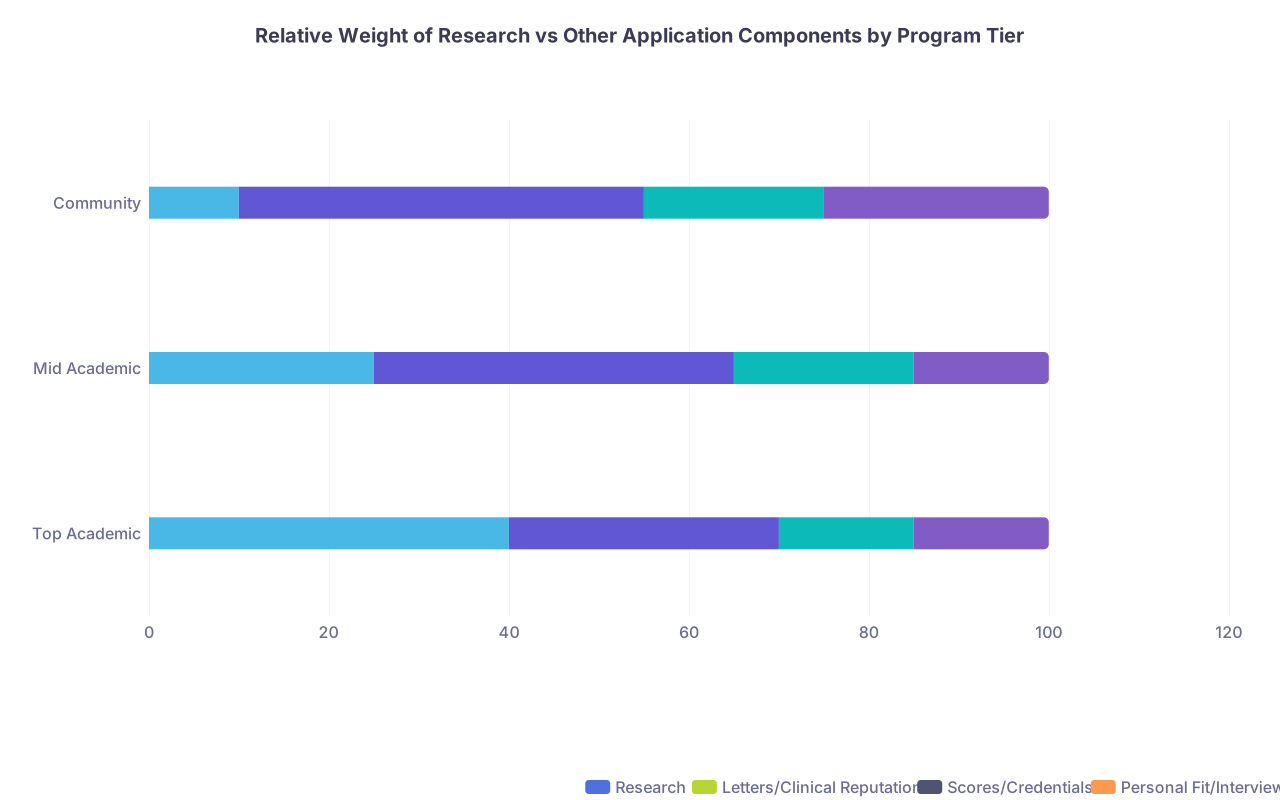
| Category | Research | Letters/Clinical Reputation | Scores/Credentials | Personal Fit/Interview |
|---|---|---|---|---|
| Top Academic | 40 | 30 | 15 | 15 |
| Mid Academic | 25 | 40 | 20 | 15 |
| Community | 10 | 45 | 20 | 25 |
A. Top-tier academic programs (Onc, Cards, GI, Pulm/Crit, etc.)
This is where research is almost a second currency.
Competitive applicants often look like:
- Total publications: 5–15+
- At least 2–3 first- or co–first-author works
- Mix of:
- Peer-reviewed manuscripts (original research, reviews, high-quality case series)
- National conference abstracts/posters (ASCO, AHA, ATS, DDW, etc.)
- Some continuity: your work has a theme (cardio outcomes, IBD, ICU QI, etc.)
If you’re:
- IMG, or
- From a low-profile residency, or
- With mid-range scores,
…research weight goes up even more; it’s your proof you can swim in academic waters.
B. Mid-tier academic and strong community programs
Here, research is “strong plus,” not always “must-have.”
Reasonable competitive range:
- Total publications: 2–6
- At least 1–2 actual manuscripts (not just “submitted” or “in preparation”)
- A handful of:
- Posters/oral presentations at regional or national meetings
- QI projects with real outcomes (reduced LOS, better sepsis bundle compliance, etc.)
For these programs, being:
- A standout resident clinically,
- With excellent letters,
- And some credible scholarly activity
…can beat someone with a longer but shallow research list.
C. Primarily community-focused or less research-heavy fellowships
For very clinically focused programs:
- Research expectation: 0–3 meaningful scholarly items.
- One solid project (e.g., a QI project that turned into a poster/manuscript) may be enough if:
- Your letters are stellar,
- You’re trusted and known as a workhorse,
- You interview well.
But let’s be honest: zero research is a handicap unless you’re aiming at very specific, known-to-you community programs that already love you.
3. How Does Research Compare to Other Application Pieces?
Here’s the part people mess up. They treat research like extra credit, not part of the core.
The truth: programs look at portfolios, not single axes.
Let’s stack research against the other big pillars:
| Component | Impact on Interviews | Impact on Rank List |
|---|---|---|
| Letters of recommendation | Very High | Very High |
| Clinical reputation/evals | Very High | Very High |
| Research productivity | Moderate–Very High | Moderate–High (academic) |
| Personal statement | Low–Moderate | Moderate (for borderline) |
| Scores (USMLE/COMLEX) | Moderate | Low–Moderate (if passed) |
| Interview performance | High | Very High |
Let’s walk through each and how it stacks next to research.
A. Letters vs Research
If I had to choose between:
- 10 publications and generic letters, or
- 2 publications and glowing, specific letters from well-known attendings,
I’d take the second scenario every time.
Letters beat raw publication count because:
- They speak to how you work, not just what you produce.
- They reassure PDs you’re safe, reliable, and not a nightmare.
- A strong letter from someone known in the field can “explain” a lighter research profile.
But here’s the catch: if that well-known attending is also a co-author on your paper or project, you get both—research and a powerful letter—from the same relationship. That’s how smart residents play it.
B. Clinical Performance vs Research
For most programs:
- If your clinical performance is weak, research will not save you.
- If your clinical performance is excellent, research magnifies your application.
Program directors don’t want:
- A brilliant researcher who can’t manage a floor,
- Or a pure clinician who’s never thought critically about evidence.
They want: “Good doctor + at least baseline academic mindset.” Research is proof of that mindset.
C. Scores vs Research
At the fellowship level:
- Passing scores and no major red flags are baseline.
- Exceptionally high scores can help, but they rarely override no scholarly work at academic programs.
If your scores are average:
- Solid research helps you stand out. If your scores are weak:
- Research plus strong letters is one of the only ways to prove you’ve grown beyond that.
D. Personal Statement vs Research
Your personal statement won’t outweigh a barren CV. It just won’t.
It can:
- Frame your research story (“Here’s why I went into outcomes work in heart failure…”),
- Connect your clinical work and your academic interests,
- Show maturity and reflection.
Think of it as the narrative wrapper around the substance (research, letters, clinical performance). Not the core ingredient.
4. How Much Research Is Enough for You? Simple Framework
Let’s actually decide how much you need rather than hand-wave.

| Step | Description |
|---|---|
| Step 1 | Choose Fellowship Type |
| Step 2 | Targeting Top Academic Programs |
| Step 3 | Targeting Mostly Clinical Programs |
| Step 4 | Focus on quality, letters, interviews |
| Step 5 | Prioritize more projects and outputs |
| Step 6 | Build letters and clinical strength |
| Step 7 | Do at least 1-2 solid projects |
| Step 8 | Highly Academic Field? |
| Step 9 | Current Research 5+ pubs? |
| Step 10 | Any publications or posters? |
Ask yourself these questions and be honest:
What fellowship and level of program am I aiming for?
- Cards at top-10 academic center? You need a robust portfolio.
- Heme/Onc at mid-tier university? You need at least several solid projects.
- Pulm/Crit at strong community with a teaching hospital? 1–3 strong pieces may be enough.
What does my current CV actually look like in numbers and quality?
- Count only:
- Published or accepted manuscripts,
- Presented abstracts/posters,
- Completed QI projects with data and implementation.
- “In preparation” with nothing submitted means nothing.
- Count only:
What’s the rest of my profile?
- Strong clinical reputation?
- Residents and faculty trust you on nights?
- You have known mentors who will go to bat for you?
If your:
- Clinical + Letters are outstanding, you can get away with fewer projects, especially if they’re high quality and clearly relevant.
- Clinical is solid but not standout, you need more research or unique experiences to separate you from the pack.
- Clinical is mixed or there are blemishes, your path is harder; research helps, but rehabilitating your clinical narrative is priority #1.
5. How to Prioritize Your Time: Research vs Everything Else
You’re in residency. You’re tired. You don’t have infinite hours. So where do you spend your energy?
Here’s the honest priority stack for most residents aiming at fellowship:
Don’t screw up clinically.
No number of papers will fix consistently poor performance, unprofessional behavior, or patient safety issues. Protect this first.Build relationships that turn into strong letters.
Be the resident attendings fight to have on their team. Communicate clearly that you’re aiming for fellowship and would value mentorship. People help the residents they actually like and trust.Then, layer in research smartly.
- Don’t chase 10 tiny case reports with no theme.
- Do 2–4 projects that:
- Are realistically completable in residency,
- Have mentors who publish,
- Fit your intended fellowship field.
Use conferences strategically.
Aim for at least:- 1–2 national posters in your field, or
- A mix of regional and national if logistics/funding are hard.
Tidy up the “small” stuff.
A clean, organized CV
A coherent personal statement that matches your CV
A realistic but ambitious rank list.
, Career/Networking, Personal Time](https://cdn.residencyadvisor.com/images/articles_svg/chart-typical-time-allocation-for-a-fellowship-bound-res-5974.svg "Typical Time Allocation for a Fellowship-Bound Resident")
| Category | Value |
|---|---|
| Clinical Duties | 55 |
| Research/Scholarly Work | 15 |
| [Studying/Board Prep](https://residencyadvisor.com/resources/fellowship-application-guide/should-i-delay-boards-to-focus-on-fellowship-interviews-and-apps) | 10 |
| Career/Networking | 10 |
| Personal Time | 10 |
6. If You’re “Behind” on Research: What Now?
If you’re a PGY-2 or even early PGY-3 and thinking, “I don’t have enough,” here’s the triage approach.

Get one or two quick-but-real wins.
- Retrospective chart review with a mentor who has data ready.
- Case series that’s already mostly collected.
- QI project with pre-existing metrics.
Aim for at least one accepted abstract/poster before applications.
Even “submitted” to a reputable national meeting is better than nothing; “accepted” is best.Stop over-promising on “in progress” work.
Programs can smell fluff. Don’t list ten “in preparation” manuscripts that will never see daylight. It hurts you.Double down on letters and clinical excellence.
If your research will clearly be average, make your letters and clinical story exceptional:- Take electives with fellowship faculty in your target field.
- Ask explicitly for feedback and grow from it.
- Let them see you handle complex patients calmly.
Adjust your target programs if needed.
There’s no shame in this. If you don’t have the research for top-5 academic spots, aim for:- Strong mid-tier university programs,
- Hybrid academic–community fellowships,
- Local/regional programs where your residency has a good reputation.
7. Common Misconceptions You Should Ignore

Let’s kill a few bad myths:
“You need 10+ papers for any competitive fellowship.”
No. You need enough solid work relative to your field, target programs, and the rest of your application.“Case reports don’t matter.”
Alone? Weak. As part of a pattern of scholarly activity and mentorship? Useful, especially early on.“If I do great research, I can be a mediocre resident.”
Programs talk. Clinical reputation spreads. A toxic or unreliable resident with Nature papers is still a problem.“IMGs must have insane research to match.”
It helps a lot, yes. But strong U.S. clinical work, convincing letters, and real presence in the specialty can offset having less than insane research. Zero is still a big problem though.
Fellowship Research vs Other Pieces: Quick Takeaways
- Research matters a lot for academic and competitive fellowships, but never more than your clinical reputation and letters.
- “Enough” research usually means 2–6 solid projects for most applicants, 5–15+ for top-tier academic tracks in research-heavy specialties.
- If you’re late to the game, focus on one or two real, completable projects, and supercharge your letters and clinical performance.
FAQ (Exactly 6 Questions)
1. Can I match a competitive fellowship (like Cards or GI) with zero publications?
It’s very unlikely at strong academic programs. You might land an interview at some clinically focused or regional programs if your letters and clinical reputation are outstanding and your residency has strong ties. But for most applicants targeting competitive fellowships, zero research is a major handicap.
2. Do abstracts and posters “count” as research, or do programs only care about full publications?
They count. Not as much as full manuscripts, but they absolutely matter. A realistic goal for many residents is to turn a project into at least a poster at a national or regional meeting. Ideal path: abstract/poster → manuscript. But even if it never becomes a paper, a serious abstract with data and a reputable conference still signals you did the work.
3. What’s better: one high-impact publication or several low-level case reports?
One high-quality, data-driven paper with a clear role for you usually beats a laundry list of weak, disconnected case reports. Case reports are fine as supplements, especially early on. But for real impact, at least one or two substantial projects (retrospective cohort, QI with robust outcomes, prospective work) look much better.
4. How late is “too late” to start research for fellowship?
If you’re PGY-3 and submitting applications in a few months, you’re late for building a robust portfolio, but not too late to add something meaningful. Focus on small, feasible projects and getting at least one abstract submitted. For PGY-1 or early PGY-2, you still have time to build a solid track record if you start now and pick good mentors.
5. Do program directors actually read my papers, or do they just count them?
Most don’t sit and read every paper. They scan:
- Journal quality,
- Your position in the author list,
- Whether there’s a coherent theme.
They care more about what the pattern says about you: Are you engaged in your field? Can you see a project through? Did you work with known faculty who might also be your letter writers?
6. If my research is in a different field than my target fellowship, does it still help?
Yes, but less. Cards programs prefer cards-themed work; GI programs prefer GI-related, etc. But any serious, peer-reviewed research shows you can think scientifically, handle data, and finish projects. If your early work is off-field (e.g., basic science from med school), try to add at least one project related to your target fellowship area during residency so your story feels coherent.


