
How Over-Applying Can Backfire in Competitive Fellowship Cycles
What if the very thing you do to “be safe” in a competitive fellowship cycle is the thing that quietly tanks your chances?
I am talking about over-applying. The panic-driven, late-night “just add 10 more programs” spiral that turns a targeted search into a frenzy.
You have seen co-residents do it. You might be planning it yourself.
Let me walk you through why that is such a bad idea.
The Myth: “More Applications = More Safety”
Residency culture has hard-wired one bad idea into almost everyone: if the process is competitive, you protect yourself by blanketing the field. You saw it in med school applications. In residency. Now you are heading toward cardiology, GI, heme/onc, pulm/crit, MFM, or whatever your poison is—and the instinct is the same.
“Everyone is applying to 80+ programs.” “I will be the only idiot who applies to 25 and gets 2 interviews.” “I cannot afford to not match. I will just apply to everything.”
That mindset is how you end up with 60+ poorly targeted, copy‑pasted applications and a calendar that explodes in October.
Programs see this from the other side. They complain (yes, out loud) about residents who clearly “sprayed” every program in the country. You think you are gaming the system. They just see you as unfocused.
Competitive fellowships are not like a lottery. They are like a series of small, tight communities trying to figure out who actually wants to be in their community.
When you over-apply, three bad things happen at once:
- Your quality drops.
- Your communication becomes inconsistent.
- Your story stops making sense.
That combination is lethal in a tight-knit specialty.
The Hidden Costs of Over-Applying (That You Will Feel Mid-Season)
Let me spell out what actually breaks when you apply to “everything above a certain reputation line.”
1. Your Application Quality Degrades Faster Than You Think
You tell yourself, “I will carefully tailor the top 20-30, then more generic for the rest.”
That second part is the trap. Generic shows. Always.
Faculty who review fellowship apps are not stupid. They see the same canned phrases 200 times:
- “I am drawn to your program’s commitment to excellence.”
- “I would be honored to train in your prestigious institution.”
- “Your program’s diverse clinical volume and research opportunities…”
If half your personal statements read like a Find-Replace template with the program name swapped, you are sending a clear signal: I am not actually serious about you. I am serious about somewhere.
Once you cross a certain volume, these quality losses show up:
- Sloppy proofreading: wrong program names, mismatched details (“I look forward to joining your transplant ID team” in a general ID‑only program).
- Vague interest: no reference to local strengths, specific faculty, or unique tracks.
- Inconsistent research narrative: trying to sound “perfectly aligned” with cardio‑oncology here, critical care outcomes there, structural imaging somewhere else.
Programs talk about this in committee: “This is a generic app. They applied everywhere.”
They often do not reward that.
2. Interview Season Becomes Logistically Unmanageable
You think more applications means more interviews. You are half right. You do get more invites—up to a point.
Then you start drowning.
A typical resident schedule + a huge interview haul =:
- Scrambled shift trades that annoy your co-residents.
- Back-to-back interview days with call in between.
- Minimal time to actually learn about each program before you meet them.
The result? You show up underprepared. You forget which program has which research track. You mix up institutions during interviews.
I have watched applicants say, “I am very excited about your advanced heart failure LVAD program” … to an institution that has no LVAD program. That is not a mistake you make when you apply to 20 programs you actually know. That is an over-application error.
And worst of all, you start canceling interviews late because you “cannot make everything work.” Programs remember that behavior.
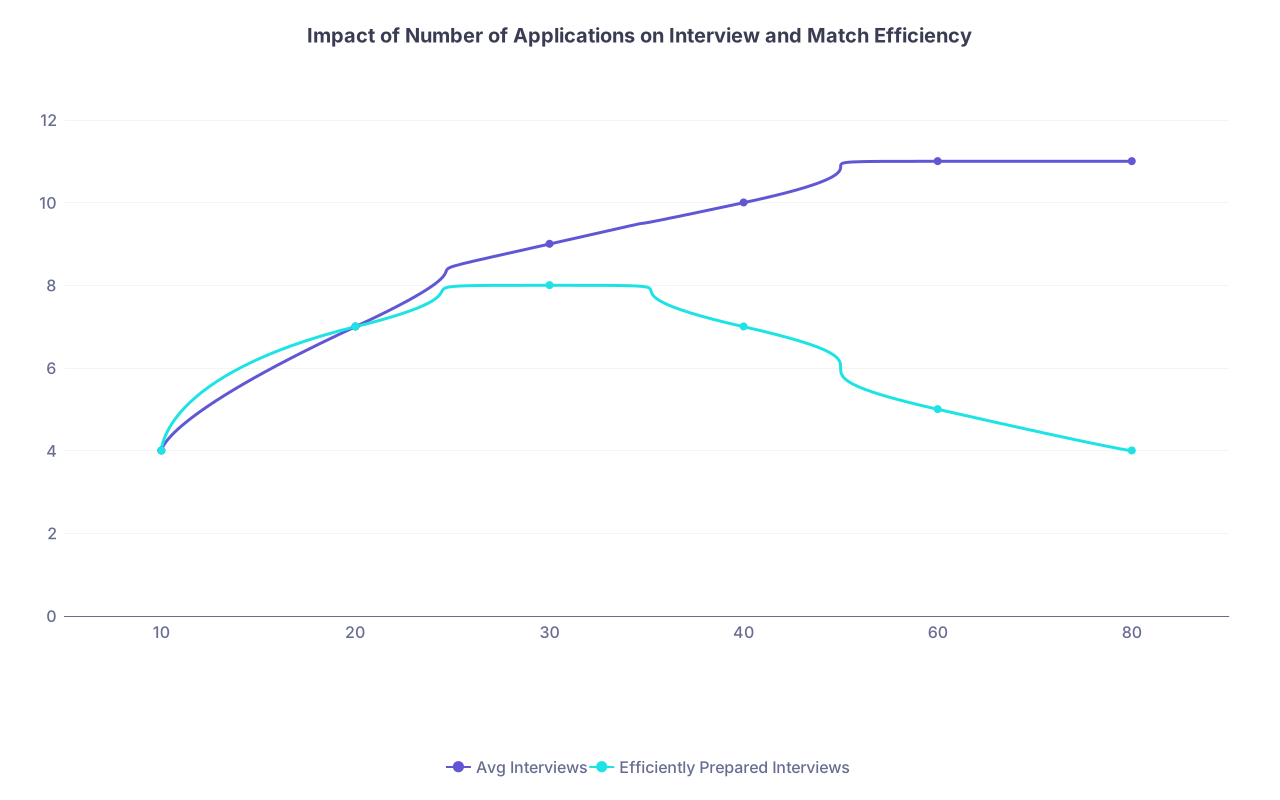
| Category | Avg Interviews | Efficiently Prepared Interviews |
|---|---|---|
| 10 | 4 | 4 |
| 20 | 7 | 7 |
| 30 | 9 | 8 |
| 40 | 10 | 7 |
| 60 | 11 | 5 |
| 80 | 11 | 4 |
You can see the pattern in real cycles: interview numbers plateau way before 80 applications, but the proportion you can genuinely prepare for drops hard.
3. Your Story Looks Incoherent
Strong applicants have a clear narrative:
- Specific clinical interest.
- Recognizable research thread.
- A reasonable geographic or professional logic to where they applied.
Over-applicants look scattered.
I have seen one applicant apply to:
- A heavy research-focused academic program famous for basic science.
- A community-based clinically heavy program with minimal research.
- A geographically scattered set of institutions with no clear rationale.
- Different subspecialty tracks at different places that do not align.
On paper, it reads like: “I just need something, somewhere.”
That is not appealing. Especially in competitive fellowships where programs want people who will stay in their niche, continue their research, and become future faculty or local leaders.
Program Perspective: What Over-Application Signals to Them
You think you are being rational. Programs see something different.
Red Flag #1: Disconnected Interests
If your ERAS list shows:
- Cardiology academic research programs.
- Community cardiology programs.
- Cardio‑oncology niche tracks.
- Intensive interventional tracks.
- And simultaneously, a handful of clinical‑only general medicine fellowships.
The question on their side is simple: what does this person actually want?
Program directors are not hunting for “flexible” people. They are hunting for people who have thought this through, committed to a direction, and will not bail halfway.
Red Flag #2: Weak, Generic Letters and Statements
Over-applicants often rush their letter strategy.
Common errors I have seen:
- Asking letter writers late because you were too busy finalizing 70 applications.
- Not guiding writers on your specific fellowship focus (“Anything is fine, I just need a strong letter”).
- Submitting a generic personal statement everywhere because you ran out of time.
Faculty who screen for top programs are quick to notice:
- LORs that read like “good resident, showed up, dependable” with nothing specific.
- Personal statements that say nothing about why this particular subspecialty, why this kind of program, why this region.
That generic smell? It is a known red flag.
Red Flag #3: Inconsistent Communication and Cancellations
With 50+ applications, here is what often happens:
- You forget to respond to a couple of interview invitations until they expire.
- You double-book yourself.
- You cancel interviews last minute when a more “prestigious” name invites you for the same date.
- You send one-line, vague thank you emails—or none at all—because you are overwhelmed.
Programs absolutely remember:
- “They no-showed our interview.”
- “They canceled the night before.”
- “Their email said, ‘Thank you for the opportunity at [wrong program name].’”
This kind of sloppiness undercuts you far more than applying to fewer places ever would.
The Financial and Time Blowback You Are Underestimating
Let us be blunt: over-applying is not just a strategic mistake. It is financially stupid.
| Number of Programs | ERAS Fees (Approx) | Interview Travel/Tech | Total Est. Cost |
|---|---|---|---|
| 20 | $550 | $600 | $1,150 |
| 40 | $1,100 | $1,200 | $2,300 |
| 60 | $1,900 | $1,800 | $3,700 |
| 80 | $2,800 | $2,400 | $5,200 |
Even with many interviews now virtual or hybrid, you pay a real price:
- Extra ERAS fees.
- Upgraded Wi‑Fi, better camera, quiet space rentals when you are on call.
- Lost income from moonlighting because you are constantly on interviews.
- Hidden cost: the stress and fatigue that bleed into your clinical work.
Everyone underestimates the time cost:
- Customizing applications (if you do it right).
- Reading up on faculty and research before each interview.
- Thank you emails and follow-up communication.
- Actually ranking programs thoughtfully.
Now layer that on top of:
- Night float.
- ICU rotations.
- Board studying.
- A life (if you still have one).
Over-applying is essentially a way to guarantee you will do everything worse for 3-4 months.
When Over-Applying Starts to Hurt Your Reputation
This is the part residents do not want to hear: your behavior in fellowship season follows you.
Inside Your Own Department
If you:
- Constantly trade away undesirable shifts for interview days.
- Complain non-stop about your chaotic interview schedule.
- Ask for “just one more” day off from already stretched services.
Your chiefs and faculty notice. They write your letters. They talk to fellowship PDs.
I have literally heard: “They applied to a crazy number of programs and were barely present this winter. Technically fine, but not the person you pick if you want reliability.”
That gets picked up in calls between program directors. Those calls matter more than you think.
Between Programs
Program directors talk. Informally, frequently.
They compare:
- Who canceled late.
- Who seemed uninterested on interview day.
- Who sent confusing signals (told everyone they were “top choice”).
If you spray a region and then treat half the programs like backups, some of those PDs will hear about it. In a subspecialty with 50 serious programs nationwide, your name is not anonymous.
The Data Reality: Diminishing Returns After a Reasonable Number
You are probably thinking: “Fine, but what if I am just not that competitive? Shouldn’t I apply widely?”
“Widely” is not the same as “recklessly.”
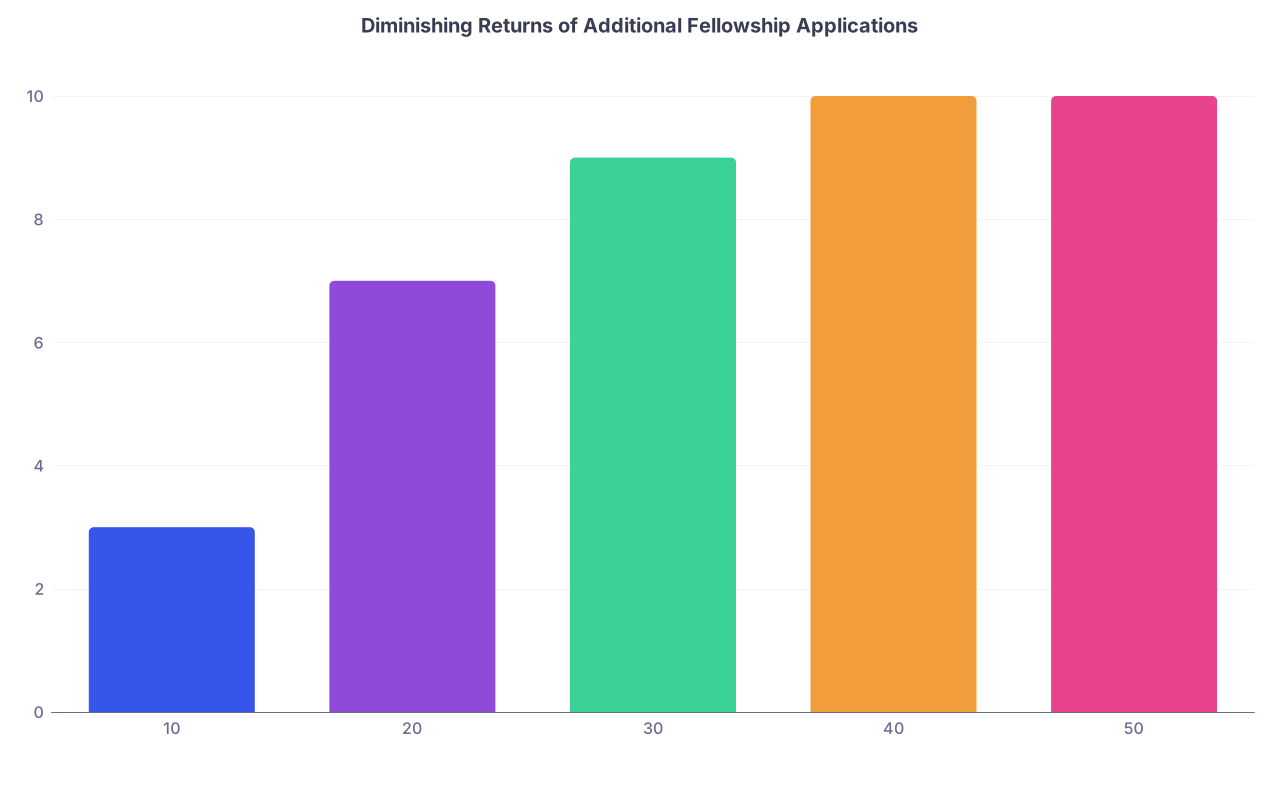
There is a clear pattern across competitive specialties and fellowships:
- Interview offers climb quickly with the first set of applications (say 15–25).
- Then the curve flattens.
- After a point, each additional 10 applications yields maybe zero or one extra interview—and often at lower-probability programs.
| Category | Value |
|---|---|
| 10 | 3 |
| 20 | 7 |
| 30 | 9 |
| 40 | 10 |
| 50 | 10 |
That 45th, 50th, 60th application:
- Rarely moves the needle.
- Adds more work.
- Increases your chance of sloppy mistakes.
- Crowds your interview calendar in unpredictable ways.
Most competitive fellowship PDs will tell you some version of this off the record:
- Strong applicants: 15–25, targeted, thoughtful.
- Solid applicants with a few weaker areas: 25–35.
- Applicants with major red flags or weak metrics: maybe 40–45, but very carefully selected.
What they will not tell you is to apply to 70. Yet residents keep doing it.
How to Avoid the Over-Application Trap (Without Being Naive)
I am not telling you to apply to 8 programs and “trust the process.” That would be stupid.
I am telling you to be strategic instead of fearful.
Step 1: Define a Coherent Target Profile
Before you touch ERAS, answer these clearly:
- What is my subspecialty goal within this field (for example, advanced heart failure, cardio‑onc, outcomes research, procedural heavy, pure clinical)?
- What kind of environment do I actually want (research‑heavy academic, clinically intense tertiary center, balanced academic‑community)?
- Where am I realistically competitive based on my metrics (US grad vs IMG, publications, program pedigree, letters, Step scores where still used)?
If that picture is fuzzy, over-applying will not fix it. It will expose it.

| Step | Description |
|---|---|
| Step 1 | Start |
| Step 2 | Clarify interest with mentors |
| Step 3 | Meet PD or advisor |
| Step 4 | Define target program types |
| Step 5 | Select 20-35 aligned programs |
| Step 6 | Prepare tailored applications |
| Step 7 | Clear subspecialty goal |
| Step 8 | Know competitiveness level |
Step 2: Build Tiers That Make Sense
Do not just sort by “Reputation” and go down the list.
Think instead:
- Tier 1: Aspirational but plausible places where you truly fit.
- Tier 2: Strong, realistic matches aligned with your interests.
- Tier 3: Safer programs that still make sense for your career goals.
Then cap yourself.
Example for a reasonably competitive cards candidate:
- 8–10 Tier 1.
- 12–15 Tier 2.
- 5–8 Tier 3.
Total: 25–33. Manageable. Defensible. Customizable.
Step 3: Customize Like Someone Who Respects Their Own Time
You can avoid most self-inflicted wounds with one rule:
If a program is not worth 30 minutes of targeted customization, you should not apply there.
“Customization” is not writing a completely new essay every time. It can mean:
- One core personal statement with 2–3 alternate paragraphs you swap in.
- A short paragraph in the “why this program” box with specifics: particular track, named faculty, region‑based reason that is not generic (“nice city” is not a reason).
- Checking your letters align (for example, having at least one letter from someone in that subspecialty).
Over-applying makes that level of care impossible for 60 programs. That is the point.
Common Rationalizations That Will Get You in Trouble
You will hear these from co-residents. You might say them yourself. Recognize and ignore them.
“I know someone who applied to 70+ and matched at a top place.”
Survivorship bias. You did not see the 30 others who did the same and crashed.
“Programs expect everyone to apply widely.”
No, they expect everyone to apply broadly but logically. There is a difference.
“I will just cancel interviews later if I get enough.”
That is not harmless. You are burning goodwill—in a small field.
“I do not have time to be selective.”
If you do not have time to be selective, you certainly do not have time to write 60 decent applications. You are just choosing a bigger mess.
A Saner, Stronger Strategy
You want to avoid the classic fellowship application mistake? Do this instead:
- Pick a reasonable, honest application cap. Stick to it.
- Invest heavily in:
- Strong, detailed letters from the right people in your subspecialty.
- A coherent personal statement and narrative.
- Thoughtful program selection that you can explain in one sentence each.
- Protect your clinical reputation during interview season. Do not become the resident who vanished from the wards for two months.
The residents who do this do not look reckless. They look deliberate. Programs like deliberate.
Key Points to Remember
- Over-applying in competitive fellowship cycles does not just waste money; it degrades your application quality, creates logistic chaos, and makes your narrative look unfocused.
- Programs can tell when you sprayed applications widely. Cancellations, generic statements, and inconsistent interests all signal you are not seriously invested in them.
- A capped, targeted list of well‑matched programs—backed by strong letters and a coherent story—protects you far better than a panicked blast of 60+ low-quality applications.