
What if the thing that ruins your fellowship chances isn’t your letters, or your research, or your interview… but that one stupid failed board attempt from years ago that you can’t erase?
Welcome to the mental loop a lot of residents live in and don’t talk about out loud.
You’re sitting in conference, someone casually jokes, “Yeah, programs don’t like multiple board failures,” and your stomach drops because you don’t have multiple. You have one. But it feels radioactive. Like it’s written in red ink on every ERAS / SF Match / whatever screen any PD opens.
Let’s pull this apart honestly. No sugarcoating, but no doomsday either.
How Programs Actually See a Failed Board Attempt
First harsh truth: yes, they see it. You can’t hide it. It’s there.
Second, more nuanced truth: it does not automatically kill your fellowship options. But it absolutely changes the game.
I’ve seen people with:
- Failed Step 1 → matched GI.
- Failed Step 2 CK → matched Cardiology.
- Failed ABIM (first attempt) → still matched Hem/Onc.
- Failed Step 1 and failed ABIM twice → struggled hard and ended up in non-ACGME or no fellowship.
So it’s not binary. It’s risk–benefit from their point of view. You’re not a person to them at first; you’re a file. Programs scan that file and subconsciously ask:
“Is this someone who is likely to pass the subspecialty boards and represent our program well?”
That failed attempt is a yellow flag. Not automatic rejection. But they want to see what you did after you tripped.
Let me be specific:
- One failed board attempt with strong subsequent scores and no repeating pattern → often survivable.
- One failed attempt with borderline passes afterward → riskier, depends heavily on everything else.
- Multiple failed attempts across different exams → this starts to become a pattern programs really worry about.
They’re protecting their fellowship board pass rates. It sounds cold, but that’s reality.
How Much Does It Hurt… Really? (By Context)
The answer depends heavily on three variables: specialty competitiveness, which exam, and what happened next.
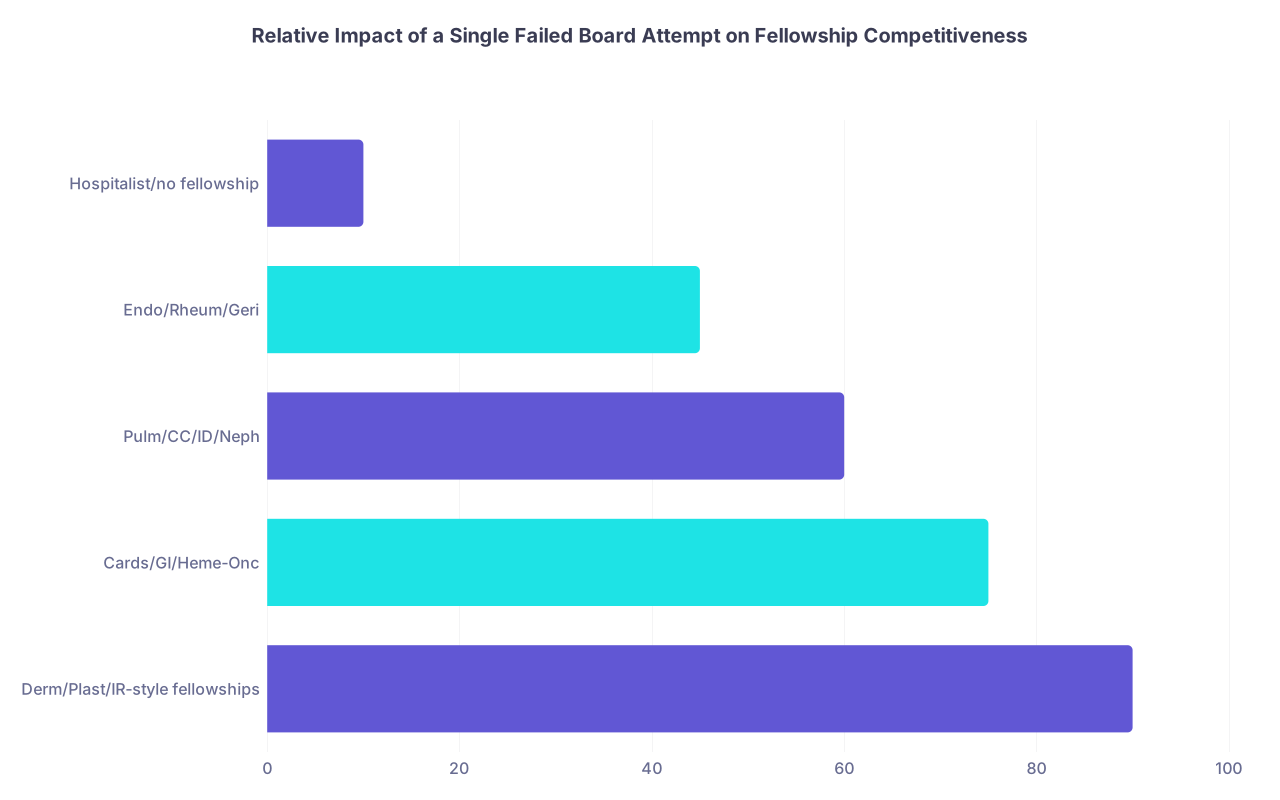
| Category | Value |
|---|---|
| Derm/Plast/IR-style fellowships | 90 |
| Cards/GI/Heme-Onc | 75 |
| Pulm/CC/ID/Neph | 60 |
| Endo/Rheum/Geri | 45 |
| Hospitalist/no fellowship | 10 |
Interpret that like “percent chance it matters a lot,” not match rates.
1. By Fellowship Competitiveness
The brutal hierarchy:
Highly competitive fellowships (Cards, GI, Heme/Onc, IR, some procedural subs)
Here, a failed attempt is a real hit. Not impossible, but you’ll need compensating strengths: high in-training scores, research, strong home program support, maybe a niche angle (e.g., advanced imaging, complex EP interest).
Moderately competitive (Pulm/CC, some ID programs, good Endo, Rheum)
They’ll notice it, but a strong application can absolutely override it. Your narrative and upward trajectory matter a lot.
Less competitive fellowships (Geri, some Neph, some community Endo/Rheum)
They care more about: are you reliable, will you pass boards eventually, will you show up and do the work? A past failure is a concern, but not a door slam.
2. Which Exam You Failed
There’s a rough “oh no” scale here.
| Failed Exam Type | Typical Impact at Fellowship Level |
|---|---|
| USMLE Step 1 (old numerical era) | Moderate |
| USMLE Step 1 (pass/fail era) | Moderate–High (because pass is expected) |
| USMLE Step 2 CK | High |
| USMLE Step 3 | Low–Moderate |
| In-Training Exam (ITE) only | Low (unless repeatedly very low) |
| Specialty Board (e.g., ABIM/ABFM) | Very High |
Step 1 fail
If you failed Step 1 but then did fine or above average on Step 2 CK and passed Step 3, many PDs will mentally translate this as: early stumble, later recovery. Still a red mark, but somewhat forgivable.
Step 2 CK fail
This one stings more because it’s closer to clinical reasoning. Fellowship PDs care about this more than Step 1. But again: a later good performance (passing boards on first attempt, strong in-training) helps a lot.
Failed specialty board (ABIM/ABFM/ABS, etc.)
This is the most dangerous one at fellowship level. You’re literally asking a subspecialty program: “Trust me to pass another board exam, after I just failed the core one.” It’s not impossible, but it triggers max anxiety for PDs.
The “Pattern” That Scares Programs (And How to Break It)
Programs don’t fear a single event. They fear patterns.
If you failed one exam but:
- Passed all subsequent exams on first try
- Have in-training exam scores trending up
- Don’t have other red flags (no professionalism issues, no unexplained leaves, no remediations)
…a lot of PDs will file you under: “Had a rough patch, seems okay now.”
If instead they see:
- Failed Step 1
- Barely passed Step 2
- Step 3 taken late with low score
- Fellowship in-training exams in bottom quartile
- Now failed primary board exam
This reads as: chronic concern. Not just “bad test day.”
So if your failure is in the past, your whole job now is to build overwhelming evidence that the pattern is broken.
That means:
- Crush your in-training exams. Like, not just “pass.” Aim for average or above.
- Take board prep seriously, early, not two weeks before.
- Show consistency: no other performance issues.
What You Can Do If You Already Failed Once
Let’s say it’s already done. You failed. You’ve replayed that score release screen a thousand times in your head. You can’t time-travel. So what now?
First, some data perspective.
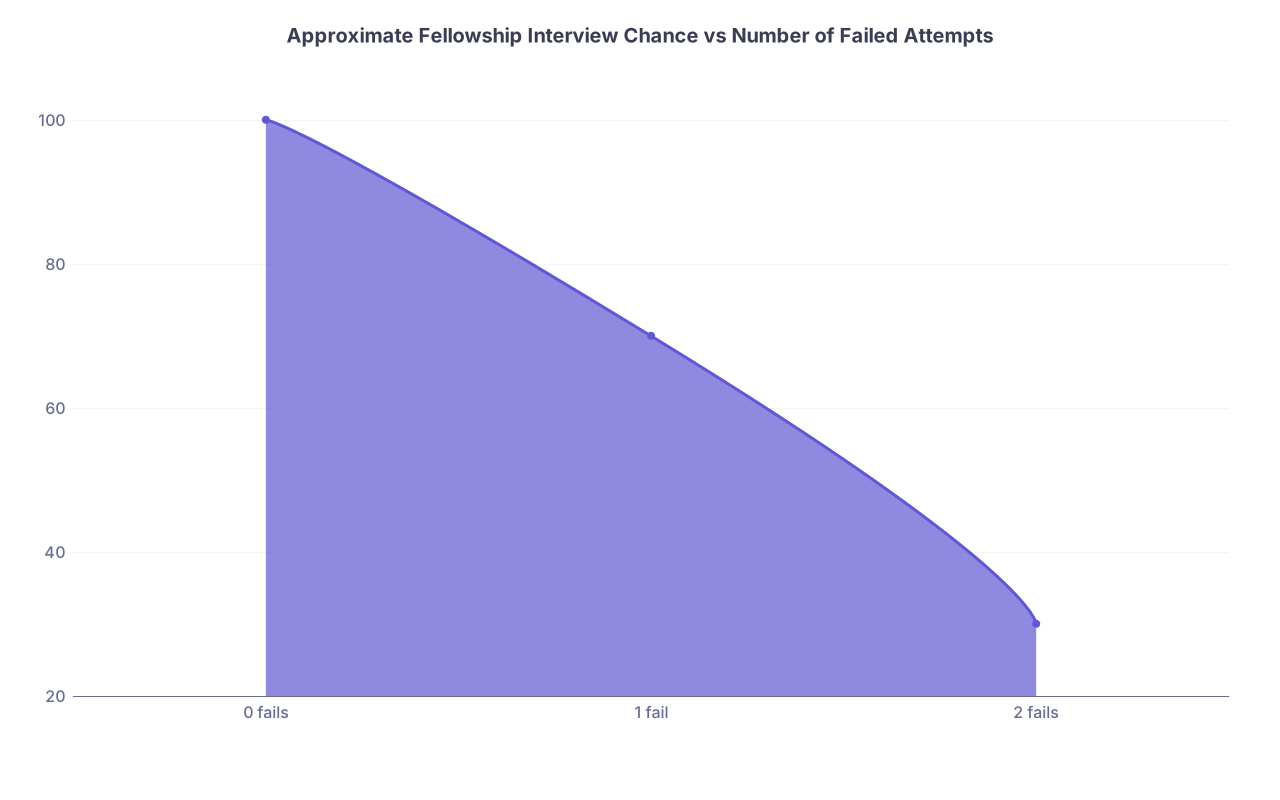
| Category | Value |
|---|---|
| 0 fails | 100 |
| 1 fail | 70 |
| 2 fails | 30 |
Not scientific, obviously. But it’s a decent emotional model: with one fail, you’re not at zero. You’re at “must be stronger in other areas.”
Concrete levers you still control:
1. Overcompensate on the things PDs actually look at
- Strong letters that specifically say you’re clinically solid and dependable.
- Research, especially if you’re going into a competitive field.
- Leadership or teaching that shows maturity and responsibility.
- A personal statement that doesn’t sound like a generic “I love GI because it combines procedures and long-term relationships” nonsense.
2. Decide your level of transparency
Do you bring up the failure in your personal statement? Sometimes. Not always.
You should consider addressing it briefly if:
- It’s a specialty board failure, or
- It’s recent, or
- It’s part of a larger story (illness, major life crisis, genuine context, not excuse-making)
And if you address it, keep it short. Something like:
“During [exam], I failed on my first attempt. At the time, I was managing [brief context, if relevant], and I underestimated the preparation needed. Since then, I’ve adjusted my approach significantly, as reflected by [later pass, stronger ITE scores, etc.]. I’ve learned to treat standardized exams as part of my professional responsibility, not just a hurdle.”
Don’t write a full-page therapy session. PDs don’t want that.
3. Fix your test-taking reality, not just your story
If you failed because you truly struggle with standardized tests, pretending that’s solved won’t help. You need receipts.
That might mean:
- Formal test-taking coaching (not the scammy kind, an actual learning specialist if your program has one).
- Evaluation for learning disorders or ADHD if that’s a possibility and you’ve never been assessed.
- A structured, scheduled plan with accountability, not vibe-based “when I have time.”
Programs care less about “why you failed” and more about “what’s different now.”
Does a Failed Board Attempt Completely Close Top Fellowship Doors?
Not automatically. But it narrows them.
Let me be blunt:
- Want big-name Cards at places like MGH, Hopkins, Duke, UCSF with a Step or ABIM failure? You’re fighting uphill. Not impossible, but the odds aren’t kind unless everything else screams “exceptional.”
- Want a solid, mid-tier academic or strong community Cards / GI / Heme-Onc with one failure and a strong rebound story? Very possible.
- For less competitive fellowships, one board failure with a good recovery absolutely still = realistic shot.
The real question isn’t “Can I match fellowship?”
It’s “Where am I still competitive, and what am I willing to do to maximize my odds?”

| Step | Description |
|---|---|
| Step 1 | Failed Board Attempt |
| Step 2 | Strongly reconsider competitiveness and timeline |
| Step 3 | Apply broadly with targeted story |
| Step 4 | Focus on less competitive fellowships and strengthen profile |
| Step 5 | Seek strong letters and research |
| Step 6 | Delay application or pursue extra year to improve |
| Step 7 | Number of Failures |
| Step 8 | Subsequent Scores Strong |
Notice: no box in there that says “Give up entirely.”
How PDs Actually Talk About This Behind Closed Doors
I’ve sat in rooms where they’re scrolling through apps and someone says:
“Board fail on Step 1 but did fine on Step 2 and strong ITE. I’m not too worried.”
or
“Failed ABIM last year… we need to be careful; our board pass rates have been shaky already.”
It’s not always a dramatic, table-slamming reaction. Most of the time it’s:
- Quick notice of the red flag
- A check for compensating data
- A gut call by the PD and committee
You’re imagining them obsessing over your failure for 30 minutes. Reality: sometimes it’s a 10-second glance, then “okay, what else?”
Your job is to give them so much “what else” that they see a whole person, not just a score.
Reframing the Worst-Case Scenario
Your nightmare scenario is: “I failed once, so my whole career is ruined.”
Let’s stretch that to actual worst-case realistic scenarios:
- You don’t match first cycle into your dream fellowship.
- You need to apply more broadly, consider less competitive programs, or consider a research year / chief year / hospitalist year.
- You end up in a program that’s not glamorous but solid, and you still practice your subspecialty.
- Or, yes, in some cases, you pivot and don’t do fellowship at all, and you have a perfectly real, impactful career as a generalist/hospitalist.
None of that is the “you’re unemployable” horror story your brain is feeding you at 2 a.m.
Is it what you wanted originally? Maybe not. Is it the end of professional worth? No. That’s just anxiety talking.
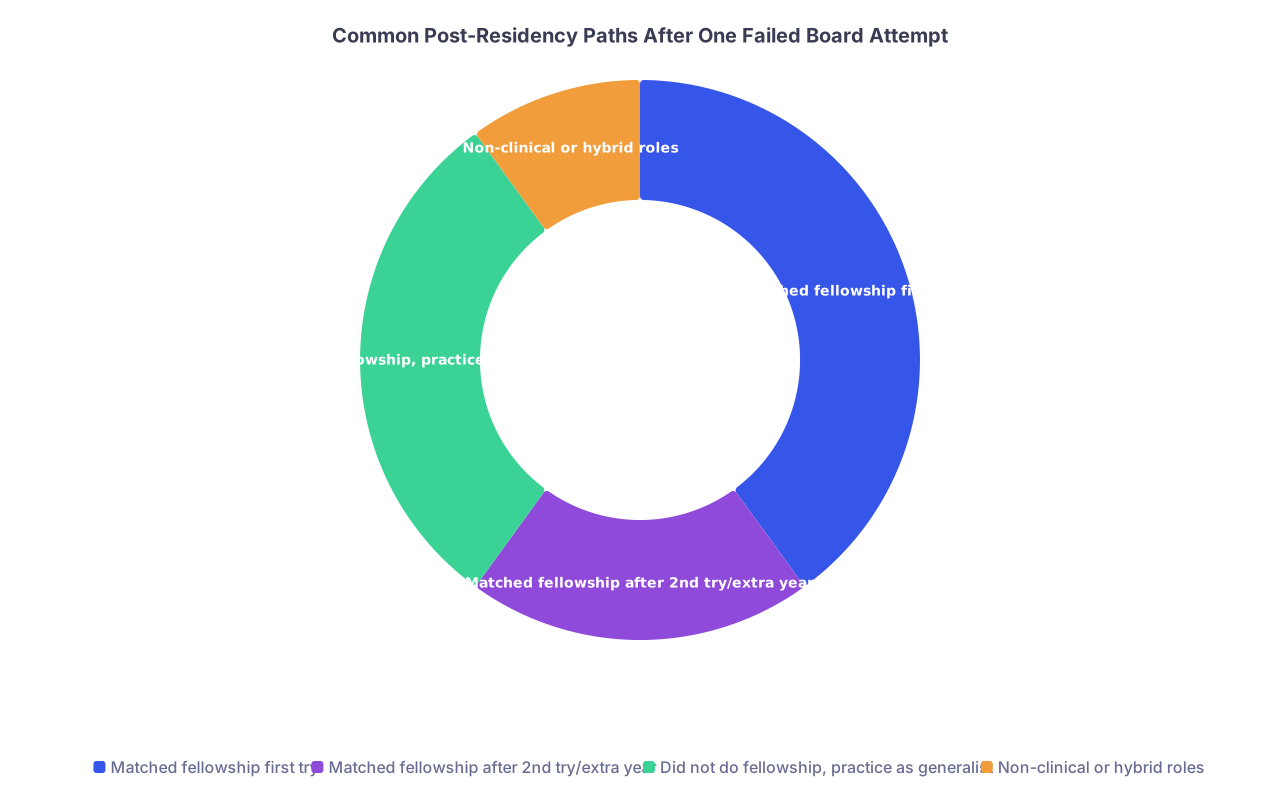
| Category | Value |
|---|---|
| Matched fellowship first try | 40 |
| Matched fellowship after 2nd try/extra year | 20 |
| Did not do fellowship, practice as generalist | 30 |
| Non-clinical or hybrid roles | 10 |
Again, these numbers are illustrative, but the point stands: lots of roads remain open.
Practical Moves for the Anxious, Board-Burned Resident
If you’re reading this in full catastrophizing mode, do three things:
Get your real data
Talk to someone who sees fellowship applications regularly: program director, APD, trusted mentor. Show them your full CV, not just the score. Ask: “Where do you realistically see me competitive?”Define your realistic tier
Maybe you’re no longer a strong contender for top 5 name-brand programs in the most cutthroat subspecialties. Fine. That’s painful but clear. What’s your next tier? Many excellent fellowships are not “famous.”Build a story of recovery, not perfection
You’re not going to erase the failure. You can show growth, accountability, and consistency since then. That’s something PDs actually respect more than fake invincibility.

Quick Reality Checks (So You Stop Doom-Scrolling)
- One failed board attempt hurts. It doesn’t erase your shot at fellowship.
- Programs care about what you’ve done since the failure as much as the failure itself.
- Specialty board failures are more serious than a single USMLE fail, but both can be overcome with a strong recovery story.
- Your file is more than a score: letters, research, clinical reputation, and in-training scores all shift the equation.
- Worst case usually means “less fancy path,” not “no career.”

FAQ (Exactly 6 Questions)
1. Should I delay applying for fellowship if I just failed my specialty boards?
If you can retake and pass before applications or interviews, delaying a cycle can actually help. A pass on the second attempt plus strong in-training scores makes your story much safer. If you apply while you’re still “failed and pending,” many PDs will hesitate. So if your heart is set on a competitive subspecialty, a one-year delay with a clear win (board pass, research, chief year, etc.) is often smarter than rushing in half-fixed.
2. Do I need to explain my failed attempt in every interview?
No. Don’t walk in and volunteer it like a confession. If they ask, answer directly and briefly: what happened, what you changed, and what’s different now. If they don’t ask, your letters, in-training scores, and application should already be speaking to your current competence. Over-explaining makes it feel bigger than it is. You’re not hiding it; you’re just not turning it into your whole personality.
3. Will a failed USMLE Step 1 automatically screen me out from competitive fellowships?
Some hyper-competitive programs do use hard filters and might never open your application. You can’t fully control that. But many places look more holistically, especially if your later performance is strong. So yes, it hurts in the most cutthroat places, but no, it’s not an across-the-board death sentence. Think “fewer doors, not zero doors.”
4. How many failed attempts is basically unrecoverable for fellowship?
There’s no magic “three strikes” rule, but once you’re at multiple failures—especially on core or specialty boards—your options shrink dramatically. At that point, your best bet is usually: fix the pattern (get specialist help for test-taking), pass the needed exam, and then strongly consider less competitive fellowships or alternative career paths. One failure is “concerning but potentially fixable.” Multiple failures start to look like a chronic risk to programs.
5. Does strong research really offset a board failure?
It helps, but it’s not a magic eraser. Research makes you attractive academically and can push you above similar applicants with clean board histories but weak CVs. But if a PD is worried you won’t pass subspecialty boards, ten publications won’t fully calm that fear. Ideal combo: board failure in the past, strong rebound on exams, plus a research track record that screams “I’ll be an asset to your program.”
6. If I don’t match fellowship because of this, am I basically stuck in a worse career forever?
No. That’s the anxiety voice talking. You might need a less direct route: hospitalist for a few years, extra research, second application cycle, or settling into generalist practice. But “worse forever” is dramatic and untrue. Plenty of people who never did fellowship have incredibly fulfilling careers, good income, and real impact. Would not matching sting? Of course. Is it a total life-wrecking endpoint? Absolutely not.
Key takeaways:
A failed board attempt hurts, but it’s not automatic fellowship suicide—your trajectory afterward matters more than the single event. Competitive fellowships will make you work harder to prove you’re low-risk, but many programs will listen if you show real recovery, strong clinical performance, and honest accountability. Your career is bigger than one exam screen you can’t stop replaying in your head.