

It’s late June. You’re a rising PGY‑3, you’ve finally decided on a fellowship, and you just sent that carefully worded email:
“Dear Dr. Smith, I was hoping you would be willing to write me a strong letter of support for my fellowship applications…”
They reply in ten minutes: “Of course, happy to support you.”
You breathe out. You think: “Great. That’s locked in.”
Let me tell you what actually happens next. And what “supportive” really means on the program‑director side of the screen.
Because I’ve seen the letters. I’ve seen how fellowship directors read them. I’ve sat in those meetings where we scroll past glowing prose that secretly means: Do not rank this person anywhere near the top.
You deserve to know the code.
The Uncomfortable Truth: Most PD Letters Are Coded Messages
Here’s the first thing people do not tell you: fellowship programs do not read your PD letter the way you think they do.
They do not read it like, “Oh wow, this is so nice, they said you’re hardworking and a team player.” They read it like a cipher.
They’re hunting for three things:
- Where you sit relative to your peers
- Whether there are any hidden red flags
- Whether the PD is actually going to bat for you, or just filling an obligation
And PDs know this. So they’ve evolved an entire language of subtext.
Let’s start with the most basic translation.

What “Supportive” Actually Means
Residents hear:
“Supportive letter” = strong endorsement, personalized, enthusiastic.
Program directors mean at least four very different things when they say they’ll “support” you:
Category 1 – True champion:
They know you well, like you, trust you, and will spend real capital on you. This is the small minority.Category 2 – Positive but generic:
You did fine. You’re not a problem. They’ll write something pleasant, basically a polished version of your evaluations.Category 3 – Obligatory, mildly concerning:
You asked. They can’t really say no. The letter will be “supportive” in the sense that it’s not obviously torpedoing you, but the code will be clear to anyone reading it.Category 4 – Quiet warning shot:
They think you’re risky. No overt slander, but they’ll build enough distance, qualifiers, and omissions that a savvy fellowship director will back away.
From the outside, categories 1–3 often sound similar to you. To us on the selection side, they’re not remotely similar.
The Codebook: Phrases That Mean More Than You Think
Every PD and APD picks up this vocabulary over years. Nobody teaches it formally. You learn from watching what happens when your letter is compared against dozens of others in a selection meeting.
Let me decode some of the most common patterns.
1. The Comparison Clause: Where You Actually Rank
Any time your PD mentions you relative to peers, that’s the gold.
Fellowship directors zoom in on sentences like:
- “One of our top residents this year.”
- “Among the top 10% of residents I’ve worked with.”
- “In the upper half of our graduating class.”
- “Comparable to our typical graduates.”
Translation:
- “Top 10% / truly exceptional / among the best”: This is as strong as it gets. They’re spending capital.
- “Top third / top quarter”: Good, but not elite. Safe. Solid.
- “Upper half / above average”: That’s a polite way of saying: not a star, but not a problem.
- “Comparable to our usual graduates / solid resident / meets expectations”: This is a ceiling, not a compliment. It means you did not distinguish yourself.
If your PD letter does not place you relative to your peers at all, that’s also information. Often negative.
Why? Because when we want to endorse someone strongly, we almost always say where they sit in the cohort. Silence equals: “I can’t honestly say they’re top tier.”
2. Adjectives That Are Actually Warnings
Certain adjectives look positive to you and your family. In committee, they read as “handle with care.”
Let me walk through a few you’ll see in “supportive” letters that are not really supportive.
“Dependable” / “reliable”
On its own, fine. If it’s listed as the strongest trait, it often means: basic, not brilliant.“Hard‑working”
If it’s coupled with “exceptionally bright” or “insightful,” then good. If the whole paragraph is “hard‑working, dedicated, shows up early, stays late,” with no mention of judgment, clinical acumen, or ownership, we read: low ceiling, tries hard, not gifted.“Pleasant” / “well‑liked” / “a joy to work with”
Great as a bonus detail. If it’s front and center and there’s no meat on clinical skills, it can sound like: nice but average.“Teachable” / “coachable”
Code for: needed a lot of correction.“Improved over time” / “responded well to feedback”
Always triggers a question in the room: “How bad was it before?”“Matured considerably during residency”
Somebody brings up: “What were they like as a PGY‑1?”
On the flip side, the words that actually move a needle are things like:
- “Outstanding clinical judgment”
- “Independent yet knows limits”
- “I trust them to run the unit / cross‑cover / triage”
- “Faculty consistently request working with them”
- “I would hire them as faculty”
You’ll notice: less fluff, more trust language.
3. The Subtle Distance Moves
A PD who’s trying to not endorse you strongly, without writing a hatchet letter, does a few recognizable things.
Common moves:
Third‑hand knowledge:
“By all accounts, Dr. X is a committed and enthusiastic resident.”
Translation: I’m not going to personally vouch for this. I’m reporting hearsay.Short letter:
View this as almost diagnostic. A “strong” letter that’s 3 short paragraphs where half is a description of the program? That’s not strong.Program overview filler:
Long paragraphs about “We are a 700‑bed tertiary care center with 18 residents per year…” means they didn’t have enough to say about you.No anecdotes:
A truly supportive PD will usually give at least one specific moment: “I first noticed Dr. X when…” or “On a recent night on the MICU, they…”
If your letter is 100% generic adjectives, no moments, fellowship PDs know exactly what that means.Group praise:
“Our residents are known for their strong work ethic, and Dr. X fits this tradition.”
This is not personal advocacy. This is: “They’re like everyone else here.”
How PDs Actually Write These Letters Behind Closed Doors
Let me pull you into the back office for a minute.
It’s August. We’ve got 15 residents applying to various fellowships. The PD’s in between meetings, the coordinator has a spreadsheet of due dates, and there are 6 half‑finished letters open on one monitor.
Here’s what’s really happening.
| Applicant Type | Time Spent | Detail Level | Risk Taken in Advocacy |
|---|---|---|---|
| True standout | High | Very High | High |
| Solid, no issues | Moderate | Medium | Low–Moderate |
| Borderline / past concerns | High | Careful | Very Low |
| Resident PD barely knows | Low | Low | Very Low |
1. The “Template + Customization” Reality
Almost every PD has some form of template:
- Intro about program
- Standard language about evaluation methods
- Stock phrases about residency structure
Then they “drop you in” to that template:
- Your strengths paragraph
- A weakness or “growth area” paragraph (yes, we’re often forced to include some version of this)
- Summary and ranking language
So if you think you’re getting some completely bespoke essay crafted from scratch, you’re not. The question is: how much real customization they do for you.
For a resident they truly want to champion, they’ll:
- Rewrite the intro to be more personal.
- Add 2–3 distinct anecdotes.
- Rework the closing to have a clear, strong recommendation.
For everyone else, they’re slotting in phrases from previous letters, editing a bit for accuracy, and moving on.
2. The “Quiet Scorecard” We Use Mentally
We don’t always write this out explicitly, but in our heads, we’re scoring you across a few domains. And those scores leak into the letter.
Common domains we’re thinking about:
- Clinical ability and judgment
- Work ethic / reliability
- Professionalism / behavior
- Team function / collegiality
- Exam performance / in‑training / boards
- Future trajectory (independent? leader? academic potential?)
Here’s how that turns into letter language.
If you’re strong in clinical ability but average in collegiality, you’ll see:
“Dr. X is clinically very strong, with excellent fund of knowledge and sound clinical judgment. They are diligent and take ownership of patient care.”
Notice what’s missing? All the “excellent team player / loved by staff / nurses fight to work with them” language.
If you’re beloved but clinically shaky:
“Dr. X is a pleasure to work with, and patients respond well to their caring demeanor. They are a dedicated resident who continues to grow in clinical confidence.”
Again, we’re talking around the weak areas. Fellowship PDs have seen this dance for years.
3. What Happens When There’s a Problem in Your File
If you’ve had any of these:
- Formal remediation
- Unprofessional behavior write‑up
- Major conflict with staff or co‑residents
- Marginal or failed rotation
- Board exam difficulty
Your PD cannot just write a “rah‑rah, perfect resident” letter. It’s too risky for them and the program.
Instead, here’s what you’ll often see in a “supportive” letter with a past issue:
- Some version of: “Early in training, Dr. X struggled with…”
- Followed by: “Since that time, they have shown real growth in…”
- And: “We have not had further concerns in this area.”
Fellowship PDs will ask: “What exactly happened early?” That may lead to direct back‑channel calls. And yes, those calls can absolutely change your rank position.
How Fellowship Programs Read and Compare PD Letters
Let’s move to the other side of the table for a second.
You’re sitting in a cardiology or GI or hem/onc fellowship selection meeting. There’s a shared drive folder of 200 applicants. Most have similar Step scores, similar research, similar CVs.
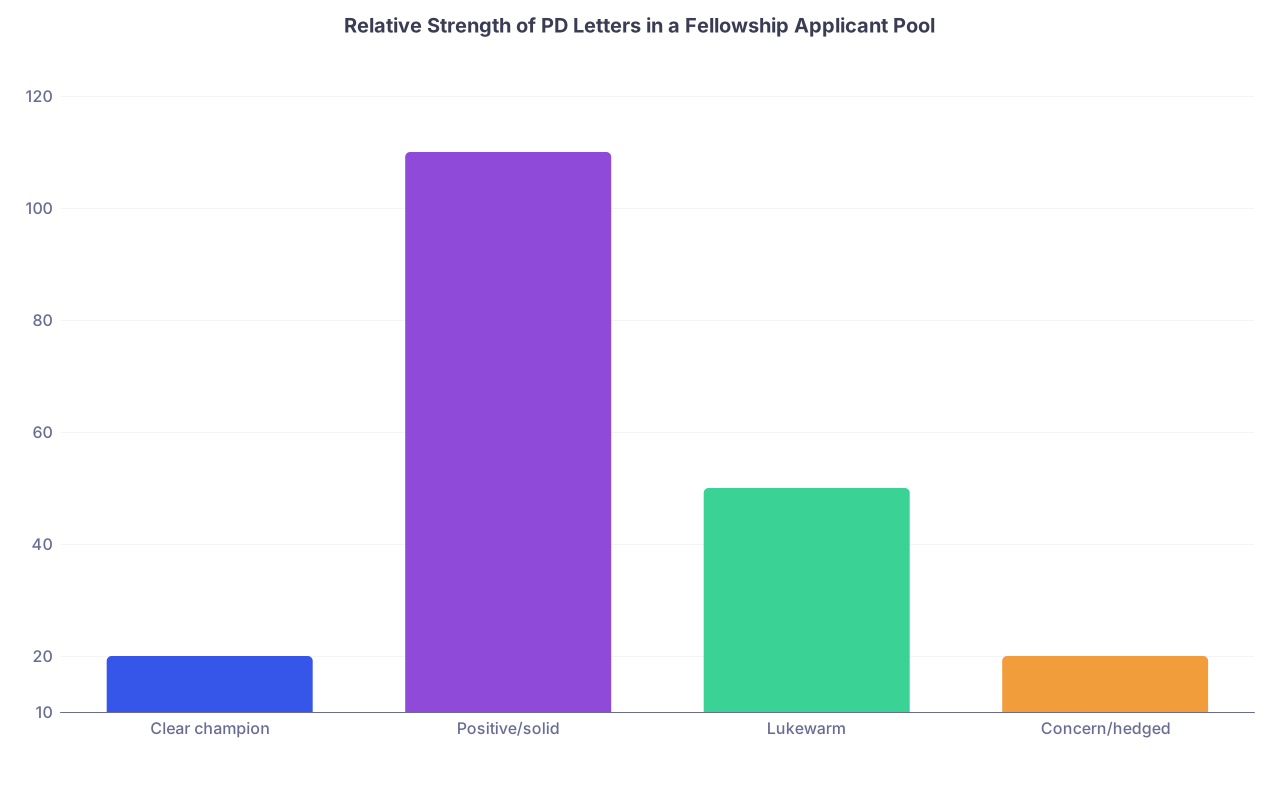
Where does your PD letter land in this mess? On a side‑by‑side stack with statements like this:
| Category | Value |
|---|---|
| Clear champion | 20 |
| Positive/solid | 110 |
| Lukewarm | 50 |
| Concern/hedged | 20 |
Roughly:
- 10–15%: clear champions
- 50–60%: positive but standard
- 20–25%: lukewarm / faint praise
- 10%: quietly or explicitly concerning
Your goal is to be in the first group, obviously. But understanding how they think helps you see how even a “positive” letter can leave you stuck in the middle.
What Actually Gets Discussed in Meetings
In real selection meetings, I’ve heard:
- “Her PD says she’s ‘one of our top residents this year’ — that carries a lot of weight.”
- “This one is very generic. Anyone see anything standout?”
- “He ‘improved considerably over three years’… what does that mean?”
- “Her PD would rehire her as faculty — that’s about as strong as it gets.”
- “This is all ‘dependable and hard‑working’ language, no mention of clinical judgment. I’m worried.”
Notice what nobody says: “Wow, such a nicely written letter.”
We’re not grading prose. We’re grading subtext.
What Triggers a Back‑Channel Phone Call
Now for the quiet part nobody talks about openly.
If your PD letter is extremely strong, or confusingly vague, or hints at an issue, fellowship PDs pick up the phone.

| Step | Description |
|---|---|
| Step 1 | Read PD Letter |
| Step 2 | Call to confirm enthusiasm |
| Step 3 | Call to clarify concerns |
| Step 4 | No call |
| Step 5 | Strengthened rank |
| Step 6 | Lowered or removed from rank list |
| Step 7 | Rank based on file only |
| Step 8 | Clear signal? |
Calls tend to happen in three scenarios:
You look stellar on paper, but PD letter is generic.
“Am I missing something?” they wonder. That may lead to:
“Off the record… they’re fine, but not a leader. Needed more supervision than peers.”PD hints at past issues or “growth.”
“Can you tell me more about the professionalism concerns?”
Your fate can swing dramatically based on that conversation.PD is effusively positive in a way that stands out.
“You said she was one of your best ever — can you expand?”
Sometimes these calls put you at the very top of the list.
Those calls are why PDs are careful. They know anything they hint at on paper might need defending orally later.
And yes, your PD might be a lot more candid on the phone than on that letter you eventually see in your ERAS/VSLO portal.
Signs Your “Supportive” Letter Was Actually Lukewarm
You might never see your actual PD letter (depending on specialty and system), but if you do, or if you get indirect hints, there are tells.
Look for these patterns:
- The letter spends more time describing the program than describing you
- There are no concrete stories or anecdotes, just adjectives
- You’re praised mostly for being hard‑working, pleasant, and reliable, without language about clinical judgment, autonomy, or leadership
- There is no ranking language (nothing like “one of our top” or “above average” or “among the best”)
- The closing line is something bland, like:
“In summary, I recommend Dr. X for your fellowship program.”
Compare that to a true champion close:
“I give Dr. X my highest possible recommendation without reservation and would be thrilled to have them as a colleague in our own division.”
Those are not the same thing, and fellowship PDs know it.
What You Can Do During Residency to Shape That Letter
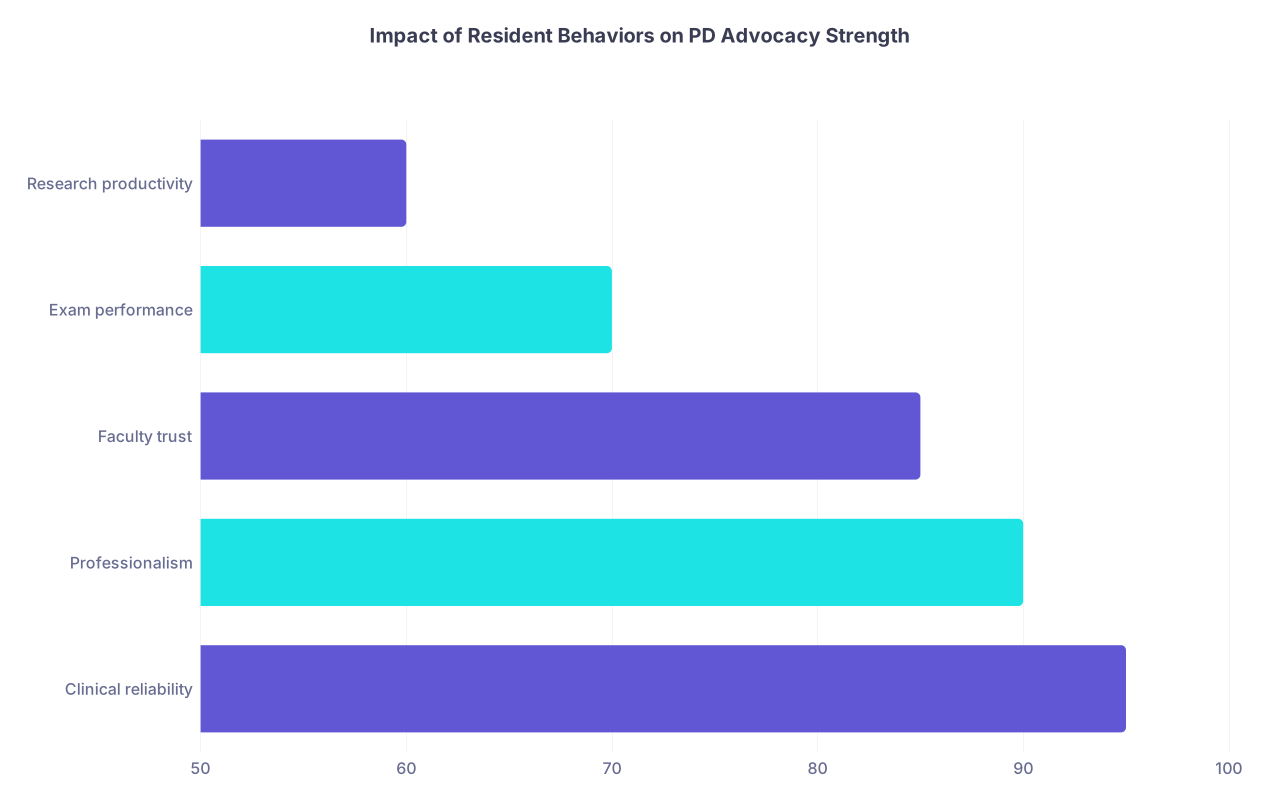
Here’s the part you actually have some control over: what your PD genuinely believes about you by the time they sit down to write.
| Category | Value |
|---|---|
| Clinical reliability | 95 |
| Professionalism | 90 |
| Faculty trust | 85 |
| Exam performance | 70 |
| Research productivity | 60 |
The things that most directly affect how strongly they’ll go to bat for you are not mysterious:
- Do they trust you to own patient care without drama?
- Have you ever created extra work for them via professionalism issues?
- Would they feel comfortable having you represent the program at another institution?
- Have you shown any signs of being a headache in the future?
I’ve watched PDs deliberately tone down letters on residents who were clinically strong but toxic. They won’t say “toxic” in writing. They’ll just omit every teamwork / leadership word and stick to the safest positive adjectives.
If you want a real champion letter:
- Be boringly professional. Zero drama. They remember the fires they had to put out.
- Be visible to leadership. If your only interaction with your PD is when something goes wrong, do not expect an A‑plus letter.
- Give them concrete wins they can reference: a situation you handled, a project you led, feedback from an ICU attending, etc.
No, you cannot script what they say. But you can absolutely influence whether they want to spend capital on you.
How and When to Nudge the PD (Without Annoying Them)
Residents get this part wrong all the time. They either send a 3‑page brag sheet that no one reads, or they send nothing and expect their PD to remember every rotation.
Middle path works best.

The “Pre‑Letter” Meeting That Helps You
The best residents did something simple: they scheduled a 15–20 minute meeting with the PD in late PGY‑2 or early PGY‑3 and framed it like this:
- “Here’s what I’m interested in and why.”
- “Here are 2–3 experiences I’m proud of that might be useful for a letter.”
- “Here’s the kind of fellowship I’m aiming for.”
That’s it. Not a monologue. Not a sales pitch. Just giving the PD handles they can grab when writing.
Program directors are busy. When your name comes up, they will absolutely remember:
- Were you thoughtful about your goals
- Did you respect their time
- Did you give them clear stories they can use
You’re not writing the letter for them, but you are stocking the pantry.
The Difference Between a Good Letter and a Career‑Changing One
There’s one last piece residents underestimate: how rare truly outstanding PD letters are.
Most are fine. A few are career‑neutral. A small number are quietly damaging.
And then there’s that tiny fraction that changes your trajectory.
They look like this:
- Specific positioning: “Top 2 or 3 residents I’ve trained in the last decade.”
- Real trust statements: “I would trust them with my own family’s care without hesitation.”
- Future prediction: “I fully expect Dr. X to be a leader in our field.”
- Willingness to stake reputation: “I give my unqualified highest recommendation.”
I’ve sat in meetings where someone’s application was on the fence — and the PD letter bumped them from “maybe” to “must interview” in 30 seconds.
Not because it was long or flowery. Because it was clear, specific, and risky. The PD put their name on the line.
You cannot demand that kind of letter. But you can live in a way — clinically, professionally, interpersonally — that makes a PD want to write it.
How to Read Your Situation Realistically
You’re not going to get perfect transparency from your PD. They’re not going to say, “I can only write you a lukewarm letter.” Most will say “supportive” by default.
So you have to piece things together:
- How often did leadership actually see you at your best, not just on a bad day?
- Did you ever create avoidable drama that escalated to their level?
- Have any attendings told you, unprompted, that they’d go to bat for you? PDs hear about that.
- When you discussed fellowship plans, did your PD sound genuinely enthusiastic or just polite?
If the answer to those questions is: they barely know me, we had some bumps, no one ever said they’d fight for me — then your “supportive” letter is probably in the middle of the pack.
Not fatal. But not magic.
That just means you have to make the rest of your application (research, interview, other letters) do more of the lifting.

The Part You’ll Actually Remember
Right now, the PD letter feels huge. Like it will define everything.
From the selection side, yes, it matters. It can absolutely swing an application up or down.
But years from now, you won’t be replaying whether your PD wrote “one of our top residents” versus “an excellent resident.” You’ll remember how you showed up every night on call when nobody was watching, and how that shaped your reputation long before any letter.
Because that “supportive” letter? It’s just the written echo of who you’ve already been for three years.
Make that person someone a director feels proud — not obligated — to support. The letter will follow.


