

The Backchannel Emails That Actually Get You Fellowship Interviews
It’s 11:47 p.m. You’re on q4 call, sitting in a half-broken chair in the call room. Your co-resident just matched into a “how the hell did they pull that off?” fellowship. Same middling Step scores. Similar CV. Yet they magically got interviews at places that straight-up ghosted you.
You hear the same phrase from everyone:
“They had people emailing for them.”
Let me tell you what that actually means — and what kind of emails move the needle versus the ones attendings delete before the second line.
I’ve sat in those closed-door fellowship meetings. I’ve watched PDs pull up their inboxes and say, “By the way, Dr. X sent a note about this applicant.” I’ve watched that single sentence push someone from “probably no” to “ok, send an interview.”
The game is not fair. But there is a game. And backchannel emails are very much part of it.
What “Backchannel” Really Means (And What It Doesn’t)
First, strip away the mystique.
“Backchannel emails” in fellowship season usually fall into three categories:
- An established faculty member emailing a fellowship PD or division chief about you
- A PD-to-PD email or text asking, “Do you know this person?” or “Is this one real?”
- A quiet nudge from alumni of your program at the target institution
You know what doesn’t count as backchannel?
You cold-emailing every PD in the country with a three-paragraph essay and CV attached. That’s just spam with a white coat.
Here’s the ugly truth: the sender matters more than the content. But the content still matters — a lot — once you clear the sender bar.
Let me show you how this actually plays out on the fellowship side.
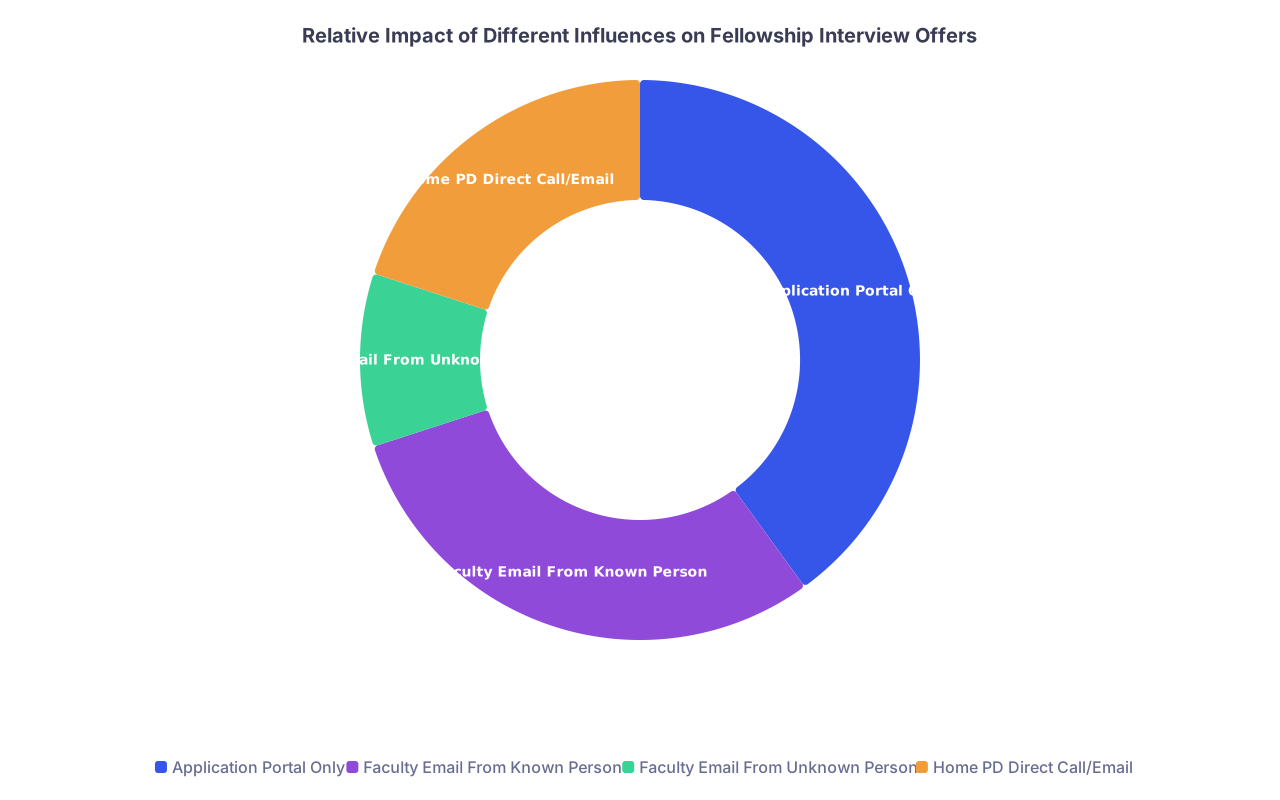
| Category | Value |
|---|---|
| Application Portal Only | 40 |
| Faculty Email From Known Person | 30 |
| Faculty Email From Unknown Person | 10 |
| Home PD Direct Call/Email | 20 |
Rough breakdown I’ve seen over multiple cycles:
- 40%: Purely judged off ERAS/central app
- 30%: Meaningfully boosted by an email from a known/credible faculty member
- 10%: Slight boost from an email by someone not personally known but clearly legitimate
- 20%: Strong nudge from a PD-to-PD communication
The part residents underestimate? That 30% + 20% is often the difference between “no interview” and “you’re on the list.”
Who Actually Has Pull (And Who Doesn’t)
This is where people get it completely wrong.
You imagine that any attending who loves you can “speak on your behalf” and suddenly Mayo and MGH will fall at your feet. That’s not how this works.
Let’s break down typical influence behind the scenes:
| Sender Type | Typical Influence on Interview Decision |
|---|---|
| Your Program Director (same specialty) | Very High |
| Division chief in your target specialty | Very High |
| Widely known subspecialist in the field | High |
| Mid-career faculty, well-published | Moderate |
| Junior faculty (assistant prof) | Low–Moderate |
| Non-faculty mentor (PhD-only, etc.) | Low |
Now add one more silent factor: relationship to the receiving program.
A mid-career cardiologist from an outside institution I’ve never met? Moderate.
A mid-career cardiologist who trained here, who texts our PD every year to catch up? That’s suddenly Very High.
So when you’re thinking about who to ask to email for you, the real calculation is:
“Who knows people where I want to go, and whose name in that inbox will make them stop scrolling?”
Not: “Who is nicest to me on rounds?”
Timing: When Those Emails Actually Get Read
People try to “time” backchannel emails like they’re trading options. You’re overthinking it.
There are three windows that matter:
Pre-screen phase (right after apps download)
Programs are doing rough triage. Scores, home institution, obvious standouts. An early email here can get you pulled out of the “maybe later” pile and placed into the “fine, let’s at least interview them” group.Interview list build phase
This is the real sweet spot. PDs sit with spreadsheets and say, “We can interview 60. Who makes the cut?” Emails that arrive in this window get mentioned out loud in committee.Late-cycle / waitlist clean-up
Late October / November. Someone cancels. A faculty member emails that day: “Any flexibility to consider this resident who just became very interested?” This can absolutely turn into a last-minute interview.
The worst time?
Months before ERAS opens, with some vague “they’re thinking of applying to your program next year.” Nobody will remember.
If you force me to give you a single best window:
- Ask your faculty/PD to send emails shortly after programs download applications but before they finalize their interview list. Call that early–mid September for most specialties.
The Anatomy of a Backchannel Email That Works
Let me show you the structure PDs actually respond to. Then we’ll talk about phrases that secretly matter.
Faculty email that helps you tends to be:
- Short enough to read on a phone between cases
- Specific enough to sound real, not copy-paste praise
- Clear about level of support (this is huge)
- Contextualized (why their program, why you)
Here’s the skeleton most attendings who “get it” use:
- Quick subject line that signals purpose
- One line of relationship + credibility
- Two to three lines describing you with specifics
- One explicit sentence about their level of support
- Optional: a line connecting you to that program
- Brief close
Example: Email That Actually Moves the Needle
Let me give you a version I have seen work almost word-for-word.
Subject: Strong applicant for your [Subspecialty] fellowship – [Your Name], PGY-3 at [Institution]
Dear Dr. [PD],
I hope you are well. I am an associate professor of [Specialty] and director of the [Subspecialty] service at [Your Institution]. I am writing regarding one of our senior residents, Dr. [Your Name], who has applied to your [year] [Subspecialty] fellowship.
I have worked with Dr. [Your Name] extensively on our [service/ICU/clinic], and they are in the top [x]% of residents I have worked with over the past [x] years. They are clinically excellent, thorough, and extremely reliable, and they handle high-acuity situations with good judgment and calm demeanor.
Beyond their clinical work, they have been productive in [brief research description], resulting in [x abstract(s)/manuscript(s)] in [general area]. They are genuinely committed to a career in [subspecialty], and I believe they would fit well in a rigorous, academic environment like yours.
I would strongly encourage you to offer Dr. [Your Name] an interview and would be happy to discuss them further by phone if helpful.
Best regards,
[Faculty Name, titles, contact info]
You’ll notice a few things missing:
No attachment of your CV. No two-paragraph background about your life story. No groveling.
Just clean, direct, and with one phrase that matters more than you think:
“I would strongly encourage you to offer Dr. [Name] an interview.”
That word “strongly” is code.
How PDs Read Between the Lines
This is the part nobody explains to you, but every PD knows.
There’s an informal “strength of recommendation” language most experienced faculty use:
- “They would do well in any program” = Good, but safe.
- “I recommend them without reservation” = Solid, but now almost boilerplate.
- “I give my strongest recommendation” or “top 5% I have worked with” = Pay attention.
- “I would especially encourage you to consider…” = Lukewarm.
- “Happy to answer questions” with no explicit ask = Neutral; often a checkbox email.
So when your mentor asks, “How strong do you want me to be?” the real answer is:
“As strong as you honestly can. If I’m not a top-tier resident, don’t say top 1%. But do not undersell me either.”
Your Role: Orchestrating Without Being Annoying
You’re not supposed to write these emails yourself, but you are absolutely supposed to orchestrate who sends them, where, and when.
Here’s the behind-the-scenes play that the savvy residents run:
Map your targets.
Make a sane list of fellowship programs where you’re a realistic candidate plus a few reaches. Not 40. Something like 10–20 where you’d genuinely go.Match faculty to programs.
For each target, ask: “Do I have anyone who trained there? Collaborates with them? Knows someone there?” That’s where you deploy your limited asks.Have a direct, adult conversation.
The residents who get help walk into an office and say, “I’m applying to [subspecialty] and [these 8 programs] are my top choices. Would you feel comfortable emailing any of these programs on my behalf, and if so, which ones?”The phrase “would you feel comfortable” is key. It gives them an exit if they actually don’t support you that strongly.
Make it easy, but do not script.
You can offer a one-paragraph summary of your work with them, your research, and your top programs. But do not hand them a full email to copy. Good faculty won’t use it. Weak faculty will, and it reads fake.Follow up once, not five times.
If they agree, a polite follow-up a week or two later is fine. “Just checking if you still felt comfortable reaching out to [Program] now that applications have been submitted.”
Residents who act like project managers without being needy are exactly the ones faculty go the extra mile for.
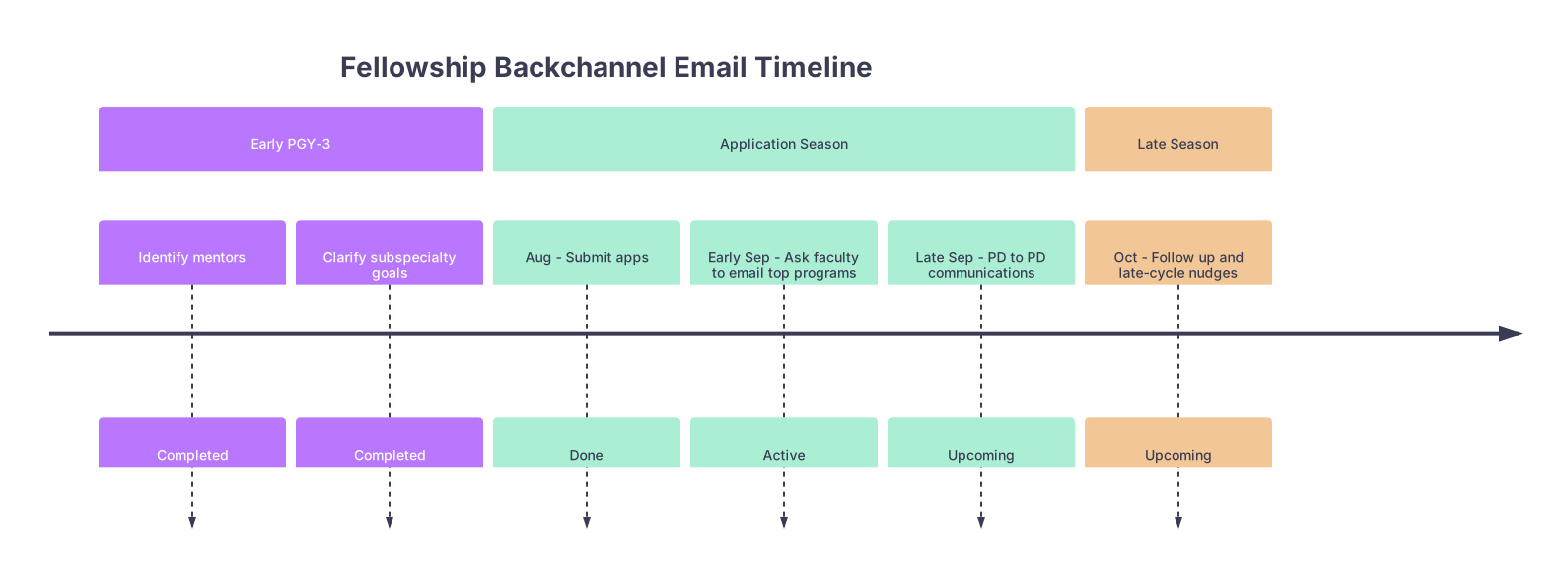
| Period | Event |
|---|---|
| Early PGY-3 - Identify mentors | Completed |
| Early PGY-3 - Clarify subspecialty goals | Completed |
| Application Season - Aug - Submit apps | Done |
| Application Season - Early Sep - Ask faculty to email top programs | Active |
| Application Season - Late Sep - PD to PD communications | Upcoming |
| Late Season - Oct - Follow up and late-cycle nudges | Upcoming |
When You Email Directly (And How Not to Embarrass Yourself)
Most PDs are indifferent to direct emails from applicants. You’re one of 200. Their inbox is burning.
That said, there are three scenarios where your own email can help instead of hurt:
- You have a genuine connection to that program or city (spouse job, family caregiving, you trained there before).
- You have a clear, time-sensitive update (accepted paper, major award, changed visa status).
- You were waitlisted last cycle and are applying again with substantial changes.
What does a sane, non-cringe applicant email look like?
Short. Specific. No attachments unless requested.
Subject: [Your Name], [Specialty] PGY-3 – strong interest in [Program] [Subspecialty] fellowship
Dear Dr. [PD],
I am a PGY-[x] [Specialty] resident at [Institution] applying to your [year] [Subspecialty] fellowship. I wanted to briefly share my particular interest in [Program].
My partner and I have deep family ties in [City], and we plan to settle there long term. I have also been following your group’s work in [specific area], and my current research with [Mentor] on [one-line topic] aligns closely with your program’s strengths.
I realize you receive many applications each year. I appreciate your consideration and would be very grateful for the opportunity to interview if my background is a potential fit for your class.
Sincerely,
[Name, contact info]
Notice what’s missing:
- You did not attach your CV; they already have your ERAS file.
- You did not mention your USMLE scores.
- You did not copy-paste generic flattery about “your esteemed program.”
Most of these emails won’t magically transform your odds. But when PDs are on the fence, a clear geographic/fit reason sometimes nudges you into the “ok, fine, we’ll see them” bucket.
How PDs Actually Use These Emails in Selection Meetings
Let me pull you into the room.
You’re in a conference room with coffee that tastes like it was brewed in 2014. PD, APD, maybe a couple of key faculty. Spreadsheet on the screen. 200–400 applicants, 50–80 interview slots. It’s surgical.
What happens:
They filter by obvious criteria. Step/board status. Visa issues. Degree. Then they start scanning down names.
This is when backchannel emails come in.
You’ll hear things like:
- “That’s the one [Dr. Famous] emailed me about.”
- “Our former fellow at [Your Institution] really likes this resident.”
- “PD at [Your Program] said this one is solid and very reliable.”
- Or on the negative side: “Their PD’s email was… not enthusiastic.”
That alone doesn’t get you ranked #1. But it absolutely gets you from row 173 to ‘let’s offer an interview’.
I’ve literally watched someone go from “eh, we have enough from that region” to “ok, add them — [Faculty X] has never steered us wrong.”
This is what you’re trying to engineer.
Not guarantees. Just a different starting position on that spreadsheet.

Common Ways Residents Screw This Up
I’ve watched very smart people sabotage themselves with backchannel stuff. A few greatest hits.
1. Carpet-bombing PD inboxes
Emailing 25 PDs yourself with essentially the same paragraph and your CV attached. They can tell. Some will filter your address. A few programs explicitly say “do not email us to ask for interviews.” They mean it.
2. Asking the wrong champions
You pick the nicest attending, not the most connected one. Or you ask a faculty member who barely knows you to “put in a strong word,” and they send a bland, generic email that effectively says, “I do not know this resident well.”
Better to have no email from that person than a weak one.
3. Over-updating
Every new poster, every tiny abstract, pinging programs repeatedly. People remember the “update every ten days” applicant — and not in a good way.
One substantial update mid-season (real accepted paper, major award, changed visa/board status) is reasonable. A constant drip is annoying.
4. Trying to script the faculty’s email
You send your mentor a 400-word draft of what you want them to say. Good mentors will ignore this and write what they believe. Less-confident mentors will just paste your words, and PDs can smell it. It reads like a personal statement dressed up as a recommendation.
Your job is to give them accurate ammo (CV, research summary, target programs). Their job is to decide what to say.
5. Ignoring your own PD
This one is fatal.
Your PD’s email carries far more weight than the random subspecialist you did a 4-week elective with at some outside place. If your PD is not “on board,” all the other emails will be interpreted through that lens.
Programs absolutely email your PD and ask, “Anything I should know?” That’s the other backchannel you don’t control directly.
So before you go chasing famous names, make sure the person who runs your residency knows you, supports you, and can speak coherently about your performance.
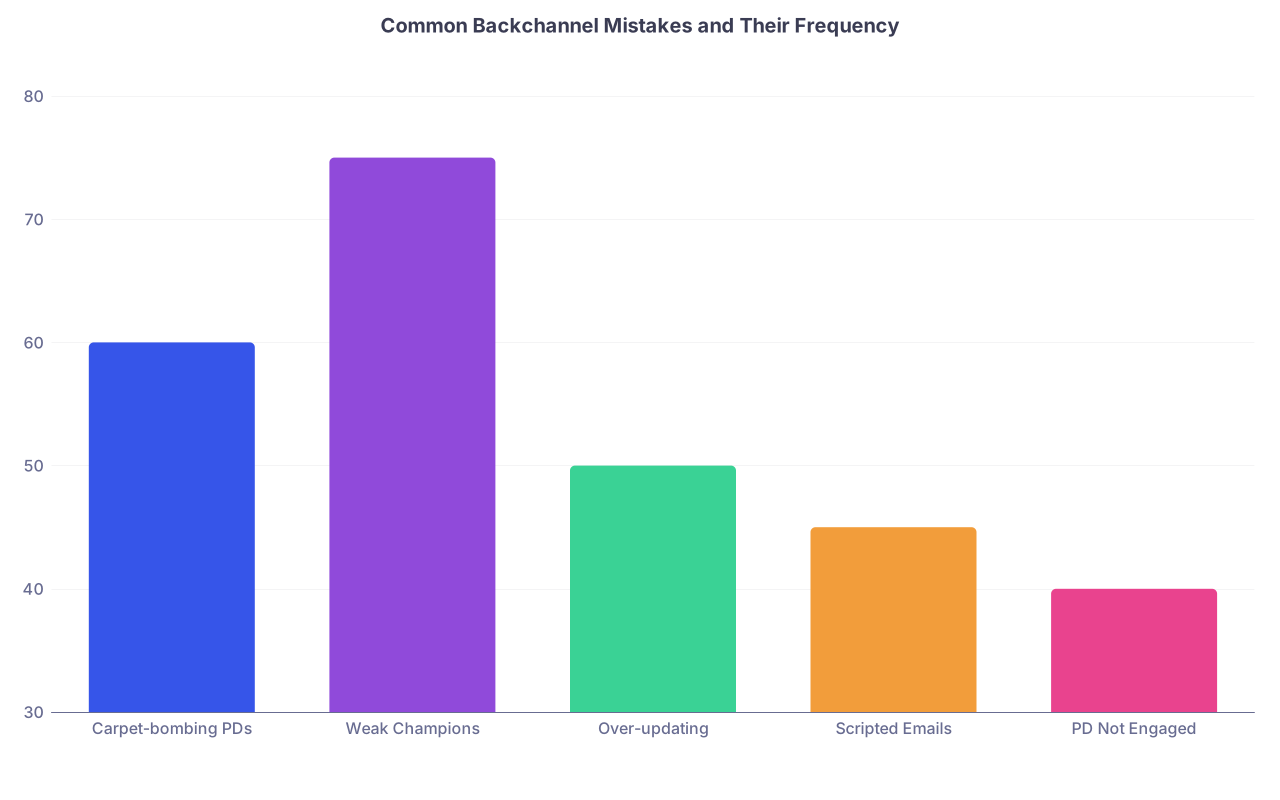
| Category | Value |
|---|---|
| Carpet-bombing PDs | 60 |
| Weak Champions | 75 |
| Over-updating | 50 |
| Scripted Emails | 45 |
| PD Not Engaged | 40 |
How Many Emails Is “Enough”?
You’re not running a political campaign. You want targeted pressure, not noise.
For a typical applicant:
- 3–6 well-placed faculty/PD emails total can make a real difference.
- 1–3 of those directed at your absolute top choices.
- The rest deployed where your mentors have strong connections.
You don’t need an email to every program you apply to. That just exposes how desperate you are.
I’ve seen applicants get at least one interview at every place where:
- Their PD sent a genuinely strong, specific email, and
- The applicant’s paper file was at least “viable” for that program.
I’ve also seen places ignore those emails when the underlying file was too far off their typical bar (board failures, huge gaps with no explanation, etc.). Backchannel doesn’t rewrite reality. It just tilts close calls.
If You’re Coming From a “No-Name” Program
Here’s where backchannel can matter the most.
If your residency is not widely known, PDs will rely heavily on what their trusted contacts say about you.
This is where you play the alumni and conference angle hard:
- Find prior residents from your program who went into your target subspecialty and are now fellows or junior faculty at big-name places.
- Reach out early (PGY-2/early PGY-3), not two weeks before apps. Build an actual relationship.
- When the time comes, ask if they’d be willing to say a word about you to their PD.
An email from “one of our current fellows who came from that same program and is excellent” can neutralize some of the skepticism about your home institution.
Again, not magic. But helpful.

The Ethical Line (Yes, There Is One)
Let me be blunt: asking for advocacy is not dirty. Every competitive fellow you admire had someone push for them.
The line gets crossed when:
- You ask someone to misrepresent your performance.
- You try to hide significant professionalism issues from your PD and hope other faculty will “work around” them.
- You pressure people who clearly aren’t comfortable advocating strongly for you.
If your record has serious issues, better to confront that with your PD and craft a coherent story than to hope some side-channel magic hides it. It won’t. PDs talk.
Use backchannel to highlight your strengths and signal fit. Not to cover up messes.
FAQs
1. Should I ever see the backchannel emails sent about me?
Sometimes a mentor will cc you; often they will not. Do not ask to read them. You’ll put people in an awkward position. What you can do is ask, “Do you feel comfortable giving a strong recommendation to [Program] on my behalf?” Their answer (and body language) will tell you most of what you need to know.
2. How do I know which faculty are actually “known” in my target programs?
You don’t always, but you can get close. Ask directly: “Do you know anyone at [Program]?” Watch their response. If they start naming people, reminiscing about fellowship, or talking about shared projects, that’s a connection. If they say, “I’ve heard good things about them,” that’s no real connection. Also watch who gets invited to give grand rounds, who chairs national committees, who disappears to ‘some conference’ every other month — those people tend to be wired in.
3. What if my PD is lukewarm on me but a subspecialty mentor loves me?
Then you have work to do at home. Meet with your PD. Ask, “What can I do in this next year to strengthen your support for my fellowship applications?” Fix what’s fixable. Your subspecialty mentor’s email will help, but most PDs will still weigh your home PD’s impression heavily. If there’s a mismatch between those two, fellowship PDs will assume the truth is somewhere in the middle. Better to close that gap before your name ever hits their inbox.
You’re still in that call room, debating whether any of this is worth the awkward conversations. It is. The residents who treat fellowship season like a passive process — “I’ll just submit and see what happens” — are the ones who watch doors close and call it bad luck.
You are allowed to be intentional about who speaks your name in the rooms you’re not in.
You’ve got the basics: who should email, what those messages should say, when to ask, and where people quietly screw it up. With that, you can start lining up your advocates now, before the spreadsheets go up on those conference room screens.
The next step in your journey is execution — actually having those slightly uncomfortable, very adult conversations with your PD and mentors. Once you’ve done that, then we can talk about the interview days you fought to get… and how not to waste them. But that’s a story for another night on call.


