Understanding Fellowship Pathways in Emergency Medicine
Fellowship preparation in emergency medicine residency starts far earlier than most applicants realize. Whether you are just starting your PGY‑1 year or are midway through residency, having a clear view of the fellowship landscape will help you make strong, strategic choices.
Why Pursue a Fellowship After Emergency Medicine Residency?
Residents typically consider fellowship for one or more of the following reasons:
- Deeper clinical expertise in a focused niche (e.g., critical care, ultrasound, EMS).
- Academic and research careers, with better positioning for faculty roles.
- Expanded career options in community, academic, or hybrid settings.
- Leadership pathways (medical directorships, system-level roles).
- Competitive advantage in a saturated job market or desired geographic area.
Fellowship is not essential for a successful career in emergency medicine, but it is increasingly common in competitive academic environments and for certain subspecialty career tracks.
Common EM Fellowship Options
Here are some of the most common fellowships EM residents pursue:
- Critical Care Medicine (various tracks: IM-CCM, Anesthesia CCM, Surgical CCM, EM-CCM)
- EMS (Emergency Medical Services)
- Emergency Ultrasound / Point-of-Care Ultrasound (POCUS)
- Medical Education
- Toxicology
- Research
- Pediatric Emergency Medicine (usually via pediatrics or EM)
- Sports Medicine
- Palliative Care
- Pain Medicine
- Global Health / International Emergency Medicine
- Health Policy / Administration / Quality & Safety
Each of these has unique eligibility requirements, training environments, and long-term career implications. Before committing to “I want fellowship,” clarify which fellowship and why.
Start With the End in Mind
When weighing how to get fellowship positions that align with your career, ask yourself:
- Where do you picture yourself 10 years from now?
- Community ED? Academic center? Leadership role? Subspecialty clinic?
- What percentage of your time do you want focused on clinical care vs. teaching vs. research vs. administration?
- Do you want a board-certified subspecialty (e.g., Critical Care, Toxicology, Peds EM)?
- What kind of day-to-day work genuinely energizes you?
Write these answers down. They will guide your choice of fellowship (or your choice not to do one) and later help you craft a coherent narrative in your personal statement and interviews.
Timeline: When to Start Fellowship Preparation in EM Residency
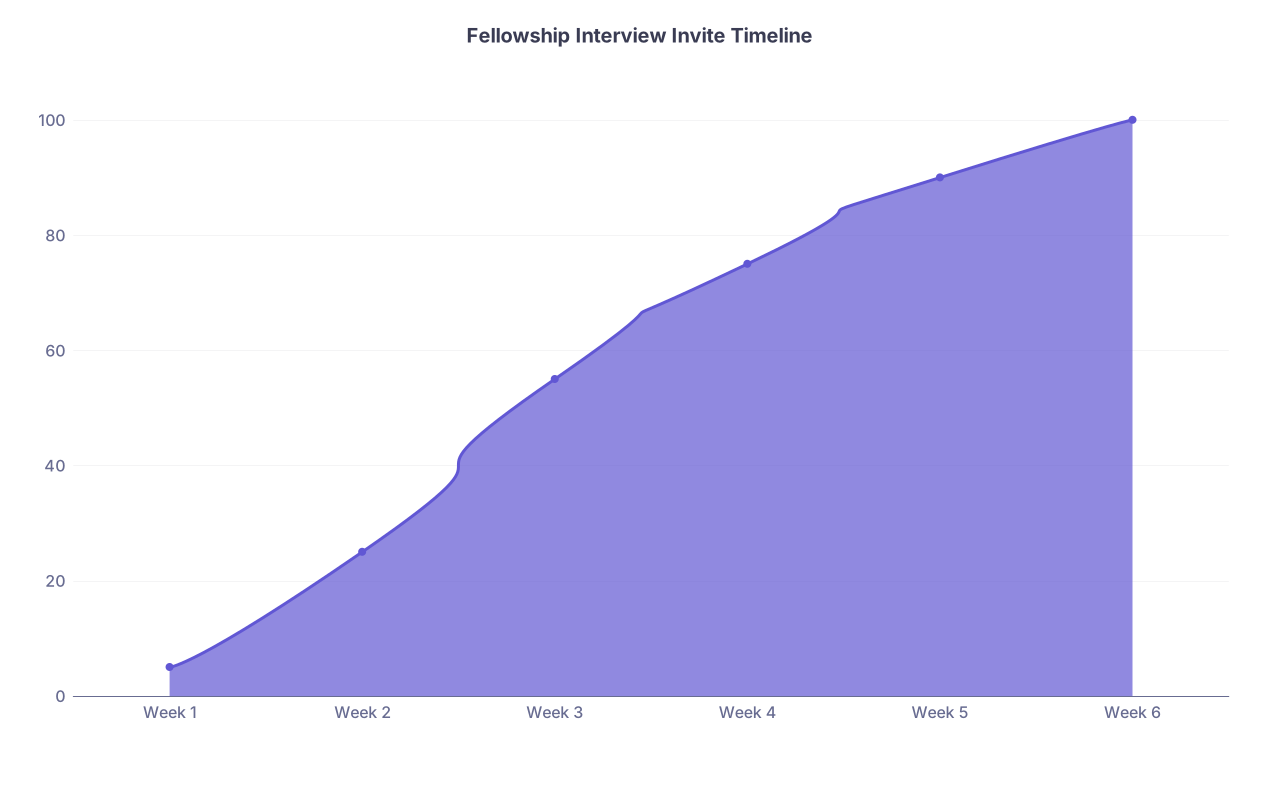
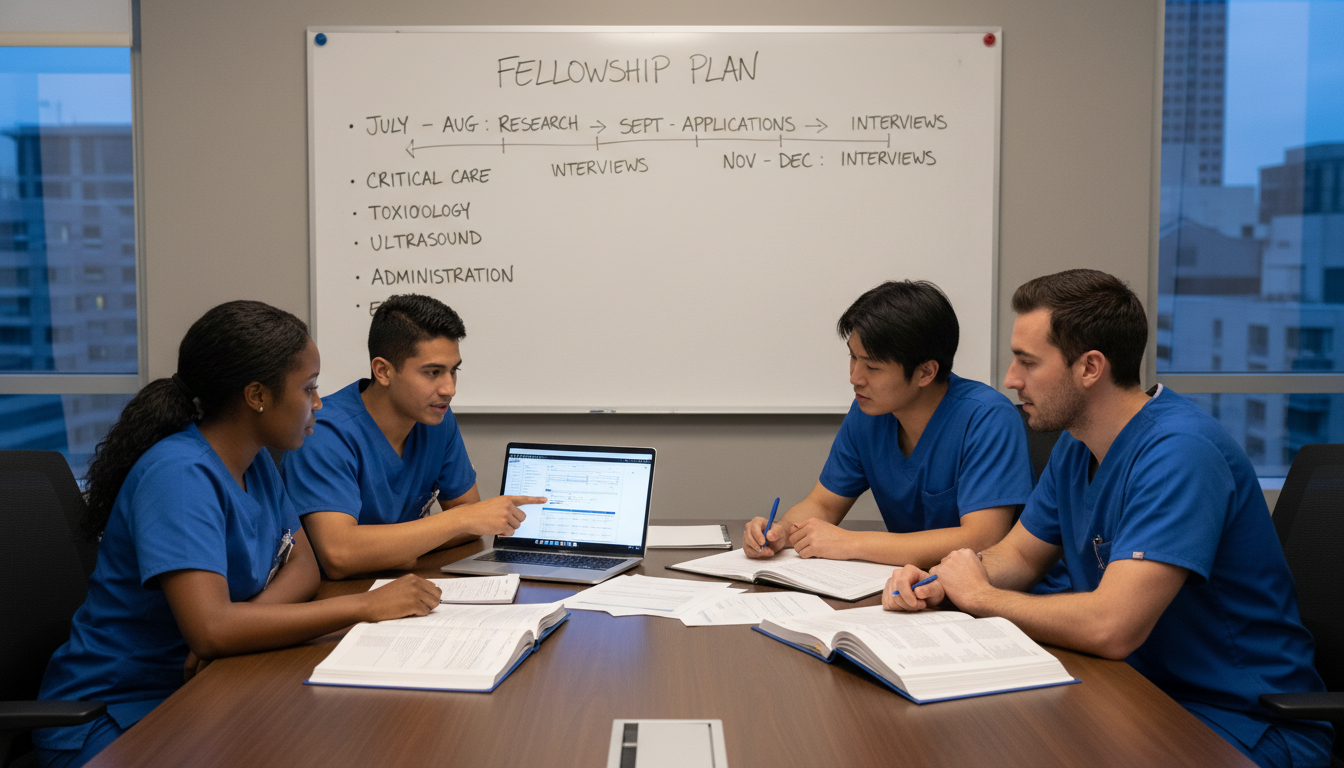
The fellowship application timeline is one of the most misunderstood aspects of planning. For many EM residents, key steps begin during PGY‑1.
Big-Picture Timeline
The exact fellowship application timeline varies by subspecialty, but as a general structure:
MS4 / Pre-Residency
- Read about EM subspecialties, talk to EM faculty and fellows.
- Factor fellowship interests into how you rank emergency medicine residency programs.
PGY‑1 (Intern Year)
- Explore interests broadly; talk to mentors.
- Start a simple CV and update it quarterly.
- Join relevant national organizations/sections (e.g., ACEP, SAEM, AAEM committees or interest groups).
- Do an early literature scan in areas you think you might pursue.
PGY‑2
- Narrow your interests to 1–2 likely fellowship paths.
- Identify a primary and secondary mentor in your area of interest.
- Begin at least one focused scholarly project.
- Target conferences and national presentations.
- Learn specifics of your chosen fellowship’s application cycle.
Early PGY‑3 (or PGY‑4 for 4‑year programs)
- Finalize fellowship list.
- Request letters of recommendation early.
- Complete personal statement drafts, revise with mentors.
- Submit applications (often late spring to early fall of the year before fellowship starts).
- Prepare for interviews.
Late PGY‑3 / PGY‑4
- Interview, rank programs (if in a match), or navigate offers (if non-match).
- Negotiate start dates, visa issues (if applicable), and contracts.
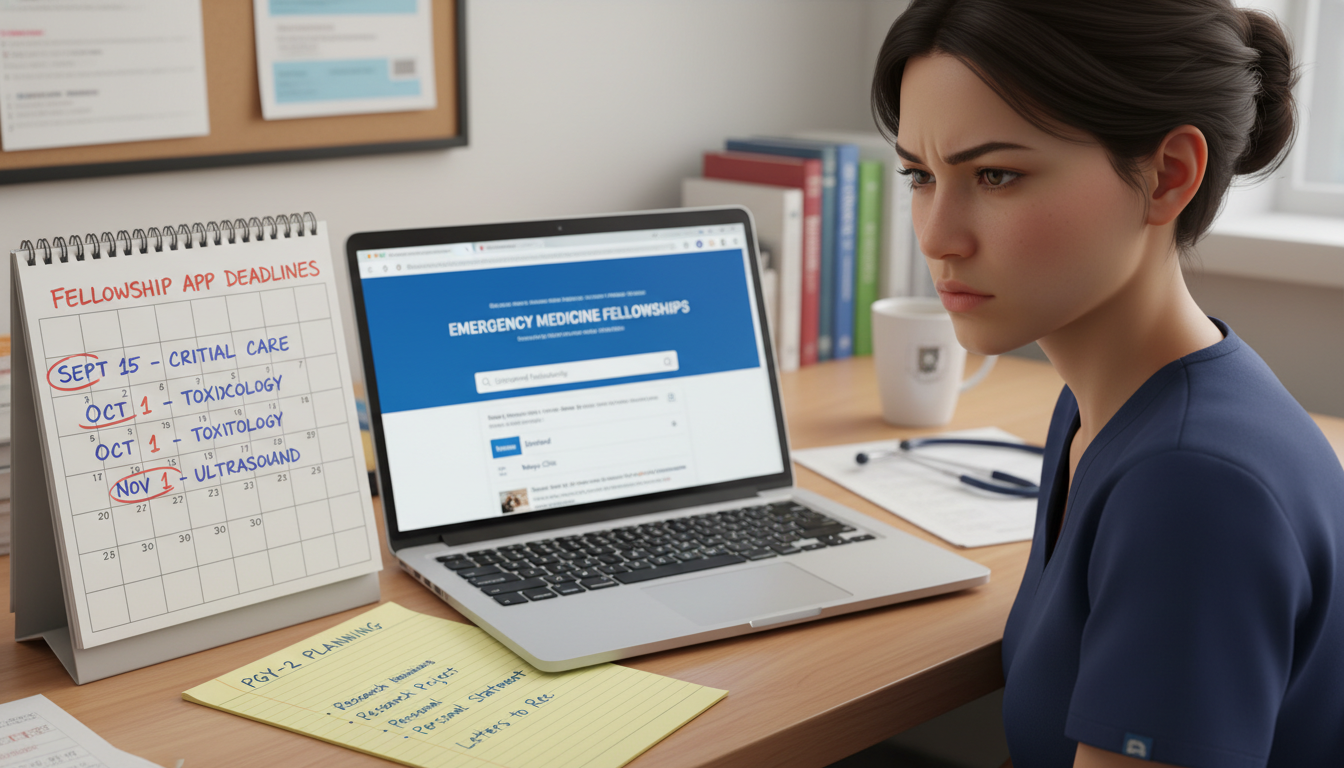
Because some fellowships now participate in formal matches (e.g., NRMP, San Francisco (SF) Match, or specialty-specific match processes), confirm precise dates early in PGY‑2.
Strategically Exploring Fellowship Interests During Residency
You do not need to know your fellowship plans on Day 1 of residency. You do need to explore strategically.
Use Rotations Intentionally
As you go through your emergency medicine residency:
Identify which rotations you naturally enjoy and excel in.
- ICU rotations → consider Critical Care.
- EMS ride-alongs, prehospital experience → EMS fellowship.
- Ultrasound shifts you look forward to → Ultrasound fellowship.
- Teaching interns/medical students → Medical Education fellowship.
- Pediatric ED → Pediatric EM.
- Toxic ingestion consults or poison center calls → Toxicology.
Ask yourself on each rotation:
- “Could I see myself doing more of this long-term?”
- “Do I like the culture and pace of this environment?”
Keep a simple “career journal” file (even a note on your phone) with:
- Cases you loved
- Skills you want to develop
- Role models whose careers you might want to emulate
Choosing Between Fellowship Options
If you are torn between possibilities (e.g., Critical Care vs. Ultrasound vs. Med Ed), consider:
- Training length and opportunity cost
- Critical care: 2 years (often) with heavy ICU time; deeper training but more delayed attending salary.
- Ultrasound or Med Ed: typically 1–2 years; easier to blend with EM shifts.
- Credentialing and certification
- Does it lead to board certification? (e.g., Critical Care, Peds EM)
- Will future employers value that credential more than just EM training plus experience?
- Job market realities
- Talk to recent graduates and fellows about actual job offers they received.
- Ask PDs how graduates with those fellowships have fared in the EM job market.
Finding and Using Mentors
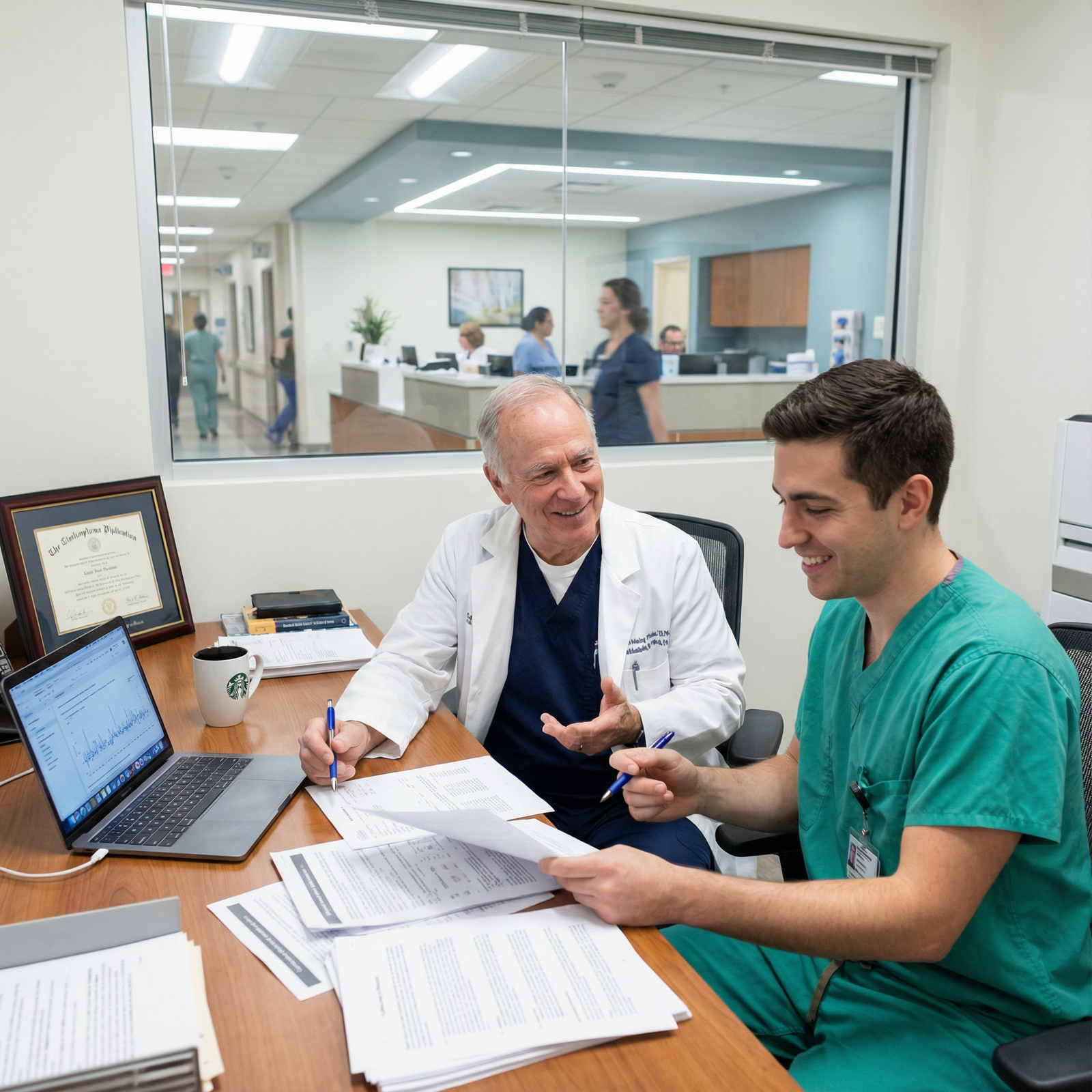
Mentorship is central to fellowship preparation.
Types of mentors to seek:
- Career mentor – big-picture guidance on where your career is headed.
- Content mentor – expert in your area of interest (e.g., EM Toxicology).
- Research mentor – helps design and execute scholarly projects.
- Peer mentor – senior resident or fellow who recently navigated the EM match or a similar fellowship path.
How to work with mentors:
- Come to meetings with a written agenda and questions.
- Bring an updated CV and draft timeline.
- Ask directly:
- “Given my interests, what are the top 3 fellowships I should look at?”
- “Where do you see gaps in my application right now?”
- “What concrete steps should I take this year?”
Mentors can also give critical feedback on your personal statement, letters, and program list.
Building a Competitive Fellowship Application from EM Residency
Fellowship directors generally care about four broad areas:
- Clinical excellence
- Evidence of commitment to the subspecialty
- Scholarly productivity
- Professionalism, teamwork, and leadership
Below is how to build strength in each area.
1. Clinical Performance and Reputation
Even subspecialty-focused fellowships expect strong emergency medicine fundamentals.
- Strive for solid evaluations on ED shifts and key off-service rotations.
- Show teachability and professionalism – programs choose fellows they can trust.
- If you have early struggles in residency, work proactively with your PD to address them and document improvement.
Programs will look closely at your Standardized Letters of Evaluation (SLOEs) and faculty narratives from your emergency medicine residency. These indirectly influence both job and fellowship options.
2. Demonstrating Genuine Subspecialty Interest
Directors want to see that you understand what their field entails.
Ways to show commitment:
Electives and rotations in your interest area
- Example: EMS elective with ride-alongs and time in the dispatch center
- Example: Ultrasound elective focused on advanced applications and QI
Participation in relevant committees or sections
- EMS: Join your hospital’s EMS committee or QA group.
- Med Ed: Help with curriculum development, simulation sessions, M&M design.
- Ultrasound: Assist with QA, teaching med students and junior residents.
Conference attendance
- Present at or attend relevant national meetings:
- SAEM, ACEP, AAEM, SCCM, NAEMSP, AIUM, etc., depending on interest.
- Target at least one abstract or poster during residency if possible.
- Present at or attend relevant national meetings:
Self-directed learning
- Regularly read high-impact journals in your area.
- Volunteer to give resident or ED conference lectures on relevant topics.
3. Research and Scholarly Activity
The expectations for research vary:
High-research fellowships (e.g., Research, Med Ed at academic centers, some Critical Care):
- Expect abstracts, posters, and ideally at least one publication.
- Look for sustained involvement in projects, not just a single, brief abstract.
Clinically focused fellowships (e.g., Ultrasound, EMS, some Global Health):
- Still value scholarly activity, but may give more credit to QI projects, protocol development, curriculum design, or educational materials.
Practical steps:
- Start a project early (PGY‑1/PGY‑2).
- Aim to be first or second author on at least one piece of scholarship by application time:
- Original research
- Case series
- Review article
- Educational innovation
- Quality improvement project with measurable outcomes
If your residency has limited research infrastructure, consider:
- Remote or multicenter collaborations via national organizations.
- Partnering with a mentor in another department (e.g., ICU, toxicology, pediatrics).
4. Leadership and Professional Qualities
Fellows are often seen as junior faculty or leaders in training. Directors look for:
- Chief resident service (if applicable).
- Leadership roles in residency committees, national organizations, or local initiatives.
- Evidence of reliability (did you follow through on projects, teaching, and scheduling responsibilities?).
Your professional reputation within your emergency medicine residency will heavily influence letters and phone calls behind the scenes.

The Application: From Program List to Interviews
Once you have built your experience and CV, you will face the practical aspects of how to get fellowship positions that fit you well.
Understanding Application Platforms and Matches
Different EM fellowships use different systems:
- NRMP Match (e.g., some Critical Care, Peds EM)
- San Francisco (SF) Match (common for some non-EM fellowships like Sports Medicine or Pain Medicine, depending on institution and track)
- ** Specialty-specific portals or direct applications** (EMS, Ultrasound, Med Ed, Toxicology, etc.)
Action item: By mid‑PGY‑2, confirm:
- Which match (if any) your desired fellowship uses
- Application opening dates
- Document requirements (letters, CV, personal statement, procedural logs, etc.)
- Whether interviews are in-person, virtual, or hybrid
Assembling Your Fellowship Application
Core components typically include:
- Curriculum Vitae (CV)
- Personal Statement
- Letters of Recommendation
- Transcript and proof of training (from your residency program)
- USMLE/COMLEX scores (for some programs)
- Procedural logs / ultrasound scans / teaching portfolios, depending on subspecialty
1. Fellowship CV for EM Residents
Your CV should be organized, concise, and tailored:
- Header: Full name, contact info, current PGY level, residency program.
- Education: Med school, residency.
- Certifications & Licensure: USMLE/COMLEX, ACLS, PALS, ATLS, etc.
- Honors & Awards
- Research & Publications
- Presentations & Posters
- Teaching Experience
- Leadership & Service
- Professional Memberships
Tips:
- Keep formatting clean and consistent.
- Group related items (e.g., all ultrasound-related projects under “Selected Projects” if you are applying for Ultrasound fellowship).
- Update at least every 3–4 months.
2. Personal Statement
Your personal statement should not be a generic essay about “loving emergency medicine.” Instead:
- Start with a specific experience or question that led you to this subspecialty.
- Show that you understand the realities of the field.
- Clearly articulate your long-term career goals:
- “I hope to spend 60–70% of my time in clinical emergency medicine and 30–40% building and evaluating EMS protocols at a regional level.”
- Explain why this fellowship type (and ideally this program) is the right fit:
- Unique resources, mentor alignment, regional needs.
Avoid:
- Vague statements like “I want to increase my knowledge.”
- Overly dramatic narratives.
- Negative comments about your current program or colleagues.
Bring a draft to at least two mentors for honest feedback.
3. Letters of Recommendation
Letters are critical for both the EM match and fellowship selection.
Aim for:
- 3–4 letters, with at least:
- One from your EM residency Program Director or Associate PD
- One from a faculty member in the subspecialty area
- One additional letter from someone who can comment on your clinical excellence or leadership
Choose letter writers who:
- Know you well and can give detailed, specific examples.
- Have experience with fellowship training or academic EM.
- Are likely to be perceived as credible advocates by fellowship directors.
Ask for letters:
- At least 2–3 months before the deadline.
- With a clear email: include your CV, personal statement draft, and the fellowships you are targeting.
Selecting Programs: Breadth vs. Focus
When building your list of programs, consider:
- Geography: Where are you (and any partner/family) willing to live for 1–2 years?
- Clinical environment: Academic vs. community; adult vs. pediatric; volume and acuity.
- Subspecialty focus: For example, some Ultrasound programs are heavy on education and others on research.
- Post-fellowship placement history: Where do graduates end up? Do they match your intended career path?
Most applicants apply to more than one program; the exact number depends on competitiveness of the field and your own application strength. Discuss this with your mentors honestly.
Succeeding in Interviews and Transitioning to Fellowship
Once your applications are in, you enter the interview and selection phase.
Preparing for Fellowship Interviews
Common interview themes:
- “Tell me about yourself.”
- “Why this fellowship, specifically?”
- “How do you see yourself using this training in 5–10 years?”
- “Tell me about a challenge in residency and how you handled it.”
- “Describe a research or QI project you are proud of.”
Preparation tips:
- Review each program’s website and faculty interests.
- Prepare 2–3 thoughtful questions for each interviewer (e.g., mentorship structure, expectations for scholarship).
- Be ready to explain any gaps or concerns in your record in a straightforward, non-defensive manner.
For virtual interviews:
- Test your tech, lighting, and background.
- Have your CV and a brief “program one-sheet” (your notes) available but off-camera.
- Maintain eye contact by looking at the camera, not the screen.
Evaluating Fellowship Offers
As you meet programs, assess:
- Culture: Do fellows seem supported and genuinely happy?
- Mentorship: Is there a clear primary mentor? Backup mentors?
- Protected time: Is there real time for research, education, or administrative training?
- Workload and expectations: Number of shifts, call burden, scholarly deliverables.
- Salary and benefits: Compare across programs, but remember fellowship is an investment.
If a program is outside a formal match and offers you a position, discreetly consult your mentors before accepting or declining. Understand any deadlines or expectations around decision-making.
Preparing for the Transition
Once you match or accept a position:
- Clarify credentialing, licensing, and any visa concerns early.
- Discuss shift expectations and scheduling with your future PD.
- Finish residency strong—your professionalism in the final months matters.
You are now not only finishing your emergency medicine residency but also preparing for fellowship responsibilities that resemble junior faculty roles. Programs will expect you to:
- Teach residents and medical students.
- Participate in QI and administrative projects.
- Represent the fellowship in institutional and sometimes national venues.
Frequently Asked Questions (FAQ)
1. Do I need a fellowship to have a successful career in emergency medicine?
No. Many EM physicians have fulfilling, impactful, and financially rewarding careers without fellowship training. Fellowship is especially helpful if you:
- Want an academic career with a defined niche
- Plan to work heavily in critical care, Peds EM, or toxicology
- Aspire to leadership roles in EMS, ultrasound, or medical education
If your main goal is full-time clinical work in a community ED, fellowship is often optional.
2. When should I decide on a fellowship during residency?
You do not need certainty in PGY‑1, but you should:
- Use PGY‑1 to explore broadly
- Narrow to 1–2 top options by mid‑PGY‑2
- Commit to a primary path and start targeted preparation by late PGY‑2
Remember, the fellowship application timeline typically requires you to apply in early PGY‑3 (or PGY‑4 in four-year programs), so you want a clear plan well before that.
3. How much research do I need to match into a competitive fellowship?
It depends on the subspecialty and program type:
Research-focused fellowships (e.g., research, some Med Ed, certain Critical Care tracks) may expect:
- At least one publication or in-press manuscript
- Multiple abstracts/posters
- Clear commitment to scholarly work
More clinical fellowships (e.g., Ultrasound, EMS, many Toxicology programs) often value:
- Any peer-reviewed work plus strong QI, curriculum, or educational projects
A general target: 1–2 solid scholarly products by the time you apply, with at least one where you are first or second author.
4. What if my residency does not have a fellowship in my area of interest?
You can still be competitive. Strategies include:
- Seek external mentors via national organizations (SAEM, ACEP, AAEM sections).
- Collaborate on multi-institution projects or join online research networks.
- Attend national meetings and network with faculty from programs that do have your desired fellowship.
- Use electives creatively: arrange away rotations if feasible and supported by your PD.
Programs understand that not every emergency medicine residency has every fellowship; they will look at what you did with the opportunities you did have.
Preparing for fellowship during emergency medicine residency is less about checking boxes and more about crafting a coherent, realistic vision for your career—and then aligning your training, scholarship, and mentorship with that vision. By understanding the fellowship application timeline, using mentorship wisely, and building a targeted, authentic portfolio, you will be well positioned to navigate the EM match or subspecialty fellowship applications and move toward the career you want.