The worst time to tell your program director about your fellowship plans is “whenever it randomly comes up.”
You need a timeline. A script. And a strategy.
You’re juggling patient care, evaluations, politics, and your future. If you treat this like a casual hallway chat, you’ll pay for it in weak letters, awkward schedules, and missed opportunities. I’ve watched residents do it right—and I’ve watched residents tank their chances by being vague or late.
Here’s the residency‑length timeline: what month to say what, to whom, and how direct you should be.
Big Picture: The Fellowship Timeline Across Residency
Before we zoom into month-by-month, you need the overall arc.
Intern Year (PGY‑1)
You do NOT need a polished plan or a specialty locked in. You DO need to:- Observe how your PD reacts to fellows, fellowship discussions, and “early planners”
- Build a reputation as reliable and coachable
- Start quiet exploration of interests
Early PGY‑2
This is when timing starts to matter. At this point you should:- Narrow to 1–2 serious fellowship options
- Tell trusted faculty mentors first
- Plan the when and how of talking to your PD
Late PGY‑2 to Early PGY‑3 (or equivalent)
This is prime application season in many fields. At this point you should:- Have already told your PD
- Have your letter writers lined up
- Be using your PD for advocacy, not hiding your plans from them
Off‑Cycle / Special Cases
Prelim years, early match specialties, non-ACGME fellowships—you move faster. I’ll flag that when we hit each time point.
To make this concrete, here’s a generic timeline for a 3‑year residency (IM, Peds, etc.) going into a standard subspecialty fellowship.
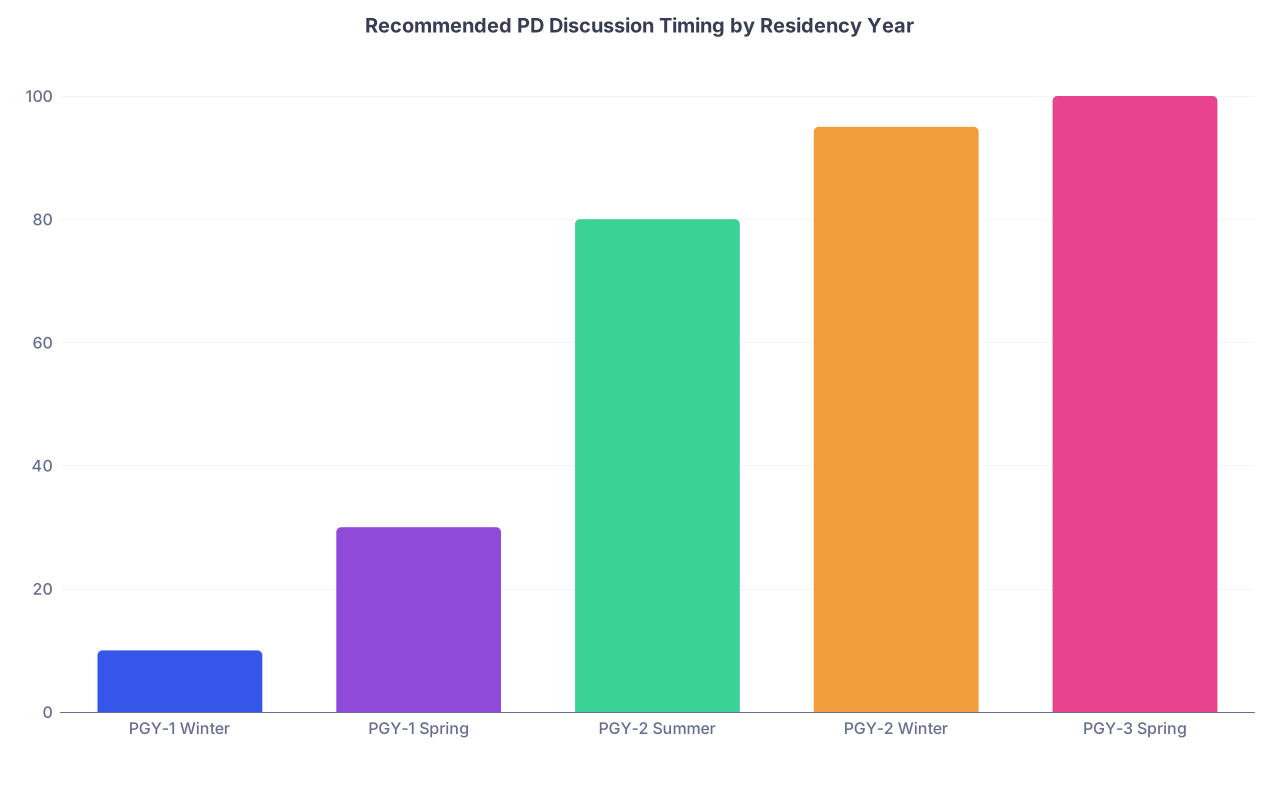
| Category | Value |
|---|---|
| PGY-1 Winter | 10 |
| PGY-1 Spring | 30 |
| PGY-2 Summer | 80 |
| PGY-2 Winter | 95 |
| PGY-3 Spring | 100 |
Interpretation: that “percent” is how strongly I recommend you already be open with your PD about your fellowship plans by that point.
PGY‑1: Planting Seeds Without Overcommitting
You don’t need a formal “I want GI” meeting in October of intern year. That’s performative and premature. But you do need to start managing your image and collecting data.
July–September (PGY‑1 Start): Just Survive, Listen More Than You Talk
At this point you should:
- Focus on:
- Being on time
- Owning your patients
- Not being the intern who “wants cards but can’t write a discharge summary”
- Observe:
- How your PD talks in orientation about fellowships
- Which faculty seem to be informal fellowship gatekeepers (cards people, pulm people, heme/onc people)
What you say about the future now:
Keep it light and non‑binding.
Examples:
- “I liked hematology/oncology in med school, but I’m very open right now.”
- “I’m interested in critical care, but first I just want to be a solid intern.”
What you do not say:
- “I’m 100% going to leave for a different program for fellowship.”
- “I only came here as a stepping stone.”
People remember that. And repeat it.
October–December (PGY‑1 Fall): First Micro‑Signals
By late fall, your PD has some sense of you from evals and block feedback.
At this point you should:
- Drop very light, non-demanding hints in:
- Semiannual review meetings
- Casual hallway check-ins
Sample script for your PD in a semiannual meeting:
- “I’m still early in training, but I’ve really enjoyed my time in the ICU and on cards. I could see myself pursuing fellowship eventually, but I want to keep seeing more before I commit.”
You’re not asking for anything. You’re just flagging yourself as “potential fellowship person” without forcing a commitment.
If you’re in a prelim year (surgery prelim, TY, etc.), different story:
- You need to be more direct, earlier.
- By late fall of PGY‑1 prelim, say:
- “I’m applying to categorical [X] and then likely [Y fellowship] down the line. I’d really value your guidance on where I might be competitive.”
January–June (PGY‑1 Winter/Spring): Start Building Mentor Relationships
You still don’t need a formal PD talk about a specific fellowship plan. But you should be cultivating the people who’ll matter when you’re ready to go on record.
At this point you should:
- Identify 1–2 attendings in your likely interest area and say:
- “I’ve been interested in [specialty] and really enjoyed working with you. Could I meet with you for 20 minutes sometime to talk about career paths and what people typically do from this program?”
Notice what you’re not doing:
- You’re not asking for a letter.
- You’re not declaring a final fellowship choice.
- You’re not forcing them to respond with, “We almost never match in that.”
You’re gathering intel. And your PD doesn’t need a “fellowship talk” yet—unless:
- You know you’re going after hyper‑competitive spots (e.g., cards from a weaker program, peds heme/onc from community program)
- Or you’re switching fields (e.g., IM resident who wants radiology, or FM resident eyeing anesthesiology).
If you’re in one of those categories, by late PGY‑1:
- Ask for a brief PD meeting and say:
- “Long term, I’m considering [field] fellowship. I know it’s competitive, especially from a [type] program. I’m not asking for anything specific yet, but I would love your honest take on how people from here have done and what I’d need to do to be realistic.”
You’re signaling ambition and inviting realism. Good PDs appreciate that.
PGY‑2: This Is When It Actually Matters
PGY‑2 is when “ideas” turn into a real application timeline. If you wait until late PGY‑3 to tell your PD you’re applying, you’ve already lost advocacy time.
Here’s the key rule:
You tell your mentors first. Then your PD. Never the other way around.
July–September (PGY‑2 Early): Narrow and Confirm
At this point you should:
- Be down to one main fellowship path or at worst a primary + backup:
- Example: Primary: GI, Backup: hospitalist • Or Primary: Heme/Onc, Backup: general cards
- Have had at least 1–2 real conversations with subspecialty faculty about:
- How competitive that field is from your program
- What your Step/COMLEX scores, in‑training scores, and evaluations look like
Now, timing the PD conversation:
- If your specialty’s fellowship apps go in summer at end of PGY‑2 (e.g., some early subs like cards in certain systems), you should talk to your PD no later than August of PGY‑2.
- For most IM subs in the current NRMP landscape, apps go in during PGY‑3; that gives you a bit more room, but not much.
This is where you schedule your first real PD meeting about fellowship.
Your First Real PD Fellowship Talk: What to Say
Here’s the structure.
1. Open with appreciation + your current thinking
“Thanks for making time to meet with me. I’ve been thinking more seriously about long‑term plans, and I wanted to talk with you about fellowship. Right now, I’m most interested in [X fellowship], and I’ve really enjoyed my rotations in [relevant areas].”
2. Show you’ve already done some homework
“I’ve talked with Dr. [Subspecialist] and Dr. [Another Faculty] about what this path looks like from our program, and they’ve given me some early feedback about strengths and things to work on.”
3. Ask for a candid read, not cheerleading
“I really value your honesty. Based on how I’m doing so far—evaluations, in‑training, whatever you’ve seen—how realistic do you think [X fellowship] is for me? And what would I need to strengthen over the next year?”
That last question matters. It tells your PD:
- You’re serious
- You’re not delusional
- You’re coachable
Then you shut up and let them talk.
What If Your PD Seems Hesitant or Negative?
You will hear stuff like:
- “Cards is very competitive from here.”
- “We don’t have a strong track record in GI.”
- “Your in‑training scores are a bit below our typical fellowship applicants.”
At this point you should:
- Ask concrete follow‑ups:
- “What scores or evaluations have our successful applicants typically had?”
- “Are there programs or geographic regions you think would be more realistic for me?”
- “If you were me, how would you approach this—apply broadly? Consider a research year?”
You want specifics, not vague discouragement.
You do not argue. You take notes, ask clarifying questions, and say:
“Thank you for being direct. I’d like to keep working hard on those areas and then circle back with you later this year to see how things are looking.”
This keeps the door open and shows maturity.
October–February (PGY‑2 Mid‑Year): Locking in and Getting Concrete
By mid‑PGY‑2, you should stop being coy. This is when “I’m interested in maybe doing something” becomes “I am planning to apply in this upcoming cycle.”
At this point you should:
Have:
- A CV draft
- A sense of which subspecialty mentors will write for you
- A realistic target list of programs (at least in rough form)
Schedule a follow‑up PD meeting and say:
Script for that meeting:
State your decision clearly
- “Since we last talked, I’ve solidified my plans. I’m going to apply to [X fellowship] this upcoming cycle.”
Mention mentors and letters
- “I’ve spoken with Dr. [Mentor] and Dr. [Letter Writer], and they’ve agreed to support my application with letters.”
Ask how they prefer to be involved
- “I’d really value your support as well—both your perspective on where I’d be a good fit, and potentially a letter if you feel you can support me. How do you usually work with residents on fellowship applications?”
If your PD says they’re happy to write, great. If they hedge or say they’d like to see another evaluation cycle, pay attention. That’s a signal about how strong they think you are right now.
March–June (PGY‑2 Late): Strategy and Scheduling
Now it becomes tactical.
At this point you should:
- Use PD meetings to:
- Review your program list
- Discuss away rotations or electives that might help
- Talk about timing: research time, key subspecialty rotations lined up before applications
This is also when you discuss coverage and scheduling impacts:
- “I’m hoping to schedule [X rotation] before applications open, because I know [important faculty] often write strong letters and make calls. Is that realistic from the schedule standpoint?”
- “I’ll likely need some flexibility for interviews next year. What’s typical in this program for that?”
If you’re applying to very competitive or geographically narrow programs:
- Ask directly: “Would you be comfortable making calls on my behalf for programs where you have connections?”
A good PD either says yes—or tells you honestly where they can or cannot help.
PGY‑3: No Surprises. Only Execution.
By the time you hit senior year, your PD should be fully aware you are applying, and to what.
If they’re hearing about your fellowship plans for the first time when ERAS opens, you waited too long.
July–September (PGY‑3 Early): Finalize, Then Notify
At this point you should:
Already have:
- Fellowship CV
- Personal statement drafts
- Letters requested (and ideally uploaded or in progress)
Send your PD an email before or right as ERAS opens:
Example email:
Subject: Fellowship Application Plans
Hi Dr. [PD],
I wanted to update you that I’ve finalized my fellowship plans and will be submitting applications to [X fellowship] this week. I’ll be applying to programs primarily in [regions] with a focus on [academic/community/mix].
Thank you again for your guidance and feedback over the past year. If there are any programs you think I should add—or any places where you have strong connections and think I could be a good fit—I’d really value your input.
Best,
[Your Name]
Then, in your next in‑person check‑in:
- “Apps are in, and I really appreciate your support. If any PDs reach out to you, I’m highlighting [3–4 strengths] in my application.”
Give them a narrative to reinforce.
October–January (PGY‑3: Interview Season): Keep Them Looped In
At this point you should:
- Briefly update your PD as the season unfolds:
- “I’ve received [X] interview invites so far, mostly in [regions]. Thank you again for any calls or informal support you’ve given.”
- If things are going poorly: “I’m not getting as many interviews as I hoped; if you hear of any programs still looking later in the season, I’d appreciate knowing.”
You can also ask:
- “If any programs contact you directly about me, is there anything you want to be sure I’m highlighting on my end to keep the story consistent?”
You’re aligning messaging. PDs notice when you think that way.
February–March (Match Time): Gratitude and Future Planning
Match day comes. Whether you match your dream or your backup, the PD conversation isn’t over.
At this point you should:
- After the match:
- Thank your PD explicitly: “I’m very grateful for your support through this process—your honesty early on and your advocacy later made a huge difference.”
- If you didn’t match or scrambled into a less‑ideal option, discuss contingency: “I’d like to talk about how to position myself over the next year or two if I want to reapply or shift directions.”
Why bother? Because future credentialing, references, and job calls will still go back to this PD.
Special Cases: When You MUST Tell Your PD Earlier
Some situations demand an accelerated timeline.
| Scenario | When to Tell PD | Why So Early |
|---|---|---|
| Prelim Year | By Oct–Nov PGY-1 | Need next spot quickly |
| Switching Specialties | 3–6 months before applying | Letters, politics, logistics |
| Very Competitive Fellowship From Weak Program | Early PGY-2 | Need long runway, realism |
| Major Geographic Constraints | Early PGY-2 | Strategy, targeted advocacy |
| Visa/Immigration Issues | Early PGY-2 | Sponsorship and program limitations |
If you’re in any of these, you don’t get the luxury of waiting until mid‑PGY‑2. You need your PD’s realistic appraisal and institutional muscle early.
What Not to Say (Common Mistakes That Backfire)
Let me be blunt. I’ve watched residents say these things and then wonder why their PD seemed less enthusiastic.
Avoid these:
“I’m applying to GI, but I might also do cards, or maybe pulm, I’m keeping it open.”
Translation to PD: I haven’t thought this through.“I’m only interested in top‑tier academic programs in [ultra-competitive city].”
If your stats don’t match that, it just looks naive.“I don’t really need a letter from you; I’ve got strong subspecialty letters.”
You just told your PD their opinion doesn’t matter. They remember that.“I know our program doesn’t usually match in [field], but I’m different.”
That’s how you sound when you argue with their realism instead of asking for strategy.
Instead, reframe:
- “My primary goal is [type of career]. I know [dream city] is very competitive from here; what would a realistic list look like to you?”
- “I value your perspective a lot. If you feel you can write a supportive letter after [upcoming rotation/block], I’d be grateful for that.”
Visualizing Your Personal Fellowship Talk Timeline
Here’s what a clean, well‑timed sequence looks like for a 3‑year residency → fellowship.
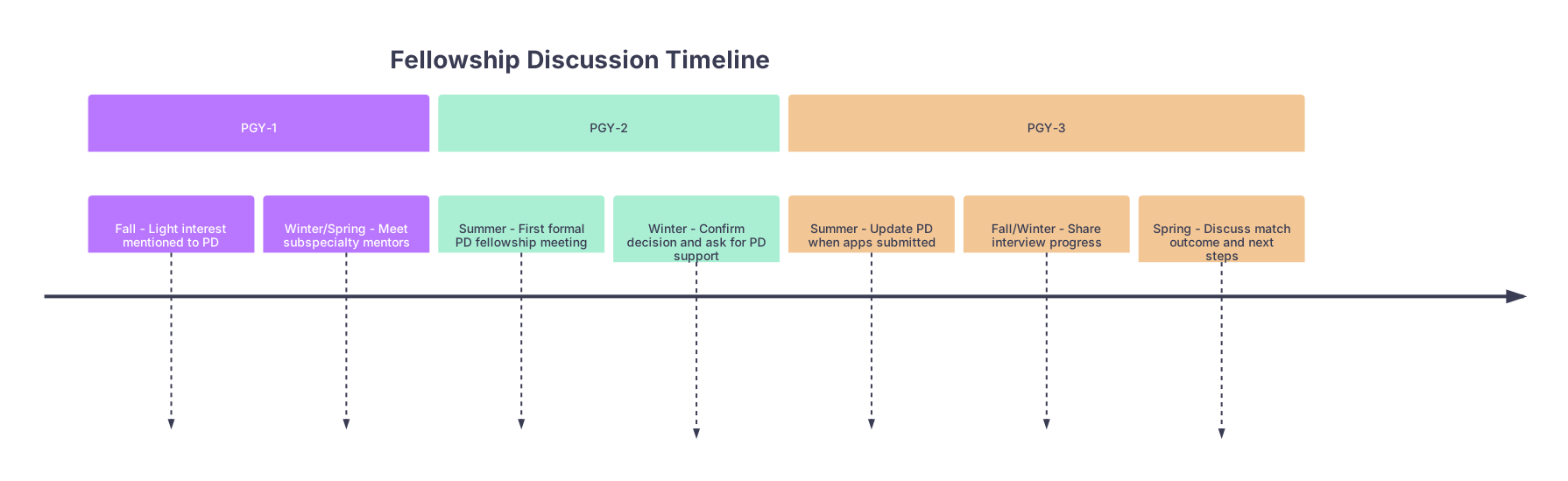
If your own timeline is way off this—say, you’re PGY‑3 in December and haven’t told your PD yet—you need a damage‑control version of that first formal meeting. Still do it. Just be honest that you’re late.
How To Handle It If You’re Late
You might be reading this already in PGY‑3, applications in, no PD conversation yet. Not ideal, but fixable.
At this point you should:
- Email your PD today for a short meeting:
- “I realize I should have looped you in earlier, but I’m applying to [X fellowship] this cycle and would really value your guidance now.”
In the meeting:
- Own it: “I should have come to you earlier in this process; I underestimated how important your perspective would be.”
- Then move forward:
- “Here’s where I’ve applied, here’s where I’ve gotten interviews so far, and I’d really appreciate any thoughts on how to maximize my chances now and how you typically support residents at this stage.”
PDs are a lot more forgiving when you take clear responsibility instead of pretending everything’s fine.
Your Next Step Today
Do not overthink this for three weeks and then do nothing.
Today, pick which category you’re in:
- Early PGY‑1
- Late PGY‑1
- PGY‑2 (early or mid)
- PGY‑3 or later and already applying
Then do one concrete thing appropriate to your stage:
- If you’re PGY‑1: Email one subspecialty attending to set up a 20‑minute career chat.
- If you’re PGY‑2: Email your PD to schedule a dedicated fellowship discussion within the next 2–3 weeks.
- If you’re PGY‑3: Draft the email updating your PD on your current fellowship application status and asking for a brief check‑in.
Open your email client right now and write that first line:
“Hi Dr. [Name], I’d love to find a time to talk about my long‑term plans, especially fellowship…”