

The biggest lie residents tell themselves about fellowship is: “I’ll get serious about this in PGY-3.”
If you wait that long, you’re already behind.
You build a strong fellowship portfolio month by month, starting Day 1 of residency. Not with some magical “fellowship year.” With dozens of small, boring, specific moves stacked over three years.
Here’s the roadmap, in order, with exactly what you should be doing and when.
Big Picture: Year-by-Year Focus
Before we dive into months, you need the macro lens.
| Year | Primary Focus | Secondary Focus |
|---|---|---|
| PGY-1 | Reputation & relationships | Early projects & habits |
| PGY-2 | Output & leadership | Clarify fellowship target |
| PGY-3 | Packaging & visibility | Strategic networking |
At each point you should know: Am I building reputation, receipts (projects, output), or relationships? Some months you’ll hit all three. But one is always primary.
PGY‑1: Foundation Year (You’re Being Watched)
July–August PGY‑1: Orientation + Reputation Setup
At this point you should:
- Act like every attending might one day write your fellowship letter. Because they might.
- Decide if you’re leaning toward a field: cards, GI, heme/onc, pulm/crit, ID, nephro, hospitalist with niche, etc. You do not need a final choice, just a direction.
Month-by-month
July
- Be visible, reliable, and low-drama.
- Learn names: fellows, chiefs, program leadership. Yes, this matters.
- Keep a simple running log (Google Doc/Notion) titled “Fellowship Portfolio” with sections:
- Cases worth presenting
- Project ideas
- People to follow up with
- Teaching moments
August
- Ask your seniors and a trusted fellow: “For someone interested in [X], who are the key faculty doing research/education/QI here?”
- Attend at least one division conference for your maybe-field (cardiology conference, tumor board, ICU conference).
- Start a tiny professional habit: after each rotation, add:
- 2–3 interesting cases
- Any teaching you did
- Any feedback you got
You’re not “doing research” yet. You are collecting ammo and learning who matters.
September–October PGY‑1: Find Your Mentors & First Project
At this point you should have:
- A short list of 3–5 faculty whose names keep coming up.
- One concrete idea or project you’re chasing.
September
- Email 1–2 potential mentors. Keep it short:
- Who you are
- Your early interest (e.g., cardiology with an interest in heart failure transitions of care)
- Ask for a 20-minute meeting to “get advice on building toward fellowship.”
- In each meeting, ask:
- “What do strong fellowship applicants from our program typically have?”
- “What kind of projects are realistic with my schedule?”
- “Is there a project you’re already running that could use a resident?”
- Say yes to one low-lift project:
- Case report
- Retrospective chart review where data set already exists
- Joining an ongoing QI initiative on the unit
October
- Block 2 hours twice a month (literally put it in your calendar) as “Portfolio Time.”
- Concrete work during that time:
- Get IRB status clarified (even if exempt).
- Start a case report draft with your attending.
- Read 3 recent major papers in your field-of-interest (e.g., in Circulation, NEJM, JCO).
- Go to division conference again. Ask one question. People remember that.
November–December PGY‑1: Turn Interest into Output
At this point you should have:
- One project actively progressing.
- One attending who knows you’re “serious about [X field].”
November
- Push your first project forward:
- Case report: aim for abstract submission by end of intern year.
- Chart review/QI: define clear roles and timeline.
- Ask your mentor:
- “What regional/national meetings should I target for abstract submissions this year and next?”
- Start a rough fellowship CV (not generic ERAS CV). Focus on:
- Education
- Awards
- Presentations (can be “submitted” or “planned” for now)
- Teaching
December
- Reality check with yourself:
- Do you still like your chosen field?
- Are there other fields you’re drawn to from real exposure, not preclinical fantasy?
- If doubt is high:
- Shadow in another clinic once or twice.
- Talk to a fellow in that other field.
- Quietly identify 1–2 faculty who might someday write letters if things go well. You’re not asking yet. You’re treating every interaction like it counts.
January–March PGY‑1: Build a Track Record, Not Just Hype
At this point you should have:
- A documented project timeline.
- A pattern of showing up to key conferences.
January
- Meet your primary mentor:
- Update them on progress.
- Ask: “What is realistic for me to have by September of PGY‑2 to be competitive?”
- Start small teaching roles:
- Offer to run a 10-minute chalk talk for your team.
- Volunteer to help with med student case discussions.
- Log these in your fellowship doc: title, date, audience.
February
- Push for a submittable abstract:
- Hospital research day
- Regional ACP, ACC, ASCO, CHEST, ATS, IDSA, etc.
- Ask your project team: “What’s the minimum data we need to submit something this cycle?”
March
- Do a rotation audit:
- Which rotations will put you in close contact with your target division/faculty?
- Which elective months are available in PGY‑2?
- Tell your chiefs/program coordinator your interests explicitly so they can try to line up helpful rotations.
April–June PGY‑1: Lock in PGY‑2 Positioning
At this point you should be:
- Planning your PGY‑2 schedule strategically.
- A known quantity to at least 1–2 people in the target division.
April
- Submit at least one abstract if timelines line up. If not, set a hard internal deadline for data completion.
- Ask to present:
- At resident noon conference
- At division journal club (if your mentor will support it)
- Keep track of feedback you receive. This is raw material for future personal statements and interview stories.
May
- Finalize PGY‑2 electives:
- At least one in your target field early in PGY‑2 (July–October if possible).
- Consider a research elective if your program allows it and your project is ready for a data push.
- Clarify night float/ICU months relative to fellowship timelines; you do not want brutal rotations while doing ERAS later.
June
- End-of-year reflection in your portfolio doc:
- What did I actually accomplish? (not what I intended)
- Where are the gaps? (no publications, weak relationships, unclear niche)
- Share this honestly with your mentor and ask: “Given where I am now, what must I accomplish by the end of PGY‑2 to have a shot at [tier of program]?”
PGY‑2: The Output Year (You’re Being Measured)
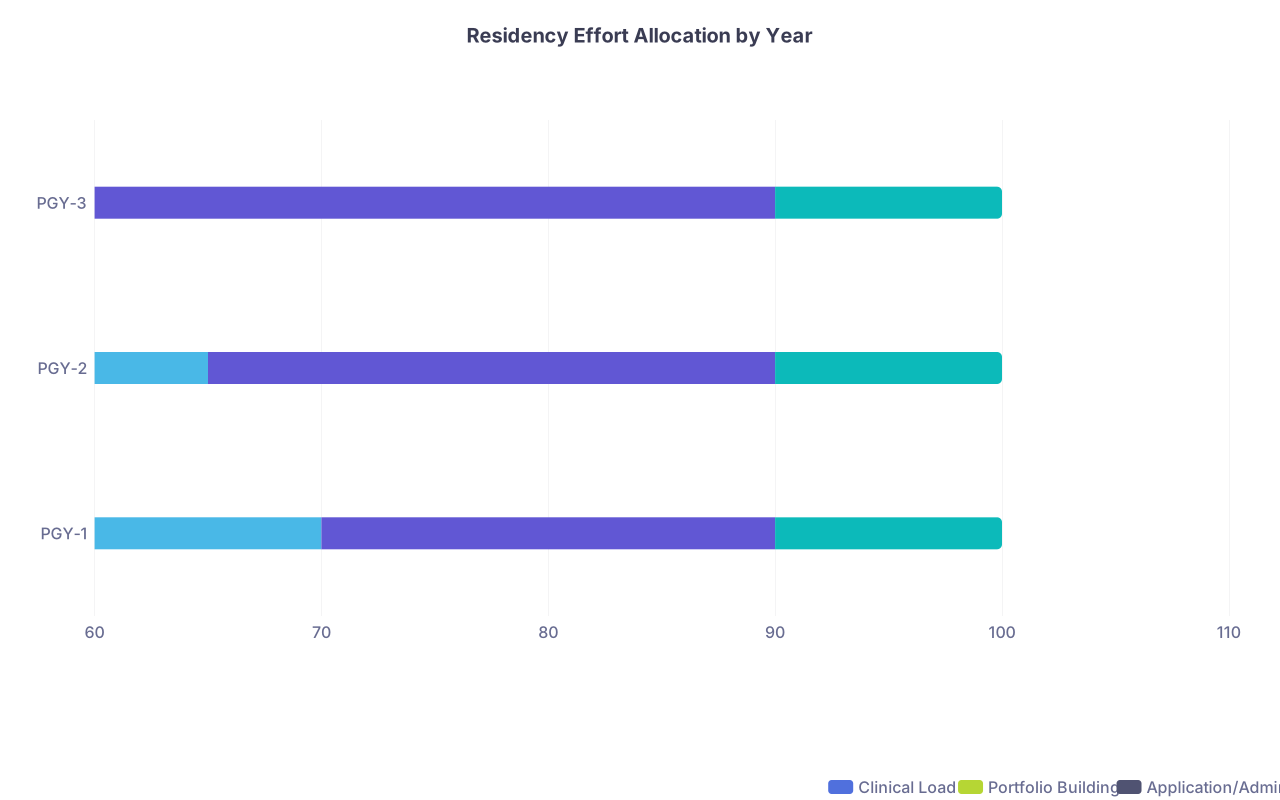
| Category | Clinical Load | Portfolio Building | Application/Admin |
|---|---|---|---|
| PGY-1 | 70 | 20 | 10 |
| PGY-2 | 65 | 25 | 10 |
| PGY-3 | 60 | 30 | 10 |
PGY‑2 is where fellowship applicants separate into two groups:
- People with concrete output
- People with “great potential” and nothing to show for it
You want to be in the first group.
July–September PGY‑2: Hit the Ground Publishing (or at Least Submitting)
At this point you should have:
- 1–2 projects far enough along to realistically submit something.
- High-visibility rotations with your target division.
July
- On specialty elective? Treat it like a three-week audition:
- Be early, prepared, and engaged in teaching.
- Ask smart questions, not performative ones.
- Volunteer to help with ongoing projects (not 5, just 1–2 you can actually finish).
- Tell your attending: “I’m planning to apply for [X] fellowship. What distinguishes your strongest residents who match well?”
August
- Force a decision on your older projects:
- Abstract submitted? Good. Turn it into a manuscript outline.
- Case report stalled? Either fix it this month or kill it and move on.
- Schedule monthly check-ins with your mentor during this quarter. Not optional. Put them on both calendars.
September
- Aim to have at least by now:
- 1 poster or abstract submitted or accepted.
- 1 more in progress with clear timeline.
- If your record is thin, your job this month is to say out loud: “I need something I can submit this year. What can I realistically complete in 3–6 months?” to your mentor.
October–December PGY‑2: Clarify Target Programs & Niche
At this point you should:
- Know your realistic fellowship tier (home program vs. regional vs. national heavy-hitters).
- Start thinking like an applicant, not just a resident.
October
- Create a draft fellowship list:
- 3–5 “reach”
- 5–10 realistic
- 3–5 safer options
- For each, identify:
- 1–2 faculty with shared interests
- Whether your home institution has alumni/fellows there you can eventually contact
- Keep this in a simple table or spreadsheet.
November
- Work on a micro-niche:
- Cards → HF readmissions, imaging, cardio-onc
- Heme/Onc → lymphoma outcomes, disparities, palliative integration
- Pulm/Crit → ARDS, post-ICU care, ultrasound education
- You’re not marrying this niche forever. You just want enough direction to shape:
- Projects you join
- How you market yourself
- Who you network with
December
- Mid-residency review with your PD or APD:
- Clearly state your plan to apply for fellowship.
- Ask directly if they see any red flags in your portfolio: “If I were applying this coming cycle, where would my application be weak?”
- Ask who typically writes strong letters for fellowship in your program and what they like to see.
January–March PGY‑2: Build Letters & Leadership
At this point you should have:
- 2 potential letter writers in mind (one likely your PD).
- At least one leadership/teaching role you can talk about.
January
- Step into intentional leadership:
- Apply to be a chief resident (if that’s a thing/appropriate).
- Or take on a discrete leadership role: journal club coordinator, QI lead, education committee.
- Document outcomes:
- “Increased attendance at M&M by 20%”
- “Implemented new sign-out template across 2 wards”
February
- Identify your letter strategy:
- PD letter (almost always required).
- 1 letter from your target division at your home program.
- 1 additional letter: research mentor, ICU attending, or subspecialist.
- Start telling these people: “I plan to apply this coming cycle and would really value your support if I continue to prove myself.” That “if” matters. Shows humility, not entitlement.
March
- Push any in-progress project toward submission:
- Journals for case reports.
- Society meetings for abstracts.
- Stop collecting new projects unless:
- They are short, very realistic.
- They fill a clear gap (e.g., no QI, no education work).
April–June PGY‑2: Application Prep Phase
At this point you should be:
- Shifting from building to packaging.
- Lining up your application components.
April
- Draft your personal statement outline:
- Not the final text; just bullet points:
- Why this field (rooted in specific experiences, not clichés).
- What you’ve actually done (projects, leadership, teaching).
- Where you want to go (career vision).
- Not the final text; just bullet points:
- Ask a trusted mentor or recent fellow: “Does this story make sense for [X] fellowship?”
May
- Create a fellowship CV in final form:
- Reverse-chronological.
- Clearly separated sections for:
- Peer-reviewed publications
- Abstracts/posters
- Presentations
- Leadership
- Teaching
- Cross-check everything against institutional records for accuracy.
June
- Confirm letter writers. Explicitly. In person if possible:
- “I’m planning to submit my fellowship application in [month]. Would you feel comfortable writing me a strong letter?”
- Give them:
- Updated CV
- Draft personal statement
- Short bullet list of things they’ve seen you do that you hope they might mention.
PGY‑3 (or Application Year): Execution & Visibility
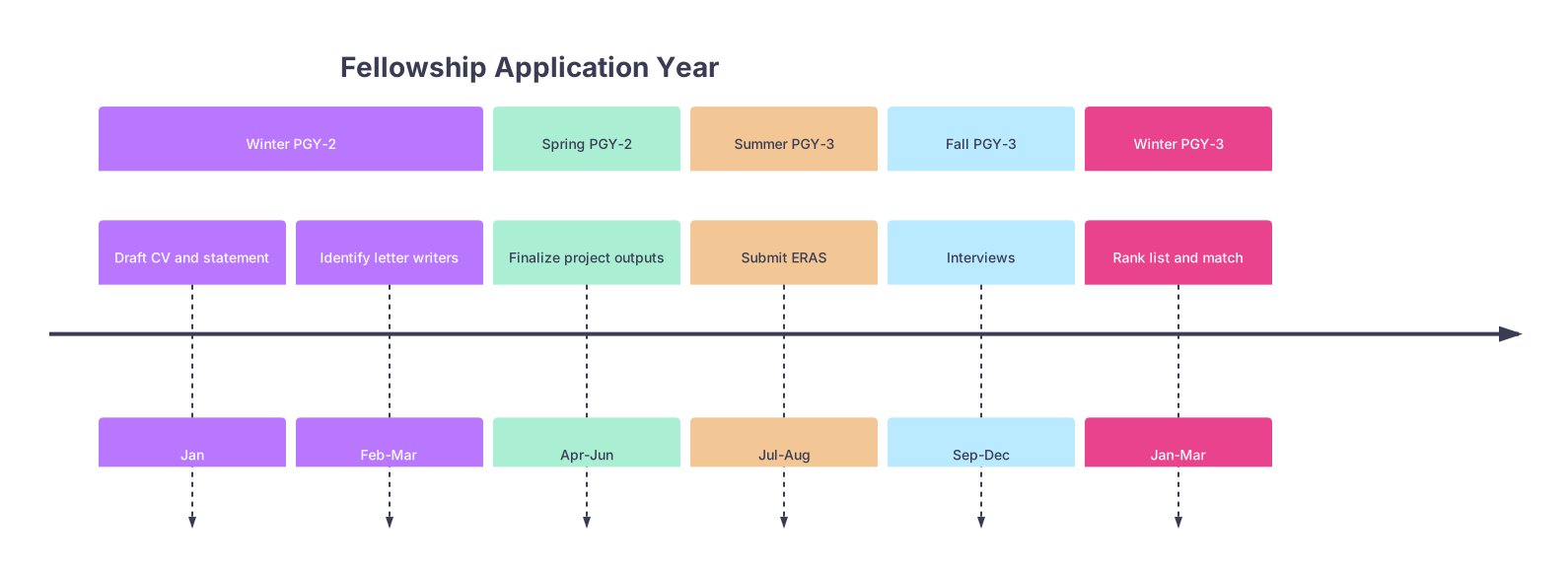
| Period | Event |
|---|---|
| Winter PGY-2 - Draft CV and statement | Jan |
| Winter PGY-2 - Identify letter writers | Feb-Mar |
| Spring PGY-2 - Finalize project outputs | Apr-Jun |
| Summer PGY-3 - Submit ERAS | Jul-Aug |
| Fall PGY-3 - Interviews | Sep-Dec |
| Winter PGY-3 - Rank list and match | Jan-Mar |
If PGY‑3 is your application year (for 3-year residencies), here’s how to use it.
July–August Application Year: Submit Clean, Early, Complete
At this point you should:
- Have ERAS (or other system) basically done before the portal opens.
- Be in control, not scrambling on nights.
July
- Finalize:
- Personal statement (get 1–2 targeted edits, not 10 conflicting opinions).
- Program list based on:
- Geography
- Reputation
- Fit with your interests
- Double-check every citation and date on your CV and application.
August
- Submit early in the cycle. Early is not desperate. Late is forgotten.
- Confirm all letters received.
- Send a brief, professional thank-you email to each letter writer:
- Let them know you submitted.
- Share your final program list.
September–November Application Year: Interview Season = Reputation Amplifier
At this point you should:
- Use current rotations strategically; you’re still being watched.
- Treat every interview as both an audition and an intel-gathering mission.
September
- Prepare 3–4 core stories:
- A challenging case you managed.
- A time you led a team through conflict or crisis.
- A project that didn’t go as planned and what you learned.
- A time you advocated for a patient or system change.
- Practice out loud. Not in your head. Out loud.
October
- During interviews:
- Reference your niche and concrete work: “In my QI project on [X], we found…”
- Ask about what their top fellows end up doing; shows long-term thinking.
- After interviews:
- Same day or next day: short, specific thank-you emails.
- Update your portfolio doc with impressions.
November
- Keep doing the work at home:
- Do not mentally check out from your residency.
- Faculty talk. “They disappeared once interviews started” is not a sentence you want attached to your name.
December–March Application Year: Finish Strong and Future-Proof
At this point you should:
- Be thinking beyond just matching—toward your early attending years.
- Clean up loose ends.
December
- If asked for updates by programs:
- Send only real updates (acceptances, new roles, new publications).
- Don’t spam small changes.
- Keep pushing any final projects to publication/acceptance. Match or no match, you’ll want them.
January–February
- Rank list:
- Be honest with yourself about fit, not just brand prestige.
- Weigh how programs treated you on interview day and via communication.
- If there’s a program you truly love and where you’d be happy even if it’s your only option, you can tell them they’re your top choice—once, clearly, professionally.
March
- Match day outcome:
- If you match: update your mentors and letter writers with a short, sincere thank-you and where you’re going.
- If you do not match:
- Meet with your PD and mentor early.
- Decide whether to:
- Re-apply after a research chief/PGY‑4 year.
- Pivot career path or timeline.
- Get a specific, written plan for how to strengthen your portfolio.
Two Quick Example Timelines (So You Can See It)

| Timepoint | Milestone |
|---|---|
| Dec PGY-1 | First abstract submitted |
| Jun PGY-1 | Case report drafted |
| Nov PGY-2 | Poster presented at regional meeting |
| Apr PGY-2 | Manuscript submitted |
| Aug PGY-3 | Fellowship application submitted |
You don’t need a Nobel prize. You need steady, visible progress that tells a coherent story:
- “I care about this field.”
- “I’ve done meaningful work in it.”
- “People you respect are willing to vouch for me.”
- “I finish what I start.”
Final Check: Are You On Track Right Now?
Where you are today matters:
- If you’re PGY‑1 and have no projects yet: you’re fine—but you need to identify a mentor this quarter.
- If you’re PGY‑2 and have zero abstracts or posters: you’re behind—but not doomed. You need at least one fast, realistic project and to be disciplined about output.
- If you’re PGY‑3 applying soon and your letters, statement, or CV aren’t ready: that’s your top priority this month. Everything else is noise.
Boiled Down to 3 Non-Negotiables
- Start early, even if you start small. A single case report in PGY‑1 beats ten “ideas” in PGY‑3.
- Pick a lane and act like you belong in it. Your projects, mentors, and conferences should point in the same direction.
- Finish things. Commit to fewer projects and drive them to submission. Fellowship programs are hiring for completion, not enthusiasm.


