

It’s late March of your PGY‑2 year. You just walked out of yet another noon conference about “Life After Residency,” and someone casually said, “Make sure your mentors are locked in before July.” You nodded like you’re on top of it.
You’re not.
You have a couple attendings who “know you,” an APD who said “happy to chat anytime,” and a CV you haven’t updated since intern year. Fellowship applications open in a few months. Letters, research, and phone calls behind the scenes will make or break your season. Right now, your mentor structure is… vibes.
Let’s fix that. Week by week. Month by month.
Big Picture: PGY‑2 Spring Mentor Timeline
Here’s the high‑level arc of what you should be doing from March–June of PGY‑2.
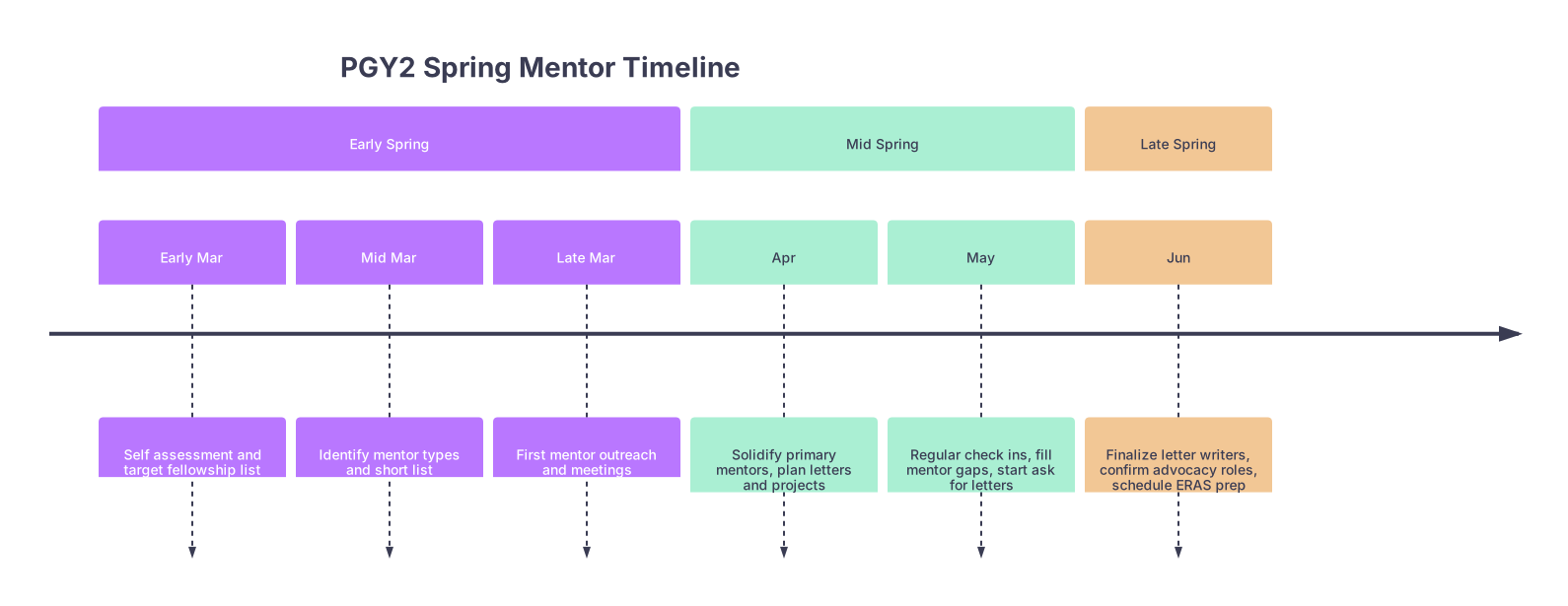
| Period | Event |
|---|---|
| Early Spring - Early Mar | Self assessment and target fellowship list |
| Early Spring - Mid Mar | Identify mentor types and short list |
| Early Spring - Late Mar | First mentor outreach and meetings |
| Mid Spring - Apr | Solidify primary mentors, plan letters and projects |
| Mid Spring - May | Regular check ins, fill mentor gaps, start ask for letters |
| Late Spring - Jun | Finalize letter writers, confirm advocacy roles, schedule ERAS prep |
This phase isn’t about “finding someone nice to talk to.” It’s about:
- Securing 2–4 committed mentors who will:
- Write strong, specific letters
- Strategize your program list
- Make calls or send emails for you
- Help shape your personal statement and CV
- Making sure those mentors are aligned with your actual fellowship goals, not just whoever happened to staff your clinic twice.
Week 1–2 (Early March): Get Your House in Order
At this point you should stop pretending “I’ll figure it out later” is a plan.
1. Do a ruthless self‑assessment
No fluff. You need a realistic version of your story before you approach mentors.
Sit down one evening and answer, in writing:
- What fellowship(s) am I realistically targeting?
- Example: Heme/Onc, GI, Cards, PCCM, ID, etc.
- Where do I fall in my residency class?
- Top third, middle, struggling? (Use actual evals and feedback, not your anxiety.)
- Numbers and portfolio:
- In‑training exam percentiles?
- Any Step 1/2 baggage?
- Publications/posters/abstracts? Be specific.
- Leadership roles? Chief potential? QI projects?
You’re not doing this to impress anyone. You’re doing it so mentors can actually help you.
2. Update your application materials
At this point you should have:
- A current CV (2–3 pages max, formatted cleanly)
- A one‑page “fellowship goals” document:
- 2–3 bullet points: what you want to do clinically
- 2–3 bullet points: research/academic interests
- 1–2 bullet points: long‑term career direction (academics vs community, etc.)
You’ll send these to mentors. If you send a stale intern‑year CV, you are wasting their time.
Week 2–3 (Mid March): Build Your Mentor Map
You’re not looking for “a mentor.” You’re building a team. Different people, different functions.
At this point you should identify specific humans to fill these roles:
| Role Type | Ideal Number | Primary Function |
|---|---|---|
| Career Mentor | 1 | Big-picture strategy |
| Content Mentor | 1–2 | Subspecialty depth & letters |
| Process Mentor | 1 | ERAS, interviews, logistics |
| Sponsor/Advocate | 1–2 | Phone calls, emails, doors |
Career mentor
- Usually a PD, APD, or senior generalist who knows your trajectory, not necessarily your subspecialty.
- Helps you decide: “Am I a realistic candidate for GI vs Heme/Onc vs…?” and shapes your list accordingly.
Content mentor (subspecialty)
- A cardiologist if you’re applying Cards, an oncologist for Heme/Onc, and so on.
- Helps you sound like a future colleague, not just “a resident who likes this field.”
- Often (not always) a letter writer.
Process mentor
- Someone who recently went through the fellowship process (senior fellow, new faculty) or a PD/APD who actually reads ERAS for a living.
- Helps with:
- ERAS details
- Personal statement angle
- Interview strategy
Sponsor / Advocate
- This is the person who picks up the phone or sends the “We really like this resident” email.
- May overlap with the roles above, but not always. Sometimes it’s a big‑name division chief who barely knows you but is impressed enough to go to bat after a few interactions.
At this point, your job is to make a short list:
- 2–3 names for career/process mentor
- 3–4 names for content/sponsor potential
Write them down. Real names. Not “someone in GI.”
Week 3–4 (Late March): Initial Outreach and First Meetings
Now you start talking to people. Not in June. Now.
Who you email first (and how)
Your first wave: PD/APDs and any attending who has explicitly said “I’m happy to help with fellowship.”
Your email template should be short and adult:
- Subject: “Fellowship planning – PGY‑2 [Your Name]”
- 3 lines:
- Who you are and your current year
- Your tentative fellowship target
- Clear ask for a brief meeting (20–30 min)
Attach:
- Updated CV
- One‑page goals document
At this point you should have at least 2 meetings set up within the next 2 weeks.
During those meetings:
- Be direct about your goals:
- “I’m leaning strongly toward Heme/Onc and planning to apply this upcoming cycle.”
- Ask for honest calibration:
- “Given what you’ve seen of me and my record, where do you think I’m competitive?”
- Ask specifically about mentors:
- “Who in the [subspecialty] division tends to be good mentors for applicants?”
You are not asking for letters yet. You’re mapping the landscape and signaling you’re serious.
Early–Mid April: Convert Contacts Into Actual Mentors
You’ve met with a few people. Some were vague. Some clearly cared. One or two gave concrete advice and said “Let’s follow up in a month.”
Those last ones are your seeds. You need to turn them into real mentors.
1. Make the explicit ask
At this point you should stop dancing around the word “mentor.” People are busy; being concrete helps them commit.
For someone you clicked with:
“I really appreciated your perspective on [X]. I’d love to have you as a mentor as I go through this fellowship season. Would you be open to meeting a few times between now and July to help with strategy and letters?”
If that feels too formal, you can soften it, but keep the core:
- You valued their advice.
- You’re asking for ongoing guidance specifically for fellowship season.
If they say yes:
- Immediately propose the next meeting:
- “Would it be okay if I set up a 30‑minute meeting in late April so we can talk about potential programs and letters?”
Mentorship without scheduled follow‑ups usually dissolves into nothing.
2. Lock in your core two
By mid‑April, you should have:
- 1 primary career/process mentor (often internal medicine PD/APD or equivalent in your specialty)
- 1 primary content mentor in your intended subspecialty
Write down:
- Their roles (career, content, sponsor potential)
- What you’ll go to each of them for
- Next scheduled meeting date
If you don’t have both by mid‑April, that’s a red flag. You need to accelerate outreach.
Mid–Late April: Start Thinking Letters (Without Spooking People)
At this point you should be maneuvering to secure letter writers, even if you don’t formally “ask” yet.
For fellowship, you typically want:
- 1 letter from PD (often mandatory)
- 1–2 letters from subspecialty faculty
- 0–1 from someone else who knows you well (research, QI, chief, etc.)
What you do now
- Ask your PD/career mentor about expectations
In your next meeting:
- “For fellowship, is it standard for you to write a letter for residents in our program?”
- “Is there anything I should be doing now that will help you write a strong letter for me later this spring?”
If your PD hesitates, that’s information. Not the end of the world, but you need to diversify your mentor base fast.
- Align with potential subspecialty letter writers
Start targeting:
- Attendings you’ve worked with clinically in the subspecialty
- Faculty you’re doing (or could start) research/QI with
You don’t ask for the letter yet, but you say variations of:
- “I’m planning to apply to PCCM this upcoming cycle. I really enjoyed our time on the MICU rotation and would love to get more involved with [their area]. Are there any ongoing projects I could help with?”
You’re doing two things:
- Signaling your fellowship goal early.
- Creating a reason for them to see you as more than “the resident who presented that one case of DKA.”
Early May: Fill Gaps and Start Real Work With Mentors
By May, fellowship season is not “far away” anymore. ERAS timeline is real. Everyone serious about a competitive field is already moving.
At this point you should:
1. Identify any missing roles
Look at your mentor map again:
- Do you have no true sponsor (someone who can make calls)?
- Do you have no subspecialty faculty who’s seen you on a project?
- Is your only “mentor” someone who barely knows your clinical work?
If yes, you need targeted outreach:
- Ask your PD or core mentor:
- “I’m concerned that I don’t have a strong subspecialty mentor yet. Who would you recommend I connect with, and could you introduce me by email?”
A short, direct intro email from your PD is gold. Use it.
2. Start using mentors for real decisions
In your May meetings, you should bring:
- A draft list of programs (categories: reach / realistic / safety)
- A rough personal statement outline or 2–3 key stories
- Questions about whether to apply this cycle vs delay a year (if borderline)
Your mentors’ job now:
- Tell you if your list is delusional or too timid.
- Point out the parts of your story that are actually compelling (you are usually bad at identifying this yourself).
- Flag obvious problems you’re underestimating (like a professionalism incident or poor in‑training exam trend).
You do not need to obey everything they say. But if two experienced people tell you the same thing, believe them.
Mid–Late May: Start the Letter Conversation
This is the part people procrastinate on. Then July comes, and they’re firing off desperate emails to attendings who barely remember them.
Don’t be that resident.
1. When to ask
For most fellowships, asking in late May to early June is perfect:
- Faculty are less panicked than in July/August.
- They actually have a few weeks to see you again, if needed.
- You’re showing you’re organized and serious.
2. How to ask (and what to provide)
When you ask a mentor or subspecialty attending for a letter:
- Do it in person if possible, then follow up by email.
- Ask specifically for a strong letter:
- “Would you feel comfortable writing a strong letter of recommendation for my [Heme/Onc] fellowship applications?”
If they hesitate, you want them to say no. A bland letter is worse than no letter.
Attach or offer:
- Updated CV
- Personal statement draft (even if rough)
- Brief bullet list:
- Context of how you worked together
- Specific cases or projects you did with them
- Your top 2–3 strengths from their perspective (clinical, teaching, research)
Make it easy for them to write a letter that sounds like it’s about a real person, not a template.
June: Lock Down Your Mentor Team and Advocacy Plan
June is where you close loops. The season starts to accelerate. At this point you should stop “hoping it all works out” and have a concrete structure.
1. Confirm who’s doing what
By the end of June, you should have in writing (even if it’s just in your notes):
Career/Process Mentor
- Name, role
- Has agreed to:
- Review your program list
- Look over CV and ERAS entries
- Possibly mock interview
Content/Subspecialty Mentor(s)
- Name(s), role(s)
- Has agreed to:
- Provide letter (yes/no)
- Review personal statement for subspecialty content
Sponsor/Advocate(s)
- Name(s): division chief, well‑known faculty, etc.
- Has agreed to:
- Potentially reach out to specific programs (you’ll give them a targeted list later)
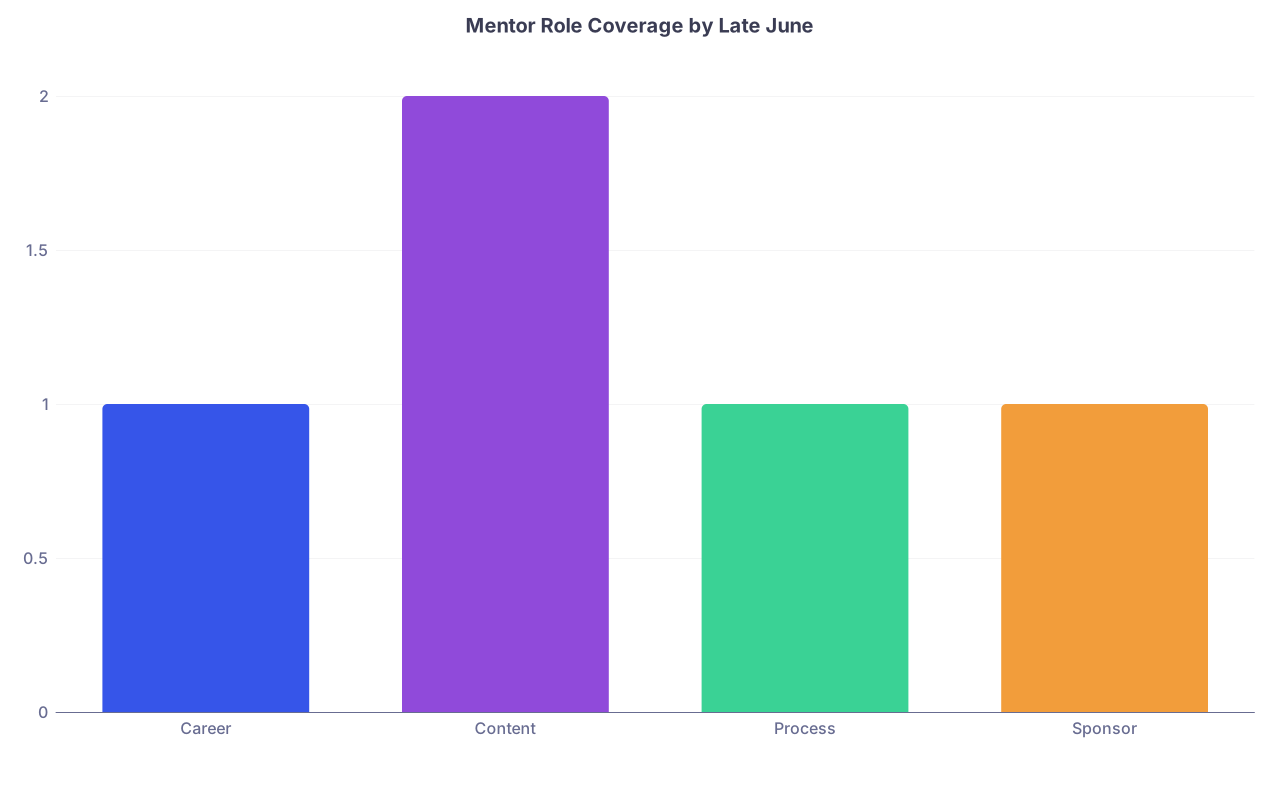
| Category | Value |
|---|---|
| Career | 1 |
| Content | 2 |
| Process | 1 |
| Sponsor | 1 |
If you look at that list and see a zero in any category, that’s a problem you need to fix now, not in August.
2. Schedule final pre‑ERAS touchpoints
At this point you should have on your calendar:
- A meeting with your PD/career mentor in late June or very early July:
- Review final program list
- Confirm their letter plan and any “red flags” they’re worried about
- A meeting (or email exchange) with each letter writer:
- Confirm when they plan to submit the letter
- Clarify if there are particular programs where they have influence
Document everything. Not in your head. In a simple table or note.
What If You’re Late? (It’s Already May/June)
Some of you are reading this in May or even June and thinking, “Well, I’m screwed.”
You’re not. But you have no slack.
Here’s your compressed emergency timeline:

| Step | Description |
|---|---|
| Step 1 | Today |
| Step 2 | Self assessment and CV update |
| Step 3 | Email PD and 2 subspecialty attendings |
| Step 4 | Meet within 2 weeks |
| Step 5 | Ask for mentorship and letters |
| Step 6 | Confirm roles and deadlines |
In 2 weeks you should:
- Update CV and goals doc (48–72 hours, max).
- Email:
- PD or APD
- 2–3 subspecialty attendings you’ve worked with
- Meet with all of them once.
- Convert at least:
- 1 to career/process mentor
- 1–2 to content/letter writers
- Explicitly ask about letters and deadlines.
You don’t have the luxury of “letting relationships develop.” You have to be tactful but direct. People understand tight timelines; this is normal in academic medicine.
Red Flags and Dumb Moves to Avoid
Quick list of things I’ve seen tank otherwise decent applications:
- Waiting until July to tell your PD you’re applying in an ultra‑competitive field.
- Relying on one super‑famous letter writer who barely knows you, and nothing else.
- Not having any mentor outside your own residency program (if your home program is weak in your desired subspecialty).
- Assuming your favorite attending “of course” will write you a letter, then finding out in August they’re on sabbatical.
- Never sending your CV and statement to letter writers, so all your letters say the same generic garbage.
At this point in PGY‑2, your job is to remove as much randomness from the process as possible. Mentors are how you do that.
How to Keep Mentors Engaged Without Being Annoying
Mentors do not need weekly updates. They do need to know you’re doing the work.
Quick rhythm that works:
- After each meeting:
- Send a 3–4 line thank‑you email with:
- 2 bullets: what you’re going to do next
- 1 bullet: when you’ll circle back
- Send a 3–4 line thank‑you email with:
- When you hit a milestone (paper accepted, major award, big project):
- 1 short email: “Wanted to share this quick update before applications go in.”
You are not “bothering” people by being concise, respectful, and prepared. You are bothering them when you show up last‑minute, empty‑handed, and disorganized.
Quick Example: How This Looks in Real Life
Let me sketch a real (de‑identified) sequence I’ve seen work for a PCCM applicant.
- March 10: Updates CV, realizes she has 1 anesthesia ICU abstract, strong evals, okay research.
- March 20: Meets with IM PD:
- PD says: “You’re solid for mid‑tier PCCM, maybe a few academic reaches. Talk to Dr. X in our ICU division.”
- March 25: Emails Dr. X (ICU attending she worked with once):
- “I’m planning to apply to PCCM this upcoming cycle. Would you have 20 minutes to talk about mentorship and whether there are any QI or research projects I could help with?”
- April: Starts helping Dr. X on an ongoing QI project. They meet twice.
- May 15: Asks Dr. X:
- “I’ve really appreciated your mentorship on the QI project and ICU career planning. Would you feel comfortable writing a strong letter for my PCCM applications?”
- Dr. X says yes; they set a mid‑July internal deadline.
- June: PD confirms he’ll write PD letter, and a second ICU attending she rotated with agrees to write another. She now has:
- PD as career/process mentor + PD letter
- Dr. X as content mentor + advocate + letter
- Second ICU attending as clinical letter
- PD plans to email a few PD friends at target programs
That’s what success looks like. Not 12 mentors. Not 8 letters. A tight, functional team who actually knows her.
Final Snapshot: What You Should Have By July 1 of PGY‑3
By the time you flip to PGY‑3, your mentor structure for fellowship should look like this:
| Item | Status Goal |
|---|---|
| 1 Career/Process mentor confirmed | Yes |
| 1–2 Subspecialty content mentors | Yes |
| PD aware of your fellowship plans | Yes |
| PD letter agreed to (if standard) | Yes |
| 2–3 total letter writers committed | Yes |
| At least 1 sponsor willing to advocate | Yes |
| ERAS/CV reviewed by at least 1 mentor | Yes |
If you can check those boxes, you’re in much better shape than the average resident heading into fellowship season.
Key Takeaways
- By late PGY‑2 spring, mentors are not optional; they’re core infrastructure for your fellowship application. Treat them that way.
- You want a team of 2–4 people with clear roles: career/process, content, and sponsor/advocate—not one overburdened “mentor” who does everything poorly.
- The critical window to lock this down is March–June of PGY‑2. Use those months to convert casual attendings into committed mentors and letter writers, or you’ll be scrambling when it’s too late to fix it.


