

It is July 10 of your PGY-1 year. You just finished another exhausting long call. Someone on nights casually asked, “So what are you thinking for fellowship?” You mumbled something noncommittal, because honestly, you are just trying to survive cross-cover.
Here is the uncomfortable truth: by the time you finally “feel ready” to think about fellowship, you are usually late.
This is the timeline I wish someone had put in my hand day one. Month by month. What to do when. What is actually urgent versus what can wait.
We will walk PGY-1 to PGY-3, then zoom into the critical months and weeks when fellowship applications are built or broken.
Big Picture Timeline: PGY-1 to PGY-3
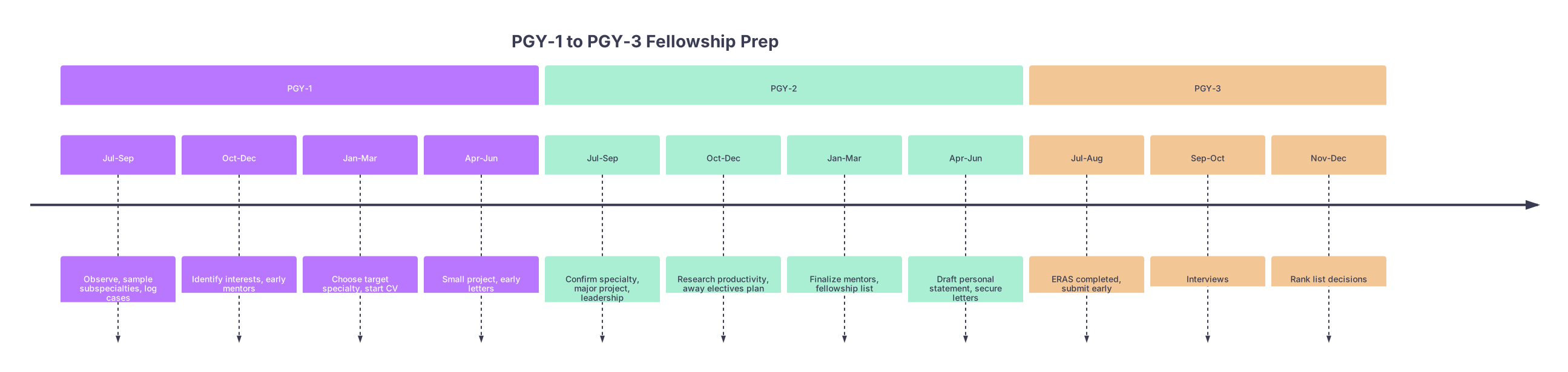
| Period | Event |
|---|---|
| PGY-1 - Jul-Sep | Observe, sample subspecialties, log cases |
| PGY-1 - Oct-Dec | Identify interests, early mentors |
| PGY-1 - Jan-Mar | Choose target specialty, start CV |
| PGY-1 - Apr-Jun | Small project, early letters |
| PGY-2 - Jul-Sep | Confirm specialty, major project, leadership |
| PGY-2 - Oct-Dec | Research productivity, away electives plan |
| PGY-2 - Jan-Mar | Finalize mentors, fellowship list |
| PGY-2 - Apr-Jun | Draft personal statement, secure letters |
| PGY-3 - Jul-Aug | ERAS completed, submit early |
| PGY-3 - Sep-Oct | Interviews |
| PGY-3 - Nov-Dec | Rank list decisions |
PGY-1: Exploration Without Wasting Time
At this point, your job is not to have everything figured out. Your job is to avoid waking up in April of PGY-2 suddenly deciding you want cards and realizing you have done nothing to support it.
PGY-1, July–September: “Just Survive” … but Pay Attention
Your priorities:
- Learn your job.
- Notice what you are drawn to.
- Avoid burning bridges.
At this point you should:
- Keep a tiny “fellowship notebook” or running note on your phone:
- Attendings you respect.
- Services you enjoyed or hated (and why).
- Interesting cases that might turn into a QI project, case report, or M&M.
- On each subspecialty rotation (cards, GI, pulm, heme/onc, nephro, etc.):
- Ask residents 1–2 years ahead:
“Who are the fellows to talk to if I am even vaguely interested in this specialty?”
Write down names. You will forget them later if you do not.
- Ask residents 1–2 years ahead:
- Start a bare-bones CV document:
- Education, exams, any pre-residency research.
- You will fill it as you go. Do not wait until PGY-3.
What you should not be doing yet:
- Writing a personal statement.
- Emailing 10 people pretending you are 100% sure about one fellowship.
PGY-1, October–December: Narrow the Noise
You are starting to see patterns. You like procedures. Or longitudinal clinic. Or physiology-heavy discussions. Now you need to move from vague interest to at least 2–3 realistic options.
At this point you should:
- After each subspecialty month, ask yourself:
- Could I see myself doing ONLY this for 30 years?
- Did I like the lifestyle the attendings actually have?
- Concrete step: schedule 2–3 brief “career chats”:
- One with an APD or PD.
- One with a fellow in a field you are considering.
- One with a senior resident applying or recently matched.
- Ask: “If I even might want [cards / pulm / GI / heme-onc], what should I be doing this year?”
- Identify at least 1 mentor-ish attending:
- Someone who was actually helpful, not just nice.
- Send a short email:
“I appreciated working with you on [rotation]. I am still deciding on long-term plans, but I would value your career advice sometime in the next few months.” - This opens the door early without committing to a field.
Parallel admin work:
- Update your CV quarterly. Put a recurring calendar reminder.
- Keep a case log or quick spreadsheet of:
- Interesting cases.
- Any talks you give.
- Committee meetings you attend.
PGY-1, January–March: Make a Provisional Choice
You need a “working hypothesis” of your future fellowship by spring of PGY-1. It can change. But you need a direction to line up rotations and projects.
At this point you should:
- Decide on:
- One primary target (example: cardiology).
- One plausible backup (example: hospitalist or pulm/crit).
- Meet again with your mentor / APD:
- Ask directly: “If I aim for [fellowship X], what does a competitive applicant from this program look like? What do the successful ones usually have by PGY-3?”
- Start or join a small, realistic project:
- A QI project linked to your residency (codes, sepsis bundle, transitions).
- A case report or small retrospective series with a motivated attending.
- The goal: something that can be presented or submitted by early PGY-2, not some five-year RCT fantasy.

PGY-1, April–June: Start Building a Track Record
Now the year is almost done. This is where smart residents quietly separate themselves.
At this point you should:
- Confirm your PGY-2 rotation schedule:
- Try to get one or two key subspecialty rotations in the first half of PGY-2 in the field you are leaning toward.
- Aim for at least one month with an attending who could plausibly write you a strong letter.
- Clarify your main project:
- Open a shared document with your mentor that clearly states:
- Research question or QI aim.
- Your role.
- Target date for abstract submission.
- Plan for authorship.
- If this is vague or slipping, either push hard now or pivot to a more attainable project.
- Open a shared document with your mentor that clearly states:
- Start doing small leadership things:
- Volunteer for one committee or teaching role (morning report, med student workshop).
- You do not need five titles. You need one or two roles where you actually did something.
By the end of PGY-1 you should:
- Have a working fellowship target (even if tentative).
- Have at least one active project.
- Have 1–2 faculty who know you well enough to vouch for your work ethic.
PGY-2: The Make-or-Break Year
This is where fellowship applications are effectively decided. Not PGY-3. PGY-3 is mostly packaging what you did in PGY-2.
PGY-2, July–September: Cement Your Direction
If you are still undecided at this point, you are behind but not dead. You must move with intention.
At this point you should:
- If undecided between two specialties:
- Put them back-to-back in your schedule if possible.
- Ask each division chief or program lead one blunt question:
“For someone at my level, what would you need to see by next June to consider me a strong fellowship applicant here?”
- For those already committed to a specialty:
- On your subspecialty rotation:
- Be the best resident on the team. That sounds cliché but attendings absolutely remember.
- Volunteer for teaching medical students.
- Ask for feedback early: “I am interested in [X]. I would appreciate concrete feedback on what I can improve to be competitive.”
- On your subspecialty rotation:
- Identify at least 2–3 potential letter writers:
- People who have actually seen you work.
- Ideally:
- One from your home program leadership (PD/APD).
- One or two from your desired subspecialty.
- One from a research / QI mentor if relevant.
PGY-2, October–December: Turn Work into Products
Here is where people either have something on paper… or they tell themselves, “I will get a paper eventually.” “Eventually” does not help your ERAS.
At this point you should:
Push every project toward a visible output:
- Abstract for local or regional meeting (ACP, CHEST, ACC, ASH, ATS, etc.).
- Poster at your hospital research day.
- Manuscript draft, even if rough.
Aim to have at least one of the following by the end of PGY-2:
- One submitted abstract.
- One accepted poster or oral presentation.
- One submitted manuscript (acceptance is a bonus, not mandatory).
Start a fellowship target list:
- 3 tiers:
- Reach programs.
- Reasonable matches.
- Safe options.
- Start tracking:
- Typical profile of matched applicants.
- Any alum from your residency currently in those fellowships.
- Application timelines and requirements.
- 3 tiers:
| Tier | Example Program | Reason for Tier |
|---|---|---|
| Reach | MGH Cardiology | Highly competitive, research-heavy |
| Reasonable | University of Colorado GI | Strong fit, similar past matches |
| Safe | Large community cards | Historically favors your home program grads |
PGY-2, January–March: Lock in Mentors and Letters
This is the quiet but critical season. The apps are still months away, but the relationships are being secured now.
At this point you should:
- Schedule explicit “fellowship planning” meetings with:
- Your PD or APD.
- Your main subspecialty mentor.
- In those meetings:
- Share your preliminary program list.
- Ask if it is realistic, too top-heavy, or too safe.
- Ask: “Would you feel comfortable writing me a strong letter for [fellowship X]?”
If there is any hesitation, that is a red flag.
- Plan any away / external electives if relevant:
- Cards, GI, pulm/crit sometimes care about demonstrating interest elsewhere.
- But do not blow up your schedule chasing aways if your home letters and performance are weak. Fix home first.
Admin prep begins now:
- Create a running document for your:
- Personal statement ideas: cases, moments, motivations.
- Bullet points for each role and project (will feed straight into ERAS later).
- Ask senior residents who matched recently to show you their:
- ERAS application (redacted).
- Personal statement.
- Program list.
PGY-2, April–June: Build the Actual Application
By the last quarter of PGY-2, you are basically assembling the pieces.
At this point you should:
- Finalize your fellowship program list:
- Check application open/close dates.
- Confirm requirements for letters (numbers and types).
- Secure letters of recommendation:
- Ask formally by May–June at the latest.
- Provide:
- Updated CV.
- Brief summary of your goals and key experiences.
- Deadlines and submission instructions.
- Politely set a reminder system; faculty are busy and forgetful, not evil.
- Draft your personal statement:
- Aim for version 1 in April–May.
- Have 2–3 trusted people review it:
- One in your specialty.
- One outside the specialty who will call out jargon and fluff.
- Clean up your online footprint:
- LinkedIn / professional profiles updated.
- Any weird public content pruned.
By the end of PGY-2 you should:
- Have:
- A clear fellowship target.
- Identified letter writers who agreed.
- At least one scholarly or QI output.
- Be ready to spend July on execution, not scrambling.
PGY-3: Execution, Not Reinvention
PGY-3 is not for reinventing your candidacy. It is for presenting it cleanly and interviewing like someone who knows what they are doing.
PGY-3, July–August: Submit a Clean, Early Application
Fellowship apps often open early July. Programs notice who submits promptly. It signals you are serious.
At this point you should:
- ERAS (or specialty equivalent):
- Finalize and proofread every entry.
- Translate vague fluff into specific outcomes:
- Bad: “Worked on quality project.”
- Good: “Led QI project reducing door-to-antibiotic time for sepsis by 20% over 6 months.”
- Confirm all letters are uploaded:
- If a letter is missing by mid-July, send a polite reminder.
- If someone still does not send it, have a backup letter writer ready.
- Submit as early in the cycle as your program allows. Do not “wait for one more edit” forever.
PGY-3, September–October: Interview Season
Interviews are their own skill. Many good residents underperform here because they walk in cold.
At this point you should:
- Do at least 1–2 mock interviews:
- With your PD, APD, or a trusted attending.
- Practice:
- “Tell me about yourself.”
- “Why this specialty?”
- “Tell me about a difficult case.”
- “Why our program?”
- Build a simple dossier for each program:
- 3 reasons you would fit there.
- 2 questions you genuinely want to ask.
- Names of any faculty or fellows with shared interests.
- Prepare a short, honest answer for:
- “Where do you see yourself in 5–10 years?”
- It does not have to be perfect, but random rambling sounds bad.
During interviews:
- Take brief notes right after each one:
- Gut feeling.
- Culture.
- Red flags: overworked fellows, toxic vibe, vague teaching.
- These notes will matter a lot when you build a rank list later and everything blurs.
PGY-3, November–December: Rank List and Backup Planning
This is where people either make rational decisions or fantasy rank lists.
At this point you should:
- Build your rank list based on:
- Training quality and case mix.
- Fellow happiness.
- Geography and family needs.
- Realistic match chances (but do not try to “game” it too much; rank in true preference order).
- Have a contingency plan:
- If you do not match:
- Will you work as a hospitalist and reapply?
- Do you have ongoing projects that keep you connected to the specialty?
- Are you open to a different but related fellowship?
- If you do not match:
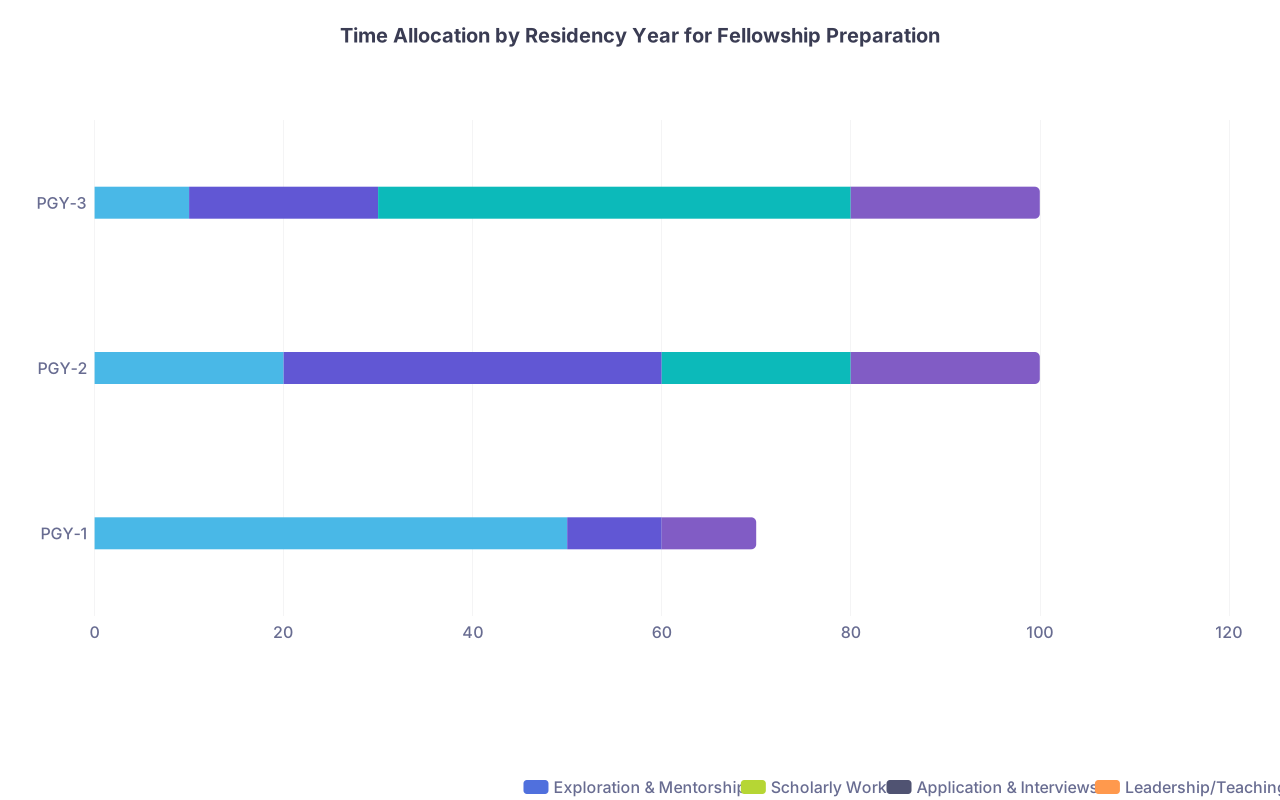
| Category | Exploration & Mentorship | Scholarly Work | Application & Interviews | Leadership/Teaching |
|---|---|---|---|---|
| PGY-1 | 50 | 10 | 0 | 10 |
| PGY-2 | 20 | 40 | 20 | 20 |
| PGY-3 | 10 | 20 | 50 | 20 |
Common Pitfalls by Year (and How to Avoid Them)
| Year | Pitfall | Better Approach |
|---|---|---|
| PGY-1 | Waiting to choose anything | Pick a working target by spring |
| PGY-2 | “Silent” research projects | Push for abstracts / posters |
| PGY-2 | No formal mentor relationship | Schedule explicit planning meetings |
| PGY-3 | Late or sloppy ERAS submission | Prepare and submit early July |
PGY-1 mistake: “I will figure it out later.”
Reality: Later comes fast, and then there are no rotations or letters left.
PGY-2 mistake: Being “on” 12 projects and finishing zero.
Choose 1–2 you can actually complete. Half-finished “ideas” do not help.
PGY-3 mistake: Treating interviews like casual conversations.
They are job interviews. Friendly ones, but still.
FAQ (Exactly 3)
1. What if I change my mind about fellowship late in PGY-2?
Then you move quickly and ruthlessly. Tell your PD and a trusted mentor immediately. Rework your remaining PGY-2 and early PGY-3 rotations toward the new field as much as possible. You will likely have less specialty-specific research, so you lean harder on:
- Strong clinical letters.
- Clear narrative in your personal statement about why the switch makes sense.
- Any transferrable projects (e.g., general QI, education work).
You may not be competitive for the absolute top programs that cycle, but you can still put together a decent application if you stop pretending “it will work out” and start acting.
2. How many research projects do I actually need for a competitive fellowship application?
For most internal medicine subspecialties, quality beats quantity. I generally like to see:
- 1 primary project where you had a clear, substantial role and a tangible outcome (abstract, poster, or publication).
- 1–2 smaller contributions (case reports, secondary author on a paper, small QI project).
If you are aiming for research-heavy programs (for example, top-tier cards or heme/onc), you will want more depth:
- Evidence you can drive a project from idea to output.
- Possibly a first-author publication or at least a major abstract.
Five half-done projects with no outputs impress nobody.
3. Do I really need an away elective for fellowship?
Often no. Away electives are overrated for most people. They can help if:
- Your home program has very weak exposure to your chosen subspecialty.
- You are aiming for an institution that heavily favors “known quantities.”
- You have a specific mentor or niche interest there.
But they are not magic. If your home performance is mediocre and you do an away just to “get noticed,” it can backfire if you underperform. Fix your core file first: strong clinical work, reliable letters, and at least one finished project. Then consider an away if it logically fits into that bigger strategy.
Key Takeaways
- The real fellowship prep year is PGY-2. PGY-1 is for exploration, PGY-3 is for packaging.
- At every stage, convert work into concrete outputs: relationships, letters, projects, and leadership with actual results.
- Do not wait until you “feel ready” to plan. By then, the calendar is already against you.


