
The last 90 days before fellowship applications are make‑or‑break. People pretend they’ll “pull it together in June.” They don’t. The residents who match where they want treat the final three months like a second job—with a calendar, not vibes.
You’re in the compression phase now. Rotations, calls, QI deadlines, maybe boards. On top of that: ERAS (or equivalent), letters, personal statement, program list, research clean‑up. The only way through this without chaos is a week‑by‑week plan.
Below is a 12‑week (90‑day) checklist, broken into clear phases:
- Weeks 1–4: Foundation and content build
- Weeks 5–8: Refinement, letters, and applications logistics
- Weeks 9–12: Final polish, submission, and interview prep
I’m assuming a July 15–August 1 primary submission window. Adjust a week earlier or later if your specialty differs, but keep the relative order.
Weeks 1–4 (Days 1–28): Build the Foundation
At this point you should stop “thinking about” fellowship and start acting like an applicant.
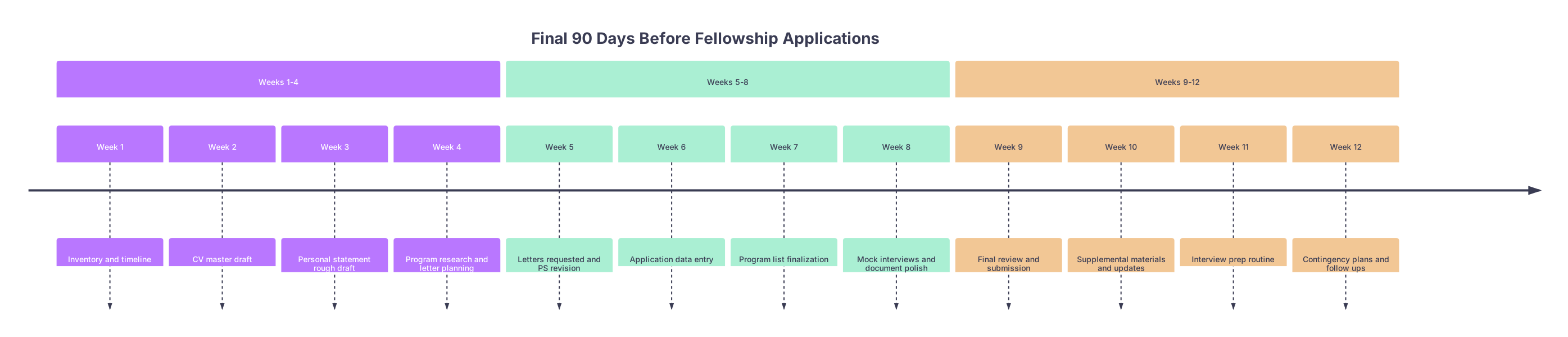
| Period | Event |
|---|---|
| Weeks 1-4 - Week 1 | Inventory and timeline |
| Weeks 1-4 - Week 2 | CV master draft |
| Weeks 1-4 - Week 3 | Personal statement rough draft |
| Weeks 1-4 - Week 4 | Program research and letter planning |
| Weeks 5-8 - Week 5 | Letters requested and PS revision |
| Weeks 5-8 - Week 6 | Application data entry |
| Weeks 5-8 - Week 7 | Program list finalization |
| Weeks 5-8 - Week 8 | Mock interviews and document polish |
| Weeks 9-12 - Week 9 | Final review and submission |
| Weeks 9-12 - Week 10 | Supplemental materials and updates |
| Weeks 9-12 - Week 11 | Interview prep routine |
| Weeks 9-12 - Week 12 | Contingency plans and follow ups |
Week 1: Reality Check and Master Calendar
Goal: Know exactly what has to be done, by when, and what’s missing.
This week you should:
- Pull all relevant dates:
- ERAS (or SF Match/other) opening and first day to submit
- Fellowship match deadlines specific to your specialty
- Internal deadlines from your PD/GME (some require early CVs/PS)
- Board exam dates, vacation blocks, ICU/night float
- Build a 12‑week calendar:
- Mark “heavy” weeks (ICU, nights) in red
- Mark realistic application blocks in green (2–3 evenings / week, 2–4 hours each)
- Protect at least one half‑day per week for deep work on applications
- Inventory your application pieces:
- CV
- Personal statement
- Research and QI projects
- Presentations, posters, teaching activities
- Potential letter writers
- Identify your gaps:
- Weak scholarly activity section?
- No clear story for your specialty?
- Missing leadership/teaching bullets?
End of Week 1 litmus test: you should have a visible calendar (paper or digital) with scheduled “application sessions” blocked off through submission week.
Week 2: CV Deep Clean and Data Mining
Goal: Build a master CV that makes filling ERAS feel like copying, not creating.
This week you should:
- Gather everything that proves you did anything:
- Old versions of your CV
- Med school CV and ERAS application
- Abstracts, posters, manuscripts (even “submitted” or “in prep”)
- Teaching evaluations, resident-as-teacher notes, chief announcements
- Certificates: ACLS, ATLS, ultrasound, teaching awards
- Create a master CV document (not the polished 2‑page version—this is the kitchen sink):
- List every activity, with dates, location, role
- Jot bullet points for:
- Clinical leadership (e.g., “Led sepsis response redesign on night float”)
- Teaching (student lectures, morning report, bedside teaching)
- Research (role: first author, data analyst, co‑PI)
- QI and committee work
- Clean up descriptions:
- Every entry should start with an action verb
- Use specific outcomes when possible (numbers, changes, presentations)
- Draft a streamlined 2–3 page CV for sending to mentors and letter writers.
End of Week 2: you should have (1) a granular master CV you’ll use to populate your application and (2) a clean version in PDF you’d be fine emailing to a PD.

Week 3: Personal Statement – Ugly First Draft
Goal: Get a complete, terrible but honest draft on the page.
This week you should:
- Block one 2–3 hour uninterrupted session for a first draft:
- No templates. No “I have always wanted to be a cardiologist since…”
- Start instead with:
- A specific patient encounter that changed how you see the field
- A moment from residency that solidified your choice
- A concrete problem in the specialty you care about solving
- Answer three questions explicitly in the draft:
- Why this specialty?
- Why you, specifically (skills, temperament, track record)?
- Where are you headed (academic, community, niche interests)?
- Do not worry about word count yet. Worry about content.
- Let it sit 48 hours, then do a first revision:
- Cut clichés
- Remove generic “I am passionate about…” without evidence
- Make sure at least one story only you could tell
- Share with exactly one trusted person this week:
- Ideally a fellow or recent graduate in your specialty
- Ask: “Does this sound like me?” and “What feels generic or boring?”
End of Week 3: you should have a full draft, marked up once by you and once by a trusted reader. If you’re still staring at a blank page, you’re already behind.
Week 4: Program Exploration and Letter Strategy
Goal: Know where you’re applying and lock in who’s writing for you.
This week you should:
- Build your preliminary program list:
- Use fellowship society websites, FREIDA, and word of mouth
- Sort programs into:
- Reach
- Reasonable
- Safety
- For each program, jot:
- Focus areas (research heavy? community? strong clinical niche?)
- Any residents/fellows you know there
- Dealbreakers (location, visa, call structure)
- Decide roughly how many programs you’ll apply to:
- Competitive subspecialty at mid‑tier residency? You’re not applying to 5. Think 20–40.
- Less competitive field with strong home support? Maybe 10–20 is fine.
Now the letters:
- Choose 3–4 letter writers:
- At least one from your specialty
- At least one who has seen you recently and can comment in detail
- Your PD—often required or strongly preferred
- Prepare a “letter packet” for each:
- Updated CV
- Draft personal statement (even if still rough)
- List of programs or at least your goals (academic vs community, research plans)
- Bullet list of things they might highlight (e.g., “led difficult family meetings in ICU rotation”)
By the end of Week 4, your program list should be 70–80% defined, and you should be ready to actually request letters in Week 5.
Weeks 5–8 (Days 29–56): Lock Letters, Load ERAS, Refine Story
This middle month is where people either quietly get ahead or quietly drown.
Week 5: Official Letter Requests and PS Second Draft
Goal: Letters formally requested. Personal statement upgraded from “ugly” to “solid.”
This week you should:
- Request letters in person or via video if possible:
- “Would you feel comfortable writing a strong letter in support of my application for [specialty] fellowship?”
- If they hesitate, that’s a no. Move on.
- After they agree:
- Confirm how they want your materials (email, shared folder)
- Provide:
- CV
- Personal statement draft
- Bullet list of 3–5 key experiences you had with them
- Deadline (give them a date 2–3 weeks before ERAS actually requires)
- Track everything:
- Make a simple table or spreadsheet for letter writer, date requested, materials sent, and date letter uploaded.
Now your statement:
- Incorporate feedback from your first reader
- Tighten the beginning and ending:
- First 3–4 sentences should anchor the story in something specific
- Last paragraph should connect your past, the fellowship, and your career direction
- Get specialty‑specific review:
- Fellow or young attending in your field
- Ask them: “Would this stand out positively or is this middle‑of‑the‑pack?”
End of Week 5: all letters requested, with clear deadlines communicated, and PS now in second or third draft form.
Week 6: Application Platform Setup and Data Entry
Goal: Your application is 70–80% populated before the chaos hits.
This week you should:
- Register on ERAS / SF Match / specialty platform
- Load the basics:
- Demographics
- Education history
- USMLE/COMLEX scores
- Training history, gaps, explanations if needed
- Copy content from your master CV into:
- Experiences
- Research
- Presentations and publications
- Teaching and leadership sections
- Watch for common time‑sink mistakes:
- Re‑typing activity descriptions every time instead of copy/paste from your master doc
- Leaving vague date ranges (PDs notice when everything is just “2023”)
- Start drafting your “Experience Descriptions”:
- 2–4 bullet points each for your most important entries
- Focus on impact, not just duties:
- “Redesigned admissions handoff template, reducing missing information events from X to Y”
- “Led weekly small‑group sessions for MS3s on…”
By the end of Week 6, if your application site crashed tomorrow, you should still have 80–90% of the content saved in your own documents and much of it already entered.
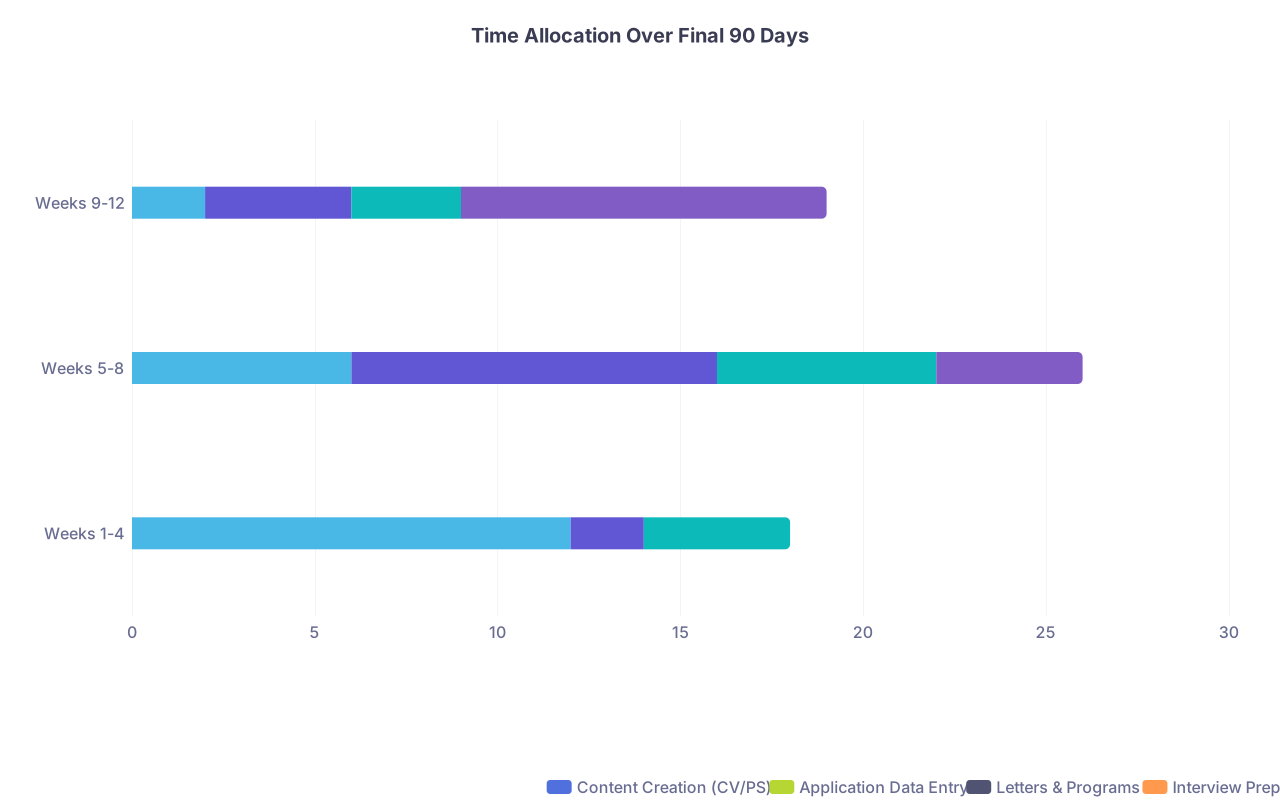
| Category | Content Creation (CV/PS) | Application Data Entry | Letters & Programs | Interview Prep |
|---|---|---|---|---|
| Weeks 1-4 | 12 | 2 | 4 | 0 |
| Weeks 5-8 | 6 | 10 | 6 | 4 |
| Weeks 9-12 | 2 | 4 | 3 | 10 |
Week 7: Program List Finalization and Targeted Prep
Goal: Know exactly where you’re applying and why.
This week you should:
- Revisit your program list with a harsher filter:
- Remove places that clearly don’t fit your career goals
- Add any “sleeper” programs recommended by trusted mentors
- For each program, create a brief note file:
- 2–3 features you genuinely like (clinical focus, research strengths, culture)
- Faculty whose work aligns with yours
- Any residents or fellows you know there
- Discuss with:
- Your PD or APD
- A mentor in your specialty
- Ask them directly: “Is this list reasonable for my profile?”
Start prepping the “Why this program?” ammo:
- You do not want to be googling basic facts the night before an interview
- Capture:
- Signature clinics or rotations (e.g., advanced heart failure, interventional pulmonary)
- Unique strengths (e.g., early procedural exposure, global health track)
By the end of Week 7, your list should be final or nearly final, with reasons attached to each program that actually make sense.
Week 8: Mock Interviews and Document Polish
Goal: You can talk your application as well as you wrote it.
This week you should:
- Do at least 1–2 mock interviews:
- With a faculty member
- With a senior fellow
- Or using your GME’s career development office if you have one
- Prepare answers to the predictable questions:
- “Tell me about yourself.”
- “Why this specialty?”
- “Why our program?”
- “Tell me about a challenging patient interaction.”
- “Tell me about a failure or mistake and what you learned.”
- Align your stories with your written application:
- If you talk a lot about teaching in interviews but it’s barely in your ERAS, that mismatch is a red flag
- Same for research—don’t oversell interests you never acted on
- Final polish on:
- Personal statement (this should now be basically done)
- CV corrections (typos, inconsistent formatting)
- Experience descriptions (tight, clear, impact‑focused)
End of Week 8: if someone asked you to apply tomorrow, you’d be nervous, but you’d be able to hit “submit” after a quick proofread.
Weeks 9–12 (Days 57–90): Submit, Update, and Prepare to Perform
This is where procrastinators panic. You will not.
Week 9: Final Review and Submission Window
Goal: Submit early, not at 11:59 PM on deadline day with a crashed server.
This week you should:
- Do a line‑by‑line check of:
- All dates
- Program names
- Degree and institution names
- Licensure and certification entries
- Print your full application as PDF and read it once on paper:
- You catch different errors when it’s not on a screen
- Circle any sections that feel redundant or vague
- Confirm letters:
- Check which letters are uploaded
- If anything is missing and deadlines are close, send a polite reminder:
- “Just a quick note to say ERAS opens for submission on [date]. If there’s anything you need from me to finalize the letter, please let me know. Thank you again for supporting my application.”
- Submit:
- Pick a specific day to submit within the first 48–72 hours the system opens
- Do it while you are awake, fed, and not post‑call
End of Week 9: your application should be in. If not, you should have a very specific reason and a new hard date within a few days.
Week 10: Supplemental Materials and Strategic Updates
Goal: Tighten everything around the core application and position yourself for interviews.
This week you should:
- Prepare email templates for:
- Notifying programs of significant updates (accepted publication, award, new leadership role)
- Thank‑you notes (you’ll adjust specifics later)
- If you have pending research:
- Clarify its status in your materials (submitted vs accepted vs in revision)
- If something gets accepted after you submit:
- Update your CV
- Consider a short, precise update email to programs where it honestly strengthens your profile
- Organize your materials:
- Dedicated folder on your computer for:
- CV versions
- Personal statement
- Program notes
- Mock interview questions and answers
- Email templates
- Dedicated folder on your computer for:
By the end of Week 10, you’re not “done”—you’re ready for the next phase: interviews.
Week 11: Interview Prep Routine and Logistics
Goal: Move from “I hope I don’t sound dumb” to “I know my story cold.”
This week you should:
- Build a simple interview prep routine:
- 20–30 minutes, 3–4 days a week
- Rotate:
- Practicing your opening “Tell me about yourself”
- Reviewing one program’s notes and generating 3–4 specific questions
- Running through 3 behavioral questions out loud
- Create a one‑page “interview snapshot” for yourself:
- Top 5 experiences to highlight (with quick bullet reminders)
- 3 strengths and 2 growth areas you can discuss honestly
- 2–3 clinical or research interests within the specialty you can talk about at length
- Sort logistics:
- Reliable headset and webcam if interviews are virtual
- Quiet space you can reserve (hospital conference room, library room, etc.)
- One backup option in case Wi‑Fi fails
By the end of Week 11, you should be able to answer common questions without sounding rehearsed—but without rambling either.
| Week Range | Primary Focus |
|---|---|
| 1–2 | Timeline, CV foundation |
| 3–4 | Personal statement, programs, letters |
| 5–6 | Letters requested, ERAS data entry |
| 7–8 | Program list, mock interviews, polish |
| 9–10 | Submission and targeted updates |
| 11–12 | Interview prep, contingency planning |
Week 12: Contingency Plans and Follow‑Through
Goal: Close gaps, manage anxiety, and set yourself up for the interview wave.
This week you should:
- Reality‑check with your PD or mentor:
- Share where you applied
- Ask candidly if there are any obvious holes
- Discuss backup plans (research year, chief year, second cycle) without assuming you’ll need them—but knowing what they look like
- Tighten communication habits:
- Check email at least twice daily (morning and evening)
- Respond to interview invitations promptly—like within hours, not days
- Have your calendar ready to plug in interview dates immediately
- Prepare for the quiet:
- There’s often a lag between submission and invites
- Decide in advance how you’ll use that time:
- Board study
- Ongoing research
- Refined reading in your specialty so you sound current
End of Week 12: you’re not scrambling. You’re waiting—prepared—for the next phase with a coherent story, a clean application, and your mentors on your side.
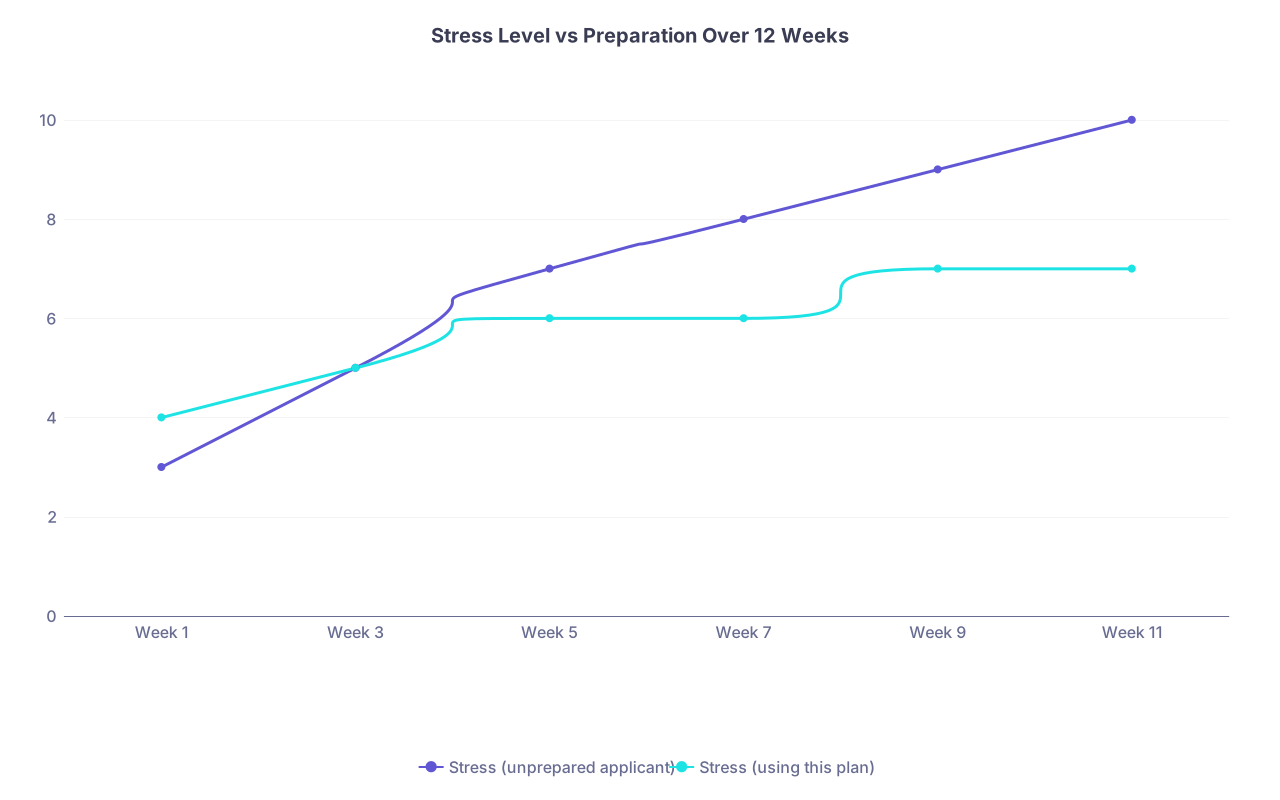
| Category | Stress (unprepared applicant) | Stress (using this plan) |
|---|---|---|
| Week 1 | 3 | 4 |
| Week 3 | 5 | 5 |
| Week 5 | 7 | 6 |
| Week 7 | 8 | 6 |
| Week 9 | 9 | 7 |
| Week 11 | 10 | 7 |
The residents who match well do not magically “have time.” They steal it back, one planned week at a time.
Here’s your next concrete move: grab your calendar for the next seven days and block three specific 60–90 minute sessions labeled “Fellowship Apps – Do Not Move.” Then, in the first one, build your master CV draft. No email. No ERAS. Just the document that will power everything else.


